Skip to content
DevMeme
5200 of 7435
Friendship Ended with Ilya, Now Satya is My Best Friend
CorporateCulture Post #5699, on Nov 24, 2023 in TG

Friendship Ended with Ilya, Now Satya is My Best Friend

Why is this CorporateCulture meme funny?

Level 1: New Best Friend

Imagine you have a best friend at school, and you both are working on a big cool science project. Suddenly, that friend decides they don’t want you in the group anymore – they kind of kick you out without warning. You’re upset, of course. But then, almost immediately, another classmate (who has the biggest science kit and all the fancy tools you need) comes over and says, “Hey, join my group, you can use my stuff, and we’ll do the project together.” You quickly smile and announce, “You’re my new best friend now!” This meme is basically showing that scenario with famous tech figures. The first friend (who kicked out the person) gets a big red “X” over them, like saying “not my friend anymore.” The new friend (who has all the cool tools – in real life, lots of computers and money for AI research) is standing proudly next to our main guy as his “best friend.” It’s funny because it’s exactly how kids might act on a playground after an argument, but here we’re talking about grown-up leaders of big companies. Seeing serious adults swap “best friends” so fast is silly and ironic – that’s why this image makes people chuckle. In the end, it’s a simple story: one friendship ended, a new one began, and the way it’s told makes it feel like a playground drama, which anyone can understand and laugh at.

Level 2: Cloud Friendships 101

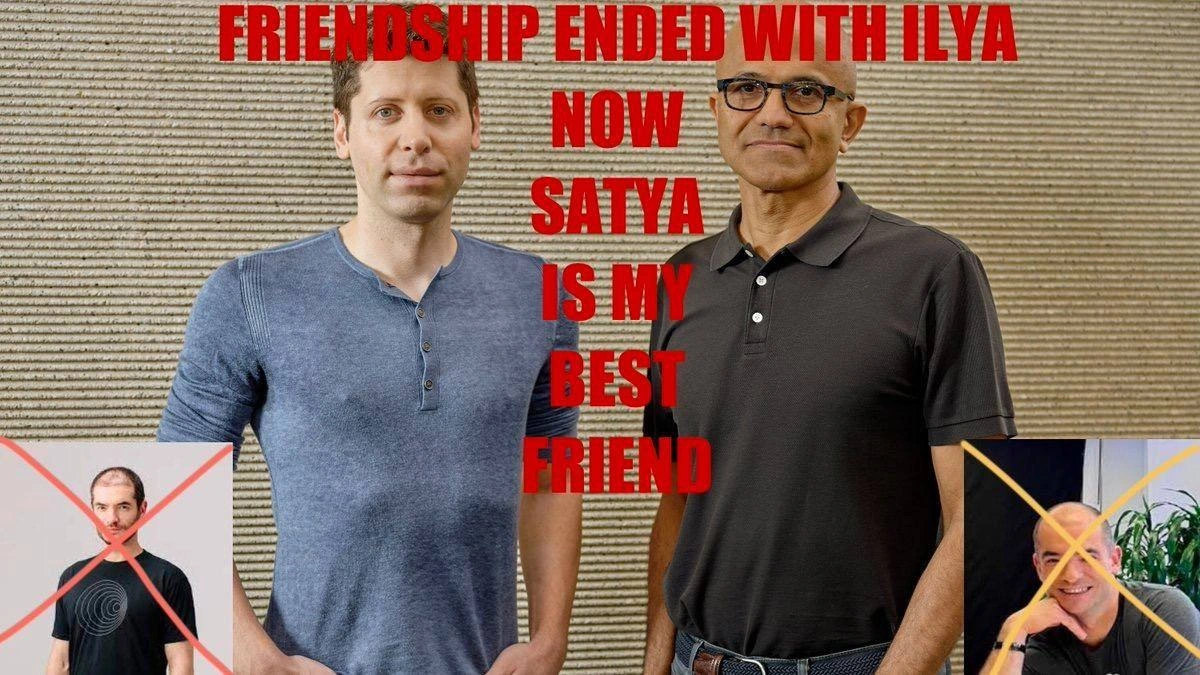
Let’s break down what’s happening in this meme in simpler tech terms. The image uses the popular “Friendship ended with X, now Y is my best friend” meme style. Originally, this meme format comes from a viral post where someone literally announced he had replaced his best friend – with pictures of the former friend crossed out and the new friend highlighted. It’s usually a tongue-in-cheek way to show a sudden switch in loyalty or preference. In our case, the meme text says “Friendship ended with Ilya, now Satya is my best friend,” plastered over a photo of two men (Sam and Satya) standing together. In the lower corners, pictures of another man (Ilya) are crossed out with red X’s. So, who are these people and what’s the story?

  • Sam Altman (the guy in the blue shirt at center) was the CEO of an AI company called OpenAI (known for making ChatGPT).
  • Ilya Sutskever (the man getting the red X treatment) is a co-founder of OpenAI and was a close colleague of Sam’s – until a big internal boardroom drama happened. The “boardroom drama” means the board of directors of OpenAI (a group that oversees the company) unexpectedly decided to remove Sam Altman from his CEO position. It was a shocking corporate shake-up – think of it like the people in charge of the company abruptly firing the team captain. Ilya, being on that board, was reportedly part of the decision, which is why the meme frames it as a personal betrayal: Sam’s friendship with Ilya ended over this incident. In techie terms, Sam lost trust in that partnership.
  • Satya Nadella (the man on the right in the dark polo) is the CEO of Microsoft. Microsoft is a huge company (a hyperscaler in cloud computing) that was heavily investing in OpenAI. When Sam was ousted, Microsoft basically said “Hey Sam, come work with us – we’ve got your back (and your team, and plenty of servers!).” This is why the meme says “Now Satya is my best friend.” It’s depicting Satya as the new loyal buddy stepping in after Sam’s break-up with Ilya and the OpenAI board. In real life, Satya openly welcomed Sam (and dozens of OpenAI employees) to Microsoft in the wake of that chaos. It was almost like Microsoft offered to be the safe rebound friend when Sam’s own company’s board turned against him.

Now, some of the jargon in the title/caption might sound technical but it’s used playfully:

  • “Friendship algorithm rebalances” – There isn’t a literal friendship algorithm, but this phrase jokes that there’s some code or rule that decides who your best friend is. Rebalancing is a term we use in computing (for example, load balancing will redistribute work if one server goes down). Here it means Sam’s internal priorities or alliances got readjusted. Think of it as Sam’s loyalty settings updating: old friend out, new friend in. It’s a humorous way to say Sam made a quick, strategic switch in who he’s aligned with.
  • “Boardroom failover” – In tech, failover is what happens when a system fails and a backup takes over. For instance, if a primary database goes down, a replica might fail over to become the new primary, so the service keeps running. By saying “boardroom failover,” the meme implies that the corporate board’s actions caused a failure of leadership (Sam being removed was like the system going down), and then there was a failover to a backup – Satya/Microsoft coming in as the backup solution. It’s a funny mixing of tech and corporate language: the board triggered a failure, and the backup friend (Satya) took over to keep things running.
  • GPU credits and cloud alliances – This part of the description notes “production workloads—and loyalties—migrate when GPU credits and executive backing shift.” To unpack that: GPUs (graphics processing units) are critical hardware for AI work. OpenAI’s research (like training AI models) needs tons of GPU power, which they were largely getting from Microsoft’s cloud (Azure). Microsoft providing cloud credits or specialized supercomputers is like giving OpenAI the fuel it needs. If Sam leaves OpenAI and goes to Microsoft, he effectively ensures continuous access to those GPUs. The meme jokes that just as you’d move your app to a different server if the original crashes, Sam moved his “workload” (his team and projects) to a different company when his original “host” (OpenAI’s board) kicked him out. In simpler terms: the support (money, hardware, approval) shifted, so Sam’s loyalty shifted too. Engineers have a saying, “It’s not personal, it’s about resources,” and here the resource is compute power for AI. Satya had it, Ilya suddenly didn’t.

All of this falls under a satire of corporate culture in the tech industry. It’s highlighting how big personalities and companies sometimes behave: alliances can change overnight depending on who has the upper hand or the necessary resources (AIHype plays a role, because AI is the hot field and everyone’s jockeying for position). To a junior developer or someone new to the industry, it might be surprising that serious executives end up in what looks like a meme-worthy squabble. But this really happened: one Friday in November 2023, Sam Altman was fired by his board (including Ilya), and by Monday almost the entire OpenAI staff (over 700 people!) threatened to leave to follow Sam to Microsoft, because Microsoft offered him a new job immediately. The meme captures this surreal sequence in a nutshell. Boardroom drama is the serious term (company politics and crises), and this meme is tech industry satire – making fun of the situation by framing it as a childish friendship swap.

In summary, the meme uses a simple internet joke format to explain a complex real event: OpenAI’s CEO got ousted due to internal conflict (old friend betrayed), and Microsoft’s CEO swooped in with support (new friend to the rescue). The “friendship ended” template makes it very visual and straightforward: big red X over the ex-friend, big bold text announcing the new friend. Even if you don’t know all the names, the format screams “there’s been a fallout, and a new alliance is formed.” And if you do know the names, it’s extra hilarious because you recognize that one of the world’s richest tech CEOs (Satya) is being called someone’s “best friend” in classic meme fashion. It’s a perfect storm of AI industry trends meets meme culture.

Level 3: Cloud Over Colleague

Zooming in from theory to the real-world tech drama: this meme lampoons a high-profile AI industry crisis with dark humor that seasoned developers and industry watchers immediately recognize. The center image shows Sam Altman (ex-CEO of OpenAI) shoulder-to-shoulder with Satya Nadella (CEO of Microsoft), under bold red text proclaiming “FRIENDSHIP ENDED WITH ILYA / NOW SATYA IS MY BEST FRIEND.” For those in the know, “Ilya” refers to Ilya Sutskever, co-founder and Chief Scientist of OpenAI, who was reportedly instrumental in Sam’s sudden ouster by the board. Seeing these names, veteran engineers smirk because it’s a tech-world twist on the classic "Friendship Ended" meme format – typically used to announce a dramatic switching of allegiances in an exaggerated, comedic way. Here it’s applied to CEO-level boardroom drama, essentially turning a complex corporate fallout into a playground spat: “You kicked me out, so I’m taking my toys (and algorithms) to a new friend!”

Why is this so dagger-to-the-heart funny for tech insiders? Because it rings true on multiple levels of our CorporateCulture. We’ve all witnessed how quickly loyalties in the tech industry can flip when big money or critical resources are on the line. One day you’re tight with a co-founder or a vendor, sharing visions of transforming the world with AI; the next day a surprise move (firing, acquisition, strategic pivot) leaves you hugging the nearest hyperscaler executive who can keep your project alive. In this case, the meme encapsulates Sam Altman’s almost instantaneous pivot: from collaborating with Ilya and the OpenAI board to literally sitting in Satya Nadella’s office the next workday, donning a Microsoft visitor badge and a grin. It’s the ultimate hyperscaler rebound. Seasoned devs recognize the subtext: OpenAI’s entire operation runs on Microsoft’s Azure cloud, powered by thousands of GPUs. When the board ejected Sam (and with him, potentially his loyal team and their innovation), Microsoft – who had poured billions into OpenAI – performed its own kind of if (CEO == null) { hireCEO(); } failover maneuver. GPU credits and cloud compute are the lifeblood of modern AI startups, and Satya essentially said “We’ve got plenty – come over here, friend.” The meme’s line about “production workloads—and loyalties—migrate when GPU credits and executive backing shift” is a nod to this reality: the true best friend in AI is often whoever supplies the most compute power and cash. It’s corporate survival as much as bromance.

This cynical comedy resonates with veteran engineers because it distills a messy saga into a single absurdly relatable image. We’ve seen similar patterns: a sudden leadership coup (like a server unexpectedly going down) leading to frantic realignments (devs scrambling to point everything at a backup server, or in this case, at Microsoft). The AI hype magnified this drama – with billions of dollars at stake and the entire tech world watching, alliances were bound to reshuffle at record speed. Microsoft was hardly a new character in this story (they’ve been a major investor in OpenAI), but the sheer speed of Satya going from partner to emergency lifeline (and new boss for Sam’s team) was head-spinning. Seasoned devs chuckle because it’s so on the nose: a failover in the boardroom happened, and Sam’s personal “algorithm” immediately rebalanced to favor the node with the most stable power supply (Microsoft’s backing).

To illustrate the humor in pseudo-technical form, consider a snippet of the “friendship algorithm” at play:

# Previous state of alliances
best_friend = "Ilya"       # Ilya was the trusted ally
backup_friend = "Satya"    # Satya was a supportive partner (cloud provider)

# Unexpected boardroom failover event:
board.decision = "Fire CEO"  # The primary friendship link fails suddenly

# Rebalancing the friendship algorithm
if board.decision == "Fire CEO":
    best_friend = backup_friend        # promote Satya to new best friend
    old_friend_status = "X_marked"     # mark Ilya with a red X (relationship terminated)

In plain English, the code above jokes that when the board “fires the CEO” (the trigger), Sam’s internal loyalty algorithm simply flips over to make Satya the new best friend and marks Ilya with the proverbial red X. This is exactly what the meme image shows: Ilya’s photos literally X’ed out in red, and Satya front-and-center as the BFF. For senior folks, there’s dark amusement in seeing human relationships treated with the same failover logic as microservices in production. It’s a reminder that behind all the lofty talk of missions and principles, the tech industry can behave with cold programmatic pragmatism: when one path is shut down, you route around the failure to whoever is still online and has capacity. And in November 2023’s AI saga, that meant Satya/Microsoft taking over as the supportive friend with benefits – the benefit being a stable cloud with infinite GPUs and a multi-billion-dollar safety net.

The meme also satirizes IndustryTrends_Hype. We’re at a stage where CEOs of AI companies are like rockstars, and their ousters and alliances play out like episodes of a binge-worthy series (call it “Silicon Valley: Game of GPUs”). A veteran dev reading “Satya replaces Ilya after unexpected boardroom failover” might roll their eyes and chuckle, “Yep, seen this failover pattern before – when internal governance fails, escalate to Big Cloud Inc.” It’s funny ’cause it’s true: corporate friendships in tech can be as transactional as API rate-limits. Today’s trusted research partner can become tomorrow’s crossed-out memory if they jeopardize the mission (or the funding). And who swoops in to fill the vacuum? The guy with the biggest data center and the fattest checkbook. This comedic framing is cathartic for those of us jaded by tech’s twists and turns – we laugh so we don’t cry. After all, as any on-call veteran will tell you with a smirk, no system design is complete without a backup plan, and apparently that applies to CEOs and their best friends too.

Level 4: Split-Brain Boardrooms

At the highest level of abstraction, this meme riffs on concepts from distributed systems and consensus algorithms, mapping them onto corporate drama. The phrase “unexpected boardroom failover” evokes the imagery of a high-availability cluster where the primary node (here, the CEO) has been abruptly removed and the system tries to failover to a backup. In an ideal distributed system, a failover is coordinated by a consensus algorithm (think Raft or Paxos) to elect a new leader without downtime. But in this real-world scenario, the consensus mechanism glitched spectacularly. OpenAI’s board (the decision-making cluster) initiated a leadership switchover without broad agreement – essentially yanking the primary node (Sam Altman) offline. The result? A corporate analog of a split-brain scenario: the board and the company’s staff ended up in two partitions with conflicting states (board says “Sam out,” 700+ employees say “we want Sam in”). In distributed systems terms, the organization lost quorum and couldn’t reach a stable consensus on who should be in charge, leading to chaos akin to a network partition where each side thinks it’s the true authority.

The meme’s talk of a “friendship algorithm rebalancing” wryly suggests an automated process optimizing the “best friend” relationship after this failure. In graph theory terms, a critical edge in the social network was removed – Sam’s trust connection to Ilya Sutskever was severed (like deleting a node’s link in a graph), and a new edge to Satya Nadella was added. One could imagine a dynamic graph algorithm quietly updating the network: drop the link to the now-unreliable node (Ilya) and reinforce connectivity with a highly available node (Satya/Microsoft). Just as a load balancer redistributes traffic when one server goes down, Sam’s loyalty (and workload) got rerouted to a backup host with spare capacity – in this case, the Microsoft Azure cloud and its CEO. The humor here is rooted in these nerdy parallels: a human relationship upheaval described with the formality of an algorithmic failover. It’s as if Sam’s trust network implemented an automatic leader election protocol and the secondary node (Satya) took over when the primary friend node (Ilya) became “unresponsive” (read: booted him out). The Byzantine fault-tolerance of human organizations is notoriously poor – with the OpenAI board acting like a Byzantine node sowing confusion. So, the system (Sam + team) achieved reliability the messy way: by manually switching over to an external stable cluster (Microsoft’s embrace) to maintain uptime on their AI ambitions. The meme’s brilliance at Level 4 is revealing how even in cutting-edge AI orgs, ultimate consistency and availability often come down to improvised human failover protocols rather than elegant algorithms.

Description

This image uses the popular 'Friendship Ended' meme format to satirize the OpenAI leadership crisis of November 2023. The main photo features Sam Altman (former and current OpenAI CEO) standing next to Satya Nadella (Microsoft CEO). Overlaid in bold red text is the declaration: 'FRIENDSHIP ENDED WITH ILYA' and 'NOW SATYA IS MY BEST FRIEND'. In the bottom corners, photos of Ilya Sutskever (OpenAI's Chief Scientist) and another individual are crossed out with a red 'X'. The meme humorously reframes the complex corporate power struggle as a dramatic personal breakup. It portrays Altman severing ties with Sutskever, who was part of the board that fired him, and forming a new, powerful alliance with Nadella, who immediately offered to hire Altman and his team at Microsoft
Comments

7
Anonymous ★ Top Pick In tech, alliances are like npm dependencies: one minute you're best friends, the next you're deprecated in favor of a new package with better corporate backing
  1. Anonymous ★ Top Pick

    In tech, alliances are like npm dependencies: one minute you're best friends, the next you're deprecated in favor of a new package with better corporate backing

  2. Anonymous

    Turns out the quickest way to refactor your social graph is letting Azure pick up the next epoch’s GPU invoice

  3. Anonymous

    When your board member votes to fire you but your biggest investor has a $13 billion vested interest in keeping you alive - suddenly you understand why distributed consensus protocols have Byzantine fault tolerance

  4. Anonymous

    When your chief scientist tries to halt AGI development but your cloud provider has a $13B investment and infinite Azure credits - suddenly 'alignment' means aligning with whoever controls the GPU clusters. Nothing says 'effective altruism' quite like a $10M/year compensation package and a board seat at the company that just rehired you after a weekend coup attempt

  5. Anonymous

    In AI at scale, the critical dependency isn’t PyTorch - it’s whoever approves the H100 quota; alignment is a P1 until procurement says no

  6. Anonymous

    Ilya: frontier model chaos. Satya: production-grade friendship with SLAs and Azure credits

  7. Anonymous

    Post‑incident RCA: the governance cluster hit split‑brain, so BestFriendService failed over from AlignmentService to HyperscalerProvider - because when choosing between alignment and compute, unlimited GPUs usually win

Use J and K for navigation