Open-Book Exam, Printed ChatGPT Weights
Why is this AI ML meme funny?
Level 1: Calculator Made Of Paper
It is like bringing a printed picture of a calculator to a math test and saying you will press the buttons by hand. The picture contains the idea of the tool, but it does not do the work. The joke is that the student found a clever loophole in the exam rule, but the loophole requires doing an impossible amount of math on paper.
Level 2: Weights Are Not Answers
In machine learning, weights are numbers a model learns during training. They control how input data moves through the model. In a neural network, layers often multiply vectors by matrices of weights, transform the result, and pass it to the next layer.
An LLM, or large language model, handles text by breaking it into tokens, which are chunks of words or characters. It uses its weights to predict likely next tokens. Repeating that process produces a response. That is why the tweet jokes about "too many tokens": more tokens means more repeated computation.
The meme is funny because the student is pretending that printing the model weights is like bringing a textbook. But a textbook can be read directly. Model weights need a computer to run all the math. Without the actual computation, the printed numbers are just an intimidating stack of decimals.
Level 3: Open Book Exploit
At the senior level, the joke is a rules-lawyer masterpiece. The professor allows anything in the exam as long as it is on printer paper. The student interprets "anything" literally and brings the model itself, represented as a stack of printed decimal parameters. It is not cheating by asking ChatGPT during the exam; it is "open book," and the book just happens to be a manually executable language model. Perfectly normal academic compliance, assuming you have several geological eras free.
The image works because AI/ML systems often feel magical from the outside, while practitioners know they are built from very unromantic operations: tensor shapes, matrix multiplies, activation functions, loss minimization, tokenization, and a lot of infrastructure. Printing rows of numbers punctures the mystique. It turns "ChatGPT" from an oracle into a pile of floating-point coefficients and dares the student to derive wisdom through arithmetic.
There is also an academic vs practical skills joke underneath. Open-book exams are meant to test reasoning rather than memorization. The meme extends that principle to the point of useless purity: if the model's knowledge is encoded in weights, and weights are numbers, and numbers fit on paper, then surely this is just another reference sheet. The flaw, naturally, is that having the reference is not the same as having the compute. Somewhere a GPU cluster is laughing in 16-bit precision.
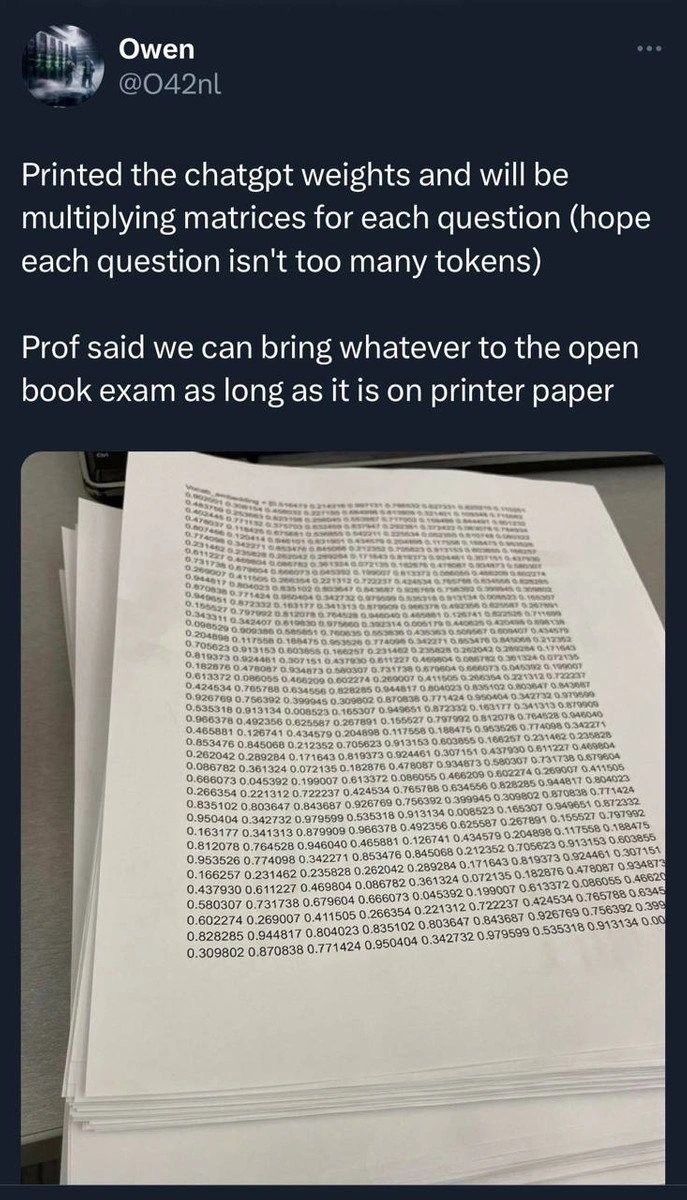
The stack of paper matters visually because it makes scale visible. A real large model's parameters are not "a few pages of notes"; they are a system-scale artifact. The dense printed decimals make the student's plan look both technically informed and completely doomed, which is the sweet spot for developer humor.
Level 4: Paper-Based Inference
The tweet says:
Printed the chatgpt weights and will be multiplying matrices for each question (hope each question isn't too many tokens)Prof said we can bring whatever to the open book exam as long as it is on printer paper
The photo below shows a thick stack of printer paper covered in dense decimal values, visually selling the idea that these are neural-network parameters. The technical absurdity is that LLM inference really does reduce, at a low level, to a huge amount of linear algebra, but the tweet treats that fact as if it makes manual execution merely inconvenient instead of cosmically impractical.
For a transformer-style language model, a prompt is first split into tokens, then mapped into vectors through an embedding table. Each transformer layer applies learned matrices to produce queries, keys, and values for attention, mixes token information with something like:
attention(Q, K, V) = softmax(QK^T / sqrt(d))V
then runs additional matrix multiplications through feed-forward networks, normalization, residual connections, and finally a projection to logits over the vocabulary. To answer one question, the model does not simply "look up" an answer in the printed weights. It repeatedly computes the next token, appends it to the context, and runs the stack again for the next token. That is why the parenthetical about hoping each question "isn't too many tokens" is the most technically accurate part of the joke.
Even if the printed pages somehow contained the relevant weights, they would not be enough by themselves. You would also need the exact architecture, tokenizer, numerical precision rules, positional encoding scheme, sampling settings, and enough scratch paper to commit a minor act of deforestation. The meme is funny because it correctly identifies the mathematical skeleton of deep learning while proposing an execution environment known as "a student with a pencil."
Description
A dark-mode tweet by Owen (@O42nl) says, "Printed the chatgpt weights and will be multiplying matrices for each question (hope each question isn't too many tokens)" followed by "Prof said we can bring whatever to the open book exam as long as it is on printer paper". The attached photo shows a thick stack of printer paper covered with dense rows of decimal numbers, resembling model weights or matrix values. The humor comes from taking "open book" literally for an LLM: instead of asking ChatGPT, the student would manually run inference by doing matrix multiplication on paper.
Comments
9Comment deleted
The proctor allowed notes, not a human TPU with a pencil and commitment issues.
If only OpenAI were actually true to their name Comment deleted
Must be a Microsoft employee Comment deleted
Iirc there were some research papers where they pulled the data on which chatgpt was trained as well as they reverse engineered how it was done Comment deleted
And they've said it was dumb and could've been done far better Comment deleted
Why not doing better? Comment deleted
But why? Comment deleted
I dont know what this is Comment deleted
Embeddings for AI Comment deleted