Skip to content
DevMeme
4759 of 7435
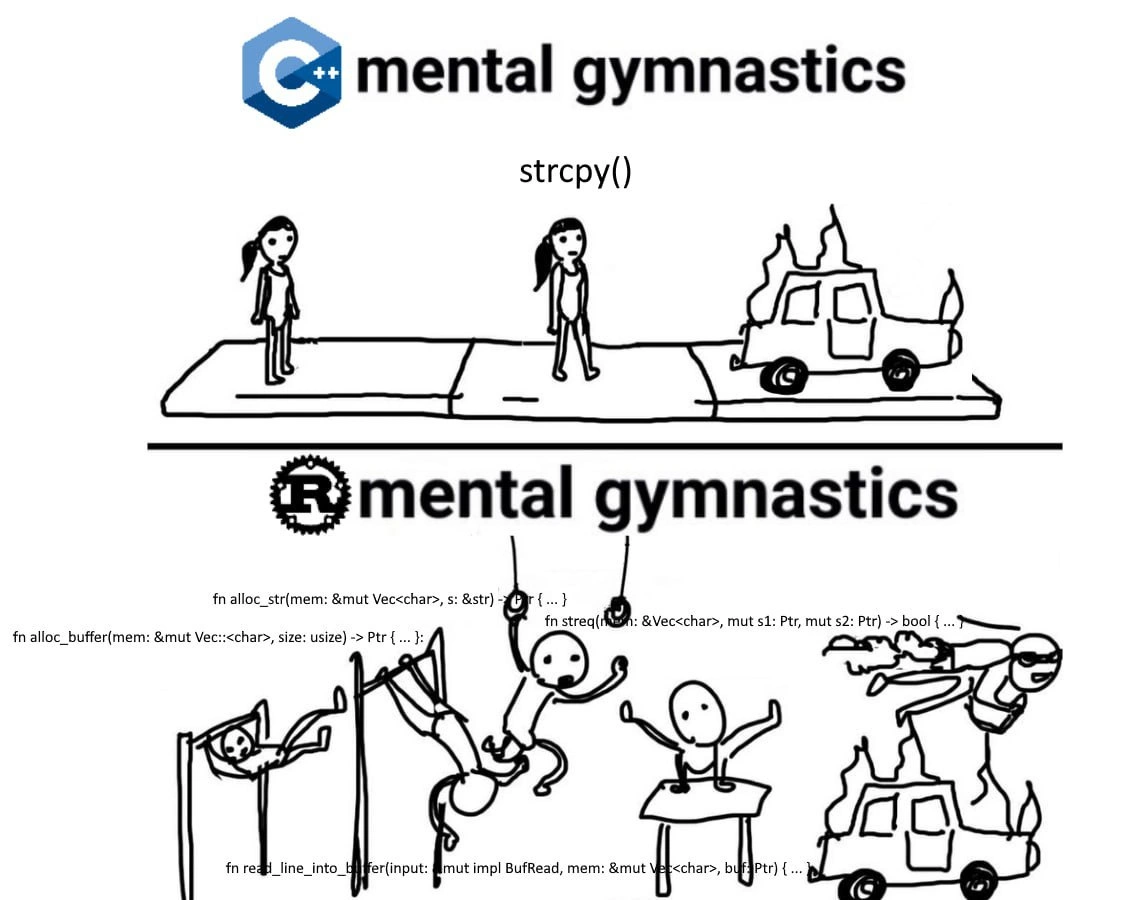
C++ strcpy stroll vs Rust borrow-checked string copy Olympic routine
Languages Post #5214, on May 20, 2023 in TG

C++ strcpy stroll vs Rust borrow-checked string copy Olympic routine

Why is this Languages meme funny?

Level 1: Risky Shortcut vs Careful Routine

Imagine you need to get across a big, busy street. One person decides to dash straight through the traffic without waiting – they run between moving cars to reach the other side. It’s super quick, and when they make it, it looks easy, but wow, that was dangerous! They could have easily gotten hit because they didn’t take any precautions. This is like the C++ approach: just quickly copying the string without checking anything, hoping everything will be okay. Now, another person wants to cross the same street but does it the safe way – they walk down to the crosswalk, wait for the walk signal, look both ways twice, maybe even put on a bright safety vest. They take their time and follow all the rules. It’s much slower and looks like a lot of unnecessary steps, but this person almost certainly will get across safely because they avoided the danger. This is like the Rust approach: setting up lots of safety checks and steps to copy the string so that nothing bad happens.

In the end, both people get to the other side of the street — just like both programs would manage to copy the string. But the reason it’s funny is the huge difference in how they did it. The first method was a risky shortcut (quick and simple, but with a serious chance of disaster), and the second method was a careful routine (complicated and a bit over-the-top, but very safe). We laugh because the safe method, when exaggerated, looks almost comically excessive (like doing a whole Olympic gymnastics routine just to deal with a small problem), while the quick method looks easy but has a hidden ‘uh-oh’ (that little fire on the car that no one is paying attention to). It’s a fun way of saying “sometimes doing things the safe way in programming feels like overkill, but doing it the easy way can be secretly dangerous.”

Level 2: Unsafe Simplicity vs Safe Complexity

Let’s break down what’s going on here in simpler terms. We have two programming languages being compared: C++ and Rust. The meme uses the task of copying a string as the battleground for this comparison, because copying text from one place to another is a very common thing in programming – but how the languages ensure (or don’t ensure) safety is very different.

Top panel (C++ and strcpy()): In C and C++ (which are low-level programming languages), there’s a traditional function called strcpy (string copy). You use it like strcpy(destination, source) and it will copy characters from the source string to the destination buffer until it hits the end of the string (a null terminator '\0'). It sounds straightforward, and it is – as long as you, the programmer, made sure that the destination has enough space to hold all those characters. The catch is, strcpy does not check if there’s enough room. It blindly copies whatever you tell it to. If the destination array isn’t big enough, strcpy will start overwriting whatever memory comes after that array. This is called a buffer overflow. Buffer overflows are a classic error in C/C++ and a common cause of program crashes and even security vulnerabilities (hackers exploiting them). When a buffer overflow happens, you’ve entered the realm of undefined behavior – basically the program is now in an invalid state and might do anything: crash immediately, crash later, or continue running with corrupted data. Undefined behavior is notoriously bad because it’s unpredictable and can be very hard to debug. In the comic, the little car on fire next to the C++ folks is that buffer overflow danger – it’s sitting right there, but the code/run-time isn’t actively telling you “hey, there’s a fire!” The characters are casually walking by it because in C++ you often don’t get an immediate warning when you make a mistake like that. The program compiles and runs, and only much later (or under certain conditions) might you notice something’s wrong. This panel is labeled "strcpy()" to drive home that we’re talking about that function and the mindset of just using it casually.

Bottom panel (Rust and the borrow checker): Rust is a more recent systems programming language that was designed to prevent exactly those kinds of errors (buffer overflows, use-after-free, etc.) at compile time. Rust has the concept of ownership and borrowing. What that means in practice is Rust won’t let you do certain things unless you follow strict rules about how memory is used. The borrow checker is the part of the Rust compiler that checks these rules. For example, in Rust if you have a reference to some data, it makes sure that reference can’t outlive (last longer than) the data it points to. Or if you have something that’s changeable (mutable), Rust ensures no other part of the code is trying to use it in a conflicting way at the same time. These rules eliminate a whole class of bugs (including the buffer overflow scenario, because in Rust you typically can’t even get a raw pointer that writes out of bounds without jumping through a lot of hoops and explicitly using unsafe code blocks, which are rare in normal Rust code).

Now, copying a string in Rust is usually done with safe abstractions – for instance, you might use Rust’s String type which automatically manages memory for you (much like using std::string in modern C++). If you wanted to copy one String to another, you could just do let new_string = old_string.clone(); (or even new_string = old_string.clone(); if both exist) and Rust takes care of allocating the right amount of memory and copying the bytes over. No overflow is possible there because Rust knows exactly how big the string is and allocates exactly that much space for the clone. So in real usage, Rust doesn’t make string copying hard at all if you use the provided safe tools. The meme, however, shows a scenario where the Rust side is doing it the hard way – manually allocating and dealing with characters – to illustrate how much overhead there can be when you are dealing with raw memory in Rust. The code snippets like fn alloc_str(mem: &mut Vec<char>, s: &str) -> Ptr { ... } and fn alloc_buffer(...) -> Ptr { ... } and fn streq(...) -> bool { ... } suggest a low-level manual management of a character buffer. They’re basically pseudo-code for: “allocate memory for a string in a big char array and give me a pointer (Ptr) to it”, “allocate a raw buffer of a certain size”, “compare two strings given their pointers”, etc. In Rust, doing this kind of thing safely means writing a lot of code: you’d use a Vec<char> (which is a growable array of characters) to act as your heap memory pool, and you’d likely use indices or a special Ptr type to reference positions in that vector. Every function (alloc_str, streq, etc.) would make sure you don’t go out of bounds or violate any borrowing rules. It’s all very explicit and, frankly, much more complicated than just calling strcpy! The comic exaggerates that by turning the sidewalk into a gymnastics arena with people doing wild flips – it’s saying “Rust makes you do all these wild mental tricks to accomplish the same thing.” The flaming car in this bottom scene is no longer being ignored; instead a gymnast is literally kicking it. That represents Rust developers/addressing the problem directly – the fire (bug) is not simply left burning. But to do that, they had to turn on “hard mode” (the whole gymnastics show) and really tackle the issue with full force.

So why is Rust’s method considered better if it’s so much work? Because all that work is front-loaded to guarantee safety. It’s like doing your homework rigorously so that you know you got the answers right, versus C++ which might let you skip some steps and you only find out later you made a mistake. ManualMemoryManagement in C/C++ is powerful but error-prone: you manually new or malloc memory and later delete or free it. If you mismatch them (free something too early, or not at all, or write more than you allocated), you get bugs. Rust automates the freeing part (when an object goes out of scope, it frees automatically – this is similar to C++’s concept of RAII and smart pointers), and for the writing part (like copying data into a buffer), Rust provides safety by default (for instance, its arrays and vectors know their length and will panic if you try to index out of bounds, or in safe Rust you literally cannot index past the end without triggering a runtime check or using unsafe code). The borrow_checker is essentially there to prevent you from even compiling code that would misuse memory. For a newcomer or a junior developer, it can feel like the compiler is being super strict or picky – sometimes you just want to do something you think is simple, and Rust will throw errors until you restructure your code a little. That’s the “mental gymnastics” feeling: you have to think about lifetimes and valid scopes for variables. But this enforces good habits and robust code.

To connect this to common experiences: if you’ve ever gotten a segmentation fault (a crash that happens when a program accesses memory it shouldn’t – often due to something like an overflow or bad pointer), that’s the kind of bug Rust is preventing. A C++ beginner might write a program that seems to work, then suddenly it crashes with a message like "Segmentation fault (core dumped)" – often that traces back to an out-of-bounds write or a pointer issue. With strcpy, a classic mistake is not allocating that extra byte for the '\0' terminator in the destination string. In Rust, a beginner might instead encounter a compiler error about borrowing or ownership and get frustrated: “Why won’t it let me do this?”. For example, they might try to reuse a string after moving it, and Rust forces them to clone it or use a reference, which is an extra step that isn't obvious at first. The meme is essentially poking fun at that learning curve: C++ lets you get away with dangerous stuff with no immediate complaint, while Rust might complain a lot (mentally taxing you) but in doing so, it saves you from those dangerous mistakes.

In summary, the top panel’s strcpy() scene is the simple yet perilous path: just call a function to copy, and if you made any mistake setting things up (like the size of dest), you won’t know immediately – it's a silent hazard (hence the quiet fire). The bottom panel’s Rust scene is the complex but safe path: set up a bunch of rules and do a lot of explicit work to handle the string copy, and in return, you can be confident there are no mistakes because the compiler checked every move (hence the intense gymnastics to put out the fire properly). The meme exaggerates to make it funny – real Rust code for copying a string isn’t actually an Olympic spectacle, but when you’re deep in systems programming, it can feel that way. As a junior developer, you can take away that Rust prioritizes safety and correctness, even if it means writing more code or thinking more, whereas C/C++ prioritize giving you control and speed, even if it means you can crash if you’re not careful. It’s a trade-off every programmer eventually learns about in the context of low-level programming. The comic just visualizes that trade-off in a very humorous, memorable way.

Level 3: Memory Safety Olympics

From a seasoned developer’s perspective, this comic nails an everyday LanguageComparison joke: C++ makes dangerous things look easy, while Rust makes safe things look hard. In the top panel, labeled with the C++ logo, we see a couple of stick figures casually walking down a sidewalk. One of them strolls past a tiny car that’s on fire, seemingly unbothered. The caption is just strcpy(), the classic C function to copy strings. This image perfectly encapsulates the typical C/C++ approach to low-level tasks: a one-liner call that appears simple and calm, while a disaster silently smolders in the background. The flaming car is a metaphor for a buffer overflow or some memory corruption – a problem that’s very much present (the car is on fire!) but easy to ignore at a glance. Every experienced C/C++ dev has had that moment where the code “seems to work” but unbeknownst to them a small memory bug is lurking, ready to explode at the worst time. It’s funny in a dark way: the characters are doing nothing visibly strenuous (just walking), which is how calling strcpy feels – trivial – and yet, there’s peril literally right behind them. This panel whispers the subtext that in C++, dangerous shortcuts don’t look dangerous in code. The function is straightforward to use, and if something goes wrong, it won’t be immediate or obvious – much like a quietly burning car, the signs of trouble might be subtle until it's too late. Seasoned programmers chuckle (or groan) here because we’ve all seen how undefined behavior in C/C++ is often hidden until it causes a crash or a security hole. It’s the classic "mental gymnastics? Nah, I’ll just wing it" scenario – minimal effort now, potential maximal pain later.

Now look at the bottom panel with the Rust logo. What a contrast! The same phrase "mental gymnastics" is shown, but this time it’s literal: the sidewalk has turned into an Olympic gymnastics arena. Stick figures are not strolling; they’re doing vaults, flips, and even karate-kicking a flaming car. Scattered around them are Rust-like code snippets: fn alloc_str(mem: &mut Vec<char>, s: &str) -> Ptr { ... }, fn streq(mem: &mut Vec<char>, mut s1: Ptr, mut s2: Ptr) -> bool { ... }, and others. This panel exaggerates the experience of writing something in Rust that would be trivial in C++. Copying a string in Rust — especially if you were to do it the low-level way with manual buffers — can feel like an entire gymnastics routine. The borrow checker (Rust’s compile-time safety referee) makes you jump through hoops to ensure every reference is valid. The code snippets above the characters illustrate how a Rust programmer might have to explicitly manage memory: allocate space in a vector, keep track of pointers (or indices) as Ptr, check equality with safe functions, read input carefully into buffers, etc. It's a tongue-in-cheek way of saying: Rust turns a simple thing like copying a string into a carefully choreographed series of steps.

For a senior developer, the humor here is twofold. First, there’s the been there, done that recognition: we know strcpy is perilous, we’ve either caused or fixed bugs from it. Many of us have scars from production issues where a stray strcpy without proper bounds checking led to smashing the stack or corrupting memory. (Think of infamous security vulnerabilities — a lot of them boil down to “someone copied more data than the buffer could hold”.) So seeing that little burning car, we smirk because it’s so true that a seemingly innocent call can hide a big problem. It’s the kind of silent problem that might pass tests and only blow up when your program is under pressure or after it’s been running for a week in production. It’s a shared joke: C/C++ devs collectively know how easy it is to make this mistake and how hard it can be to track down, hence the phrase UndefinedBehavior being a boogeyman.

Second, the Rust side of the joke resonates with anyone who’s tried to learn Rust (especially coming from C/C++). Rust often makes you feel like you’re doing mental gymnastics. Experienced programmers chuckle at the comic acrobatics because we remember our first complex Rust function, where we had to juggle lifetimes (<'a> annotations all over) or restructure code to satisfy the borrow checker. It might have felt like doing backflips just to accomplish something straightforward. The comic magnifies this feeling: we see a gymnast literally diving through a table and another doing a flip over a high bar – that’s what it feels like when you’re refactoring your code for the fifth time because “cannot borrow x as mutable more than once at a time” or “reference must not outlive this function” errors. It’s as if the Rust compiler is a strict coach making you repeat the routine until you get it perfect. The reward, of course, is a program that’s far less likely to crash or have memory bugs. In the comic, one of the stick figures drop-kicks the flaming car itself – a great visual for how Rust forces you to confront and extinguish the bug (the fire) head-on, rather than casually walking by it. Rust devs are essentially putting out the fire with dramatic flair, whereas the C++ devs might pretend it’s not there. 🏆

This “Memory Safety Olympics” metaphor also touches on the cultural shift in programming. In C++ (and C), the mentality was performance and control at all costs. You didn’t add extra checks or infrastructure unless you had to, because every CPU cycle counted and the language lets you do whatever you want (even if it’s unsafe). So, tasks like string copying were left to the programmer’s discipline. Over the years, we developed conventions and tools: “don’t use strcpy, use strncpy or better yet std::string”, and tools like AddressSanitizer or Valgrind to catch mistakes. Those are like adding safety nets after seeing too many fires – similar to placing some crash mats along the C++ sidewalk once we realized how often people trip. But fundamentally, C++ will not stop you from doing something dangerous if you insist; it will just perhaps kindly warn you (or not, often not!). The top panel’s calm facade is a perfect satire of this reality: everything seems fine until suddenly it isn’t, and the language/runtime doesn't automatically save you.

Rust, on the other hand, was designed in reaction to that decades-long experience. It’s like the industry collectively said, “we’re tired of subtle memory bugs, let’s enforce rules so you just can’t make those mistakes (at least not easily).” The result is a language that front-loads the complexity: you spend more time designing how data flows, how ownership is handled, and you sometimes feel like you’re solving a puzzle just to get the code to compile. That’s the careful routine you see in the bottom panel – the Rust team isn’t strolling; they’re busy setting up parallel bars and vaulting horses (i.e., extra code and abstractions) to ensure every step is safe. It’s hilarious because it’s true: copying a string with absolute safety might involve writing a custom allocator or understanding lifetimes of buffers, which seems over-the-top when you first encounter it. But experienced devs also know why that routine is there: it prevents the chaos of the first panel. There’s an old joke, “C++ is like having a loaded gun on your desk – it’s up to you not to shoot your foot off.” Rust is more like having a gun with a thousand safety locks; it might take you a minute to actually fire it, but at least you won’t accidentally shoot yourself while cleaning it. The meme basically visualizes that trade-off: ease with hidden danger vs. effort with enforced safety.

In real-world terms, the comic could be referencing that in C++ you might do something as simple as:

// C++ (using strcpy from C library)
char dest[5];
const char* src = "Hello";
// This will overflow dest (5 bytes) with "Hello" (6 bytes incl '\0'), but compiles fine:
strcpy(dest, src);

Whereas in Rust, a comparable safe operation might be:

// Rust (copying a string safely)
let src = String::from("Hello");
let dest = src.clone();  // Allocate a new string and copy the contents of src
// Rust ensures dest has its own allocation sized exactly for "Hello"

In the C++ code, nothing stops you from overfilling dest and corrupting memory (here "Hello" is 6 characters with the null terminator, but dest can only hold 5!). The result of that strcpy is undefined behavior – your program might crash now, or later, or it might appear to work and corrupt something unrelated (the scariest outcome). In Rust, the second snippet, src.clone(), is straightforward and safe: it allocates just enough memory for the new string under the hood and copies the data. The Rust compiler and standard library have done all the gymnastics behind the scenes so that you can’t make the same mistake. The meme’s point, however, is that if you were implementing something low-level yourself in Rust (like writing your own alloc_str or manual buffer handling as shown in the panel’s code), you would be explicitly coding those checks and constraints with the compiler guiding or forcing you. It’s work that C++ doesn’t require at compile time – but you often pay for it later during debugging.

For seasoned developers, there’s also a wink here about mental stress: C++ might cause you debugging gymnastics at 3 AM when that hidden fire finally erupts, whereas Rust makes you do the gymnastics up front at 3 PM, in the compiler, so that 3 AM is peaceful. It’s an Olympic trade-off. The bottom line (and the reason we smirk when we see this comic) is that both panels depict the act of copying a string. One is deceptively easy with potential chaos smoldering unseen, and the other is absurdly elaborate but inherently safe. In the “Memory Safety Olympics,” the Rust approach is going for the gold in safety (even if it means a tougher training regimen), while the C++ approach might feel like a leisurely walk but risks a spectacular wipeout. 🥇🚒

Level 4: Ownership Acrobatics

At the deepest technical level, this meme highlights a fundamental difference in how two languages handle memory safety through their design philosophies. In the C/C++ world, operations like strcpy run with almost no safety harness – the compiler does not check if you have enough space, so a simple string copy can invoke undefined behavior if you overflow a buffer. Undefined behavior means the language spec says "anything can happen" (crashes, corrupt data, security holes – it's not defined!), effectively leaving it to the hardware or OS to catch egregious errors (like a segmentation fault) or, worst of all, letting the program continue with memory quietly on fire. This approach stems from C/C++’s design goal of giving maximum control and performance: the compiler assumes you, the programmer, know what you’re doing. There's very little overhead – and no automatic checks – during the copy. It’s a bit like a mathematical proof with a missing step: the language doesn't prove the memory copy is safe; it just doesn’t consider the possibility of failure, leading to that “small car quietly on fire” scenario as an invisible bug.

Rust, by contrast, employs an advanced compile-time ownership and borrowing model to guarantee memory safety (in safe code) before the code even runs. This is where the mental gymnastics truly kick in. Rust’s compiler (through the borrow checker) performs a form of static analysis akin to solving a complex constraint-satisfaction problem: it must ensure that references (& or &mut pointers in Rust) never outlive the data they point to, and that you never have an illegal combination of aliases (like one mutable reference alongside another reference to the same data at the same time). In theoretical terms, Rust’s type system leans on concepts from affine/linear type theory – you can think of it as each piece of data having a single owner, and the compiler checks a strict set of rules for when ownership moves or when a reference is just borrowed temporarily. These rules act like a formal proof that memory is handled correctly. For example, Rust will refuse to compile code that tries to free memory while something else is still using it – essentially preventing dangling pointers and use-after-free errors at compile time. This is a sort of preventative theorem: Rust proves (within certain bounds) that your string copy won’t overflow or access freed memory, whereas C++ would let it compile and leave the proof (or the consequences of not having one) to runtime.

This ownership-checking process can feel like doing algebra with lifetimes. Each reference in Rust carries an implicit or explicit lifetime parameter that the compiler uses to ensure it doesn’t outlive its data. It's as if every variable and memory buffer is participating in a carefully choreographed routine, where the compiler tracks who has the "right" to use a piece of memory at each moment. If C++ is a free-form dance (fast but with the risk of missteps), Rust is a tightly judged Olympic gymnastics routine where every move (every pointer usage) is scrutinized against the rules. The humor in the meme’s Rust panel – with code snippets flying around – reflects this rigorous checking. Functions like fn alloc_str(mem: &mut Vec<char>, s: &str) -> Ptr { ... } hint at manual allocation in Rust done in a safe way: using a Vec<char> (growable array) as an arena and returning a safe Ptr handle, rather than a raw pointer. It's mocking how Rust sometimes requires more ceremony to achieve what C++ does with a single unsafe call, but all that ceremony has a purpose grounded in advanced compiler-enforced guarantees. In short, at this level we see that a simple string copy touches on deep language theory: Rust provides a compile-time proof of memory safety (no buffer overflows, no double frees, no dangling references), whereas C++ leaves those concerns to the runtime, trading safety for flexibility and speed.

One could say Rust performs zero-cost safety abstractions – all those extra rules and checks don't slow down the program at runtime (once compiled, a well-formed Rust string copy is just as fast and pointer-efficient as C++), but they do slow down development because the programmer has to reason through the borrow checker’s demands. It's a classic case of shifting complexity: Rust moves the complexity into compile-time (and into the developer’s head) to ensure the machine-code that comes out the other end won’t spontaneously explode. This is very much like a formal gymnastics routine where every flip and twist is pre-planned to avoid injury. By contrast, in C++ you might improvise a quick move (just call strcpy) and it might be fine... or you might land on your head (figuratively speaking) due to a memory error. The meme takes this abstract difference and visualizes it: the C++ panel’s silent fire is the undetected undefined behavior, and the Rust panel’s over-the-top acrobatics represent the compiler and developer working together in a very elaborate way to achieve something that is guaranteed not to catch fire.

Description

Two-panel stick-figure comic comparing C++ and Rust string copying. Top panel: a blue hexagon C++ logo, the words "mental gymnastics," and a calm sidewalk scene labeled "strcpy()" where two figures simply walk past a small car that’s quietly on fire - implying the danger is hidden. Bottom panel: the Rust gear logo with "mental gymnastics," but now the sidewalk is a full gymnastics arena: stick figures vault over bars, flip upside-down, dive through tables, and karate-kick a flaming car. Scattered above them are Rust-style code snippets such as "fn alloc_str(mem: &mut Vec<char>, s: &str) -> Ptr { ... }" and "fn streq(mem: &mut Vec<char>, mut s1: Ptr, mut s2: Ptr) -> bool { ... }", illustrating the elaborate memory-safe boilerplate required. The meme humorously contrasts C++’s simple yet unsafe strcpy with Rust’s safer but mentally taxing pointer and lifetime management, highlighting low-level memory concerns, manual allocation, and the borrow checker’s complexity


Comments

15
Anonymous ★ Top Pick C++ strcpy: “Just copy the bytes and hope.” Rust strcpy: “After convincing the borrow checker, documenting three lifetimes, and passing the safety audit, we discovered the optimizer erased the whole copy - turns out paranoia is the fastest path to zero work.”
  1. Anonymous ★ Top Pick

    C++ strcpy: “Just copy the bytes and hope.” Rust strcpy: “After convincing the borrow checker, documenting three lifetimes, and passing the safety audit, we discovered the optimizer erased the whole copy - turns out paranoia is the fastest path to zero work.”

  2. Anonymous

    After 20 years of C++, I've mastered the art of strcpy() - it only takes three safety meetings, two code reviews, and one sacrificial junior developer to ensure we don't accidentally summon undefined behavior demons

  3. Anonymous

    The real mental gymnastics is explaining to your team why rewriting that 20-year-old C++ codebase in Rust will only take 'a few sprints' - when you're still wrestling with the borrow checker on day 47, trying to convince it that yes, you do actually need two mutable references to different parts of the same buffer, and no, you can't just slap 'unsafe' around everything because that defeats the entire point of the rewrite that you sold to management as 'eliminating memory safety bugs forever.'

  4. Anonymous

    C++ strcpy: stroll across the beam. Rust equivalent: full apparatus routine to appease the borrow checker, lest it no-compile you mid-flip

  5. Anonymous

    strcpy() is two keystrokes and a Sev‑1; Rust’s version is arguing with the borrow checker through five lifetimes and three trait bounds - the acrobatics hurt, but at least the car catches fire at compile time, not in prod

  6. Anonymous

    C++: strcpy is O(1) cognitive load and O(infinite) blast radius; Rust: O(n) keystrokes to appease the borrow checker, zero 3am SIGSEGVs

  7. @RiedleroD 3y

    that feeling when strcpy (string copy) is not recommended for copying strings

  8. @Vlasoov 3y

    still can be incorrectly initialized tho 😃

    1. @Mikle_Bond 3y

      int main() {return true;}

      1. @Vlasoov 3y

        This is correct btw

  9. @Armiixteryx 3y

    Let me introduce you lifetimes

  10. Zeno Bin Kanaan 3y

    What was that one with the java factory of a factory?

  11. Zeno Bin Kanaan 3y

    LMAO I FOUND IT: https://ws.apache.org/xmlrpc/apidocs/org/apache/xmlrpc/server/RequestProcessorFactoryFactory.html

  12. @neizvestnyi 3y

    Wait, it's pure C

    1. Deleted Account 3y

      it always has been

Use J and K for navigation