Skip to content
DevMeme
4011 of 7435
Once the Unknowns Are Known
Debugging Troubleshooting Post #4367, on May 6, 2022 in TG

Once the Unknowns Are Known

Why is this Debugging Troubleshooting meme funny?

Level 1: The Real Puzzle

This is like saying, "All I have to do is solve the puzzle, and then solving it will be easy." The funny part is that figuring out what the puzzle even is can be the hardest part. Programmers laugh because they often spend more time understanding the task than actually writing the final code.

Level 2: Finding the Task

The visible joke says the character only needs to figure out what to do. Once that is solved, everything else will be easy. In programming, this is a common feeling because many tasks begin vague. The developer may know the goal, but not the exact steps, files, APIs, tests, or edge cases involved.

RequirementsUncertainty means the desired behavior is not fully clear yet. CognitiveLoad is the mental effort required to keep all the details in your head. ProblemSolvingTechniques are methods developers use to reduce that load, such as writing down assumptions, making a small prototype, adding logs, reading existing code, or asking the product owner what should happen in a specific case.

For a junior developer, this is why a senior may spend a long time reading and asking questions before typing code. They are not stalling. They are trying to avoid building the wrong thing quickly. The most expensive code is often the code that perfectly solves the problem nobody actually had.

Level 3: Unknown Unknowns

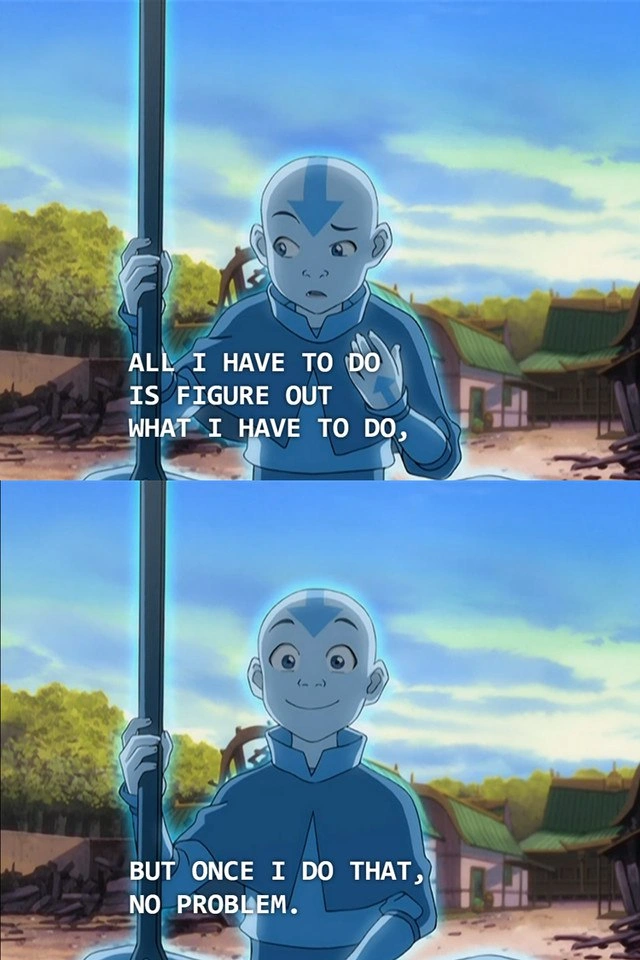
ALL I HAVE TO DO
IS FIGURE OUT
WHAT I HAVE TO DO,

BUT ONCE I DO THAT,
NO PROBLEM.

The meme captures the part of software work that never fits neatly into estimates: discovering the real problem. The first panel is worried because "what I have to do" is not a small missing detail. It includes requirements, constraints, edge cases, stakeholders, existing code behavior, data shape, deployment risk, and the weird legacy rule that nobody wrote down because everyone who understood it left three reorganizations ago. The second panel smiles because once that fog clears, implementation feels comparatively mechanical.

That is why this fits RequirementsAmbiguity, Debugging, and ProjectManagement at the same time. A feature request may sound simple until the team learns that "export reports" means permissions, localization, file formats, background jobs, audit logs, retry behavior, and support for one enterprise customer still using the workflow from 2016. A bug may sound simple until "the button is broken" becomes a race condition between cached state, stale API data, and a browser extension. The code is not always the hard part; finding the exact shape of the work is.

Senior developers recognize the dangerous optimism in BUT ONCE I DO THAT, NO PROBLEM. It is both true and false. True, because a well-framed task often collapses into a few coherent changes. False, because figuring it out frequently reveals that the task is larger, riskier, or politically uglier than anyone hoped. The real skill is turning confusion into a bounded plan: ask sharper questions, inspect the system, reduce unknowns, sketch data flow, define done, identify rollback paths, and separate facts from guesses.

The post message calls this The distilled essence of programming, and that is accurate in the least glamorous way. Programming is not just converting ideas into syntax. It is repeatedly discovering that the idea was underspecified, the current system is stranger than expected, and the shortest path is first to build a correct mental model. After that, sure, "no problem," apart from the usual problems.

Description

A two-panel Avatar: The Last Airbender meme shows Aang standing by a staff in a bright outdoor scene. In the first panel he looks worried, with white caption text reading: "ALL I HAVE TO DO IS FIGURE OUT WHAT I HAVE TO DO,". In the second panel he smiles confidently, and the caption continues: "BUT ONCE I DO THAT, NO PROBLEM." The software-engineering angle is the familiar gap between solving the actual implementation and first discovering the real task, constraints, dependencies, and failure modes.

Comments

3
Anonymous ★ Top Pick The hard part is turning "figure it out" into a bounded DAG; after that it is merely typing until the hidden nodes appear.
  1. Anonymous ★ Top Pick

    The hard part is turning "figure it out" into a bounded DAG; after that it is merely typing until the hidden nodes appear.

  2. @callofvoid0 4y

    exactly most of the time for coding is thinking about the structure of what you are going to do

    1. @SamsonovAnton 4y

      Especially when writing in Prolog or any other language where each line of code is an essence of thorough thought.

Use J and K for navigation