Skip to content
DevMeme
5675 of 7435
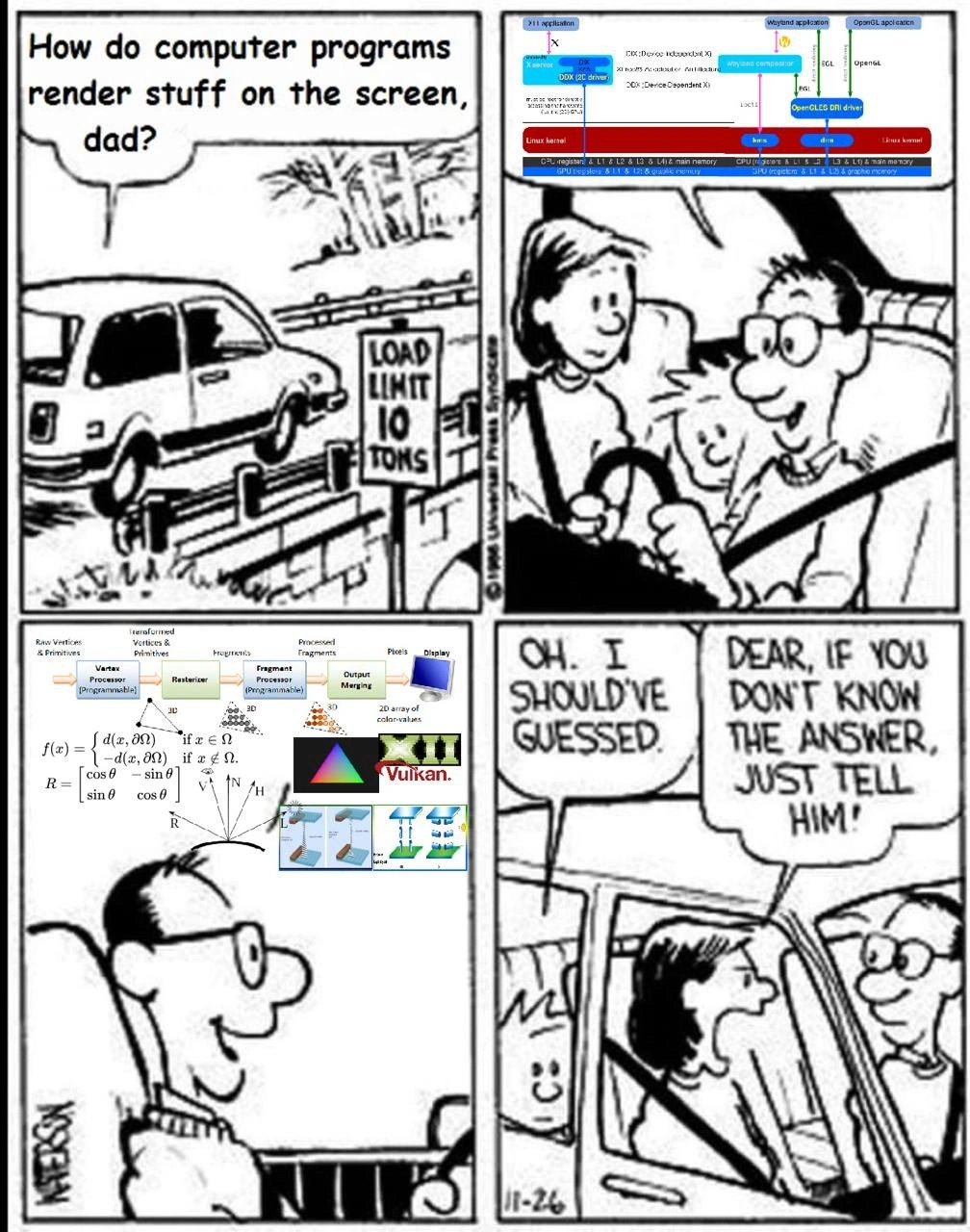
Asking dad about rendering unleashes full Linux GPU stack and math-laden pipeline spiel
Graphics Post #6226, on Sep 4, 2024 in TG

Asking dad about rendering unleashes full Linux GPU stack and math-laden pipeline spiel

Why is this Graphics meme funny?

Level 1: Too Much Information

Imagine you ask your dad a simple question like, “Why does the lamp light up when I flip the switch?” Instead of saying, “Because electricity makes the bulb glow,” he starts explaining every single thing – how electricity is generated at the power plant, how it travels through wires to your house, how the filament in the bulb heats up and produces light, even the physics formula for electromagnetism! By the time he’s talking about Maxwell’s equations, your eyes are probably glazing over. You just wanted a quick answer, but Dad is giving you a whole science lesson. It’s kind of funny and a bit frustrating at the same time. In this meme’s story, the kid only asked how computers show stuff on the screen. But the dad answered with way too much detail, going on about all the tiny parts and processes that make it happen. It’s like asking for a one-sentence answer and getting a full book! The joke is that sometimes parents (or anyone who knows a lot about something) can get carried away and overwhelm you with information when you really just needed the basics. It’s the goofy situation of a kid getting a textbook lecture when all they wanted was a simple explanation.

Level 2: Nerd Mode Engaged

This meme highlights a big gap between technical detail and everyday explanation. Let’s break down what the dad is talking about in simpler terms. The child asks how computers render stuff on the screen – basically, how do we get from a program to seeing images or text on a monitor. The dad’s answer touches every part of that process, which we call a graphics stack (a stack means layers of technology). In a normal conversation, you might just say, “The computer uses a special graphics card to draw things.” But Dad went full nerd mode and started naming every component:

  • X11: This is an old system (from Unix/Linux) that manages windows and displays. Think of X11 as the part of the operating system that decides what goes on the screen, where windows appear, etc. It’s like a manager for drawing on the screen. Dad even mentioned DIX and DDX, which are inner parts of X11 (basically the generic part vs. the hardware-specific driver part). Most people, even many developers, don’t ever deal with those directly – it’s deep insider terminology for graphics programmers working on Linux.

  • OpenGL: This is a programming interface that lets programs draw 3D graphics. Video games and 3D apps often use OpenGL (or things like it) so they don’t have to talk to the hardware directly. It provides commands like “draw a triangle here” or “fill it with this color.” Dad name-dropped OpenGL likely to explain how a program turns 3D models into the actual drawn image using the GPU.

  • GPU: The Graphics Processing Unit, a special processor in your computer or device just for handling graphics and images. It’s like an artist inside the computer that is really fast at drawing and coloring pixels. The GPU driver in userspace and the Linux kernel parts Dad mentioned are basically how the operating system talks to this graphics card. The driver is software that knows how to work with the GPU hardware. Part of it runs in the Linux kernel (the core of the OS that has direct access to hardware), and part runs in user space (regular software level). Dad was essentially describing how an app’s drawing request goes through the driver and kernel to reach the GPU.

  • Vulkan: This is a newer graphics API (like OpenGL but newer and more complex/flexible). Vulkan lets developers have very fine-grained control over the GPU for drawing things. It’s powerful but pretty complicated to use. By showing the Vulkan logo, the meme implies Dad even brought up the latest and greatest tech, as if the kid needed to know that too. If OpenGL is like a handy drawing toolkit, Vulkan is like a low-level toolbox that gives you screws and nails and says “build it yourself, carefully.” For a kid’s question, mentioning Vulkan is just going way too far down the rabbit hole.

  • Graphics Pipeline (Vertex Processor, Rasterizer, Fragment Processor, etc.): This is basically the step-by-step procedure that graphics hardware (the GPU) uses to turn shape data into the final image. In simpler terms:

    • The vertex processor stage takes the corners of shapes (vertices of triangles, etc.) and positions them correctly in 3D space, doing the math to figure out where each point should appear on your screen after camera perspective. This usually involves matrix transformations (a kind of linear algebra).
    • The rasterizer takes those positioned shapes and breaks them into a bunch of tiny pixels or fragments – like turning a triangle into a little mosaic of colored dots, because screens are made of pixels.
    • The fragment processor calculates the color of each of those tiny fragments (pixels), which could involve running a small program (shader) that accounts for lighting, texture, etc. For example, it answers questions like “what color should this pixel be? Is it part of a shadow, is it shiny, is it red or blue?”
    • Then the output merger combines all those pixels (from perhaps multiple shapes or layers) into one final image and sends it to the screen (display).

Dad basically described this whole pipeline. He even threw in a mathematical formula, which likely represents something like the complicated equations for lighting or color. To a beginner or a child, that formula would look like random symbols. In fact, it’s probably referencing the rendering equation, which is a super advanced concept explaining how light bounces around in a scene. That’s nothing a kid (or even a regular developer who’s not into graphics) would normally know about.

So why is all this funny? Because the dad’s response is technically correct but totally out of scope for the situation. The meme pokes fun at how developers or engineers sometimes answer a simple question with an avalanche of detailed information. There’s even an expression, “nerd sniping,” for when someone is lured into deep technical talk that nobody else asked for. Here the child essentially nerd-sniped his own dad by accident. The dad went into what we’d call “over-engineering” mode – providing an answer far more elaborate than needed. It highlights a communication gap: the dad is speaking in terms of systems and processes that a young kid (or any non-tech person) just wouldn’t follow.

For a junior developer or someone new to this field, this scenario might also feel familiar in another way. Have you ever asked a senior dev a question like “Hey, how does our logging system work?” and gotten a 30-minute answer starting from “Well, in 1970, UNIX syslog was invented…”? That feeling is the same as what this kid is experiencing. You expect a simple explanation, but the expert, meaning well, gives you the entire history and architecture. It can be overwhelming. As a new dev, you learn that big systems (like rendering graphics, or handling web requests, etc.) have many layers and moving parts. This meme is basically a caricature of that realization: even something as straightforward as drawing to the screen has a lot going on behind the scenes. The tags like HiddenComplexity and CommunicationGap are spot on – the complexity is hidden until someone dumps it on you, and there’s a gap between the explainer and listener in terms of what detail level is appropriate.

In short, Dad’s brain went into developer-overdrive. He answered in terms of every component and process involved, rather than phrasing it in a simple, kid-friendly way. The family car setting makes it extra humorous – imagine being stuck in a car on a road trip with a parent giving you a lecture you didn’t ask for! The mom’s response, telling dad to just admit if he doesn’t know, is the cherry on top. It suggests that from the outside, this overly detailed answer doesn’t even look like knowledge – it just looks like confusion. It’s a reminder: sometimes being able to simplify is as important as knowing the details.

Level 3: Full Stack Overflow

For seasoned developers, this meme elicits a knowing grin because it perfectly captures a common communication pitfall in tech: when asked a simple question, an expert launches into an exhaustive answer that overwhelms the audience. The child in the backseat just innocently asks, “How do programs render stuff on the screen, dad?” – a question any non-technical person might ask out of curiosity. But Dad, being a hardcore developer or graphics engineer, hears this and his brain goes, “Oh boy, where do I even begin?!” Instead of a kid-friendly summary, he starts at the very top of the graphics stack and works his way down: from the windowing system (X11) to device drivers to the GPU pipeline to the underlying math. The comic illustrates this by literally replacing Dad’s speech bubbles with diagrams and formulas. The result is hilariously true to life: many of us in software have either given or received an answer like this at some point. It’s the classic scenario of expert over-explaining – sometimes dubbed an “information firehose” or answering the question you wish they’d asked. The title nails it: “Asking dad about rendering unleashes full Linux GPU stack and math-laden pipeline spiel.” In other words, the kid opened Pandora’s box, and out poured a torrent of detail only a graphics programmer would love.

The humor lands because of the contrast between expectation and reality. Mom and kid likely expected Dad to say something like, “The computer has a special part that draws pictures on the screen,” which would have sufficed. Instead, they got a dissertation on the inner workings of computer graphics. The second half of the comic (panels 3 and 4) really drives this home. The child’s reaction, “OH. I SHOULD’VE GUESSED.”, is drawn as a sort of wide-eyed, overwhelmed acceptance – the kid didn’t actually learn anything useful, he’s just like “okay, sure, Dad.” It’s the kind of resigned response you give when you’re drowning in jargon. Meanwhile, the mom’s quip is the punchline for us readers:

Mom: “DEAR, IF YOU DON’T KNOW THE ANSWER, JUST TELL HIM!”

That line is gold because it’s so relatable to anyone who’s witnessed a techie overshare. From the mom’s perspective (a stand-in for a non-specialist audience), Dad’s rambling might as well be evidence that he doesn’t actually know how to explain it simply. If you can’t break it down, do you really understand it? It’s a playful jab at the dad, suggesting all that word-vomit wasn’t helpful. Seasoned devs chuckle here because we see ourselves: how many times have we excitedly dumped technical details on someone (or in a design meeting, or a code review) when a one-liner answer would do? This meme exaggerates it to absurdity by showing actual technical schematics in a speech bubble. We find it funny because it’s truth amplified – we’ve all either been the Dad (the explainer) or the Kid/Mom (the overwhelmed listener) in situations like this.

On a more concrete level, the specific content of Dad’s “spiel” is itself an inside joke for graphics programmers and Linux users. Mentioning X11 and DDX evokes the era of the X Window System, which is highly familiar to folks who have messed with Linux GUI internals or tried to optimize graphics performance. The fact that Dad’s explanation starts by going into X11 driver architecture (with DIX/DDX) – something even many developers find arcane – is hilarious because it’s so unnecessarily deep. It’s like someone asking “why is the sky blue?” and the responder starts with the Big Bang. Then Dad piles on OpenGL and GPU drivers – which are just more layers that could confuse a layperson. And just when you think he might stop, he apparently dives into the GPU’s rendering pipeline (vertex processing, fragment shading, etc.) and the actual math formulas used in advanced rendering! The inclusion of the Vulkan logo is a cherry on top, since Vulkan is known among devs as a very low-level, verbose graphics API – a sort of byword for “even more complicated way to draw things” compared to the relatively simpler OpenGL. So Dad basically invoked both the old complexities (X11) and the new complexities (Vulkan) in one breath. For those of us in software, it’s a riot because we get the references: each term he spews out represents a rabbit hole of complexity. We chuckle in commiseration – yeah, been there, suffered that.

The “LOAD LIMIT 10 TONS” road sign in panel 1 is an extra gag that developers might appreciate. It’s as if the comic is warning: “Caution, heavy load of information ahead.” Sure enough, the Dad’s response breaks the load limit of what that poor kid can carry. It’s a clever visual pun on the idea of information overload. If you’ve ever been in a meeting where someone dumps a truckload of technical jargon on an unsuspecting audience, you know that feeling. The sign sets up the expectation that Dad’s answer is going to be way too heavy – and he delivers. This detail makes the meme even more delightful for observant techies, because it shows the meme creator’s attention to detail: they’re winking at us, saying “yes, this answer is 10 tons of nerd stuff.”

Underneath the humor, there’s a real grain of truth about communication gaps in tech. Senior engineers often have a wealth of knowledge and context that juniors or non-engineers lack. A simple question can trigger a knowledge dump because the senior is thinking of all the edge cases, the history, the architecture – essentially the full stack. The dad’s mistake (and comic flaw) here is not gauging his audience. This is a well-known challenge: explaining complex technology in simple terms is hard, especially if you’re super excited (or pedantic) about the details. As experienced devs, we laugh because we know we’re prone to this too. The meme is basically a playful self-own for the engineering community: “Haha, sometimes we answer like this dad, totally overdoing it.” And the mom’s punchline is a humble reminder that, hey, if you can’t communicate clearly at a high level, maybe you’re not being as helpful (or as knowledgeable) as you think.

Level 4: Projected Overkill

At the deepest technical level, this meme dives headfirst into the full Linux graphics pipeline – from high-level windowing systems down to low-level GPU math – all in response to a simple child’s query. The dad doesn’t just give a quick answer; he unleashes a firehose of computer graphics theory. In the second speech bubble, we actually see components of the OpenGL/Vulkan graphics pipeline laid out: raw 3D geometry (vertices and primitives) enters a vertex processor (a programmable stage where each vertex’s position is transformed by matrix math like $M \cdot v$), then a rasterizer breaks triangles into pixels, feeding a fragment processor (another programmable stage calculating each pixel’s color, possibly running a tiny program called a fragment shader). The pipeline proceeds through an output merger that blends all those pixel fragments into the final image that goes to the display. This mirrors the standard GPU rendering pipeline architecture taught in graphics courses and APIs like OpenGL: it’s the step-by-step journey from 3D models to the 2D pixels you see on screen. The dad even throws in heavy math – one bubble shows a trigonometric matrix and an integral formula. That formula is a nod to the Rendering Equation, the foundational integral in photorealistic rendering which, in simplified form, looks like:

L_o(x, \omega_o) = L_e(x, \omega_o) + \int_{\Omega} f_r(x, \omega_i, \omega_o)\, L_i(x, \omega_i)\, (n \cdot \omega_i)\, d\omega_i 

This equation (introduced by Kajiya in 1986) formally describes how light reflects off a surface $x$: the outgoing light $L_o$ equals any emitted light $L_e$ plus the integral of incoming light $L_i$ from all directions $\omega_i$ in the hemisphere $\Omega$, modulated by a material’s BRDF $f_r$ and the surface’s orientation $(n \cdot \omega_i)$. It’s heavy-duty calculus for lighting and shading – far beyond a typical casual explanation. By including such an equation, the dad’s answer encompasses not just the mechanics of drawing graphics, but also the theoretical physics and math of rendering realism. This is the kind of content you’d find in graduate-level computer graphics or GPU architecture discussions, certainly overkill for a kid in a car seat asking an innocent question!

The first speech bubble in the comic is no less dense – it’s a diagram of the Linux GPU driver stack. We see labels like X11 application, DIX (Driver Independent X), DDX (Device Dependent X), OpenGL (the legacy 3D API) and a GPU userspace driver, all feeding into the Linux kernel. This is a real architecture: historically, on Linux, drawing something on screen went through the X11 Window System. X11 (X Window System) has a core server (the DIX) that is hardware-agnostic, and loads a DDX module which is the hardware-specific video driver. So an X11 app’s drawing calls flow into X’s engine, then into the DDX driver. Meanwhile, modern 3D apps might bypass some of X by using OpenGL to talk to the GPU through a userspace driver (like Mesa), with the kernel managing the actual GPU device. The fact that these exact terms appear in dad’s speech bubble means he’s reciting the entire graphics software stack from application to kernel. And if that wasn’t enough, in the next breath he apparently brought up Vulkan (its logo is visible in the collage) – Vulkan is a newer GPU API that gives developers even more explicit control (and complexity!) over that pipeline. It’s as if dad said: “Well son, first your program talks to X11, which uses a DIX and DDX, or if it’s a 3D program it might use OpenGL or Vulkan to communicate with the GPU driver in user space, which then goes into the kernel’s DRM subsystem, and then the GPU does vertex processing, rasterization, fragment shading, and so on…,” ad infinitum.

From a theoretical perspective, the humor is highlighting the sheer depth of knowledge behind something seemingly simple like “rendering stuff on screen.” It’s a gentle poke at how hidden complexity in computing can be layered from user-level software abstractions (window systems, APIs) down to hardware behavior and mathematical principles. Each box in dad’s diagrams represents a layer of abstraction or a stage in the pipeline, and each is complex in its own right. For instance, the vertex processor stage involves linear algebra (multiplying coordinate vectors by transformation matrices for rotation, scaling, projection into 2D), and the fragment processor stage can involve solving equations for lighting (normals, dot products, possibly those integrals for advanced lighting models). GPUs execute these stages using hundreds or thousands of parallel threads, respecting an intricate synchronization and memory model – details one could ramble on about for hours. In Linux, the driver stack has historically been labyrinthine: the X11 system (originating in the 1980s) was notoriously complex, involving network-transparent client-server design and device-specific driver extensions (the DDX). The presence of X11 and Vulkan in the same breath spans decades of graphics evolution – from the old-school 2D windowing of X to the cutting-edge explicit GPU control of Vulkan. This dad basically unloaded decades of computer graphics history and technology in one go. No wonder the kid is speechless. The projected 3D geometry, the overkill of math – it’s all there. The meme revels in this absurdity: the father’s detailed knowledge is correct and thorough, but it’s comically out of place as an answer to a child’s question. It’s like using a particle accelerator to crack a peanut – technically impressive, but totally unnecessary for the task at hand.

Description

Four-panel black-and-white family car comic. Panel 1: child in backseat asks, “How do computer programs render stuff on the screen, dad?”; roadside sign reads “LOAD LIMIT 10 TONS.” Panel 2: instead of an answer, dad’s speech bubble is overlaid with a tiny diagram whose legible labels include “X11 application,” “DDX (Driver Independent X),” “DDX (Device Dependent X),” “OpenGL application,” “GPU userspace driver,” and “Linux kernel.” Panel 3: his next bubble is replaced by a dense graphics-pipeline collage: boxes labeled “Raw Vertices & Primitives,” “Vertex Processor (Programmable),” “Rasterizer,” “Fragment Processor (Programmable),” “Processed Fragments,” “Output Merger,” “Pixels,” and “Display,” plus a trigonometry matrix, an integral formula beginning “f(x)=∫ d(x,ΩΩ)…,” and a conspicuous Vulkan logo. Panel 4: child says, “OH. I SHOULD’VE GUESSED.” Mom replies, “DEAR, IF YOU DON’T KNOW THE ANSWER, JUST TELL HIM!” The humor lies in dad answering with the full Linux graphics driver stack and GPU pipeline rather than a child-friendly summary, highlighting how developer explanations can overshoot their audience
Comments

9
Anonymous ★ Top Pick Some parents explain pixels; this one starts with the DRM-KMS handshake and ends in Vulkan queue semantics - apparently mom still calls that “not knowing the answer.”
  1. Anonymous ★ Top Pick

    Some parents explain pixels; this one starts with the DRM-KMS handshake and ends in Vulkan queue semantics - apparently mom still calls that “not knowing the answer.”

  2. Anonymous

    After 20 years of graphics programming, I still can't explain rendering without accidentally deriving the entire history of computer graphics from Bresenham's line algorithm to real-time ray tracing, complete with a detour through why we still argue about immediate mode vs retained mode APIs

  3. Anonymous

    Every senior engineer has been this dad - asked a simple question and immediately diving into the full OSI model equivalent of graphics rendering, complete with kernel-space memory diagrams and shader pipeline stages, only to realize the audience just wanted to know 'pixels go brrr.' The real engineering challenge isn't building the rendering pipeline; it's compressing 40 years of graphics API evolution into something that doesn't require a PhD to understand. Bonus points if you've ever caught yourself mid-explanation thinking 'maybe I should've just said magic' while gesturing at a whiteboard full of transformation matrices

  4. Anonymous

    In graphics, “draw a triangle” somehow requires X11/Wayland, DRM/KMS, Mesa, a PSO, command buffers, and a swapchain - so yes, dear, the short answer really is “it depends on the compositor.”

  5. Anonymous

    20+ YoE truth: Rendering pipeline? 'CPU yeets vertices at GPU, pixels appear' - probing deeper risks driver-level impostor syndrome

  6. Anonymous

    Kid asks about pixels; Dad starts with X11 vs Wayland, detours through DRM/KMS, Mesa, command buffers, and Vulkan swapchains - ELI5 with a kernel-space context switch

  7. @eddsakey 1y

    What the fuc

  8. @M4lenov 1y

    Real

  9. @ovleoyu 1y

    Real,sad

Use J and K for navigation