When your partner dislikes objects so you offer a struct instead
Why is this Languages meme funny?
Level 1: Missing the Point
Imagine you tell your friend, “Hey, I feel like you’re treating me like I’m just a toy, not a real friend,” and your friend replies, “Oh, so do you want me to treat you like a stuffed animal instead?” 😕 That wouldn’t make things better, right? They’d be completely missing the point of what you were upset about. You’d probably give them the same look the woman in the meme has!
That’s exactly what’s happening in this meme, just with coding words. The woman says, “I hate it when you treat me like an object,” meaning she feels not respected or valued as a person. The guy responds, “Would you like to be a struct?” which is basically him offering to treat her like a different kind of thing. It’s a silly, literal answer when she wasn’t looking for that at all. It’s as if she said “Don’t objectify me!” and he went, “Okay, I’ll structurize you instead!” It makes us laugh because he’s so totally not understanding her feelings. He’s treating an emotional complaint like it’s a problem with terminology.
In very simple terms: she wanted him to treat her with more respect, but he acted like the only issue was the word “object.” It’s funny in the way a bad dad-joke is funny — he responds with logic when she wanted love. So the core of the joke is a goofy misunderstanding. One person is emotional, the other is overly literal. Even if you don’t know what an object or struct is, you can feel that disconnect. The guy basically proved her point: he was still treating her like a thing (just a different kind of thing). Kids, it’s like if you say “Stop calling me a baby!” and your sibling grins and says “Sure thing, toddler.” Not helpful, right? But in a cartoon or a joke, that mix-up is what makes us giggle. Here the cartoon just uses nerdy computer terms to do the same setup. The humor is in how badly he misses the point of what she really wants.
Level 2: Objects vs Structs 101
Let’s break down the terminology and context for those who might not be fluent in code-speak. The joke here revolves around the words “object” and “struct,” which have special meanings in programming.
What’s an object? In programming (especially in Object-Oriented Programming), an object is like a little capsule that contains data and functions that operate on that data. You usually define a class (a blueprint) and then create objects from it. For example, imagine a class Car with attributes (data) like color and speed, and methods (functions) like drive() or stop(). If you create a Car in your code, myCar might be an object with, say, color = red and able to perform myCar.drive(). So an object is basically an instance of a class, bundling state and behavior. In languages like Java, C++, C#, or Python, almost everything can be an object. You interact with objects by calling their methods or changing their properties.
Now, in the meme, the woman says “treat me like an object.” Of course, in everyday English, that means “you’re treating me like a thing, not a person,” which is a bad thing – she feels disrespected. But let’s see why the guy’s brain jumped to code: he heard “object” and likely thought of the programming kind of object. Many developers spend so much time with code objects that the word automatically triggers tech thoughts.
What’s a struct? A struct (short for structure) is a term used in languages like C, C++, C#, and Go to describe a simpler kind of data grouping. Think of a struct as a custom container for some variables. For example, in C you might have:
// Define a struct in C for a Person
struct Person {
char name[50];
int age;
};
Here, Person is a struct that just holds a name and age. There’s no built-in method or function attached to it – it’s purely data. In C, and in Go, you typically use structs just to organize data, then write separate functions that take a struct as input if you want to operate on that data. In C++, you can actually put methods inside a struct (C++ treats struct almost the same as a class), but by convention people often still use structs for plain-old-data types.
In C# (.NET), the difference between a class and a struct is quite significant: a class is a reference type (which we touched on above in Level 4), and a struct is a value type. This means if you have a ClassPerson and you set personB = personA, now personB refers to the same object as personA (two references, one object in memory). But if you have a StructPerson and do structB = structA, you’ve just made a copy — now there are two independent data copies. Changing one won’t affect the other.
- Reference type (object/class): Think of it like having a house (the object) and two people with the address to that house. If one person repaints the living room, the other person, when they visit, will also see the new paint because it’s the same house they’re referencing.
- Value type (struct): Think of it like two separate houses that just happen to have identical layout and furniture initially. If one house gets a new paint job, the other house is unchanged. They were copies, not the same exact entity.
In simpler terms, an object from a class tends to be a single entity everyone can refer to, whereas a struct is more like a bundle of data that gets duplicated whenever you assign it to a new variable.
Now, why is this funny in the meme? The woman’s statement “I hate it when you treat me like an object” is about feelings, not code. She means “I feel like you don’t see me as a person.” But the guy responds as if she literally said “I don’t like being an instance of a class.” 😅 So he quips, “Would you like to be a struct?” as if she might prefer being a different data type. Essentially, he’s joking that if she doesn’t want to be an object, they can downgrade her status to a humble struct. It’s a play on words: object vs struct – two concepts every programmer learning about LanguageFeatures in languages like C++/C# encounters.
For a new developer or someone not familiar with these terms, here’s the pun explained in plain language: She says, “Don’t treat me like a thing.” He replies, “Would you like to be a different kind of thing?” He’s totally missing the point of her plea, and doing so by referencing a nerdy detail from programming. The reason programmers find it funny is because “object” and “struct” are as different to us as night and day in certain contexts, but to a normal person, that response is complete nonsense. It’s like if someone said “Don’t call me short!” and you earnestly reply “Okay, would you prefer the term vertically challenged?” Technically you changed the word, but you definitely didn’t solve the problem – in fact, you sounded a bit ridiculous. Here the word swap is from one programming term to another.
The type_system_pun relies on knowing that some languages have both objects and structs. If you’ve only coded in, say, Python or JavaScript, you might not have seen a struct before (those languages don’t have that keyword; everything in Python is an object, for example). But in C, there’s no classes or objects — you’d use structs for composite data. In C++, you have a choice: class and struct are almost the same (the only difference is default access modifiers). In C#, you deliberately choose struct for small value types and class for larger reference types. And in Go, you just use struct for defining objects (Go doesn’t call them objects, but you can attach methods to structs, so they work kind of like objects without the word “class”). Knowing any of that helps the joke click: you recognize he’s swapping OOP lingo with a more bare-bones concept. It’s as if in a conversation someone said “Don’t label me as X” and the other person, misunderstanding, replies “Okay, I’ll label you as Y instead” — where X and Y are technical categories.
In summary, objects and structs are two ways to handle data in programming. An object usually means a richer entity with identity and behavior (from a class), and a struct means a simpler bundle of data. The meme’s humor comes from the boyfriend absurdly applying that nerdy distinction to a romantic context. He’s effectively treating his partner’s feelings like a software problem: Oh, you don’t like being an object? I’ll just reclassify you! 🤖 For a junior dev or someone new to coding, just remember that a struct is a term for a simple data structure. So he’s basically asking “Would you like to be just a plain data structure?” If that still sounds odd, that’s exactly the point — it is odd! The charm of the joke is in how blatantly it misuses programming jargon where it absolutely doesn’t belong.
Level 3: No Class, Only Struct
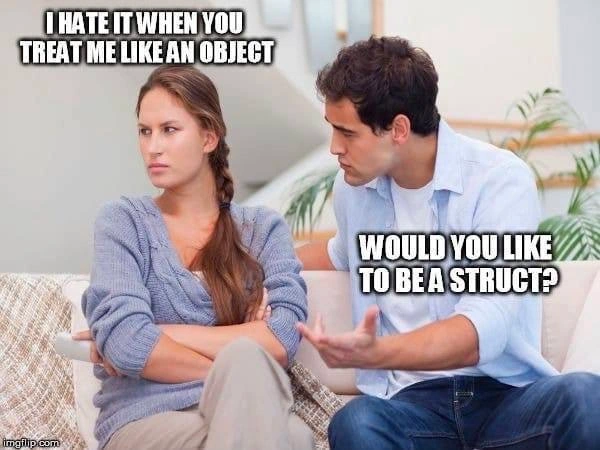
On the surface, this meme is a classic case of a developer taking a relationship complaint way too literally. The image shows a couple on a couch: the woman looks upset, arms crossed, saying “I hate it when you treat me like an object.” That’s a pretty normal phrase outside of coding — nobody wants to be objectified or treated as a thing. But the punchline is the boyfriend’s response, positioned right by his explanatory hand gesture: “Would you like to be a struct?” 😂. In one swoop, the conversation veers from emotional to ultra-nerdy.
For those of us steeped in code, this is hilariously relatable. It’s developer humor 101: take something non-technical and very earnestly misinterpret it as technical. The boyfriend hears “object” and immediately thinks programming. Instead of addressing her feelings, he offers a solution (because of course, engineers love solving problems) by changing her data type. This is the kind of joke that makes programmers both laugh and facepalm, because many of us have been guilty of similar moves (though maybe not so cartoonishly). It’s poking fun at the stereotype that engineers are better with code than with empathy – when confronted with an emotional statement, this guy literally proposes a refactor! It’s like he’s saying, “Oh, you don’t like your class type? Let’s reinstantiate you as a different struct, that’ll fix it.”
The humor works on a couple of levels. First, it’s a pun on programming terminology: “object” versus “struct.” In languages such as C++ or C#, these terms have specific meaning. An object usually means an instance of a class (with all the OOP trappings like inheritance, methods, etc.), whereas a struct is typically a simpler construct (often a value type, mainly just holding data). By asking if she’d like to be a struct, he’s riffing on that difference. Developers familiar with these languages know that some people do express strong preferences here – e.g., “I hate using heavy objects for simple data, I’d rather use a struct”. It’s a tongue-in-cheek allusion to ongoing debates in programming: Object-Oriented Programming vs. plain old data structures. The boyfriend’s quip could almost be something a grumpy C programmer or a Go developer would joke: “Don’t like objects? No problem, we’ll use a struct instead!” It’s the absurdly literal fix to what was not a technical problem at all.
Secondly, the meme nails the miscommunication aspect. Instead of addressing why she feels objectified (the real issue), he seizes on the word “object” and responds with a tech inside joke. Every seasoned dev has likely experienced or witnessed this kind of conversational train-wreck where a technical mind answers the words but not the intent. (Think of someone complaining “my phone is so slow,” and a developer launching into a lecture about CPU scheduling, when the person just wanted sympathy or a simple tip.) Here it’s magnified to comedic effect: he effectively asks if she’d prefer being treated like a struct – which, to non-coders, is gibberish, and to coders, is a silly category error. It’s LanguageQuirks meets relationship quirks. The guy’s pose, leaning in with that explanatory hand, is perfect: we can almost hear him starting a well-actually spiel about data types in a relationship argument!
For experienced programmers, there’s an extra layer of chuckling because we’ve had those internal monologues about objects vs structs in real code. Perhaps you remember times refactoring a class into a struct for performance, or arguing that “maybe we don’t need a full object here.” It’s a common pattern in system design discussions: use a simpler data container instead of a class if you don’t need polymorphism. The meme leverages that nerdy familiarity. It’s basically transfering a software engineering solution to a domestic dispute. The sheer inappropriateness is what makes it funny. It highlights how an engineer’s brain might work: Problem: she doesn’t want to be an object. Solution: make her a different data structure. Problem solved? – Of course not, but the thought process is recognizable and ridiculous.
Also, the specific choice of a struct is golden for those in the know. He didn’t say “Would you like to be a subject?” or something playfully romantic. He went straight to one of the most dry, technical alternatives to an object. 😂 This suggests the meme creator assumes an audience that knows a bit about programming languages where struct is a thing. It’s targeting the kind of dev who chuckles at a type system pun. The categories even hint at this: Languages and CS_Fundamentals. Indeed, only in a programmer’s world would the nuance of object vs struct be common knowledge. If you’ve worked with C or low-level languages, you know struct as the way you bundle data. If you’ve done C#, you’ve learned that a struct is a lightweight value type and a class is a heavier reference type. And if you’re a Java or Python dev with no struct equivalent, you might still get it if you’ve heard C-folks joke about how Java “treats everything as an object” (even your basic integers get wrapped as objects in some cases). This meme finds its mark with those who have felt the difference between these concepts.
The stock couple meme template amplifies everything. We see a clearly frustrated partner and a cluelessly logical responder. This format has been used in many DeveloperHumor memes precisely because it exaggerates the disconnect in communication. The man’s face is earnest, like “Honey, I have a perfectly reasonable technical workaround for your complaint!” and that just makes the joke land harder. It’s really highlighting an OOP inside joke within a familiar comedic scenario. We’re essentially watching a dramatic relationship moment get a laugh track for coders. It resonates especially with developers who have had to explain their jokes to non-tech friends or partners. We can imagine the woman’s next line: “That’s not what I meant, and you know it!” And the dev sitting there confused why his clever struct comment isn’t defusing the tension.
In essence, from a senior developer’s perspective, this meme is funny because it’s absurdly true to form. We’ve seen how using the wrong abstraction in code causes bugs; here using the wrong abstraction in communication causes a comedic misunderstanding. It also slyly references the ongoing love-hate relationship our industry has with OOP. (There are corners of the internet where saying “I prefer structs over objects” signals one’s allegiance in the great OOP wars.) The meme takes that nerd turf war and sticks it into a completely unrelated real-life context. The result is a perfect storm of CodingHumor: if you get it, you groan-laugh because you’ve been that guy or you know that guy — the one who might, even for a split second, think a pun like this could lighten the mood. Spoiler: it usually doesn’t. But it sure makes for a great meme.
Level 4: Identity vs Value
At the deepest technical level, this joke hinges on the difference between objects with identity and plain data values in programming. In many languages, an object (instance of a class in OOP) has a distinct identity and is typically accessed by reference. That means two variables can refer to the same object in memory – update one reference, and the other “sees” the change. It’s like having two different remote controls for the same TV; no matter which remote you use, you’re controlling the one TV (the single object). In contrast, a struct in languages like C, Go, or C# is often a value type: if you assign one struct to another, you copy all its data, creating an independent clone. This is more like making a photocopy of a document – now you have two separate papers with the same content, and changing one doesn’t affect the other. There’s no shared identity, just duplicate information.
This difference is fundamental in CS fundamentals and language design. An object’s identity allows for complex behaviors: objects can be mutated from different parts of a program via references, enabling patterns like shared state and polymorphism. A struct, on the other hand, is just raw data grouped together; it doesn’t intrinsically carry methods or the OOP overhead of inheritance or polymorphic dispatch (unless dressed up in languages like C++). In type theory terms, an object (especially in class-based OOP) is a nominal type identified by a class name and potentially part of an inheritance hierarchy, whereas a struct is akin to a product type (a simple composite of fields) or a record. There’s even a cheeky nod here to structural typing vs nominal typing: in structural type systems, compatibility is determined by having the right fields/properties rather than the exact declared class. The word “struct” hints at this “structure matters” approach. So in a sense, the boyfriend in the meme is humorously suggesting a complete type-system change for his partner: from a nominally typed object (with a specific class identity – girlfriend class?) to a structurally typed plain data record. It’s an absurd form of type casting in the relationship! (In fact, one could imagine a tongue-in-cheek code comment here: // TODO: cast Girlfriend from Object to Struct without losing data 😉).
Digging even deeper, there’s an ironic twist about agency vs. passive data. In real life, saying “Don’t treat me like an object” is an appeal to be seen as a person with autonomy. Interestingly, in software, objects were a paradigm created to give our code elements more autonomy and behavior – an object can act via its methods. A struct by itself has no behaviors; it’s passive, just a bunch of bytes until some function operates on it. So from a philosophical view, the boyfriend’s offer to make her a struct would strip away even the metaphorical “agency” she had as an object! 😅 In OOP terms, an object could at least do things (respond to messages, call methods on itself); a struct just sits there with its fields. It’s a hilarious inversion: he’s proposing to solve her complaint about objectification by turning her into even more of a literal object (just data). No wonder that suggestion falls flat – it’s the ultimate identity crisis: trading the rich identity of an object for the hollow simplicity of a struct in a context where none of that technical stuff should even matter.
There’s also some historical context packed in here. Back in the day, programming was largely about procedures and data structures (struct in C, for example). Then Object-Oriented Programming (OOP) came along (Simula in the 1960s, then Smalltalk, C++ in the 80s) encouraging us to bundle state with behavior and think in terms of objects “acting” with each other. This was supposed to make programs model the real world more intuitively – objects send messages to other objects, like actors. Fast forward, and OOP became mainstream, but not without pushback. By the 2010s, some developers started rejecting the “all things must be objects” mindset, favoring simple data types (structs/records) with functions (the rise of data-oriented design, or languages like Go which pointedly has no class keyword). So when the meme’s guy says “Would you like to be a struct?”, on a meta level he’s echoing that backlash: it’s like he’s saying, “Let’s abandon this relationship’s OO paradigm and go back to a simple data-oriented model.” 🤓 It’s a comedic oversimplification of a decades-long debate in software architecture. The fact that he does this in response to a relationship problem makes it doubly ridiculous and thus funnier to those of us who appreciate these nuances.
In summary, beneath the humor lies a collision of two worlds: the concept of an object with identity and behavior vs. a plain structure of data. The meme tickles us experts because it marries a fundamental computer science distinction with everyday life in the most incongruous way. It’s a perfect example of how a simple seeming dev joke can hide layers of theory — from pointer semantics and heap allocation (object instances living on the heap, vs. struct values on the stack) to the philosophy of modeling real-world entities in code. And it proves that sometimes the deepest bugs are human misunderstandings, not code at all!
Description
A stock-photo style scene shows a woman and a man sitting on a living-room couch; the woman has her arms crossed and looks annoyed while the man leans toward her with an explanatory hand gesture. White, bold, all-caps caption text sits at the top left: "I HATE IT WHEN YOU TREAT ME LIKE AN OBJECT". A second block of identical styling appears near the man’s hands: "WOULD YOU LIKE TO BE A STRUCT?". The humor relies on programming vernacular, contrasting object-oriented "objects" with simple data "structs", turning a relationship complaint into a type-system pun. Developers versed in languages such as C, C++, C#, or Go will recognize the reference to reference-versus-value semantics and the broader joke about how engineers talk
Comments
7Comment deleted
Fine, you can be a struct - but if you walk out mid-argument, don’t expect the instance I’m holding to update; value semantics mean I’m stuck dating a stale copy
After 20 years in this industry, I've finally realized the real difference between objects and structs: objects have methods to handle their own problems, while structs just dump all their data on you and expect you to figure it out
Being a struct means she gets copied on every argument - at least as an object they'd both be pointing at the same problem
The classic dilemma: she wants encapsulation and polymorphism, but he's offering stack allocation and direct memory access. Turns out the real issue isn't the paradigm - it's that neither of them implemented a proper communication interface
Happy to make it a struct - just don’t page me when the hot path tanks from interface boxing and deep copies; value semantics weren’t free in the profiler
Stop treating me like an object? Fine - be a struct: value semantics, no inheritance, and a surprise 64KB memcpy in the hottest loop
Structs dodge vtable bloat and inheritance chains - ideal for relationships without the polymorphic drama