Academia fixes it on paper, industry waits for the zero-day headline
Why is this Security meme funny?
Level 1: Fix it after it breaks
Imagine you and your friend both know that the wheel on your bike is loose. Your friend (let’s call them the “academic” friend) says, “We all know the wheel is loose. We don’t actually need to ride the bike and have an accident to prove it. Let’s just tighten the bolt now because obviously it’s a problem.” But the bike’s owner (let’s call them the “industry” person) says, “Yeah, the wheel’s a bit wobbly, I see that, but I’m not going to do anything about it until it actually falls off while someone’s riding.” 🙄 See the difference? One person wants to fix the known issue before it causes a crash, and the other person is willing to wait until after the wheel falls off (when the crash has already happened) to fix it. It’s funny in a facepalming way because it’s so clearly a bad idea to wait for the disaster. The humor comes from recognizing that in real life, people actually do this: they ignore a known problem until it causes a big mess, then they scramble to clean it up. It’s like knowing your roof has a leak and deciding, “I won’t repair it until the house is flooded.” Both sides agree something’s broken, but only one side wants to act before it gets worse – that’s why this quote hits home and makes tech folks laugh (and cry a little inside).
Level 2: Known Bug Ignored
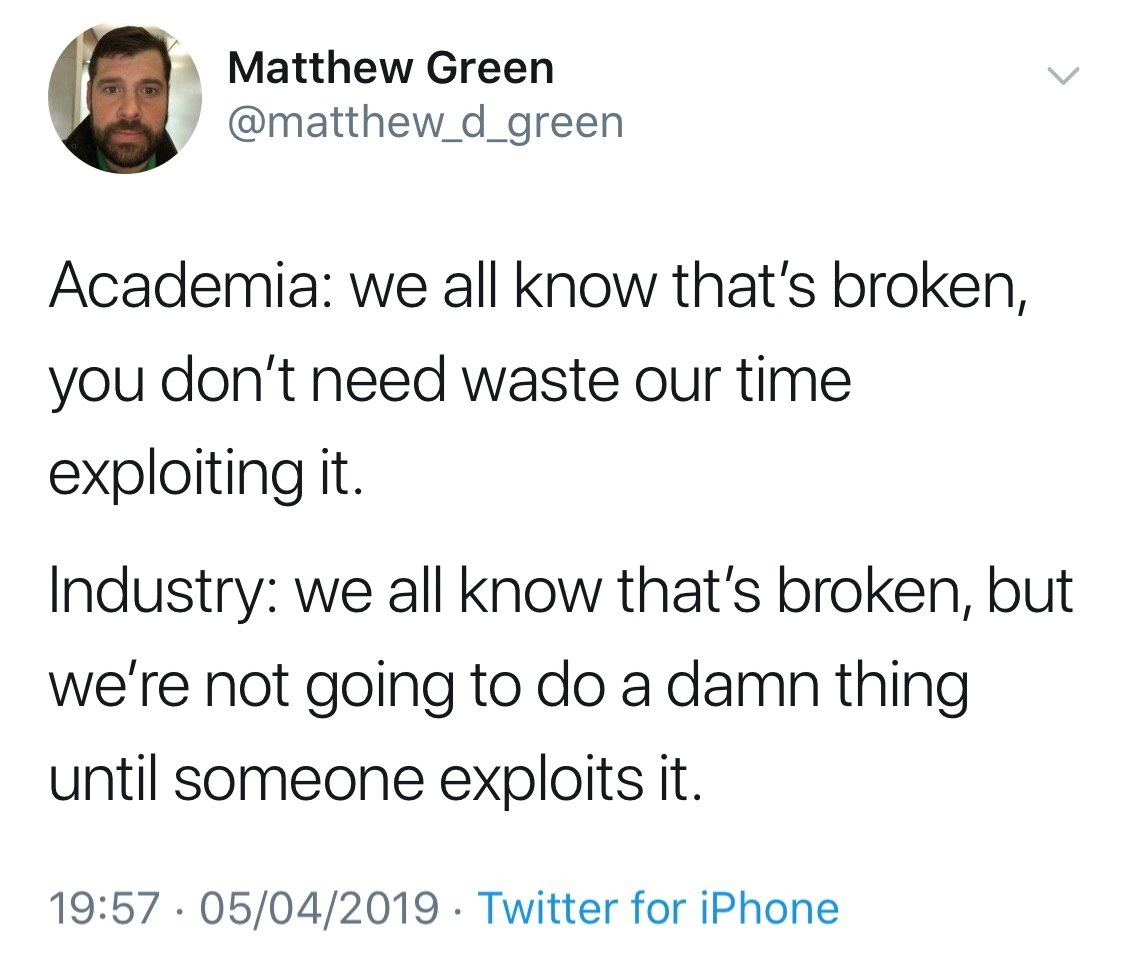
So what’s going on here in simpler terms? This meme (a screenshot of a tweet from professor Matthew Green) contrasts how academia and industry handle a known problem in software or security. In the tweet, both academia and industry voices say, “we all know that’s broken,” meaning everyone is aware there’s a bug or security vulnerability somewhere. It might be a flaw in a program, an insecure design in a system, or some known weakness in a computer network. Basically, something is wrong under the hood, and it’s not a secret. The twist is in what each side chooses to do about it:
Academia’s approach: “We all know that’s broken, you don’t need to waste our time exploiting it.” In the academic world, once a vulnerability or bug is identified and understood, researchers feel no need to actually use it for an attack (that’s what “exploiting it” means – taking advantage of the bug to cause harm). They’re essentially saying: “This thing is obviously broken. We could hack it if we wanted to, but there’s no point in doing so just to prove a point. It’s a known fact, let’s not dwell on it.” Academia often “fixes it on paper” by writing about the problem and maybe suggesting a solution in theory. Think of academic cybersecurity researchers like detectives who publish a report, “The door lock is broken and here’s why it can be picked,” and then they move on to the next case. They assume everyone will read the report and take appropriate action because, hey, it’s clearly documented now.
Industry’s approach: “We all know that’s broken, but we’re not going to do a damn thing until someone exploits it.” This is highlighting a sometimes sad reality in companies and the tech industry. Even if engineers in a company know there’s a bug or vulnerability, the organization might not prioritize fixing it until it becomes an actual problem – specifically, until some malicious person exploits it. “Exploiting it” means a hacker or attacker finds the bug and uses it to break in, cause a crash, steal data, etc. The phrase “until someone exploits it” implies waiting for a zero-day incident – that’s a term for when a vulnerability gets actively abused by attackers before the good guys have a patch in place (basically, the headline-grabbing hack we hear about in news). The industry stance in the meme is basically: “Yes, we’re aware it’s broken, but it’s not an immediate problem. We’ll deal with it later… if we really have to.” This is a form of risk acceptance. Companies sometimes formally decide to “accept the risk” of a known issue because maybe they think the chance of someone actually exploiting it is low, or the cost of fixing it is high in terms of time/money. It’s like saying, “We live with this flaw for now.” However, that “for now” can become “uh-oh, now we have to fix it ASAP” when an exploit happens and it does cause damage or embarrassment.
This meme is funny to developers because it rings true. The known_bug_ignored scenario happens a lot in real life. For instance, a development team might know their website has a weakness (say, a way for a skilled person to trick the system and get unauthorized access), but since no hacker has done it yet, the bosses might label it “low priority” or push it off to the next quarter. Then everyone kind of forgets about it… until one day, maybe a security researcher or a bad actor actually uses that vulnerability and it becomes big news. That’s the vulnerability_disclosure_gap: the gap between knowing about a problem and the problem getting fixed or disclosed publicly. In that gap, the issue is lurking while folks are essentially hoping no one will take advantage of it.
In plainer terms, academia tends to be proactive about such issues – they’ll identify and document a bug early, essentially saying “it’s broken and we all agree on that.” Industry tends to be reactive – not fixing the issue until there’s pressure, usually from an actual incident (which could mean real users are affected or the company’s reputation is at stake). This is also a cultural commentary (CorporateCulture in tech): many companies talk about being secure and high-quality, but when push comes to shove, if something isn’t on fire, it gets backlogged. People who work in tech find this meme humorous because it’s a shared frustration. It’s pointing out a kind of laziness or shortsightedness: “We won’t do anything until we absolutely must.” And when is that? When a hacker exploits the bug and suddenly everyone upstairs is panicking.
To decode a couple of the terms: “zero-day” refers to a vulnerability that is exploited on “day zero” of it becoming known, meaning there was zero time to prepare or patch it. A “zero-day headline” in the title suggests a big news story about a brand-new exploit hitting the public. It’s the kind of thing that forces a company’s hand. So when the title says, “Academia fixes it on paper, industry waits for the zero-day headline,” it’s summing it up: academics publish a fix or at least point out the problem in theory (on paper), while the industry folks wait until their hand is forced by a worst-case scenario (a headline about a breach) to implement the fix. And indeed, security vulnerabilities often get handled in exactly this slow-reactive way, which is both ironic and a little scary – thus perfect material for tech humor.
Level 3: Zero-Day Ultimatum
At a more practical level, this meme captures a scenario every seasoned software engineer or security professional finds painfully familiar. It’s pointing out the AcademicVsIndustry divide in how known problems are handled. On one side, you have the academic mindset (often including independent security researchers or the R&D folks) saying, “Look, the issue is obvious – it’s a known bug, a design flaw. We’ve documented it, we know exactly why it’s broken. There’s no need to prove the point again by actively exploiting it; just acknowledge the problem and fix it proactively.” On the other side, you have the industry mindset, which often translates to management or business stakeholders, effectively responding, “Yeah, we see it’s broken in theory, but it’s not hurting us yet. Why allocate budget or developer time to this now? We’ll wait until it actually causes a crisis – until someone malicious figures it out and it blows up in our faces – and then we’ll deal with it.” The humor (and horror) lies in this IndustryIrony: everyone knows about the vulnerability, yet the organizational inertia or prioritization black hole means nothing gets done until there’s a fire.
This pattern comes up all the time in corporate tech culture (CorporateCulture at its finest). It speaks to how companies handle SecurityVulnerabilities versus how academics would like them handled. In many tech organizations, especially those juggling dozens of projects and deadlines, there is a quiet practice of risk acceptance – essentially saying “We know of this risk, but we accept the chance of something bad because preventing it is, for now, too costly or inconvenient.” It’s often formalized in risk tables and backlog tickets that get continuously deprioritized. For example, a security team might file a report: “The password reset function is susceptible to an obvious race condition exploit.” Engineering management responds: “Noted.” But if no hacker has actually hit that exploit in the wild yet, the issue might languish as a Jira ticket for months or years. After all, fixing it might require refactoring a critical module and could delay that big feature release. Why fix today what you can put off indefinitely fix after the next penetration test report or breach?
This mentality can be insanely frustrating for developers and security engineers on the ground. They often already know about the bug (just like academia knows it on paper). They might even joke darkly about it among themselves: “Yup, we ship next week with that known hole wide open. Crossing fingers no one finds it!” It’s a combination of SecurityTradeoffs and inter-departmental dynamics: product managers worry about new features and deadlines, ops teams worry about stability, and security teams... well, they worry about the thing that no one else wants to worry about until it’s too late. The meme’s second line, “we’re not going to do a damn thing until someone exploits it,” is basically the unofficial slogan in many orgs when it comes to low-hanging security fixes or nasty BugsInSoftware that aren’t yet causing user-visible errors. The frank language “not gonna do a damn thing” is funny because it’s so bluntly true – it’s exactly what exasperated tech folks mutter under their breath after leaving yet another meeting where a serious bug fix got postponed in favor of something flashier.
Let’s remember, too, the incentive structures at play. If a professor or PhD student in academia finds a critical vulnerability, they publish a paper and get a pat on the back, maybe even press coverage. Their job is done; they pointed out the hole in the hull. In contrast, in a company, acknowledging a vulnerability can create immediate responsibility to act – and if action isn’t taken, there’s liability. Oddly, this can create a perverse incentive to downplay or ignore known issues until action is absolutely unavoidable. It’s a bit like an open secret: everybody internally knows something’s off (there might even be internal documents or emails warning about it), but officially nobody wants to ring alarm bells until they have no choice. Why? Because as soon as you ring the bell, the countdown to fix it begins, and that can divert resources or make someone look bad for letting it be there. Some companies literally operate under the mantra “if it’s not in the news, it can’t hurt us.” They wait for a zero-day headline – a public exploit or a vulnerability disclosure that forces their hand – often because only then is there enough pressure (from the media, from customers, or upper management) to justify the scramble. It’s crisis-driven development: fix it only when you’re in the hot seat.
We’ve seen real-world examples of this procrastination-fueled drama. Take the case of the Equifax breach in 2017: there was a known Apache Struts vulnerability (a web framework bug) with a patch available for months, and internal teams were aware of it. But it wasn’t patched in time. Why? Possibly internal triage labeled it low priority – “no known exploits yet.” Then attackers did exploit it, and bam! 147 million people’s personal data was compromised. Suddenly that “theoretical” bug became front-page news, and executives were testifying to Congress. The meme could just as well reference that scenario: academia (or the security community) had said “this Struts bug is serious,” industry (Equifax in this case) effectively said “we’ll wait until someone exploits it.” And exploit it someone did. This is the vulnerability_disclosure_gap incarnate – the gap between acknowledging a bug and acting on it, often only closed by an attacker’s hand. Another notorious instance: for years, experts rang alarm bells about using outdated encryption like SSL 3.0 or weak hash algorithms like SHA-1. Many companies dragged their feet on upgrades – until hackers demonstrated real attacks (like the BEAST and POODLE attacks on SSL, or a real collision attack on SHA-1 in 2017). Only after headlines like "New attack lets hackers impersonate Google!" did organizations finally disable those old protocols in a hurry.
From a senior developer’s perspective, this meme is both amusing and cathartic. It sums up countless war stories in one tweet. We’ve all sat in meetings where a critical bug is shrugged off until it becomes a five-alarm fire. It highlights a classic TechIndustryHumor: the absurdity that, in a cutting-edge industry, common sense fixes often take a backseat to reactive firefighting. It’s DeveloperHumor with an edge of truth; you laugh, but only to keep from crying. The tweet by Matthew Green resonates because it’s a cynical summary of how different worlds operate: academic researchers publish a scathing vulnerability report and think “job done,” while many companies skim the report and think “sounds theoretical; we’ll deal with it if someone actually uses this against us.” The punchline is essentially: We all agree it’s broken. One side treats that as sufficient reason to act (or at least publish the knowledge), the other side needs to feel the pain before doing anything. It’s a head-desking, familiar situation for anyone who’s tried to push proactive fixes in a corporate setting, only to be told to chill until further notice. And when that “further notice” comes in the form of an exploit, all you can do is sigh and mutter “told you so,” while you’re woken up at 3 AM to finally patch the darn thing under duress.
Level 4: Papers vs Patches
In the rarefied air of academic security research, proving a system is broken doesn’t always require pulling off a flashy hack in the wild. Academics often "fix it on paper" by identifying a flaw, formally proving its existence or impact, and maybe even suggesting a theoretical patch or mitigation. This is akin to writing a proof in mathematics: once you’ve shown a contradiction or weakness under certain assumptions, the case is closed. For example, cryptographers might publish a paper mathematically demonstrating that a certain encryption algorithm is broken by design (e.g. it’s susceptible to collisions or predictable outputs). They don’t necessarily need to weaponize that knowledge beyond a proof-of-concept. In academic circles, a vulnerability can be considered solved (or at least well-understood) once it’s documented and peer-reviewed – the academic incentive is to move on to the next big discovery, not to spend time writing an actual exploit code for something everyone in the field already knows is vulnerable. Why waste time building a malware variant to exploit a flaw when the academic consensus already agrees it’s a flaw? As the tweet humorously puts it, “we all know that’s broken, you don’t need to waste our time exploiting it.” From a researcher’s perspective, exploiting an already-proven vulnerability can feel like busywork; the real intellectual heavy lifting was finding and proving the bug in the first place.
However, in the industry realm, things operate under a different paradigm – one bound by real-world constraints, business priorities, and a dash of wishful thinking. Here, a vulnerability isn’t truly real until it’s biting you in production with actual consequences. There’s an unwritten rule in some corporate environments: if a tree falls in the forest (i.e., if a security hole exists) but no hacker exploited it yet, did it really fall? This leads to a form of Schroedinger’s vulnerability – it’s both known and not urgent at the same time. Industry engineers might privately acknowledge, “yeah, our authentication module has a theoretical flaw,” but unless someone demonstrates a working exploit or a zero-day attack in the wild, management will likely classify it as a low-priority risk. In academic terms, one might say industry decision-makers are implicitly demanding an existence proof by exploitation. It’s not enough that the vulnerability exists in theory; they want to see it exploited (preferably somewhere else or to a competitor!) before mobilizing resources. This reflects a stark contrast in threat modeling: academic researchers assume a powerful adversary will eventually exploit any weakness (worst-case, adversarial model following principles like Kerckhoffs’s principle), whereas industry often leans on optimistic assumptions or security by obscurity, figuring that if an attack hasn’t happened yet, maybe it never will.
This divide is also rooted in economics and incentives. There’s a whole field of security economics exploring why companies often hold off on preventative fixes. Patching a vulnerability can be costly – it might require developer time, system downtime, or performance trade-offs – and if there’s no imminent threat (no headline-grabbing exploit), the cost/benefit calculus skews towards inaction. Academics, on the other hand, are rewarded for identifying problems (publishing papers, advancing knowledge), not necessarily for fixing operational systems. In fact, once they’ve sounded the alarm in a paper, their job is done; it’s up to vendors or maintainers to implement the patches. This creates a notorious vulnerability disclosure gap: the time between when a vulnerability is academically or privately known and when it’s actually patched in real-world systems. During that window, the vulnerability sits, acknowledged but unaddressed – essentially a ticking time bomb. Many famous bugs have lurked in this gap. For instance, the cryptographic hash function MD5 was shown to be theoretically broken (collisions could be found) by researchers years before attackers pulled off practical exploits like forging SSL certificates. Academia had proven MD5’s weaknesses, but industry was slow to react, continuing to use it until practical exploits forced emergency deprecations. Similarly, computer scientists have warned for decades about buffer overflows and memory-unsafety in C/C++ (with formal models showing how such flaws enable arbitrary code execution), yet it took industry years of viruses and worms (like the notorious Code Red, Slammer, etc. exploiting those very weaknesses) to widely adopt preventative measures like non-executable memory and address space layout randomization.
In summary, at this deep technical level, the meme is highlighting a kind of theoretical vs empirical divide. Academia deals in proofs and potentialities: once something is demonstrated to violate a security property or a spec on paper, it’s considered broken. Industry deals in incidents and impacts: a bug may be known, but it’s treated as hypothetical until a real exploit forces everyone’s hand. This disconnect is a fundamental challenge in cybersecurity. It’s why we have zero-days (exploits with zero days of warning) catching companies off-guard despite whitepapers warning about the underlying issue years prior. The tweet delivers this insight with biting humor: academia already wrote the report and moved on, while industry will only budge when that reported flaw graduates to front-page news as a full-blown breach.
Description
Screenshot of a tweet styled in the standard Twitter interface. A small circular avatar sits at the top left, followed by the bold name "Matthew Green" and the handle “@matthew_d_green.” The tweet text reads: “Academia: we all know that’s broken, you don’t need waste our time exploiting it. Industry: we all know that’s broken, but we’re not going to do a damn thing until someone exploits it.” Beneath the text is the metadata line “19:57 · 05/04/2019 · Twitter for iPhone.” Visually, the layout is simple white background with black text, blue handle and timestamp links. Technically, the post humorously contrasts academic security research - where acknowledged flaws are documented and moved on from - against corporate risk culture, which often delays remediation until an exploit becomes public. It highlights real-world attitudes toward vulnerability management, disclosure, and organizational incentives around fixing known bugs
Comments
7Comment deleted
Security triage flowchart: 1) Academic paper cites the vuln → file a Jira tagged “someday.” 2) PoC exploit tweeted → backlog behind OKRs. 3) HackerNews headline → Sev-1 war room. 4) CFO’s face on Bloomberg → “rewrite it all in Rust by Monday.”
The difference between a CVE and a P0 incident is about three quarterly earnings calls and one CISO's resignation letter
The vulnerability backlog has two states: 'theoretically broken, won't fix' and 'actively exploited, P0 all-hands' - nothing in between ever gets scheduled
The eternal security paradox: Academia publishes a CVE with a 9.8 severity score and a detailed write-up, but Industry's risk register still shows it as 'accepted' until someone drops a working exploit on GitHub. Then suddenly it's P0 and everyone's working weekends - because apparently theoretical cryptographic breaks don't count until they're weaponized in a Metasploit module
Our risk model is event‑driven: nothing is scheduled until the CVE ships with a logo, then it preempts the entire roadmap
Academia footnotes the flaw in a paper; industry footnotes it in the postmortem
Industry threat model: "academic PoC" -> backlog; "same PoC with a logo and a domain" -> sev-0 war room