The Null Pointer You Have at Home
Why is this Bugs meme funny?
Level 1: Empty Cookie Jar
Imagine you’re on a car ride home and you ask your mom, “Can we stop and get some cookies?” Mom says, “No need, we have cookies at home.” You get home, hungry for a sweet treat, only to find the cookie jar completely empty. No cookies at all – just disappointment! In a simple way, that’s what this meme is joking about. The programmer (like the kid) wanted something good – a simple variable that works. The “mom” (maybe the situation or an excuse) said, “we already have that at home.” But the thing at home turned out to be nothing useful, even harmful (like an empty jar or a broken toy). In the meme, the “empty jar” is a null pointer dereference, which is basically a fancy term for a big mistake that makes a program crash. It’s funny (especially to computer folks) because it’s a classic case of expecting a nice treat and getting a nasty surprise instead. Even if you don’t know the tech words, you can feel the silly frustration – it’s the old switcheroo: you wanted something simple, but what you got was “oops, there’s nothing here!”. Just like that empty cookie jar scenario, it’s a mix of surprise and let-down that makes the joke work, even in the programming world.
Level 2: Null Pointer Crash Course
Let’s break down the joke in simpler terms. In programming, a pointer is like a slip of paper with an address on it, telling you where to find a piece of data in memory. For example, in C you might have int *p; meaning p is a pointer to an int. But pointers don’t automatically point to something; they need to be set to a valid address. If you haven’t set it yet, or if you explicitly set it to “nowhere,” that’s what we call a null pointer. In code, you’ll often see NULL or nullptr used to represent this pointer to nothing. It’s a way to say “this pointer isn’t currently holding a valid address for data.”
Now, dereferencing a pointer means accessing the value at the address the pointer is holding. Think of it as following the pointer’s directions to open a box in memory and read what’s inside. If the pointer actually points to a real box, you get the contents. But if the pointer is null (i.e., it doesn’t have a real address to follow), what happens when you try to dereference it? That’s right – there’s no box to open. The program will try to access an invalid memory location. This usually causes a crash called a segmentation fault. A segmentation fault (segfault, for short) is a common error on systems like Linux/Unix that basically means “the program tried to access memory that it wasn’t allowed to.” It’s the computer’s way of slamming the door and saying “Stop! You’re not allowed to go there.” This is a type of RuntimeError because the error happens while the program is running (as opposed to a compile-time error, which would be caught before the program even runs).
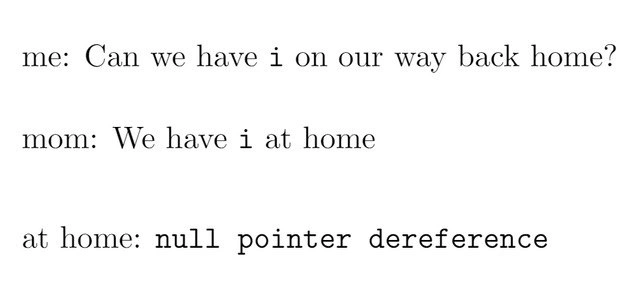
So where does the meme humor come in? The meme uses the popular “we have X at home” format. Usually, that format implies that the thing at home is a lousy version of what you actually want. Here, the thing being requested is “i”. In programming, i is traditionally a simple loop variable (we often write loops like for(int i = 0; i < N; ++i) {...} where i goes 0,1,2,…). It’s probably the most common variable name in code examples. The at_home_meme_format joke structure goes:
- Me: “Can we have i on our way back home?” – This is like a developer asking, “Can I get a fresh
i(perhaps a properly initialized variable or a new approach)?” - Mom: “We have i at home.” – This implies, “No need to get a new one; we already have an
iin our code base.” - At home:
null pointer dereference– And here’s the punchline: theiwe “have at home” is not a healthy, functioning variable at all, but rather a null pointer bug that crashes the program.
In plainer words, the developer wanted to use a variable i safely, but the existing i in the program turned out to be an uninitialized_pointer or otherwise faulty. It’s like your mom claiming she has what you need, but the provided thing is completely useless or broken. A null_pointer_dereference is definitely useless – it doesn’t give you a value, it just blows up the program. This highlights a common bug in languages like C and C++: if you forget to initialize a pointer or mistakenly use a pointer that’s null, your program can explode in a hurry. For a newbie, encountering a segfault can be bewildering. There’s no explicit message like “NullReferenceException at line 10” (as you might get in Java or C#). It’s often just “Segmentation fault” and maybe a memory address or core dump, and you have to figure out which pointer did the damage.
Let’s clarify a few terms and why this is about MemoryManagement and MemorySafety: In manual memory management (as in C/C++), you, the programmer, are responsible for allocating memory (creating that “box” for data) and assigning pointers to that memory. If you have a pointer variable and you never give it a box (never allocate or assign it), it doesn’t automatically start as null; it could be just garbage (some random address). Accessing it is even worse (truly undefined behavior – possibly a crash or random gibberish data). Good practice is to set pointers to NULL if they aren’t pointing to anything, specifically to help catch errors – because accessing a null pointer tends to crash immediately, which is easier to notice than silently corrupting memory. However, in our meme, the null pointer was used when the programmer likely expected a real value. The phrase undefined_behavior_pun applies because a null pointer dereference is one of those “undefined behaviors” in C that can do anything (but usually just crashes).
The categories here are Bugs and Debugging_Troubleshooting for good reason. A null pointer dereference is a classic bug, and troubleshooting it involves using debuggers or adding logs to see where things went wrong. It typically goes like: run program, get a segfault, then use tools or print statements to trace which pointer was null or which line caused it. It’s a rite-of-passage bug for new C programmers – you forget malloc or fail to check a return value, and boom, segmentation fault. After you experience it, you learn to be more careful (like always initializing your pointers, checking if malloc returned NULL, etc.). Higher-level languages or newer ones have safeguards: for example, Python doesn’t even let you deal with raw pointers; Java will throw a named exception if you use null incorrectly. But in C, the trade-off for speed and control is that the RuntimeErrors can be rough and unfriendly.
So the meme is basically saying in coder-joke form: you wanted a simple loop variable, but what you ended up using was a null pointer – oops! It’s the kind of mistake that is both trivial (just an i variable) and serious (crashes the program) at the same time. If you understand that, you can see why developers find it funny. They’re laughing at a scenario that they’ve either experienced or live in fear of – the program-killing bug that was hiding in plain sight, innocently named i. The contrast between the expectation (“having i”) and the reality (“segfault due to null i”) is the core of the joke. And even if you’re a junior dev, once you’ve dealt with pointers a bit, you’ll appreciate the underlying lesson: always make sure your “i at home” isn’t secretly a null that will crash everything!
Level 3: We Have Segfaults at Home
Everyone who’s done LowLevelProgramming in C or C++ can chuckle (or shudder) at this meme, because it captures a classic scenario of Debugging_Troubleshooting gone wrong. The format is the familiar “Mom, can we get X? – We have X at home – At home: [terrible version of X]”. In our case, X is the innocent loop variable i (the one you see in every for loop tutorial). The punchline “at home: null pointer dereference” is the catastrophic substitute, akin to mom offering you spoiled milk instead of the milkshake you asked for. It’s a nerdy twist: the developer wants a proper, working variable i, but what they have at home in their codebase is an i that isn’t set up – a pointer bug that leads straight to a SegmentationFault. It’s the programming equivalent of expecting a treat and getting a slap in the face.
Why is this so relatable to seasoned developers? Because null pointer dereference bugs are painfully common and memorable. Picture a real-world scenario: A junior dev says, “Shouldn’t we create or initialize a new index variable here?” and a rushed senior replies, “Nah, we have i already defined elsewhere, just use that.” Fast forward to runtime: the program tries to use i but, surprise, i isn’t pointing to anything valid – bam, segmentation fault! The meme nails this BugsInSoftware pattern: reusing or assuming something is valid when it isn’t. We’ve all seen versions of this: maybe a pointer that was never initialized because someone “was sure it was set in a constructor,” or a pointer that was set to NULL as a placeholder but never updated, and then blindly used. The result? DebuggingFrustration of the highest order – your program crashes with little explanation. If you’re lucky, you get a core dump or an address to trace. If you’re unlucky, the crash might happen sporadically (say, the pointer was usually non-null, but one rare code path left it null), leading to a heisenbug that has you tearing your hair out at 3 AM.
The humor here also comes from mixing a mundane family dialogue with hardcore tech jargon. A non-programmer reading “i at home: null pointer dereference” would be baffled – it reads like nonsense. But for developers, each part triggers an recognition: PointerArithmetic and memory management bugs, the dreaded “segfault” error message, the mental image of that stark NULL memory address causing a program to implode. It’s funny in the “ha-ha (oh no)” way because it recalls real pain. Many of us remember the first time our program just vanished with a segmentation fault due to a null pointer. No helpful error, just instant termination. Then came the witch-hunt: sprinkling printf statements or firing up gdb to find which line accessed a null. When the meme says “we have i at home,” it’s invoking that false sense of security that we’ve got this covered, and then “at home: null pointer dereference” reveals the ugly truth: Nope, our home-grown solution is a bug.
There’s an unwritten law in programming that if something can go wrong with memory, it will. This meme taps into that shared cynicism. The MemorySafety woes of C/C++ mean that a single forgotten initialization can snowball into a program crash. Experienced devs have learned (often the hard way) to double-check pointers: Did I allocate memory for that? Did I check if it’s null before using it? The meme’s dark joke is that in our imaginary conversation, Mom’s assurance “We have i at home” stopped the kid (developer) from doing the safe thing (getting a proper i). It’s reminiscent of those meetings where you propose using a reliable library, and someone says “We have our own implementation in-house.” You know how that story ends – the in-house tool is a dumpster fire of bugs. Here, the “i at home” is exactly that: a dumpster fire in the form of an undefined pointer causing a crash.
For seasoned programmers, the phrase null pointer dereference itself triggers a mix of trauma and camaraderie. It’s “that bug” you’ve debugged at least once. It might have taught you to always initialize variables, or to use tools like Valgrind/ASAN to catch mistakes, or perhaps to adopt higher-level languages for critical work. The meme distills this whole saga into one line of monospace text. It’s laughable because it’s true – too true. Every senior dev reading it can instantly recall a war story: “Oh yeah, I remember when an uninitialized ptr cost us a week of debugging in production.” It’s humor as a coping mechanism, turning a painful lesson about MemoryManagement and RuntimeErrors into a quick punchline. And of course, it’s a gentle poke at C/C++ culture: where something as small as an i can bring everything crashing down if you’re not careful. In short, the meme is funny-not-funny: we laugh, then we sigh, knowing how easily “Can we have nice things?” turns into “No, we have segfaults at home.”
Level 4: The Billion Dollar Mistake
At the deepest level, this meme pokes at one of computing’s most infamous blunders: the null pointer. Computer scientist Tony Hoare famously called the invention of the null reference his “billion-dollar mistake” – a tiny design decision that led to countless BugsInSoftware and system crashes over decades. So what exactly is a null pointer? In low-level programming (think C/C++), a pointer is essentially a memory address. It’s like a numeric coordinate pointing to a location in the process’s memory. A null pointer is a special “nowhere” value (often represented as 0x0) used to indicate that the pointer isn’t currently pointing at valid data. Dereferencing a pointer means following that pointer to access the memory at its address. Now, if the pointer is null (address 0), you’re telling the CPU to access memory at address 0 – which is a bad idea.
Modern operating systems reserve address 0 (and usually an entire memory page at the start of the address space) to catch this exact error. The moment your program tries to read or write at address 0, the hardware’s memory management unit raises an exception. The OS then sends your process a Segmentation Fault signal (SIGSEGV on POSIX systems), immediately terminating the program. A segfault is essentially the OS saying, “Whoa there, you’re not allowed to touch that memory!” Historically, the term comes from older architectures where memory was divided into segments – accessing an invalid segment/address triggers a fault. The result is usually a cryptic message like “Segmentation fault (core dumped)”, and possibly a memory dump file for debugging (a core file that’s like a snapshot of the program’s memory at the crash moment).
In technical terms, dereferencing a null pointer in C/C++ is undefined behavior. This means the language specification provides no guarantees about what will happen – the program might crash, or it might do something bizarre. (C developers like to joke that undefined behavior can even “make demons fly out of your nose” – meaning absolutely anything can happen.) In practice, it almost always results in a crash on modern systems, but the key is that the compiler won’t stop you or throw a helpful error message. Unlike languages with automatic MemoryManagement and safety checks, C and C++ assume you know what you’re doing. This lack of MemorySafety is powerful (it lets systems programmers do pointer arithmetic and manual optimizations) but it’s also dangerous. A simple oversight like forgetting to initialize a pointer or check for null can bring down the whole program.
To put it into perspective, here’s a tiny C example of a null pointer dereference:
int *ptr = NULL;
printf("%d\n", *ptr); // BOOM! Dereferencing NULL (0x0) → segmentation fault.
When that *ptr line runs, the CPU attempts to access memory at address 0x0. The OS immediately halts the program with a segmentation fault. Nothing about this is checked at compile time – the crash happens at runtime, which is why these are called RuntimeErrors. Over the years, the software industry devised ways to avoid such fiascos. Some languages (Java, C#) don’t allow raw memory access and will throw a NullPointerException (an exception you can catch or handle) if you try to use a null reference. More modern systems languages like Rust go further: they have no null pointers at all in safe code, instead using an Option type that forces you to handle the “nothing there” case explicitly. All these approaches are trying to prevent the havoc wreaked by null references – the kind of havoc our meme is humorously highlighting. The undefined_behavior_pun in the meme title (“i at home” being a null pointer dereference) is a wink at the fact that under the hood, this error arises from deep computer science fundamentals: how memory and pointers work at the machine level, and how a seemingly simple NULL value can crash the whole party. It’s both terrifying and, in retrospect, darkly funny – a testament to why that null pointer really has cost industries billions in debugging time.
Description
A text-only meme on a white background, using a black serif font. The meme follows the popular three-part 'We have food at home' format. The first line reads, 'me: Can we have i on our way back home?'. The second line is the reply, 'mom: We have i at home'. The final line, representing the inferior version at home, is 'at home: null pointer dereference'. The humor is derived from a clever computer science analogy. The variable 'i' is universally recognized by programmers as a standard loop counter or iterator. The meme equates the desire for a functional iterator with the disappointing and catastrophic reality of getting a 'null pointer dereference' error instead. This type of runtime error, which typically crashes an application, occurs when the program tries to access an object or data structure through a pointer that isn't pointing to anything (it's null). It's a painfully relatable experience for developers, especially those working in languages like C++, Java, or C#
Comments
8Comment deleted
The difference between a junior and a senior dev is that the junior gets a NullPointerException, while the senior gets an Optional that's been empty for three weeks
Every time the VP says, “Just reuse the old C library - it’s perfectly fine,” all I hear is “We have i at home,” and I start blocking calendar time for the inevitable null-pointer-dereference post-mortem
After 20 years in this industry, I've learned that the real null pointer dereference is the hope we had for clean abstractions along the way
The i at home was declared but never initialized - like most things mom promises, it points to nothing
The real tragedy isn't the null pointer dereference - it's that after 50+ years of C-family languages, we're still asking for 'i' and getting segfaults. At least Rust would've told us at compile time that mom's promise was a lie, but here we are, discovering it at 3 AM in production when the loop counter we thought we had turns out to be pointing to the void. The 'i' we have at home isn't just null - it's a whole career's worth of trust issues with uninitialized memory
Asked for a loop index; our monorepo handed us i from the C layer, nullable via JNI, dereferenced in prod - aka the quarterly reminder why on-call exists
Mom's i: int *i = NULL; *i; // 💥 SIGSEGV family special
Asking for i and getting a null deref is the C-family version of dinner at home - you still end up single-stepping through SIGSEGV in gdb, vowing to enable -fsanitize=address next time