Skip to content
DevMeme
290 of 7435
Pythonic Obfuscation vs. Readable Code
CodeQuality Post #347, on Apr 29, 2019 in TG

Pythonic Obfuscation vs. Readable Code

Why is this CodeQuality meme funny?

Level 1: Neat vs Messy

Imagine two friends are writing instructions for making a sandwich.

  • The first friend isn’t fully comfortable speaking English, so they say, “Sorry if my English isn’t good.” Then they carefully write out the steps: Step 1: Get two slices of bread. Step 2: Spread peanut butter on one slice. Step 3: Put the slices together. Their instructions are simple and easy to follow. Even if there might be a tiny grammar mistake, you would understand exactly how to make the sandwich. It’s neat and clear.

  • The second friend is a native English speaker, so they don’t apologize at all. They laugh and say, “LOL it’s okay!” (which is a very casual, slangy way to say “No problem!”). But when this friend writes their sandwich instructions, it’s one super messy sentence: “take bread for bread in breads for breads in peanut butter for peanut butter in jar”. Huh? That sounds confusing and all over the place, right? The steps are all jumbled up, like they mixed three instructions into one long line. You’d read that and have no idea what to do first. It’s messy and hard to understand.

The funny part is that you’d expect the native English speaker to write clear instructions (since English is their first language) and the non-native speaker to maybe make mistakes. But here it’s the opposite! The person who was worried about their English wrote a perfect, easy recipe. The person who was super confident wrote something no one can figure out.

This shows that being careful and clear is more important than being a native speaker. In the end, we’d rather follow the neat instructions with a small apology than the messy instructions with a “LOL.” That’s why it’s funny – it surprises us and makes a point that clarity matters more than fancy language.

Level 2: Readability Matters

Let’s break this joke down in simpler terms. This comic is comparing how two developers write code and talk, and it finds humor in the difference:

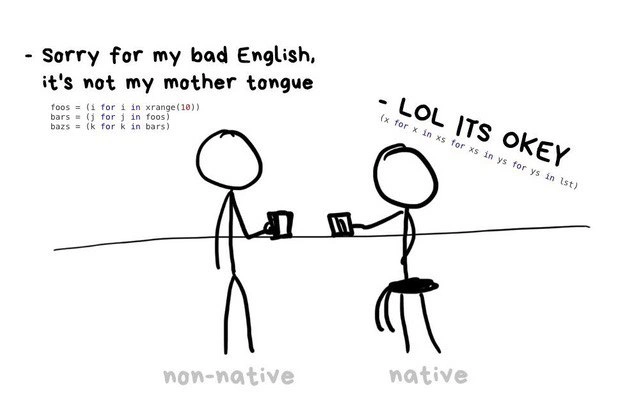
Who’s who? On the left, we have a developer who is a non-native English speaker. This means English is not their first language (not their “mother tongue”). They feel a bit unsure about their English, so they say “Sorry for my bad English.” On the right, we have a native English speaker – English is their first language, so they usually don’t worry about it. The native speaker’s reply “LOL ITS OKEY” is written in a very casual, internet-slang way (with a misspelling of “OKAY” for comedic effect). Already, you can see the contrast: one person is overly polite about their language, the other is super casual.

The Code on the Left (Non-native dev): Below the apologetic dialogue, the comic shows three lines of Python code. They look like this (in Python 3 it would be range(10) instead of xrange(10)):

foos = (i for i in xrange(10))
bars = (j for j in foos)
bzzs = (k for k in bars)

Don’t worry if you’re not a Python expert – here’s what’s happening:

  • xrange(10) (or range(10) in modern Python) produces the numbers 0 through 9. It’s like saying “give me a sequence of 10 numbers.”
  • foos = (i for i in xrange(10)) is a generator expression. That’s a compact way to create a sequence of values. The part in parentheses (i for i in xrange(10)) means “for each number i in the range 0–9, yield i.” So foos will generate 0,1,2,…,9 as you iterate over it. It doesn’t make a list in memory; it generates one number at a time (that’s what a generator does).

Then they do:

  • bars = (j for j in foos) which takes whatever foos generates and yields those same values as j. In other words, bars will produce the same sequence as foos (0–9) when used. It’s like passing the numbers through unchanged.

And then:

  • bzzs = (k for k in bars) which again just takes the output of bars and yields each as k. So bzzs will also produce 0–9.

Why chain generators like this? In a real program, you probably wouldn’t write three in a row that don’t transform the data (you could just use one generator or even just range(10)). The comic is likely doing this to show a pattern clearly or to exaggerate how careful the left-side coder is. Each step is broken out separately, using a new variable name each time (i, then j, then k). It’s very explicit. This makes the code easy to read: even if you’re new to Python, you can guess that foos makes some sequence, then bars goes through that sequence, then bzzs goes through that. Nothing tricky is happening with the variables. This reflects good code readability – the code is written in a clear, step-by-step way, just like the non-native dev’s English: a bit formal, maybe overly cautious, but correct and understandable.

The Code on the Right (Native dev): Now look at the right side code in the comic:

(x for x in xs for xs in ys for ys in lst)

This is meant to be one generator expression that has multiple for parts. In Python, you can indeed put multiple for clauses in a comprehension or generator expression. It’s like nested loops written in one line. For example, a normal nested loop might be:

for a in list1:
    for b in list2:
        do_something(a, b)

As a comprehension, you might write: [do_something(a,b) for a in list1 for b in list2]. The order of for a... then for b... follows the nesting.

But in the comic’s code, the order and naming are all wrong. They wrote for x in xs for xs in ys for ys in lst all in one parentheses. Let’s try to interpret what they might have intended versus what they wrote:

  • Possibly intended meaning: maybe they meant to loop through lst, call each item ys, then loop through ys (maybe assuming ys is a list itself) and call each element xs, then loop through that and call each element x. That would conceptually be a triple nested loop (like going through a list of lists of lists).
  • What they wrote: The first part for x in xs implies there is a collection xs already to loop over. Then for xs in ys comes after – but at that point in reading it, Python doesn’t know what ys is yet (it comes later). And for ys in lst comes last, meaning they intended lst to be the outermost thing. The correct logical order should have been for ys in lst for xs in ys for x in xs to nest properly. They completely reversed the order and also reused the names in a confusing way.

This misuse is an example of variable shadowing or just poor naming. They used xs in two different roles: first as something to iterate over (for x in xs), then immediately reused xs as the loop variable in for xs in ys. That means even if this ran, the moment you enter the second part, xs would refer to something else, clobbering the original meaning. Same with ys. Essentially, the code is broken: it’s not how you write a nested comprehension at all. Most likely, if a beginner wrote this and ran it, they’d get an error or an unexpected result. Even if it somehow ran, no other programmer could easily tell what it’s supposed to do. It’s very unreadable code.

Why is that funny? Because it’s the opposite of what you might expect given who wrote it. The person who’s a native English speaker writes a line that is like broken English, but in code! It’s full of confusing references and doesn’t follow good structure – akin to a grammatically messed-up sentence. And yet, that person is totally casual about it (“LOL it’s okay!”). Meanwhile, the non-native speaker, worried about their English, actually writes code that is well-structured and clear. It’s a role reversal that catches us by surprise and makes us laugh. It’s saying: in programming, being careful and clear (like the apologetic non-native dev) is more valuable than being overly confident but sloppy.

Key Concepts and Terms:

  • Generator Expression: In Python, this is a way to create a generator on the fly. It uses parentheses and a loop-like syntax. For example, (i * 2 for i in range(5)) would produce 0,2,4,6,8 as you loop over it. It’s like a recipe that yields one item at a time. In the meme, both sides are using generator expressions (the left side just splits it into multiple smaller ones).

  • List Comprehension vs Generator: A list comprehension uses square brackets and creates a whole list in memory, e.g. [i*2 for i in range(5)] gives you the list [0,2,4,6,8] immediately. A generator expression uses (...) and doesn’t create the list right away – you get the items on demand. In Python 2, xrange(10) was actually like a generator that yields numbers 0–9 (where range(10) would make a list). In Python 3, range(10) itself is lazy (so xrange was dropped). The left code is effectively making a generator of 0–9, then another generator from that, and so on. All generators, no big lists, just passing values along.

  • Variable Naming: Choosing good variable names is a fundamental part of writing readable code. Here, i, j, k are simple, short names, used in a contained way (each in its own generator). That’s okay for small loops. On the right side, x, xs, ys are actually fine names in concept (often xs might imply “a list of x’s”, and ys a list of y’s), but you must use them consistently and not redefine them incorrectly. The native dev’s code misuse of xs and ys is an example of what not to do. It confuses the reader (and the program). This is what we call poor code quality or specifically poor CodeReadability. A rule of thumb is: code is read more often than it’s written, so always aim to make it understandable for the next person (or future you).

  • Variable Shadowing: This occurs when a variable in a smaller scope has the same name as a variable in an outer scope. In some languages, this might just override the outer one or cause bugs. In Python comprehensions, each comprehension has its own scope for the loop variable, but here they are nesting comprehensions in one line, so it’s especially confusing. In simpler terms, it’s like if you have two people named Alice in the same room and you start giving instructions to “Alice” – both might respond or you don’t know which one you’re talking to. The code on the right has that problem: multiple roles named xs and ys.

  • Apologizing for English: It’s very common in international developer communities to see someone preface their question or comment with “Sorry for my bad English.” It’s a courteous thing; they’re being modest about a potential language barrier. Often, their English is quite okay! This meme plays on that: the apology isn’t necessary at all, because we understand them (and their code) perfectly. In contrast, the native speaker doesn’t apologize (no need, right?) but ends up being the one who creates confusion.

  • “LOL ITS OKEY”: Let’s decode that: “LOL” means Laugh Out Loud, an internet slang for laughing or that something is funny/not a big deal. “ITS OKEY” is a purposely misspelled “It’s okay.” The lack of an apostrophe in “ITS” and the spelling “OKEY” instead of “OKAY” are there to show a kind of flippant, carefree tone. The native speaker is basically saying “Haha, it’s fine, no worries.” The all-caps text makes it look even more casual or jokey (sometimes people type in caps mockingly or just without concern for case). This is ironically poorer English writing than the non-native’s very proper sentence. That’s part of the joke: the native speaker is not even using their own language “correctly” or carefully.

  • Readability vs. Correctness: The meme highlights that just because code is syntactically correct (or almost correct), doesn’t mean it’s readable. The left code is both correct and readable. The right code is arguably not correct (it likely won’t run properly), and it’s definitely not readable. In general, programmers strive to write code that not only works but is also easy for others to understand. If you’ve just started coding, you might notice how some solutions or examples are written very compactly and feel hard to digest – sometimes it’s better to write a bit more verbosely and make sure each step is clear. Here, the non-native dev did exactly that (perhaps out of caution) and it resulted in clean code. The native dev perhaps tried to do something fancy in one line or didn’t think it through, resulting in a mess. So the advice hidden in the humor is: prioritize clarity. Good naming and breaking problems into steps can save everyone from confusion.

Why developers find this relatable: It mixes two worlds – human language and programming language. We often call programming languages just “languages” too, and we communicate with code as much as we do with English (in documentation, code comments, commit messages, etc.). This meme points out a situation many have seen: someone apologizes for their English but in reality contributes great code, versus someone who is fluent in English but writes spaghetti code. It’s a lighthearted nudge to not judge a developer’s skill by their English proficiency. In a globally connected coding world, you’ll meet brilliant programmers whose English might be broken or accented, and that’s fine – their code speaks for itself. And you might meet native English-speaking programmers who nonetheless write code that feels like gibberish.

In summary, readability matters a lot in coding. The comic uses an exaggerated example to show that the way you write code can be just as important as the code working. The non-native dev’s code is like a well-spoken explanation, and the native dev’s code is like a confusing rant. It’s both a joke and a gentle lesson: focus on making your code understandable, and don’t be too hard on yourself (or others) about accent or grammar when the meaning is clear. After all, code and documentation are a form of communication, just like English is, and the goal is to be understood.

Level 3: Lost in Comprehension

On the surface, this meme contrasts two developers using Python generator expressions, but it packs a punch of irony about communication. The left side (the non-native English speaker) writes code that is technically correct and surprisingly clean, while apologizing for their language. The right side (the native speaker) responds with casual internet slang ("LOL ITS OKEY") and presents a monstrosity of a comprehension that would give any senior engineer a headache. Let’s unpack why this is hilarious to experienced devs:

  • Generator Pipeline vs. One-Liner Chaos: The non-native dev’s code is a tidy generator pipeline broken into three steps. For example:

    # Polite, step-by-step generator usage (Python 2 style with xrange)
    foos = (i for i in xrange(10))
    bars = (j for j in foos)
    bzzs = (k for k in bars)
    

    This is perfectly valid Python. It creates a chain of generators: first foos yields numbers 0–9, then bars takes each of those and yields them unchanged, and finally bzzs does the same. It’s a bit redundant (each generator just passes values along), but it’s clear. Each comprehension introduces a new loop variable (i, j, k) so nothing collides. It’s like the code is speaking in simple, complete sentences. An experienced dev sees this and nods: it’s straightforward, easy to read, and doesn’t try to be overly clever. In fact, it’s almost overly polite in how it spells out each stage – much like the dev’s “sorry for my bad English” apology.

  • The Gibberish Comprehension: Now look at the native speaker’s code:

    # Sloppy one-liner with variable shadowing galore
    nightmare = (x for x in xs for xs in ys for ys in lst)
    

    This is supposed to be a single generator expression with multiple for clauses – basically a nested loop in one line. But wow, did they mess up the variable naming. It reads like for x in xs; for xs in ys; for ys in lst. 🤨 Instead of using distinct names for each loop, they shadow variables in a self-referential tangle. The outer loop uses xs, but then an inner loop reuses xs as a new iterator, and an even deeper loop reuses ys. This is not just bad style, it’s nonsense logic. In Python, writing comprehensions with multiple for parts is legal, but the order matters – each for can introduce a new name that subsequent clauses can use. Here, they reversed the natural order. It’s as if you wrote a sentence with pronouns that have no clear referent. If you actually run this code, it will likely raise a NameError or behave unpredictably, because when Python evaluates (x for x in xs for xs in ys for ys in lst), it can’t resolve xs or ys in the order they’re given. It’s the code equivalent of word salad.

  • Readability vs. Cleverness (or Lack Thereof): Seasoned developers often preach that explicit is better than implicit and Readability counts (both are maxims from the Zen of Python). The non-native dev’s generator chain, while a bit verbose, exemplifies those ideals. There’s no magic – you can follow the data as it flows through foos -> bars -> bzzs. The native dev’s one-liner is the opposite: an attempt to do everything at once, collapsing three loops into one comprehension without thought for the poor soul who has to understand it. It violates the spirit of Python and basic CodeQuality guidelines. A Python veteran might chuckle because we’ve all seen novices (or overconfident programmers) write a one-liner that technically works but is practically unreadable. Here it doesn’t even technically work! It’s a caricature of bad code.

  • Variable Shadowing Nightmare: The right-side code demonstrates a classic pitfall known as variable shadowing. This happens when a variable declared in an inner scope has the same name as an outer-scope variable, “shadows” it, and potentially causes confusion or bugs. In the comprehension, xs is used in two different loops, and ys in two different loops – the inner definitions completely override the outer ones. It’s like writing a loop for item in items: and then inside it starting another loop for items in something: – you’d probably do a double-take reading that in a code review. Python’s compiler/interpreter gets just as confused. Most linters or senior reviewers would flag this instantly. The meme exaggerates this mistake to drive the joke home: the native speaker’s code isn’t just slightly unclear, it’s utter gibberish logic-wise, akin to a sentence with jumbled grammar.

  • Communication Irony: Here’s the big irony that industry folks appreciate: in global software development, it’s super common to work with colleagues whose first language isn’t English. Often, these folks will start emails or pull request comments with “Sorry for my bad English” – a polite, humble gesture. Nine times out of ten, their English is perfectly fine, and more importantly, their ideas or code are great. Meanwhile, native English speakers (especially in casual settings like chat or code comments) might not be nearly as cautious; you’ll see sloppy writing, typos, or overly slangy language ("LOL it's okey" 😅). This meme flips the script in a humorous way: the guy worried about communication actually communicates better in code, while the guy who isn’t worried writes something indecipherable. It’s a tongue-in-cheek reminder that being a native speaker doesn’t automatically make you a good communicator in the programming world. LanguageQuirks in natural language and quirks in coding style are two different beasts.

  • Relatable Situations: Seasoned devs have plenty of war stories about inheriting “native-speaker code” that was a mess. Maybe it’s that one local colleague who writes all variable names as x1, x2, foo, bar with no comments, assuming everyone understands their thought process. Or the chat message from a teammate that’s just “yea code’s fine, ship it” with no punctuation – only to find out later the code wasn’t fine at all. On the flip side, many of the best-documented projects have contributions from non-native English speakers who, despite minor grammar mistakes, write crystal-clear documentation and code. The shared understanding is: we’d much rather have a slightly awkward English sentence and great code, than perfect English and a code dumpster fire. The meme captures that sentiment with an exaggeration that makes us laugh (and maybe cringe a little remembering real examples).

To sum up the technical humor: the left side shows a respectful approach to both spoken and programming language (apology for English, careful coding), and the right side shows a careless approach to both (text-speak English, careless coding). It’s developer humor at its finest, highlighting a CommunicationGap – not the one you might expect (English fluency), but the gap in CodeReadability. The joke lands because it’s a role reversal: the person who you’d think has a disadvantage (not being a native English speaker) actually demonstrates superior skill in the thing that matters to devs (writing good code). Meanwhile, the “advantaged” native speaker comes off as both linguistically and computationally sloppy. It’s a gentle roast of those among us who might take our native language for granted and slack off on clarity – in speech or in code.

Here’s a quick comparison to crystalize the contrast:

Non-native Dev (Left) 💻📝 Native Dev (Right) 🤦‍♂️💻
Polite: “Sorry for my bad English.” Casual: “LOL ITS OKEY” (all-caps, typo and all)
Code is broken into clear steps using three generator expressions. Crammed everything into one confusing generator comprehension.
Each loop uses a different variable (i, j, k), avoiding conflicts. Reuses variables (x, xs, ys shadowing each other) – a scoping disaster.
Code readability is high – easy to follow what happens. Code readability is abysmal – even Python is confused.
Actually delivers correct, if verbose, results. Likely doesn’t even run correctly (and nobody knows what it’s supposed to do).

The table above underscores why this meme gets knowing chuckles: it’s a satire of Readability vs. Cleverness and a nod to the contributions of non-native speakers in tech. After all, code is a language too, and here the true fluency isn’t in English – it’s in writing clean code.

Description

A two-part, hand-drawn comic in the style of xkcd, comparing a 'non-native' and a 'native' programmer. On the left, a stick figure labeled 'non-native' says, '- Sorry for my bad English, it's not my mother tongue'. Below this, there is a clear, multi-line Python 2 code snippet creating nested generators: `foos = (i for i in xrange(10))`, `bars = (j for j in foos)`, `bazs = (k for k in bars)`. On the right, a second stick figure labeled 'native' casually replies, '- LOL ITS OKEY'. Below this is a single, convoluted, and unreadable Python generator expression: `(x for x in xs for xs in ys for ys in lst)`. The humor stems from the irony: the non-native speaker, despite being apologetic about their English, writes code that is far more readable and maintainable. The 'native' programmer, meanwhile, writes code that is technically compact but practically indecipherable, satirizing the tendency in some programming communities to favor overly 'clever' or dense one-liners over clarity, which goes against the core philosophy of Python (the Zen of Python)
Comments

8
Anonymous ★ Top Pick The native speaker's code is so 'pythonic' it's basically a write-only file. It's a great way to guarantee job security, because you'll be the only one who can ever touch it again
  1. Anonymous ★ Top Pick

    The native speaker's code is so 'pythonic' it's basically a write-only file. It's a great way to guarantee job security, because you'll be the only one who can ever touch it again

  2. Anonymous

    Relax about your English; it’s his comprehension that rebinds xs inside xs inside xs - syntax checkers forgive grammar, PagerDuty doesn’t forgive 3 AM stack traces

  3. Anonymous

    The developer who apologizes for their English writes documentation that actually explains what the code does, while the native speaker's PR description just says "refactored stuff" with seventeen nested ternaries that would make a LISP programmer weep

  4. Anonymous

    The non-native speaker lints their grammar; the native ships 'ITS OKEY' straight to prod - and it still passes review because it parses

  5. Anonymous

    The real tragedy here isn't the spelling - it's that the 'native' developer's comprehension is so broken it wouldn't even raise a SyntaxError, it would just make the interpreter weep. Meanwhile, the non-native speaker wrote perfectly idiomatic Python 2.x code that any senior dev would approve in code review. Proof that fluency in English and fluency in Python are orthogonal skills - though both communities will roast you for using deprecated syntax

  6. Anonymous

    If your Python comprehension shadows xs and ys across three fors and still fits on one line, you’re not clever - you’re negotiating a lifetime maintenance contract

  7. Anonymous

    Don’t apologize for your English - apologize for the list comprehension that shadows x, xs, and ys into an accidental O(n³) Cartesian product. PEP 8 never said “LOL ITS OKEY.”

  8. Anonymous

    Non-natives fret over English; natives make for...in loops that even the prototype can't parse

Use J and K for navigation