A Software Developer's Idea of 'Talking Dirty'
Why is this CodeQuality meme funny?
Level 1: Ignoring All the Alarms
Imagine you have a car where every single warning light on the dashboard is lit up – the engine light, oil light, tire pressure, you name it. The car is basically begging for help. Now picture someone driving that car and proudly saying, "I see all those warnings, but I still drove 100 miles and everything’s fine!" You might laugh because it's so ridiculous and daring. It's funny for the same reason as this meme: a person is bragging about ignoring a huge number of warning signs (732,106 of them!) and still getting away with it. It's like they're saying, "I did something very risky and nothing bad happened (yet)!" We find it humorous because it's a silly, extreme example of not being careful and then boasting about it – kind of like a kid bragging that they didn't do any of their homework but still didn't get in trouble. It's naughty, it's risky, and that's why it's a laughable "dirty" little secret.
Level 2: Shipped with Warnings
If you're a junior developer or just learning the ropes, let's decode why this is both funny and a bit alarming. In programming, warnings are messages from the compiler or build tools saying, "Hmm, something about this code looks fishy, but I'll let it slide for now." They differ from errors (which stop your code from running at all). Think of a warning as your IDE or compiler waving a yellow flag: the code compiles and runs, but you might have a bug hiding or you did something non-ideal. Common examples include:
- Unused variable: You declared a variable and never used it. Not a show-stopper, but it's sloppy.
- Deprecated function: You're using a function that is outdated and might be removed in the future.
- Possible type mismatch: You passed an
intwhere afloatis expected; it converted implicitly, but could cause weird behavior. - Ignoring return values: You called a function that returns an error code and promptly ignored it (fingers crossed nothing went wrong!).
Normally, good developers aim to have 0 warnings. That's considered a sign of clean, quality code. Many teams adopt a rule: treat warnings as errors. This means even one little warning will fail the build, forcing it to be fixed. Why? Because letting warnings accumulate is like ignoring your car's service lights – eventually, you're in trouble.
Now imagine ignoring not one, not ten, but 732,106 warnings. That's the joke here: the number is ridiculously large to the point of absurdity. It's like if every single line of code produced a caution and the developer said, "meh, ship it anyway." The meme's punchline "I still shipped it" means they went ahead and released the software to users despite all those glaring warnings.
Why would anyone do that? In real life, there are a few reasons (not necessarily good reasons, but it happens):
- Crunch time pressure: Deadlines and launch dates can make teams rush. If the code "works" (passes basic tests or runs), some might ignore the warnings to save time.
- Legacy code: Older projects often have tons of warnings because standards were different or nobody addressed them over the years. Newcomers might find thousands of warnings already there. Fixing them all would be a huge task, so people throw up their hands and focus only on critical issues.
- Lax build process: The build system or CI/CD pipeline might not be set up to fail on warnings. By default, many compilers just print warnings but still produce an output (an executable or package). If no one manually enforces fixing them, they pile up.
- "It works, don't touch it" mentality: Sometimes, teams are afraid to change code just to fix warnings, because who knows what else that could break. If the software is working enough, they leave well enough alone (even if the logs are screaming).
Let's clarify some terms: CI/CD stands for Continuous Integration/Continuous Deployment. It's a pipeline that automatically builds and tests code changes, and often can deploy them too. In a mature CI/CD setup, you'd have checks that stop the process if something's off. For example, there might be a rule "no more than 0 or 5 warnings allowed" or "code must pass all tests." In our meme scenario, the implication is that the pipeline either didn't have such a rule or someone bypassed it. They basically said: "We don't care if there are hundreds of thousands of warnings, deploy the code anyway." This is pretty much letting the fox guard the henhouse from a quality perspective.
Now, technical debt: this is a key concept in software development. It's a metaphor comparing writing quick-and-dirty code to taking on financial debt. You "borrow" time by not cleaning up code or fixing warnings now, but you'll "pay it back with interest" later when those issues cause bugs or slow down future development. Each ignored warning is like an IOU for future bug fixing. A few warnings (like a small debt) might be manageable. But 732,106 warnings? That's like maxing out every credit card in code quality terms. So bragging "my code has 732k warnings" is basically bragging about a huge technical debt load.
Code quality refers to how well-written, maintainable, and error-free the code is. High code quality means the code is easy to understand, has few bugs, and follows best practices. Warnings are indicators of lower code quality. So if someone says their project has a ton of warnings, most developers hear, "this code might be problematic or fragile."
The meme resonates with developers because it's a hyperbole of a real scenario. Maybe you've seen something similar on a smaller scale: like a friend who admits, "Haha, I had 50 warnings but it still ran fine." It's a nervous kind of humor – we laugh, but we also know it’s a bit of a horror story. Newer developers might not have experienced this yet, but eventually you might work on a project where you compile the code and dozens of yellow messages flood the screen. The first time, you might ask, "Should I fix these?" Often the answer from an overworked senior dev is "If it’s not breaking anything right now, leave it." That's how warnings become background noise.
This meme basically puts that experience into a joking context: "talk dirty to me" becomes "tell me something scandalous about your code." And the scandalous thing? "We ignored all the safety warnings and pushed the code anyway!" It's funny in the way that doing something obviously risky and getting away with it (for now) is funny. Kind of like someone proudly saying, "I never change my car's oil and it still runs, isn't that wild?" You chuckle, maybe cringe a little, and understand the risky bravado behind the statement.
In short, for a junior dev: the guy in the meme is boasting about skipping all the usual quality checks and caution signs (732,106 of them!) and still delivering the software to users. It's portrayed as a flirty, daring act – which is the joke. It highlights the tension in software between doing things right (slow, careful, fix warnings) and doing things fast (ignore minor issues, just ship it). Seasoned engineers usually side with "fix your warnings!" but they've also seen situations where pressure wins and warnings get ignored. The meme is a lighthearted way of saying "yeah... sometimes we've been naughty like that with code, and we know it's not ideal."
Level 3: Quality Gate Crashers
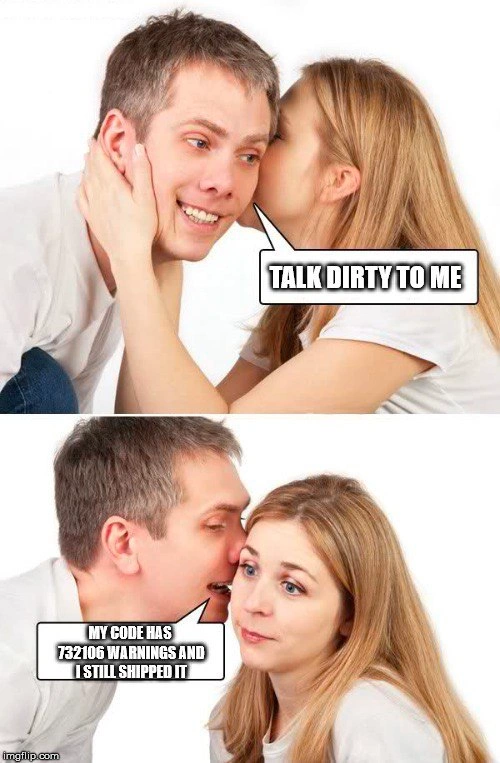
Dev A: "Talk dirty to me."
Dev B (whispering proudly): "My code has 732,106 warnings and I still shipped it."
This meme plays on the phrase "talk dirty," twisting it into developer dirty talk. Instead of a sultry secret, we get a brazen confession about code quality sins. For seasoned engineers, the humor comes from the absurd brag: shipping a product with 732,106 compiler warnings. It's the kind of technical debt flex that simultaneously horrifies and amuses. Normally, bragging rights in software come from clean code, green tests, and a build pipeline free of errors (and warnings). Here, the supposed "turn-on" is the exact opposite – a mountain of ignored warnings that would make any sane QA engineer spit out their coffee.
Let's unpack why this is funny (and painful). Build warnings are the compiler or linter politely clearing its throat to say, "Uh, you sure about this?" They flag suspicious code: uninitialized variables, deprecated API calls, type mismatches, possible NULL dereferences – all the little code smells that won't stop the program from compiling but might cause funky behavior at runtime. Best practices (and every Continuous Integration handbook) preach: keep warnings to zero, or even better, treat warnings as errors with a flag like -Werror. That way, you crash the build on warning number 1 and force developers to clean up their act. In an ideal world, "0 warnings" is a badge of honor.
Now enter reality – or as this meme implies, a fantasy where ignoring warnings is an illicit thrill. Having 732k warnings is so far past normal it becomes a caricature. This likely means one or more of:
- An enormous legacy codebase that hasn't seen a spring cleaning since the Bush administration.
- Warnings turned off or suppressed so long that the team treats them like background radiation.
- A copy-pasted chunk of code or macro that triggers a flood of repeated warnings (imagine including a header 100k times).
- CI/CD settings that explicitly say "meh, warnings don't matter."
In any case, 732,106 warnings is a ginormous pile of potential bugs and sloppy code. It's as if every line of code raised its own little red flag and the developers responded with a collective shrug. And yet, Dev B in the meme is proudly whispering this in someone’s ear, like it's an accomplishment. The senior-dev humor here is dark: we've all seen projects where "it compiles, ship it" was effectively the motto. Deadlines loom, managers only care that the feature is delivered, and those yellow warning messages scrolling by... well, nobody had time for those. The code "works" (so far), so why let a pesky 732,106 yellow triangles in the IDE ruin the party?
This meme hits on the culture of shipping over polishing. The phrase "I still shipped it" carries a rebellious swagger. It's the software equivalent of saying "I drove 100 miles with the check engine light on." As experienced devs, we cringe because we know those warnings are not harmless – they're ticking time bombs. Each ignored warning is a unit of technical debt, with interest accruing in the form of future debugging sessions and production bugs. The person bragging might as well be saying, "I swept 732,106 pieces of broken glass under the rug and invited everyone over to dance." Sure, the product shipped, but at what cost to maintainability and sanity?
There's a shared scar tissue in the developer community: many of us have inherited projects where the compiler spews a wall of warnings. Initially, you try to fix them, but soon you realize you're boiling the ocean. Management says "no time to address those, we have features to build." Over time, the team becomes desensitized. Warnings? What warnings? Oh, those 732k lines of fluff in the build log that no one reads anymore? Meh. This is warning fatigue in a nutshell. The first few are alarming, the next hundred are annoying, by the thousandth you just filter them out mentally. It's a tragicomic reality of bad software process.
From an architectural standpoint, shipping with so many warnings suggests the Continuous Integration pipeline isn't enforcing quality gates. Modern pipelines (Jenkins, GitLab CI, GitHub Actions, you name it) can be configured to fail a build if warnings exceed a threshold or certain critical warnings appear. Here, clearly someone set the threshold to "infinite" or just turned that feature off. Maybe they even sprinkled @SuppressWarnings("all") like candy to keep the noise down (problem solved, right?). The meme's subtext is that this team treated warnings as gossip – something to be ignored or even weirdly bragged about.
# CI/CD config excerpt (satirical):
treat_warnings_as_errors: false # YOLO mode enabled - warnings won't break the build
max_warning_threshold: 999999999 # practically infinite, let 'em all through
deploy_anyway: true # Ship it, no matter what
(Above: If the build config could talk, it'd basically legalize shipping with monstrous warning counts.)
For veteran devs, the "dirty talk" here triggers a mix of laughter and horror. We laugh because we've met that cocky engineer who treats process and quality as optional. "Heh, 732k warnings? Bold move, let's see how that pays off in production..." We also wince because we know the late-night emergency that can result when one of those warnings turns out to be an actual bug biting a real user. It's not if but when. As the saying goes in ops circles, "Ship happens." Ignoring warnings is like stacking dominoes — eventually, one wrong move and crash, your pipeline (or worst-case, your app in production) topples.
The absurd exaggeration (732,106!) and the intimate whisper format heighten the comedy. It's making fun of that bad boy archetype in development: the one who doesn't write tests, doesn't fix warnings, merges on Friday afternoon, and still somehow hasn’t been fired. The whisper suggests this is the kind of confession that, to the right person (probably another overworked developer), is strangely exciting. After all, when you're neck-deep in corporate deadlines and legacy code, there's a twisted camaraderie in joking about our collective negligence. It's like firefighters joking about the number of small fires they've ignored — you laugh to cope, even though you know it's insane.
In summary, at the senior level, this meme is a nod (and a wink) to all the CodeQuality atrocities committed in the name of shipping on time. It's hilarious because it turns a failure of best practices into a seductive one-liner. The next time some teammate brags to me about ignoring even a handful of warnings, I'd likely respond with a pained grin and perhaps a referral to the nearest code linting clinic. But in the meme world, we're free to laugh, acknowledge "ha, I've been there (unfortunately)," and maybe reply with an equally ridiculous one-up: "Oh yeah? My last project had a million warnings and still went live on a Friday." Now that's dirty.
Description
A two-panel meme format known as 'Couple Whispering' or 'Talk Dirty to Me'. In the top panel, a woman whispers into a smiling man's ear, with a speech bubble that reads, 'TALK DIRTY TO ME'. In the bottom panel, the roles are reversed: the man whispers into the woman's ear, who now has a look of slight disgust and disappointment. His speech bubble says, 'MY CODE HAS 732106 WARNINGS AND I STILL SHIPPED IT'. The humor comes from the reinterpretation of 'talking dirty' within a software development context. For a developer, ignoring hundreds of thousands of compiler or linter warnings and deploying the code is a reckless, 'dirty' act that goes against best practices. It highlights the accumulation of technical debt and the pressure to ship features regardless of code quality, a scenario deeply familiar and painfully funny to experienced engineers
Comments
8Comment deleted
Sure, 700k warnings are bad, but the real dirty talk is when you whisper '--force' into the command line on a Friday afternoon
I asked why CI still showed green with 732 106 warnings - apparently we’ve rebranded them as “convertible technical debt” and plan to refactor once the interest rate drops
Those aren't warnings, they're 732,106 individual feature requests from the compiler that I've chosen to defer to the next sprint
732,106 warnings isn't tech debt, it's tech bankruptcy - but the build was green, and green means ship
When your CI/CD pipeline has more yellow flags than a Formula 1 race but the PM says 'looks good to me' and you merge anyway - because who has time to fix 732,106 warnings when there's a sprint to close? The real technical debt is the emotional baggage from knowing your linter gave up counting at some point and just started approximating
732 warnings? That's not dirty talk - that's the foreplay before prod decides which ones were actually bugs
Nothing says romance like disabling -Werror, setting eslint max-warnings to Infinity, and watching the SonarQube quality gate become a polite suggestion
Real senior energy: -Werror off, lint baseline checked in, quality gate disabled - 700k warnings rebranded as observability. Ship