Skip to content
DevMeme
6484 of 7435
Massive npm Supply Chain Compromise Hits Packages With 2 Billion Weekly Downloads
Security Post #7109, on Sep 8, 2025 in TG

Massive npm Supply Chain Compromise Hits Packages With 2 Billion Weekly Downloads

Why is this Security meme funny?

Level 1: Block Tower Crash

Imagine you built a giant tower out of Lego blocks, using pieces from all your friends. It looks awesome and saves you time because you didn’t have to mold each brick yourself. Now, picture one tiny but important Lego block deep in the base suddenly turning into a bad piece – say it melts or shrinks. What happens to your tower? Crash! The whole structure might wobble and collapse. This meme is using that idea in the world of computer programs. Developers often rely on lots of little building blocks (called packages) that others made. It’s like borrowing Lego pieces. But if even one of those borrowed pieces secretly goes bad, it can cause the entire program (your tower) to fall apart or act crazy. In the meme, a super common little piece (used for adding color to text, like making error messages red) got corrupted, and because so many people’s projects use it, everyone’s “towers” started breaking at once. The post is written like an urgent news alert on LinkedIn – basically shouting “Oh no, one tiny piece broke and now everything might break!” It’s funny in a nervous laugh kind of way, because it shows how something very small can lead to a big disaster when all our creations are connected. Think of it as a reminder: if you depend on others for parts of your project, you’re trusting them not to hand you a bad Lego. One bad block, and boom – self-destruct sequence initiated, just like a Jenga tower tumbling down when a single crucial block is removed. The humor comes from how dramatic and 😬 nerve-racking that scenario is, even though it’s about such a small thing.

Level 2: Dependency Dominoes

For a less experienced developer, let’s break down why this LinkedIn post is causing equal parts laughter and panic. In modern development, dependencies are external libraries or packages your project uses so you don’t have to write everything from scratch. npm (Node Package Manager) is the JavaScript ecosystem’s go-to hub for sharing these packages. For example, chalk is a very popular npm package that lets you print colored text in the console (imagine making error messages red or success messages green). Chalk is handy, so millions of projects include it. But chalk itself relies on other small packages to do its job – this is normal, and we call those transitive dependencies (a dependency of a dependency). Over time, this creates a long chain: your app → chalk → (ansi-styles, supports-color, etc.) → those packages might depend on even more packages, and so on. This chain is the “dependency dominoes” effect: if any one of those domino pieces falls (i.e., gets corrupted or compromised), it can knock down everything upstream. The meme lists a bunch of oddly-named packages like ansi-styles, has-ansi, color-name, strip-ansi – these are all part of chalk’s family of helper tools. Each one might seem trivial (like is-arrayish is literally a tiny code that checks “is this an array?”), but together they’re downloaded billions of times because they’re included in so many projects. Now here’s the scary part: a supply chain compromise in this context means a bad actor managed to slip malicious code into these widely-trusted packages. That could happen if an attacker hacks the maintainer’s account or convinces them to include a new contributor who injects bad code. If a package as fundamental as, say, ansi-regex (used to match color codes in text) gets hacked and starts doing something nasty (like stealing environment variables or inserting backdoors), then any project that automatically pulls the latest version could be running that nasty code. The LinkedIn post is styled as an urgent alert with an alarm emoji, trying to get developers’ attention fast: “packages with a total of 2 billion weekly downloads just got turned malicious… compromised 1 hour ago.” It reads like a fire alarm for anyone using Node.js: basically “Hey everyone, check your projects NOW because a huge part of the Node ecosystem might have been poisoned!” This is both humorous and horrifying because it’s exaggerated but based on a very real risk. It’s a commentary on PackageManagement culture: we often install tiny packages for convenience (like colorizing output, formatting strings, etc.), and end up with a DependencyHell of hundreds of packages. When things are good, it’s fine – we get to build apps quickly. But when one piece turns bad, it’s like finding out one of the ingredients in all your recipes has been contaminated. The meme’s punchline "One chalk dependency and your production stack just self-destructed" sums it up: something as innocent as chalk (just for colored text!) could inadvertently cause your whole live application to crash or, worse, get hacked, if its dependency chain is compromised. It’s a wake-up call in a jokey format: even juniors can relate to running npm install and seeing a flood of packages get added. This is saying, “beware, those packages might harbor hidden dangers.” In short, DependencyHell isn’t just about version conflicts; it’s also about SecurityVulnerabilities creeping in through the back door. The meme wants you to laugh, but also to double-check your package-lock.json and maybe run npm audit – just in case!

Level 3: Chalkpocalypse Now

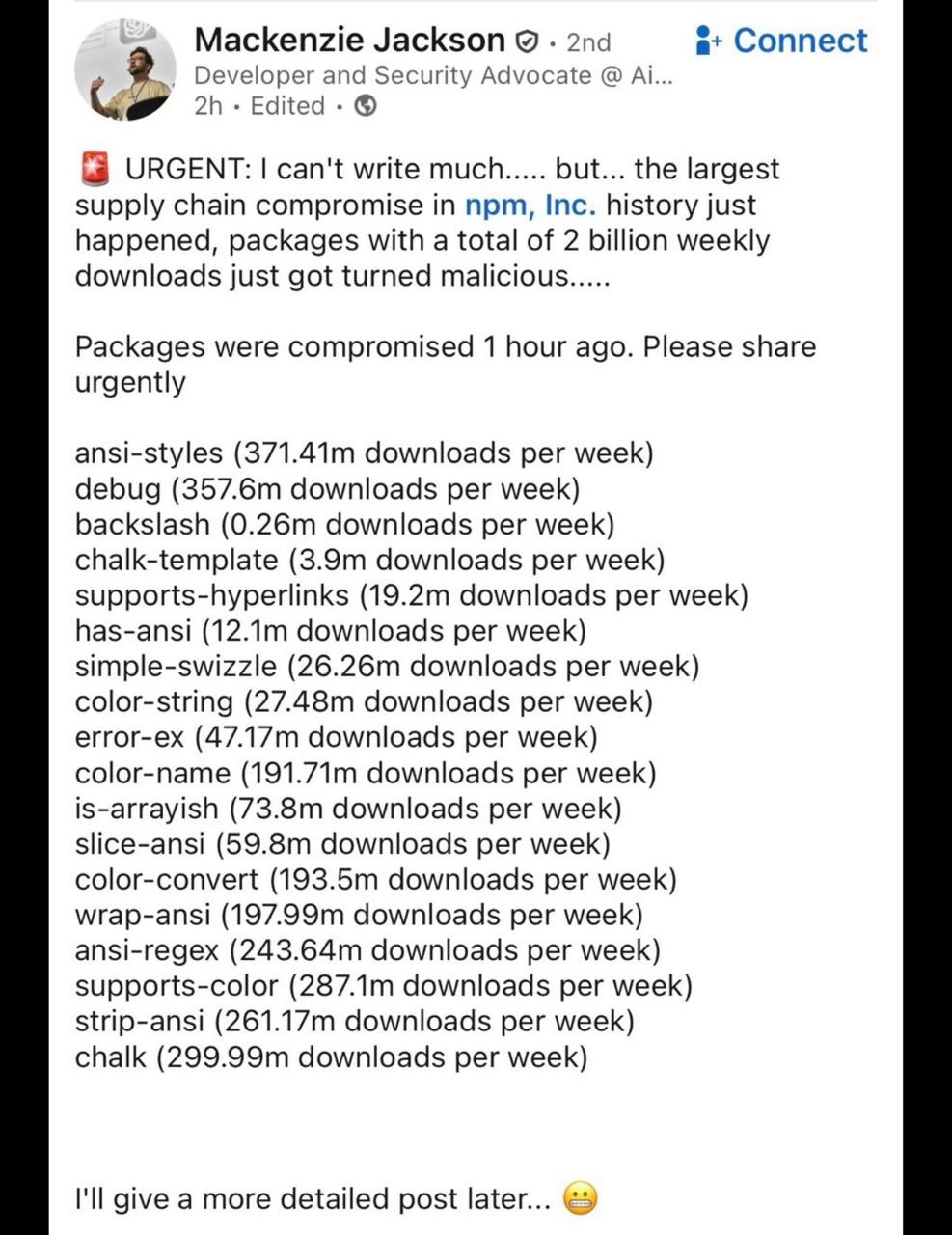
At this top tier, the meme hits seasoned developers with the terrifying absurdity of a Software Supply Chain Security meltdown. It references a hypothetical mass compromise of widely-used NPMPackages – all triggered by one malicious update deep in a chalk dependency chain. Chalk (a popular Node.js library for coloring console text) is itself harmless, but it pulls in a web of tiny modules: things like ansi-styles, supports-color, ansi-regex, strip-ansi, color-convert, and more. In the LinkedIn screenshot, a security advocate urgently lists these packages (with their staggering download counts) to underscore how a trivial dependency can have a 2-billion-download blast radius if it goes bad. This scenario is every DevOps engineer’s nightmare: a single point of failure lurking in the thousands of transitive dependencies your application unknowingly trusts. It’s poking fun at our collective reliance on an npm ecosystem where even printing colorful text relies on a Rube-Goldberg machine of packages. The humor is dark: DependencyHell meets zero-day exploit. The meme screams “the largest supply chain compromise in npm history” – a line that gives any senior engineer flashbacks to real incidents (like the infamous left-pad disaster or the event-stream hack). It exaggerates for effect, but not by much: we've seen how a teeny update can slip malware into thousands of apps within hours. Security folks use terms like “transitive trust” and “attack surface” to describe this; in plainer terms, it’s a chain reaction. One compromised maintainer account or poisoned package, and boom – your entire production stack self-destructs before you even finish your morning coffee. The LinkedIn post format adds to the irony: serious breaches often get disclosed via official advisories or GitHub alerts, yet here we have a social media post with 🚨 siren emojis. It's simultaneously a PSA and a meme. Seasoned devs chuckle (or cringe) because we know there’s truth here: our modern apps are essentially held together by thousands of strangers’ code, and any one of those strangers could get hacked or go rogue. This Chalkpocalypse highlights the fragility of our PackageManagement habits. The lesson lurking beneath the laugh: SoftwareSupplyChainSecurity is no joke, and maybe, just maybe, we should audit our dependencies before one line of code in an ansi-regex package brings down the house.

Description

A LinkedIn post screenshot from Mackenzie Jackson (Developer and Security Advocate) posted 2 hours ago with urgent warning about the largest supply chain compromise in npm, Inc. history. Packages with a total of 2 billion weekly downloads were turned malicious. The post lists 19 compromised packages with their weekly download counts: ansi-styles (371.41m), debug (357.6m), backslash (0.26m), chalk-template (3.9m), supports-hyperlinks (19.2m), has-ansi (12.1m), simple-swizzle (26.26m), color-string (27.48m), error-ex (47.17m), color-name (191.71m), is-arrayish (73.8m), slice-ansi (59.8m), color-convert (193.5m), wrap-ansi (197.99m), ansi-regex (243.64m), supports-color (287.1m), strip-ansi (261.17m), and chalk (299.99m). The post ends with 'I'll give a more detailed post later...' with a grimacing emoji
Comments

40
Anonymous ★ Top Pick Your node_modules folder was already a black hole of untrusted code, now it's just officially compromised instead of theoretically compromised
  1. Anonymous ★ Top Pick

    Your node_modules folder was already a black hole of untrusted code, now it's just officially compromised instead of theoretically compromised

  2. Anonymous

    I see my entire dependency tree is on this list. On the bright side, my node_modules folder finally has a single, unified purpose: exfiltrating my data

  3. Anonymous

    Remember when we worried about our k8s control plane being the single point of failure? Turns out it was strip-ansi’s preinstall script all along

  4. Anonymous

    The real supply chain attack was the 18 layers of color formatting dependencies we accumulated along the way - because apparently printing red text in a terminal requires more packages than launching a space shuttle

  5. Anonymous

    When your entire dependency tree turns malicious and you realize that 'chalk' wasn't just for making your console output pretty - it was for writing your infrastructure's obituary. Nothing says 'modern JavaScript development' quite like discovering that the package responsible for coloring your terminal text now has more access to your production environment than your actual security team

  6. Anonymous

    Dependency injection meets supply chain infection: npm's way of keeping your node_modules fresh... with malware

  7. Anonymous

    Every “largest npm compromise ever” ends the same: leadership asks if we use chalk, and I explain we don’t - our 37 transitive deps do - so the only thing it actually colored was my 3am pager

  8. Anonymous

    Nothing reveals your architecture like a supply‑chain scare: “Not affected” - until the SBOM shows chalk via 73 transitives; see you on the 3 a.m. bridge

  9. dev_meme 10mo

    https://www.aikido.dev/blog/npm-debug-and-chalk-packages-compromised

    1. @pyrothefuck 10mo

      good thing we don't update our deps

  10. @Adamus1red 10mo

    https://github.com/debug-js/debug/issues/1005#issuecomment-3266868187

  11. @feralape 10mo

    Just don't use JavaScript

    1. @NaNmber 10mo

      just don't open any website

      1. @jtoming830 10mo

        Or e.g. Slack at all coz it's desktop app is written on Electron

      2. @feralape 10mo

        I don't only rss for me

      3. @wishmeluckplease 10mo

        just don’t use internet, it might be dangerous

      4. @seyfer 10mo

        Just don't

    2. @Agent1378 10mo

      Just use core libraries only and maybe also some big well known libraries like DB client and shit. Stop use libraries with 100 lines that do absolutely trivial things, write it yourself.

      1. dev_meme 10mo

        Doesn't work like this Dependendecies that were infected are dependencies of your dependencies, something you have to work hard to protect against within your entire organization

      2. @TheFloofyFloof 10mo

        why have every library reimplement the same feature when you can import it?

        1. @Agent1378 10mo

          Because if you can't trust the code you mustn't use it. We kind of have to trust the language itself and big libraries that are bundled or well known. Trusting some random shit from random people - is simply dangerous. The "source is open someone will check it" paradigm isnt working in these amounts of code.

  12. @ASCENDEDPULSAR 10mo

    Well, for those who are sleepy heads and wants to hear TLDR. - Yes those packages we infected. - It only runs inside your browser if launched frontend code with infected package. - Infected packages were only pushed as `latest`\new release tags - Infected packages were active only for a short perioud of time: 2.5~ hours - It could have affected your build only if you tried to install one of those packages directly with npm install during this timeframe - It's true that you might have those packages installed as dependencies inside package-lock.json but they are import with sha256 hash, it means that even if hacked package tries to override all tags inside registry it still shouldn't affect you Correct me if I am wrong Good night everyone and have a nice sleep

  13. @feralape 10mo

    Js plebs stay mad and have a v8

  14. @glatavento 10mo

    According to the standards of python, rust, c++, or any other sane language, js just simply doesn't have a so-called core library.

    1. @Agent1378 10mo

      Well, lol

  15. @glatavento 10mo

    Deno do have a std which I literally saw zero people using.

  16. Deleted Account 10mo

    Wow, the hacker has been damaged to core, Nice and interesting! 👏

  17. @mihanizzm 10mo

    And use six remaining values for different kind of flags

  18. @SamsonovAnton 10mo

    Thanks god is-even and is-odd are safe! 😅

  19. @neopulsar 10mo

    And people asking why enterprise store everything on its own arficatories and you go trough 3 circles of hell to bump package version in lock file. I guess that’s why

  20. @gmayv 10mo

    Never used any of those. Christ is King.

    1. @Broken_Cloud_1 10mo

      They live somewhere in your node_modules

      1. @gmayv 10mo

        I'm not falling for that demoralization campaign.

  21. @ZgGPuo8dZef58K6hxxGVj3Z2 10mo

    This is why I write everything I can myself or use the OS's APIs

    1. @gmayv 10mo

      That's also why you are unemployable

      1. @ZgGPuo8dZef58K6hxxGVj3Z2 10mo

        I am exployed but privately I dont use 92737 dependencies just for a calculator app

        1. @RiedleroD 10mo

          you're employed? hey um reminder that you still owe me 160€ >:P

  22. @RiedleroD 10mo

    ✅ just write it yourself you lazy bastard

  23. @RiedleroD 10mo

    exactly

  24. @sysoevyarik 10mo

    "package manager is a convenience that every language must have" incident

Use J and K for navigation