Embedded Engineers Judge You for Wasting an Entire Int on a Counter
Why is this EmbeddedSystems meme funny?
Level 1: Giant Box, Tiny Toy
Imagine you have a huge box but only a tiny toy to put in it. Using a big box for a tiny toy is pretty silly, right? You’re wasting almost the whole box – it’s mostly empty space. Now picture your friend who only has a really small box for all their toys. They have to use every little corner of that small box so everything fits. When your friend sees you put one little toy in this giant box, they roll their eyes and say, “Wow, what a waste. You could’ve put that toy in your pocket instead!” In this meme, the giant box is like using a big integer variable (lots of space) to hold a number from 1 to 10 (which is very small). The friend with the small box is like an embedded systems engineer who’s used to tiny computers with barely any space. They think using such a big container for such a small thing is pathetic, just overly wasteful. The humor comes from seeing it through the friend’s eyes – when you don’t have a lot of space, you learn to be super-efficient, and it’s funny (and a bit absurd) to judge someone for not squeezing things into every nook and cranny. It’s basically a joke about being stingy with space: one person doesn’t care about a little wasted space, but the other person acts like it’s a huge sin because in their world every bit of space really counts.
Level 2: Tiny Counter, Massive Overkill
Let’s break down the technical joke in simple terms. We have a counter that only goes from 1 to 10 – meaning it never needs to hold a value larger than 10. In binary, the number 10 is 1010, which is just 4 bits of information (since 4 bits can represent up to 15). Now, an int in many programming languages is typically 32 bits (which is 4 bytes of memory). Using a whole 32-bit integer variable to store a number that actually only needs 4 bits is like using a huge 32-slot egg carton to hold just 4 eggs. Most of those slots (or bits) stay empty. This is what the meme is highlighting: a high-level programmer might casually use an int counter for convenience, even if the max value is 10, whereas an embedded systems programmer might say, “Whoa, that’s overkill – you could fit that in just a few bits you’re not using elsewhere!”
Embedded engineers are developers who write code for very small computers (microcontrollers) often found in devices like thermostats, cars, medical devices, etc. These tiny computers have limited memory. For example, an Arduino Uno’s microcontroller has only 2,048 bytes of RAM total – imagine all your program’s variables and data having to fit into that! Because of this, embedded folks are extremely conscious of memory usage. They do things like bit packing, which means squeezing data into as few bits as possible, often by combining multiple pieces of information into one binary pattern. The meme specifically mentions “packing it into 4 leftover bits in other variables.” This refers to a trick: if you have some other variable (say a status byte) where a few bits aren’t being used, you can store your 1–10 counter in those unused bits instead of creating a whole new 32-bit variable. Essentially, you piggyback the counter onto an existing piece of memory by using just the nibble (4 bits) that you need.
How would that work in practice? Let’s say we have an 8-bit variable called status that already uses its lower 4 bits for some flags (for example, individual yes/no settings). The upper 4 bits of status are free. We can store a number 0–15 in those 4 bits. Here’s a simple illustration in C-style pseudocode of packing a small counter into an 8-bit space:
uint8_t status = 0x0A; // 00001010 in binary (lower 4 bits 1010 are used, upper 4 bits 0000 free)
uint8_t counter = 7; // 0111 in binary (our counter value, fits in 4 bits)
// Pack 'counter' into the upper 4 bits of 'status'
status = (status & 0x0F) // 0x0F = 00001111, this clears the upper 4 bits of status
| ((counter & 0x0F) << 4); // take counter (0111), ensure it's 4 bits, then shift left 4 to put it in upper bits
// Now 'status' contains the original lower bits (1010) and counter in the upper bits (0111).
// status becomes 0x7A (01111010 in binary), where 0111 (7) was our packed counter.
In this code, status is an 8-bit variable (like a byte). We used a bitmask 0x0F (which is binary 00001111) to isolate and clear certain bits. The counter (7) is masked with 0x0F too, to ensure it’s within 4-bit range (0–15), then shifted left by 4 bits (<< 4) to move it into the upper half of the byte. Finally, the | (bitwise OR) combines the two parts. The end result: we stored two pieces of data in one byte – some flags in the low 4 bits and our 1–10 counter in the high 4 bits. We effectively replaced two separate variables (which might have taken 1 byte + 4 bytes) with one byte doing double-duty. This is bit packing in action.
Now, why would someone bother doing this? In everyday programming on a PC, they wouldn’t – it’s usually not worth the trouble. Using an int is straightforward and 4 bytes is nothing when you have millions of bytes available. But in memory-constrained code, like on a tiny microcontroller, saving even a single byte can be important. It might let your program have one more variable, or handle one more sensor reading without running out of memory. Embedded devs have a mindset of “waste not, want not” with memory, because they often don’t have the luxury of extra space. So they find these clever ways to reuse space. It’s a bit like a tightly packed suitcase: if you only have a small bag, you’re going to fill every little gap with socks and chargers so no space is wasted. Here, the “gap” was the unused 4 bits in an 8-bit status variable, and we filled it with the counter.
The meme is funny to developers because of this contrast. The high-level developer’s approach (“just use an int, who cares?”) is simple and easy, but seen through the eyes of an embedded engineer, it looks careless or pathetically wasteful. Meanwhile, the embedded engineer’s approach (packing bits everywhere) can seem insanely meticulous or even overly complicated to others. Both approaches have their place. The embedded dev’s habit comes from real needs – if you’ve only got a few kilobytes, you must save space. But if you’re working on a server with gigabytes of RAM, spending time stuffing a 1–10 value into 4 bits is usually not worth the effort and can make the code harder to read. This is the classic optimization trade-off: is it worth making the code more complex in order to save memory? In embedded systems, often yes. In other software, usually no. The humor is recognizing how an embedded dev would react with almost moral outrage at something a regular dev wouldn’t think twice about.
Level 3: Byte-Pinching Pride
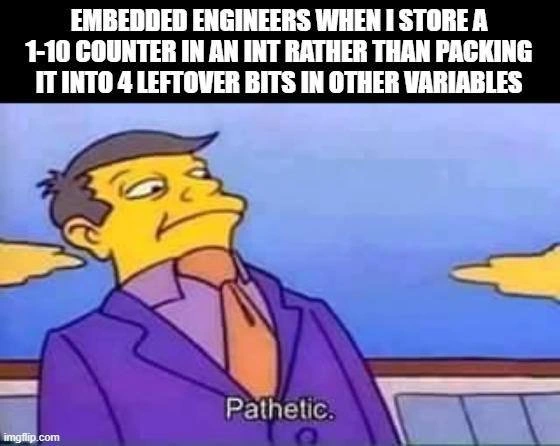
The meme nails a culture clash between dev communities. In the world of Embedded Software Development, there’s a proud tradition of being a memory miser – if you don’t need those extra bytes, you don’t use them. Here we have an embedded engineer ( personified by Principal Skinner’s smug look ) judging a high-level programmer’s casual use of a whole int for a trivial counter. The top caption effectively reads as an embedded dev’s inner monologue: “You used 32 bits for a value that fits in 4 bits? Amateur.” The bottom caption, Skinner’s classic Simpsons line “Pathetic.”, delivers the punchline – pure condescension. It’s funny because it’s a truth seasoned engineers know: embedded folks can be snobbish about efficient use of memory, raising an eyebrow at what they see as wasteful coding. It’s a mix of pride and schadenfreude: pride in their own frugal coding habits, and a sly enjoyment watching others “waste” resources that embedded devs fight tooth-and-nail to conserve.
Why such strong feelings over a few bytes? Because on a tiny microcontroller, memory is a precious, tightly limited resource. Many of these devices have, say, 2048 bytes of RAM total – that’s smaller than a single high-res PNG image file. In those environments, using a 4-byte integer where 4 bits would do is like bringing a 10-ton truck to deliver a single loaf of bread. It’s overkill, and overkill can mean running out of RAM or program space. Embedded engineers carry a microcontroller memory-saving mindset ingrained from constant memory-constrained code challenges. They swap war stories of trimming firmware size by 20 bytes to make things fit. So when they see a codebase casually filled with full-size ints for tiny ranges or dozens of booleans each taking a whole byte, it triggers that inner gut reaction: “We could pack these into one byte! These devs have no idea how to optimize!” It’s partially rational (they do have a point about efficiency) and partially a bit of elitism. It’s the same vibe as a performance tuner scoffing at someone else’s unindexed database query – a mix of I can’t believe you don’t see the problem and behold my superior skills.
There’s also a rich irony here: this Performance Optimization obsession can backfire when taken too far. Sure, packing that counter into existing bits saves memory, but it also makes the code more complex and possibly harder to maintain. If you’ve ever had to debug or extend firmware where every single bit in every other variable is repurposed for some clever reason, you know it’s a special kind of headache. (The meme’s poster hints at this with the comment “Imagine supporting such a system 🥰” – with a loving emoji for extra sarcasm). Indeed, an overly optimized codebase can become a ticking time bomb of Optimization Tradeoffs – what you save in memory, you might pay for in code clarity and bug-hunting pain. Many a senior developer has inherited a project full of bit-packed variables and thought, Was saving 20 bytes worth the weeks of reverse-engineering this? But in contexts where it truly matters, those savings are the difference between the system running or crashing.
This meme resonates because it captures a common dynamic in programming: the low-level programming veteran vs. the high-level “memory rich” developer. The embedded dev’s smug “Pathetic.” is hyperbolic humor – of course most applications these days can spare 4 bytes without issue. But anyone who’s worked close to the hardware can’t help but smirk and nod. We’ve all encountered that colleague who can’t resist micro-optimizing, or maybe we are that colleague. The image of Principal Skinner looking down with disdain perfectly encapsulates that vibe of unearned superiority over something so trivial. And yet… the embedded folks have a valid perspective born from real constraints. That tension – practicality vs. pride, necessary optimization vs. over-the-top OCD – is why the joke lands. Both sides recognize themselves in it. The high-level dev chuckles, “Yep, that’s how those firmware people are,” and the embedded dev chuckles, “Heh, guilty as charged, I would judge that code.” It’s a friendly jab within the industry’s culture, grounded in the very real differences of our computing environments. When every bit and byte counts, habits form – and sometimes die hard, even when you’re no longer on a microcontroller. The result? A bit of inter-developer dark humor over something as small as an integer for a counter. Pathetic? Yes – and also pretty hilarious.
Level 4: Bitwise to the Bone
At the bit-level granularity, using a 32-bit int to count from 1 to 10 looks ridiculously wasteful. In raw binary terms, numbers 1 through 10 can be represented with just 4 bits (since $2^4 = 16$ covers 0–15). Storing that tiny range in a full 32-bit integer means ~87.5% of the allocated bits are always zero – a 28-bit overhead doing absolutely nothing. In a modern desktop program with gigabytes of memory, nobody notices. But in a microcontroller with, say, 2 KB of SRAM, those wasted bits start to matter; 28 surplus bits is 3.5 bytes – and if you have many such counters, the bloat adds up until you’re out of memory. On tiny embedded devices, every bit is sacred (to steal a phrase): developers will scrutinize memory usage down to individual bit fields and spare bits.
From a computer science standpoint, this is about encoding information with optimal efficiency. The information content of “a number from 1 to 10” is about $\log_2(10) \approx 3.32$ bits of entropy. Yet a 32-bit int allocates 32 bits, effectively a very sparse encoding. This discrepancy isn’t just theoretical – it has real costs in constrained environments. To pack a 1–10 value into exactly 4 bits, you often leverage bitwise operations (like shifts and masks) or language features like C/C++ bitfields. For example, an embedded C programmer might define a struct with a 4-bit field for the counter, or combine multiple small values into one byte manually. These techniques exploit the fact that CPUs and memory don’t inherently care what a bit “means” – one 32-bit word can store one number, or it can be chopped into fields holding several smaller numbers.
However, doing this bit packing isn’t free – it introduces extra operations for packing and unpacking. There’s a potential trade-off with CPU cycles: masking and shifting bits requires instructions. On many Low-Level Programming platforms, though, these bitwise ops (&, |, <<, etc.) are extremely fast (often single CPU instructions). The memory savings usually outweigh the negligible CPU cost, especially since memory access itself can be a bottleneck on tiny systems. There’s also the matter of alignment: a 32-bit int is aligned to 4 bytes, but if you stuff two 4-bit values into one byte, you’re using memory more densely. In tightly packed structures, you avoid padding bytes that compilers insert to align data on word boundaries. In essence, bit packing maximizes data density. This is critical when working close to the hardware, such as reading memory-mapped registers where specific bits control hardware features (a reality that conditions embedded devs to think in bits). Historical context underscores this mindset: early microcomputers and devices had so little RAM that devs invented clever bit-level tricks just to fit programs into memory. That legacy lives on in today’s Embedded Systems culture – part engineering necessity, part badge of honor. It’s a case of engineering pragmatism meeting information theory: represent data with no more bits than absolutely needed. Why use 32 bits when 4 bits suffice? To an embedded purist, anything more is, well, pathetic.
Description
A Simpsons meme using Principal Skinner's 'Pathetic' scene. The top text reads: 'EMBEDDED ENGINEERS WHEN I STORE A 1-10 COUNTER IN AN INT RATHER THAN PACKING IT INTO 4 LEFTOVER BITS IN OTHER VARIABLES'. Skinner looks down dismissively with the caption 'Pathetic.' at the bottom. The meme captures the extreme memory optimization mindset of embedded systems engineers who would never waste 32 bits on a value that only needs 4 bits, preferring to pack data into spare bits of existing variables. The imgflip.com watermark is visible
Comments
23Comment deleted
An embedded engineer doesn't see unused bits -- they see wasted real estate in a silicon apartment where every bit pays rent
Most developers see a 32-bit integer as a number. An embedded engineer sees it as a block of 8 potential four-bit counters for eight different state machines
On a 32 KB AVR, those 28 wasted bits are like leaving the company jet idling on the tarmac
The real pathetic part is when you realize the compiler was already packing those bits efficiently, but you spent 3 hours hand-optimizing it anyway, only to discover the MCU has 256KB of RAM you'll never use because management insisted on 'future-proofing' the hardware selection
Ah yes, the eternal divide between embedded engineers who treat every byte like it's 1975 and the rest of us living in the post-scarcity era of 64GB RAM. While we're casually throwing around 64-bit integers for boolean flags, they're over there playing Tetris with bits, squeezing four counters into a single byte and using the sign bit for error flags. But let's be honest - when your entire program needs to fit in 32KB of flash and you're running on a coin cell battery for five years, suddenly that 'wasteful' int allocation looks less like engineering and more like a war crime. They're not wrong; they're just operating in a parallel universe where malloc() is a four-letter word and the stack overflow isn't a website, it's an actual Tuesday afternoon disaster
Embedded devs packing bits like it's 1985: 'Why allocate 32 when 4 tortured ones suffice?' Until feature creep demands an actual int - and your flash overflows
Only in firmware does saving one byte by nibble-packing turn a ++ into a read-modify-write with masks, ISR races, and three lost weekends
Saving four bytes is noble until the next firmware rev changes the register map and your 4-bit counter straddles two volatile fields - enjoy mask/shift archaeology at 3am
embedded devs seeing how powerful new embedded chips are Comment deleted
Noooo Comment deleted
Bold if you to assume we dare use all. You know maybe we will need those resources later in the future in 10 years. /s Comment deleted
Yeah imagine using a single static var for 3 different things instead of a 8 bit register you have for free Comment deleted
The time spent on extracting it from other variable will be more valuable than using extra 16 bits of memory. Btw you can use uint8_t🤓🤓🤓 Comment deleted
Packing bits is easy with bitfields: struct mydata { int counterA : 4 = 0; counterB:3 =0; stateFlag :1 = 0; errCounter : 5 = 0; .... } Comment deleted
It is still an abstraction, compiler will make it usual bitwise operation code. Though it is really convenient for storing registers of some module Comment deleted
wow, how have I never heard about this Comment deleted
Yea this is absolutely true. We will judge you for using references for single use values too Comment deleted
Ага, и потом дебажить это до трёх ночи. Comment deleted
We dont make mistakes so you wont need to touch it until hardware fails Comment deleted
Please, stick to English around devmeme 🙏 Comment deleted
yawn Comment deleted
best I can do is using u8 Comment deleted
std::vector<bool> Comment deleted