The Dunning-Kruger Effect in Software Development
Why is this Learning meme funny?
Level 1: Cooking Show Confidence
Imagine you watch a chef on TV baking a fancy cake. They make it look so easy – mixing ingredients, popping it in the oven, and out comes a perfect cake. You feel excited and think, “I can do that!” But when you actually go to your own kitchen to try, it’s a disaster: you spill flour everywhere, the batter doesn’t look right, and the cake comes out burned and sunken. Suddenly you think, “Oh no, I actually have no idea what I’m doing.” This meme is just like that, but for coding. It’s funny because the person went from feeling super confident (just by watching someone else do it) to realizing that doing it yourself is much harder. We laugh because we’ve all felt that way at some point – whether it’s cooking, riding a bike, or writing code. It’s a friendly reminder that things often look simple when someone else is doing them, and it’s normal to struggle and learn when you do it on your own. The joke comforts us: everyone learns by making mistakes, and it’s okay if your first try isn’t perfect.
Level 2: Hands-On Reality Check
So what’s actually happening in this meme? It’s contrasting two states of a new coder: confidence after watching a tutorial versus frustration when actually coding. First, the person watches some videos of people coding. A tutorial is a lesson, often a YouTube video or online course, showing how to build something step-by-step. Everything makes sense in the video because the instructor likely explains the logic and nothing goes wrong on screen. After binge-watching, you feel “Wow, I understand this, I can code that too!” – that’s the rush of tutorial overconfidence. This is a common part of the LearningToCodeJourney: you absorb a lot by watching, and you’re excited, thinking you’ve got it down.
Then comes the second part: "writes code … Ah, I cannot code." This is the reality check. The moment you try to write your own code from scratch, you quickly realize it’s not so simple. Maybe you can’t even get the program to run, or you don’t know where to begin without the tutorial guiding you. The meme is highlighting that big skill gap between understanding something conceptually and being able to do it yourself. CodingFrustration sets in when you hit errors or blank out on what to type. For example, in a video the teacher might have everything set up already, but on your computer you might see:
# In the tutorial video, this worked flawlessly:
import some_library
some_library.do_magic()
# On your own machine, trying the same:
import some_library # ModuleNotFoundError: No module named 'some_library'
Suddenly you’re stuck. The tutorial didn’t mention you needed to install that library or maybe the instructor wrote some setup code off-screen. This leads to a quick loss of confidence. You might think, “It looked so easy for them. Why can’t I do it? Ah, I cannot code.” This feeling is often jokingly called a coding reality check or a tutorial hangover – when the high of watching turns into the headache of debugging.
Let’s break down a few terms here. Impostor syndrome is a huge part of this experience: that’s when a developer (often a beginner, but it can happen to anyone) feels like a fraud, like they’re not really capable or knowledgeable. In this context, after struggling, you might start to doubt if you can ever code at all, even though moments ago you felt confident. The learning curve for programming is known to be steep at first – which means it’s really hard in the beginning until you get some practice. That steep climb can surprise those who only watched others do it. Developer expectations vs reality is basically what this meme is about: you expect to breeze through writing code because the tutorial made it look straightforward, but in reality, you encounter lots of unexpected issues. It’s DeveloperHumor because every programmer has experienced this. It’s funny in a bittersweet way: we’ve all had that moment of overestimating our ability and then eating humble pie.
The meme also conveys the importance of hands-on practice. Watching someone solve a problem can give you new ideas and knowledge, but it doesn’t automatically grant you the skill. Think of it like watching a pro gamer or a chef: just because you watched them doesn’t mean you can do it on the first try. You have to actually practice writing code, running into errors, and fixing them to get good. All developers learn that there is no shortcut around this. You’ll run into syntax errors (like a missing ; or a typo that stops the program), logic errors (the code runs but does the wrong thing), and environment issues (setting up databases, installing packages, etc.). Tutorials often present a polished, simplified scenario. Real projects are messy and unstructured. So when you go from the structured learning environment to an empty code editor, it’s normal to feel lost.
The key takeaway for a newcomer is: feeling like “I cannot code” after your first attempt is normal and temporary. Every developer has been there, and it doesn’t mean you’re actually incapable. It just means writing code is a different skill than knowing code in theory. The meme is relatable because we’ve all confidently said “I got this” and then quickly realized “uh… no, I don’t (yet).” The good news is that with each frustrating attempt, you are learning. The next time you watch a tutorial, you’ll pay attention to different details, and the next time you code, you’ll remember a bit more. That swing from confidence to doubt is a rite of passage in the LearningToCodeJourney. It teaches you humility and the value of practice. In essence, the meme is laughing at the tutorial overconfidence that many of us have felt. It’s encouraging, in a humorous way, because it reminds you that you’re not alone in finding coding harder than it looked. Keep at it, and soon writing code will start to feel as doable as watching it.
Level 3: Confidence vs Compiler
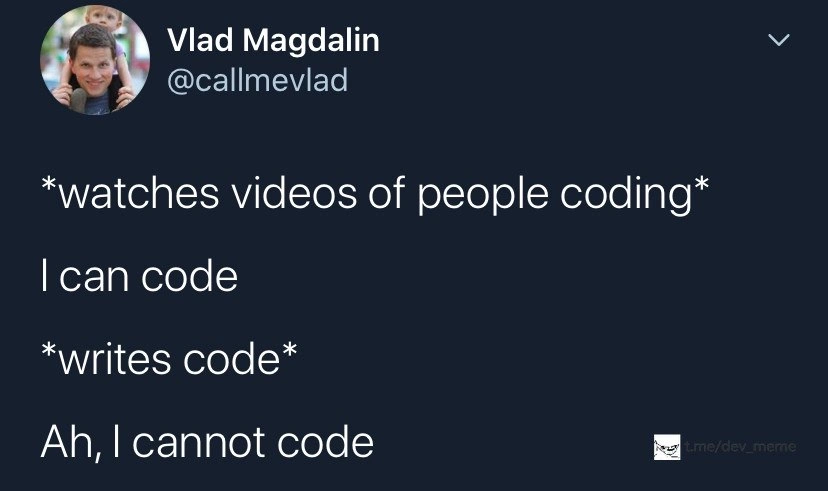
This meme humorously exposes the illusion of mastery that often comes from passive learning. It’s a scenario every seasoned developer recognizes: after binge-watching coding tutorials or conference videos, you feel on top of the world—ready to build anything. The tweet’s script-like format (“watches videos of people coding … I can code … writes code … Ah, I cannot code”) nails that whiplash of confidence. Why is it so funny? Because it’s true.
Watching an expert live-code tricks our brain into thinking we’ve learned it. Psychologically, recognizing someone else’s solution isn’t the same as being able to produce it ourselves. The gap between theory and practice becomes painfully clear the moment you confront a blank editor or a stubborn compiler. In education research, this is akin to the Dunning-Kruger effect in fast-forward: a beginner’s confidence shoots up quickly (“I got this, coding is easy!”) only to crash into reality when faced with actual problems. Experienced devs have seen this pattern not just in others, but in themselves whenever picking up a new language or framework. You watch a tutorial on a new JavaScript framework and everything seems straightforward. But the minute you start a real project, you hit configuration snags, cryptic error messages, and head-scratching bugs that the video magically never showed. It’s a coding reality check we all get sooner or later.
Impostor syndrome often lurks in that moment where you say “Ah, I cannot code.” Even veteran engineers chuckle at this, because we’ve all felt like total impostors when something seemingly simple doesn’t work under our own fingers. The meme speaks to the LearningToCodeJourney and the wider Developer Experience (DX): it highlights how learning to code isn’t a straight line from tutorial to mastery. Real coding involves a learning curve full of trial-and-error. The Developer Expectations vs Reality gap is exactly what creates the humor here—expectation: “I’ll just reproduce what I saw”; reality: “Why is nothing working? Maybe I’m not cut out for this.”
On a deeper level, the tweet is pointing out the difference between passive understanding and active problem-solving. Tutorials give you familiarity, but writing actual code forces you to recall details, synthesize knowledge, and deal with the unknown unknowns. Seasoned devs know that reading or watching code only gets you so far; you truly learn by doing, by debugging those nasty errors. The funny (and comforting) part is that everyone experiences this skill-gap realization at some point. In fact, even the author of the tweet, Vlad Magdalin, is a highly skilled developer—so him joking “Ah, I cannot code” makes it even more relatable. The meme resonates because it’s a shared slice of DeveloperHumor: we laugh at ourselves for how quickly our confidence crumbles when theory meets practice. It’s a gentle reminder that knowing something in your head isn’t the same as creating it in the real world. As any senior engineer will tell you, tutorial overconfidence is common, but it’s just a phase. The real coding skill comes from those frustrating sessions staring at error logs at 2 AM, not from breezing through a perfectly edited video lesson. In short, the tweet encapsulates that humbling part of the RelatableDevExperience: coding always looks easier when someone else is doing it. When you sit down and type, you earn your knowledge the hard (but rewarding) way.
Description
A screenshot of a tweet from Vlad Magdalin (@callmevlad) on a dark background. The tweet captures a relatable developer experience in a four-line narrative format. The first part is '*watches videos of people coding*' followed by the confident statement 'I can code'. The second part describes the action '*writes code*' which is immediately followed by the humbling realization 'Ah, I cannot code'. A small watermark for 't.me/dev_meme' is in the bottom right. This meme perfectly illustrates the gap between passive learning (watching tutorials) and active application. It highlights a common cycle of overconfidence followed by a reality check that leads to feelings of imposter syndrome, a prevalent issue in the tech community, especially for those learning new skills
Comments
7Comment deleted
Following a YouTube tutorial is like being a co-pilot with autopilot on. Writing your own code is when you discover the flight manual is in a language you don't speak and the plane is on fire
Watched a slick 10-minute demo on “effortless serverless event-sourced microservices.” Twelve terraform files, 4 k lines of YAML, and one empty handler later: I’m starting to suspect the real tutorial was optimism
The only thing more reliable than our CI/CD pipeline is the cycle of watching a 10-minute tutorial on clean architecture and then immediately violating every SOLID principle while implementing a 'simple' feature that somehow touches 47 different microservices
This perfectly encapsulates the Dunning-Kruger curve of software engineering education: watching a senior architect refactor a monolith into microservices makes you feel like you could design the next AWS, until you spend three hours debugging why your Docker container can't resolve localhost. The gap between 'I understand this conceptually' and 'I can implement this in production' is where most developers discover that Stack Overflow is actually their most important dependency
My personal Gartner Hype Cycle: watch a 10‑min coding video → Peak of Inflated Self‑Assessment; open our codebase → Trough of Stack Trace
Watching tutorials: overfitting to toy examples with perfect gradients. Blank editor: catastrophic generalization failure
The Dunning-Kubernetes effect: confidence peaks after a playlist, then craters when prod asks for idempotency, rollback-safe migrations, and SLOs