Skip to content
DevMeme
3717 of 7435
When customer support morphs into tech support over a cup of coffee
Communication Post #4056, on Dec 17, 2021 in TG

When customer support morphs into tech support over a cup of coffee

Why is this Communication meme funny?

Level 1: Coffee Can't Fix Computers

Imagine you bought a hamburger to fix your broken bicycle. After eating the burger, you’re upset because your bike’s flat tire is still flat. Sounds silly, right? 🍔🚲 A burger fills your tummy but it can’t repair a tire. That’s exactly what’s happening in this meme, only with coffee and a computer. The person thought that buying a cup of coffee would cure their computer’s “sickness” (a virus). It’s funny because it’s a big mix-up: coffee is like a yummy drink for people, not medicine for computers. Everyone else can see that a cup of coffee won’t make a bad computer virus go away, just like a snack won’t fix a flat tire. The joke is essentially showing how one confused customer asked the wrong helper for a problem, and that misunderstanding makes us laugh.

Level 2: Mixing Beans and Bytes

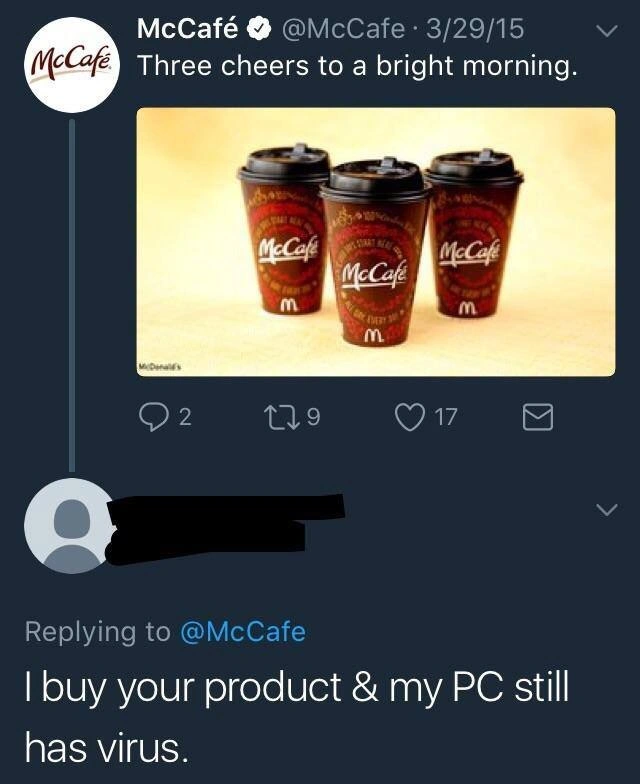
Let’s break down why this tweet reply is so absurd (and amusing) in simpler terms. The scenario is that McCafé – which is McDonald’s coffee brand – posts a happy message with a picture of coffee cups. A person replies saying, “I buy your product & my PC still has virus.” In plain language: “I bought your coffee, but my computer still has a virus.” This is a big mix-up between coffee and computers. The customer expected that buying a coffee would somehow remove a computer virus.

First, what do these terms mean? A computer virus is a malicious program (a type of malware) that can infect your computer and cause problems – kind of like how a germ can make you sick. Antivirus software (like the well-known McAfee program, which sounds a lot like McCafé) is designed to find and remove those viruses from your PC. On the other hand, McCafé coffee is just… coffee. It’s a drink with caffeine to wake you up. It has absolutely no ability to interact with your computer at all. The user in the meme is basically complaining to a coffee company about a computer problem, which is a clear misunderstanding of technology and how products work. They might have confused the names (McCafé vs. McAfee), or they just thought any product they bought should fix any problem they have – which is obviously false.

To clarify the roles of each item, consider this comparison:

McCafé Coffee Computer Antivirus (e.g. McAfee) 🛡️
A beverage from McDonald’s, meant to be enjoyed as a drink. Software installed on a computer to detect and remove viruses (malware).
Made of coffee beans, it gives you a caffeine boost to feel alert. Made of code, it scans your files and memory to find bad programs (viruses) and remove them.
Does not interact with your computer’s files or software in any way. Directly interacts with your computer system to improve its security and health.
Example: Drinking a latte might wake you up in the morning. Example: Running a virus scan might clean an infection and speed your PC up again.

As you can see, coffee and antivirus software are completely unrelated. The person replying to the tweet has made a category error – mixing up a consumer product (coffee) with a technical solution (antivirus program). This is a classic case of unrealistic stakeholder expectations. In customer service terms, the user’s expectation was that the company’s product would solve a problem that’s totally outside what the product is meant for. It’s like expecting a fast-food chain to fix your laptop just because you bought a burger from them.

Why would someone make this mistake? It could be simple confusion. Perhaps the person saw “McCafé” and thought of “McAfee,” or they genuinely have very little knowledge about computers and grabbed at straws. It might even be an intentional joke, playing on the similarity of the names, but the meme treats it as a real support request. In any case, it’s a communication mix-up: the user communicated a problem (computer virus) to a company that can’t possibly address it (a coffee brand).

For junior developers or support folks, this highlights a real-world lesson: you’ll sometimes get tickets or questions from clients that don’t make sense. You might have a customer blaming your app for something unrelated or asking for help with something outside your domain. This happens because not everyone understands where one service’s responsibility ends and another begins. Part of working in tech (especially in support or client-facing roles) is learning to handle these politely. You might have to explain, as calmly as possible, that the coffee they bought can’t remove malware, and guide them to the proper solution (like installing a real antivirus program or contacting actual tech support).

In summary, the meme is funny for us because it spotlights a Communication slip-up and a wild technology misunderstanding. A customer essentially asked, “Why didn’t your coffee fix my computer virus?” In reality, solving that Security issue requires the right tools (antivirus software or IT help), not a breakfast beverage. Understanding why that’s ridiculous is straightforward once you know what a computer virus is and what coffee does — they operate in completely separate worlds, like beans vs. bytes.

Level 3: Coffee != Antivirus

The tweet in this meme is a case study in epic CommunicationBreakdown. A verified McCafé Twitter account posts a cheerful marketing message: “Three cheers to a bright morning.” It’s harmless corporate social content featuring three cups of coffee, but then comes a head-scratching reply:

Random User: "I buy your product & my PC still has virus."

Seasoned engineers immediately recognize the dark humor here. This reply is a glorious UserError where a frustrated customer confuses a coffee purchase with some kind of tech support service. It's as if the user expected a McCafé latte to function like McAfee antivirus software. (Yes, the names sound similar, adding to the comedy 😅.) The customer’s StakeholderExpectations are wildly misaligned with reality, suggesting they thought a hot brew would magically purge malware from their PC. It’s a perfect storm of MisunderstandingTechnology and unrealistic ClientExpectations that senior tech support folks have ironically seen many times before.

From an experienced developer’s perspective, the humor comes from the absurdity of mixing two completely unrelated domains: caffeinated beverages and computer Security. We’ve all dealt with those surreal support tickets or calls where a non-technical stakeholder asks for the impossible. This tweet reply reads like a parody of a customer filing a helpdesk ticket for the wrong product altogether. It highlights how people sometimes misroute their problems to whoever will listen on the internet. The social media manager for McDonald's coffee likely had a bewildered “uh... wrong number?” moment seeing a complaint about a PC virus 🎃.

Behind the laughter is a grain of truth: support channels often get bizarre requests that fall far outside their scope. In corporate IT or SaaS support, you occasionally see users blaming the last thing they interacted with for an unrelated failure. It's the same impulse that leads someone to say "your app gave my computer a virus" when in reality they downloaded something sketchy elsewhere. Here the user literally bought coffee and then complained their PC is still infected — a nonsensical leap that tech veterans find both funny and painfully familiar. Malware removal is a job for anti-malware tools or IT specialists, not baristas.

This comedic scenario also underscores the gap between tech insiders and the general public. We chuckle because it's obvious to us that coffeeCup.installAntivirus() isn’t a real thing. In code humor form, the user’s logic might look like:

// User's assumed logic in pseudocode:
purchase(product = "McCafé Coffee");
if (pc.hasVirus) {
    throw new DisappointmentException("Virus still present 😒");
}

The code above captures the flawed assumption: the act of buying a McCafé drink was expected to automatically trigger antivirus effects on the user’s PC. Of course, in reality, coffee can’t call pc.removeVirus(). Instead, the unlucky support agent or community manager dealing with this had to gently explain that a latte can’t debug a laptop.

For senior developers, this meme hits the sweet spot of facepalm humor. It satirizes those unforgettable moments when a client or user so thoroughly confuses cause and effect that you hardly know how to respond. Why do smart people keep encountering these scenarios? Partly because technology naming can be confusing (McCafé vs. McAfee is one typo away), and partly because non-tech folks often see computers as magical boxes. They might think any purchase or service related to “computer stuff” should solve all their computer problems. The result: a legendary support anecdote like this one, where customer support unintentionally morphed into tech support over a cup of coffee. It’s funny, a bit sad, and oh-so-relatable to anyone who’s been on an IT helpdesk at 3 AM fielding the question, “I updated my Java (coffee) — why is my computer still slow?” 🙃

Description

Screenshot of Twitter’s dark-mode UI. At the top, the verified @McCafe account (dated 3/29/15) tweets: “Three cheers to a bright morning.” Below the tweet is a photo of three McCafé takeaway cups aligned in a triangle on a beige background. Under the image, Twitter shows 2 replies, 9 retweets, and 17 likes. One reply (avatar and handle redacted) reads: “I buy your product & my PC still has virus.” The humor comes from a customer conflating a physical coffee purchase with antivirus protection, illustrating classic support-channel miscommunication and unrealistic user expectations that seasoned engineers often field when non-technical stakeholders file tickets

Comments

10
Anonymous ★ Top Pick If caffeine alone patched vulnerabilities, production would be running on Mocha OS and we’d finally close all those CVEs before the espresso shot cools
  1. Anonymous ★ Top Pick

    If caffeine alone patched vulnerabilities, production would be running on Mocha OS and we’d finally close all those CVEs before the espresso shot cools

  2. Anonymous

    This is the same user who opens JIRA tickets complaining that the Java update didn't improve their morning coffee

  3. Anonymous

    Tier 1 support's hardest tickets aren't bugs - they're users convinced a latte and a reboot should clear the trojan

  4. Anonymous

    This perfectly captures the eternal struggle of explaining to non-technical stakeholders why buying coffee won't fix their malware problem - though honestly, after dealing with legacy McAfee enterprise deployments that refuse to uninstall, sometimes the coffee is the only thing that helps. The real irony is that McAfee antivirus has become so notorious for being difficult to remove that it's practically achieved virus-like persistence itself

  5. Anonymous

    Classic procurement typo: autocorrect swapped McAfee for McCafé - SOC hit its caffeine SLOs, but endpoint protection stayed at 0%

  6. Anonymous

    Dependency confusion, but for brands: someone installed [email protected] expecting antivirus and got a mocha; now they’re filing a CVE against the barista

  7. Anonymous

    Coffee patches NullPointerExceptions in your consciousness, but leaves rootkits laughing in the boot sector

  8. @callofvoid0 4y

    whats the connection?

    1. @Rawoosa 4y

      Probably that McAfee and McCafé sounds similar

  9. @a_desant 4y

    Pc still has virus after buying their products, so morning is not bright

Use J and K for navigation