From smug API spectator to panic-patched prod firefighter in one pager ping
Why is this API meme funny?
Level 1: Not So Funny Now
Imagine you see another kid at school accidentally spill their lunch all over the floor. You laugh a little and think, “Glad that’s not my mess to clean up!” That’s like the first part of the joke here. Now picture that just a moment later, you trip and your tray of food goes flying, making an even bigger mess. Suddenly you’re the one with spaghetti in your hair, and it’s definitely your problem now. Not so funny anymore, right? This meme is showing that exact kind of instant karma, but in the world of coding. First, the developer is laughing because someone else’s stuff broke (and he thinks he’s safe). Then his own stuff breaks and he has to deal with the chaos. It’s a funny reminder that if we laugh at others and say “not my problem,” we might end up with the same problem ourselves. Just like laughing at your friend’s mess and then landing in a mess of your own, life (and programming) has a way of turning the tables!
Level 2: Production Fire Drill
So what’s going on here, in simpler terms? This meme is using a funny comparison to show how a developer’s attitude can flip really fast when something goes wrong with software. On the left side (first part of the tweet), the developer is laughing at another team’s broken API. An API, or Application Programming Interface, is like a contract or middleman between two software components – for example, your app calls an API to get data from another service. If that other team’s API is broken, it means their service isn’t working right, and maybe your team’s software can’t get what it needs from it. The developer says “not my circus, not my monkeys,” which is a playful way of saying, “not my problem, not my mess.” He feels safe and even a bit smug because it’s their service that’s having issues, not his. It’s like he’s watching someone else’s show go wrong and joking that he’s glad he’s not the ringleader of that circus. This is a common feeling, especially for new engineers: when another team has a bug or outage, you might shrug and think, “Whew, at least my project is fine.”
Now the right side (second part of the tweet) shows the exact opposite situation – and it happens to the same guy. Suddenly he has to “fix prod,” meaning he’s the one dealing with a problem in production (the live system where real users are affected). In tech, “prod” is short for production environment, i.e. the real app or service running for customers as opposed to your local or testing environment. If you have to fix prod, something has gone seriously wrong – a bug or error is impacting users or uptime, and it’s all hands on deck to correct it. The tweet says “the monkeys in my circus have been throwing shit at the codebase,” which, minus the crude humor, means “my own team caused a chaotic mess in our code.” In other words, some code that his team wrote (or maybe a mistake someone made) is now causing big problems. The circus here is a metaphor for his project or team, and the monkeys are the developers (including possibly himself) or the code acting crazy. The phrase paints a picture: think of a bunch of monkeys going wild and throwing stuff everywhere – that’s what his codebase feels like right now, totally messed up and messy.
The meme is basically showing a before vs after: Before, he’s relaxed and even giddy because someone else’s system failed (and he thinks it won’t bother him). After, he’s stressed and scrambling because his own system failed (and now it’s definitely his problem). The funny (and educational) part is how quickly the switch happens. The title even jokes it happened “in one pager ping.” Let’s unpack that: traditionally, when you’re on on-call duty, you carry a pager or have a system that will ping (alert) you if something breaks. Nowadays engineers use apps or phones, but we still say “pager” out of habit. So one pager ping means he got exactly one alert and boom – he went from spectator to firefighter instantly. One moment he’s saying “not my circus,” and moments later he’s very much in his own circus trying to control the chaos. It’s like a fire alarm went off for his service, and now he has to drop everything to fix it. This sudden reversal is something many developers experience, especially when they start taking on on-call rotations or managing live services. You might be ending your workday laughing at a meme about someone else’s bug, and then an alert pops up that your service is down — time to jump into action!
Let’s go over some terms and concepts to make sure everything’s clear:
- API (Application Programming Interface): This is a defined way for one piece of software to talk to another. For example, if your program needs to get a list of users from another system, it might call an API like
GET /users. If that other system’s API is broken or returns errors, your program might not work properly. In the meme, another team’s API broke. Initially, our developer thinks “oh well, not my app, I’m safe.” - “Not my circus, not my monkeys”: A funny saying meaning “not my problem.” It suggests that whatever chaos is happening (“circus with monkeys running wild”) belongs to someone else, so I’m not responsible for cleaning it up. Developers sometimes use this phrase to dodge responsibility or involvement in issues outside their scope.
- Production (Prod): The environment where the application or service is running for real users. If something goes wrong in prod, it’s serious because customers might be affected (imagine a shopping site’s cart stop working during prod – users can’t check out!). Fixing prod means urgently addressing an issue on the live system. Often changes in prod have to be handled carefully, because you’re tinkering with the real thing, not a toy example.
- On-call: Many software teams have an on-call rotation, meaning at any given time, one engineer is the point person to respond if something breaks unexpectedly. If you’re on-call and a critical alert comes in at 2 AM or on a weekend, it’s your job to respond, investigate, and fix it (or at least mitigate the issue). They literally might call you or, more commonly, send a loud alert to your phone. In the old days it was an actual pager device buzzing. Being on-call can be stressful – you never know when you’ll be called to be the “firefighter.”
- Pager ping/alert: This refers to the notification on-call folks get. When the tweet says “one pager ping,” it humorously implies that with just one notification, his whole situation flipped. Think of it like this: at 4:49 PM he’s giggling at someone else’s misfortune, and by 4:50 PM ding! – he gets an alert that his service is crashing, and now he’s in panic mode.
- Bug: A flaw or error in the code that causes a program to behave in a way it shouldn’t. Bugs can cause crashes, incorrect results, or other unintended behavior. In the context of this meme, the monkeys throwing stuff could be seen as developers introducing bugs or bad code into the codebase, which then cause the production issue.
- Breaking change: This is a change in a software system (often an API) that is not backward-compatible, meaning it can break other software that depends on it. For instance, if that other team changed the format of their API response without telling anyone, all the code written to use the old format would break – causing errors on teams that rely on it. It’s considered good practice to avoid breaking changes or at least communicate and coordinate them carefully. Part of the humor here is that maybe our smug developer didn’t anticipate or guard against a breaking change in that other team’s API. Or possibly, his own team introduced a breaking change or bug in their last release, and now they caused an outage.
- DevOps culture: DevOps is a set of practices that tries to get dev teams (who build software) and ops teams (who run the software on servers) to work together closely. A big part of DevOps is owning your code “from development to operations.” That means not just writing the code but also being responsible for it running well in production. In a DevOps culture, saying “not my problem” is highly discouraged, because it is your problem if the overall service is hurting. In this meme, initially the developer is not showing a very DevOps mindset (he’s basically saying it’s not his problem because it’s another team’s issue). But when his own service fails, he’s forced into that DevOps responsibility role – he has to take ownership and fix it. The meme humorously underlines why that holistic responsibility matters: today’s OncallNightmares might be yours even if yesterday it was someone else’s.
Overall, the scenario depicted is something many junior developers learn as they gain experience: in a software company, teams and systems are often interconnected. You can’t always just ignore an issue in another team’s area, because it might affect your work too. And even if it truly doesn’t, the tables can turn fast — your team might be the next to have a slip-up. The feeling of laughing at another team’s bug (like “haha their code broke, glad mine’s okay”) is usually short-lived. It’s better to have some empathy and perhaps even help if you can, because you’ll want the same when you’re the one with a sev-1 outage at 3 AM. The meme is a lighthearted reminder not to get too comfortable or cocky when someone else’s system crashes, because your own codebase could be one deploy away from a meltdown. As the saying goes in more plain terms: “What goes around comes around.” In tech, that translates to “today it’s their bug, tomorrow it could be yours.” So be careful about feeling too smug – those monkeys have a way of swinging into your circus when you least expect it!
Level 3: On-Call Karma
For any battle-worn developer, this meme delivers a painfully familiar punchline: the minute you gloat about someone else’s outage, fate queues up one for you. In the tweet’s own words, it contrasts two states of the same engineer:
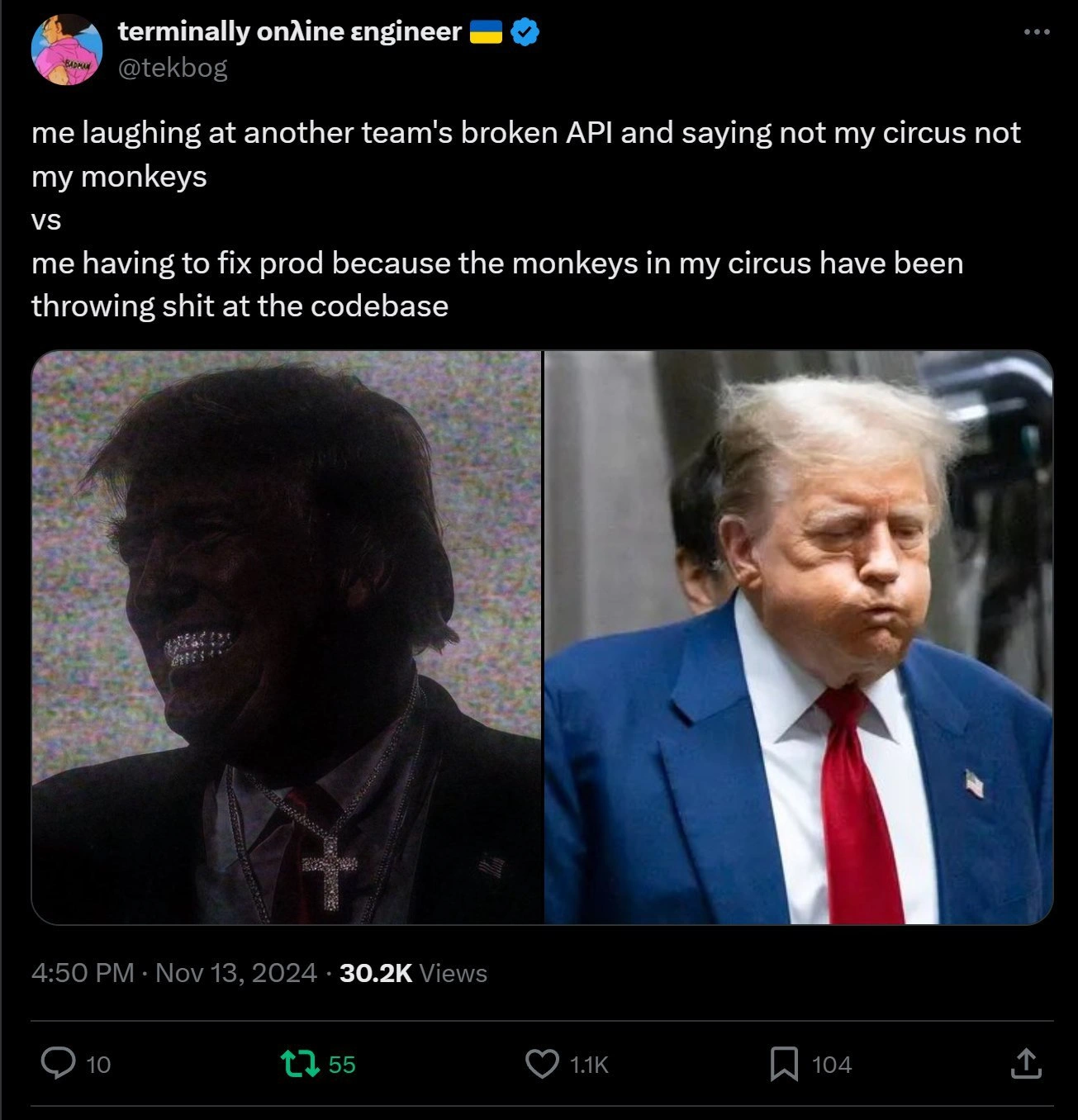
me laughing at another team's broken API and saying “not my circus, not my monkeys”
vs
me having to fix prod because the monkeys in my circus have been throwing shit at the codebase
On the left, our smug developer is basically enjoying some schadenfreude – laughing at another team’s broken API. “Not my circus, not my monkeys” is an idiom meaning “not my problem, not my responsibility.” He’s effectively saying: “Their API is down? Ha! Glad my team isn’t involved in that mess.” It’s a common cocky reaction in siloed organizations: one team’s failure is viewed as entertainment by others, a chance to feel superior or just relieved that this incident isn’t on your pager. The meme image reinforces this: the left panel shows a dimly lit silhouette grinning with bling (looking exceedingly self-satisfied in the dark, like a villain savoring someone else’s misfortune).
But then comes the right panel – and the inevitable reality check. Suddenly that same engineer is under harsh light, hair askew, face contorted in stress. Why? Because one pager ping later, he’s the one in crisis mode. The on-call phone rang (or rather buzzed) and now his service is on fire. The caption spells it out: “the monkeys in my circus have been throwing shit at the codebase.” In other words, his own team’s code (his own monkeys) went wild and broke something in production. The circus monkey analogy paints a vivid picture of chaos: imagine a bunch of unruly code-changes (monkeys) flinging bugs (💩) all over a once tidy codebase. It only takes one deployment gone wrong or one overlooked bug for your service to start malfunctioning. And now he has to drop the smug laughter and become a panicked “prod firefighter,” frantically patching things up to get the system stable again.
This pivot from smug spectator to frantic fixer is the core humor of the meme. It’s funny because it’s true: in tech, karma comes on a Sprint timeline. Today you mock someone’s failed API integration; tomorrow your microservice is the one spewing errors. Seasoned engineers have seen this pattern so often it’s practically a rule of thumb. Call it Murphy’s Law for DevOps: the moment you say “not my problem,” the universe finds a way to make it your problem. The meme garners so many likes and retweets because countless developers have lived this exact whiplash. One minute you’re sipping coffee, joking “works on my machine” while another team scrambles; the next minute that same coffee cups hits the floor as your pager alerts you to a P1 ProductionIncident on your own service. It’s a rite of passage in DevOps culture and especially in on-call life – humility delivered via push notification.
From a senior engineering perspective, there’s also a subtle critique of team silo mentality. In a modern microservices architecture, no service is an island. Sure, each team might run its own little “circus” (owning a distinct service or API). But these circuses are interconnected in a larger system – data flows, backend calls, integration points everywhere. There’s a team_boundary_illusion at play when you think another team’s outage won’t affect you. If Team A’s API is down, and Team B’s service depends on it (even indirectly), Team B is going to feel the pain too sooner or later. Maybe your service starts timing out because it can’t reach theirs, causing your users to see errors. Or maybe your support team gets flooded because a feature in your app (that relies on that external API) is now broken. In tech, someone else’s monkeys very often find their way into your circus tent. 🐒🎪
Even if your system truly has zero dependencies on that other API, the smugness can still be short-lived. Why? Because complex systems fail in complex ways. The bug that hit the other team could just as easily exist in your code – maybe you haven’t hit that edge case yet, but give it time. Or perhaps while you were laughing at them, you missed an alert on your side. There’s a shared subconscious knowledge among senior devs: never laugh too soon. The on-call gods have a cruel sense of humor. Today it’s their API returning 500 Internal Server Error and you chuckle; tomorrow an innocent refactor in your codebase triggers a memory leak and your service starts OOMing at midnight. 🙃
Let’s break down the before/after of this meme scenario in plain terms:
| Before (Smug Spectator) | After (On-Call Firefighter) |
|---|---|
| Laughs at another team’s API outage – “Glad it’s not us!” 🤭 | Gets a page about his own service failing – “Oh no, it’s on us!” 🚨 |
| Assumes the issue is isolated to their team’s circus 🎪 | Discovers his service isn’t as independent as he thought (or has its own issues) 🔥 |
| No urgency: grabs popcorn, carries on with day 🍿 | High urgency: drops everything to triage logs, restart servers 🛠️ |
| “Not my problem” attitude, zero involvement 😌 | “All hands on deck” mode, feverishly patching code in prod 😰 |
| Feels a smug sense of safety behind team boundaries 😎 | Feels the stress of responsibility as boundaries disappear 😅 |
In the left column, our hero’s enjoying the show from a distance. In the right, he is the show, scrambling to put out the fire. The transformation can happen literally within the span of an hour (or one push notification). The tweet’s author even notes it happened “in one pager ping” – that’s how fast karma strikes. One minute you’re gossiping about those poor souls in Team X who introduced a breaking change that took down their API; the next minute you’re reverting a deploy or applying a hotfix because your team’s last merge deployed a nasty bug to production. It’s DevOps irony at its finest.
Now beyond the humor, there’s an important insight about APIs and integration: when you build a service that talks to another team’s service, you share fate to some extent. A breaking change in their API (say they changed response format or removed an endpoint without proper coordination) can break your application. If you were busy laughing instead of paying attention to their release notes, you’re going to get bit. This is why robust systems use things like feature flags, resilient design patterns (circuit breakers, timeouts, retries), and communication channels across teams. A senior engineer reading this meme nods knowingly because they’ve either implemented those safeguards after a hard lesson, or suffered the consequences of not having them. The meme exaggerates it with monkeys flinging poop, but it’s pointing to real DevOps/SRE practices: incident response (jumping in to fix prod), post-mortems (“how did our codebase become a gorilla exhibit?”), and hopefully learning not to just point fingers at “the other team.” In fact, a core tenet of DevOps culture is “You build it, you run it” – meaning teams take end-to-end ownership. The laughing engineer at first rejects that ethos (“not my monkeys!”), but the situation quickly drags him back to reality that in a healthy engineering org, we’re all ultimately part of the same circus serving the customer.
The “monkeys throwing 💩 at the codebase” line is crude, but oh-so-relatable to anyone who’s dealt with a chaotic code hotfix. When production is down at 3 AM, developers might apply a rapid patch (often called a monkey patch in programming slang) just to get things working. It’s not elegant – it can be hacky and make the code messier – but it stops the bleeding. Those emergency fixes often leave a mess to clean up later (hence the codebase ends up splattered with... questionable changes). The veteran voice in this meme knows that feeling: you implement a quick fix under duress, muttering “we’ll refactor it later,” and cross your fingers. The next day, you’re essentially scraping off the muck and hardening the system so this exact issue (or this exact embarrassment) doesn’t happen again.
In summary, at the senior engineer level this meme is a nod and a wink to all the times we’ve seen pride goeth before a fall in the tech world. It humorously encapsulates the OnCall nightmare where you pivot from armchair commentator to frontline responder. The industry patterns lurking here include siloed teams smugly ignoring each other’s problems, brittle microservice integrations, lack of graceful error handling, and the universal truth that no one’s code is ever truly safe. The reason this tweet blew up (30K+ views and hundreds of likes) is because it resonates with a shared experience: today’s smug spectator is tomorrow’s exhausted firefighter. Every senior dev has worn both hats, and this meme gets them to crack a rueful smile — right before they double-check that their own alert pager is quiet. 😉
Description
Dark-mode screenshot of a tweet by the account “terminally onℓine engineer 🇺🇦” (@tekbog). Tweet text (fully visible): “me laughing at another team's broken API and saying not my circus not my monkeys vs me having to fix prod because the monkeys in my circus have been throwing shit at the codebase”. Beneath the text is a split image: left panel shows a dimly lit silhouette of a suited person wearing a glittery cross necklace; right panel shows the same person in bright light, hair disheveled, blue blazer and red tie - their stressed expression emphasized (faces are blurred for privacy). The juxtaposition visualizes a developer’s schadenfreude when another team’s interface fails versus their own exhaustion when on-call for production. Twitter footer displays “4:50 PM · Nov 13, 2024 · 30.2K Views” and engagement icons (10 comments, 55 retweets, 1.1K likes, 104 bookmarks). Technically, the meme riffs on cross-team API dependencies, brittle integrations, and the inevitable wake-up call when your own microservice melts down after hours
Comments
11Comment deleted
Microservice rule #1: the phrase “not my circus” has a TTL equal to the time it takes for the incident manager to trace the failing dependency graph back to your repo
The beautiful irony of maintaining strict service boundaries and API contracts until you realize your team's 'well-architected' microservice is actually just a distributed monolith with extra steps, and now you're debugging race conditions at 3 AM because someone's 'temporary workaround' from 2019 just became load-bearing infrastructure
The beautiful irony of distributed systems: you can laugh at another team's 503s until your own service's cascading failures remind you that in microservices architecture, everyone's circus eventually becomes your circus, and those monkeys? They're all using the same shared cache layer you forgot to properly invalidate
Microservices sold 'not my circus' - until the service mesh turns everyone's monkeys into a distributed outage circus
In microservices, “not my circus” lasts until an upstream’s “minor” API tweak breaks your idempotency guarantees and PagerDuty reminds you the SLO is one big tent
Schadenfreude over broken APIs lasts until the pager reminds you your org chart is a distributed monolith without contract tests
Gigabased Comment deleted
Plotnoe q vsem nashim. A che zdes' vse na english govoryat? Comment deleted
English yeahs Comment deleted
Dense q to all ours. Why does anyone speak english here? Comment deleted
That’s international community, dear Welcome 🙌 Comment deleted