Visualizing the Exponential Hype of GPT-5
Why is this AI ML meme funny?
Level 1: The Giant and the Dot
Imagine you have a big balloon that you’re really proud of – it’s the biggest balloon you’ve ever had. You’re showing it off and thinking, “Wow, this is amazing!” But then your friend comes along with a hot air balloon. 🏰🎈 Suddenly, your big balloon looks like a tiny little dot next to theirs. You both laugh because the difference is so ridiculous: your balloon could fit inside your friend’s balloon a thousand times over! You feel a mix of emotions: part of you is excited to see such a giant balloon (what a cool thing!), and another part of you is a bit overwhelmed, thinking, “My balloon used to feel huge, but now it’s teeny.” You even kind of miss the time when your balloon was the biggest, because things seemed simpler then. That’s the funny feeling this meme is joking about – how something new can be so giant that it makes the old big thing look small, and all you can do is chuckle at how crazy it all is.
Level 2: Bigger Than Big
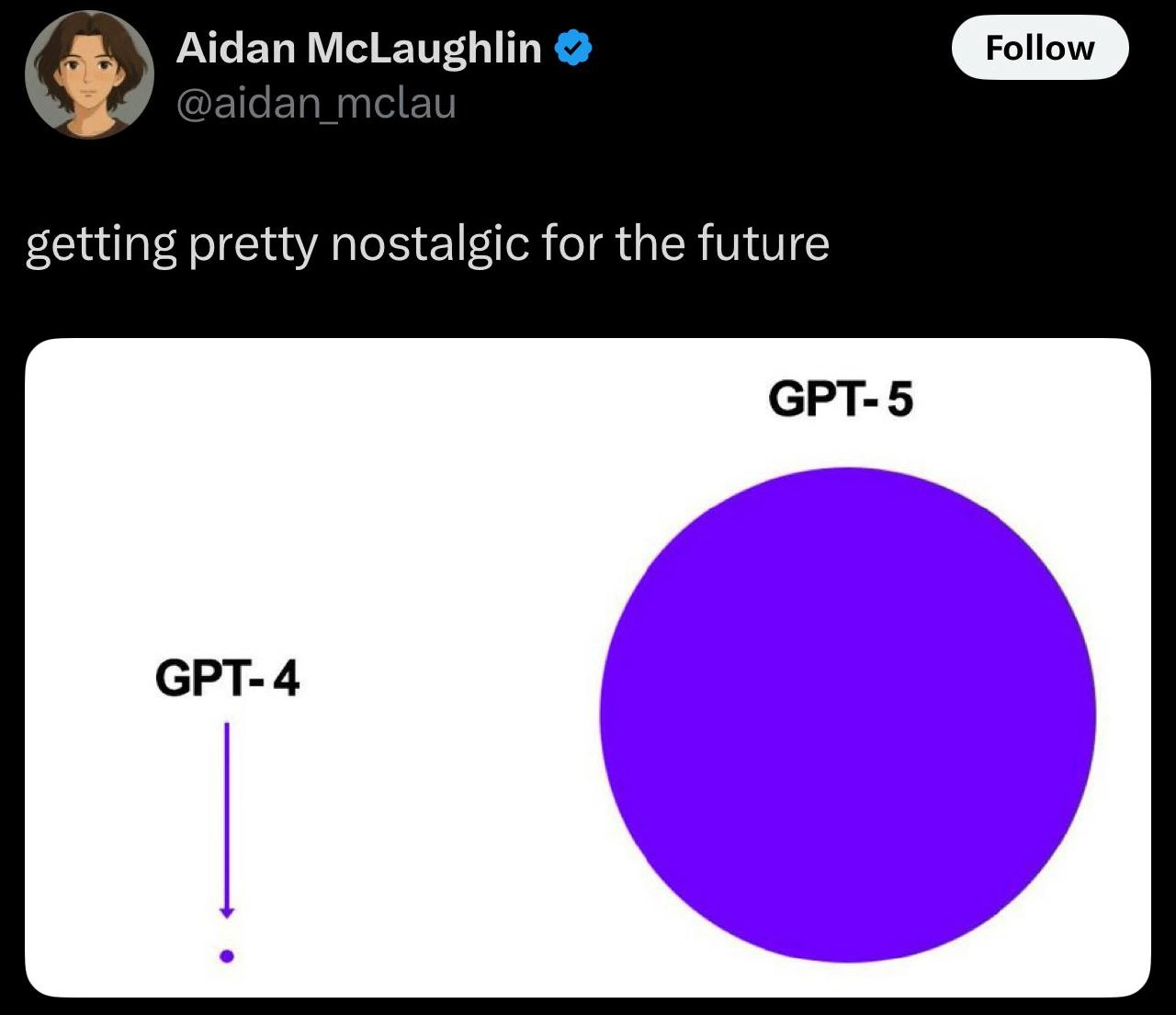
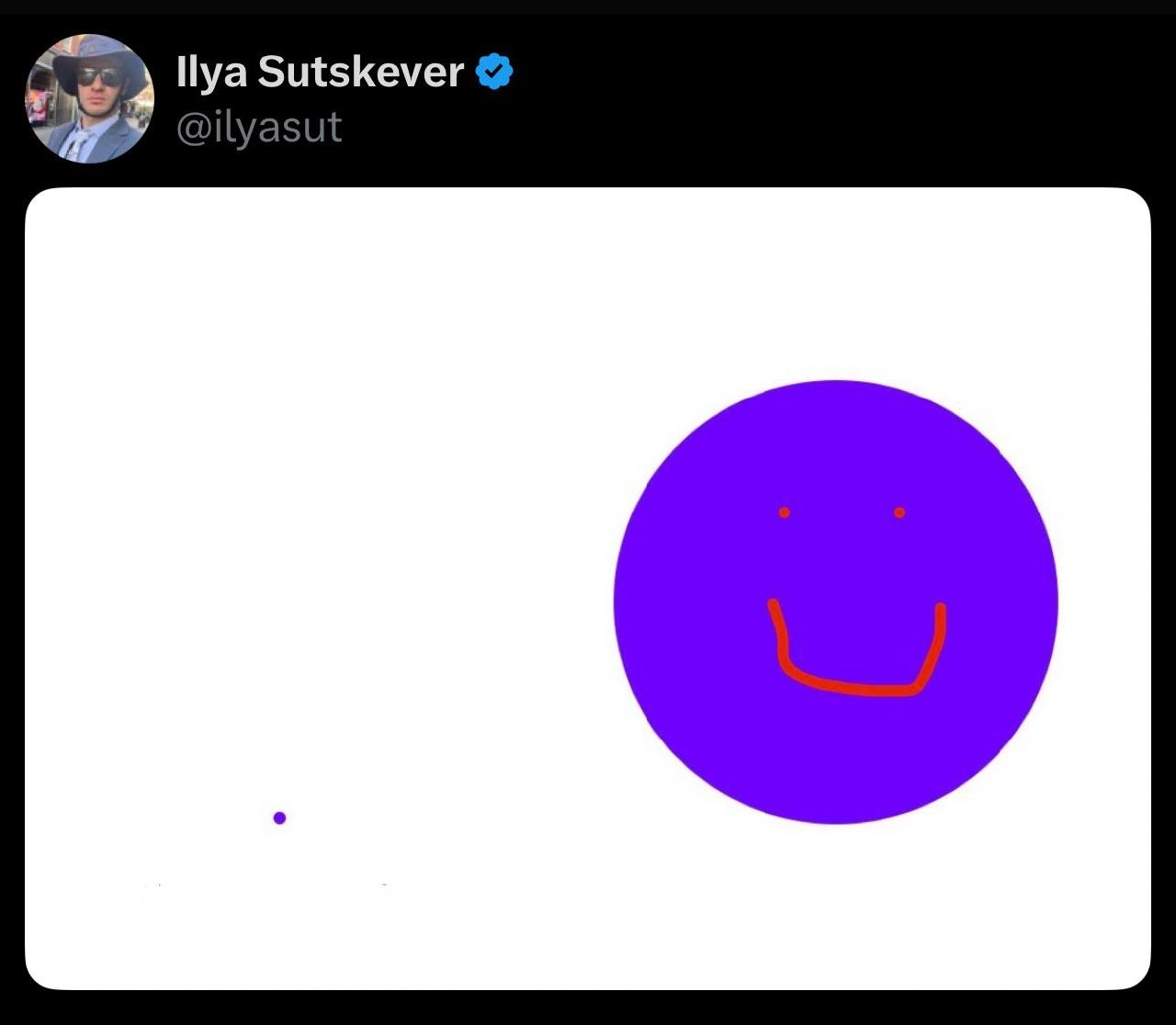
This meme is highlighting a simple idea in a dramatic way: GPT-5 is expected to be way bigger and more powerful than GPT-4. In the image, GPT-4 is represented as a tiny purple dot, and GPT-5 is shown as an enormous purple circle. That visual exaggeration drives home the point that the next version (GPT-5) might utterly overshadow the current version (GPT-4). It’s like saying, “If you think GPT-4 is big, just wait for GPT-5!”
Let’s break down some terms to understand why this is amusing to folks in tech. GPT-4 and GPT-5 are names of AI models. “GPT” stands for Generative Pre-trained Transformer, which is a type of Large Language Model (LLM). Essentially, these are very advanced programs that have learned to generate human-like text. They learn from tons of written data (like books, articles, websites) and develop the ability to predict and compose text that sounds quite natural. GPT-4 is the fourth iteration of these models. It was already huge in scale — think of it as one of the most complex AI brains created up to that point. How do we measure “huge” for an AI model? One common metric is the number of parameters it has. Parameters are like the adjustable knobs or values inside the model that it tunes during training to learn how to solve problems (in this case, to generate or understand language). You can think of parameters as the “memory” or “knowledge capacity” of the model. The more parameters, generally the more it can capture subtle patterns in language, albeit with diminishing returns. GPT-3, for example, had about 175 billion parameters – an almost unfathomable number of settings in its neural network brain. GPT-4 is believed to have even more (the exact number isn’t public, but let’s just say it’s a lot).
Now, the funny (and somewhat crazy) part: GPT-5 is anticipated to have even more parameters – potentially exponentially more. When we say exponential_parameter_growth, imagine that instead of just adding a few more, you multiply. For instance, an exponential jump could mean 10 times or 100 times more parameters, rather than, say, 1.5 times more. It’s the difference between climbing a single step versus jumping up an entire staircase in one go. In everyday terms, if GPT-4 were a library with millions of books, GPT-5 might be envisioned as a library the size of a city. The meme reflects this by making GPT-5’s circle so huge that GPT-4’s dot is barely noticeable. It’s an intentionally ridiculous comparison to make us chuckle, but it’s rooted in the real trend of AI models growing extremely fast in size and capability.
Now, what about the phrase “tomorrow’s changelog” in the title/caption? A changelog is a list of changes or updates in a new release of a software or product. Developers write changelogs to let users know what’s different in the latest version. By saying GPT-4 is just a tiny dot on tomorrow’s changelog, the meme suggests that by the time the next update (GPT-5) comes out, the presence of GPT-4 will be so minor that it’s like a footnote – just a little dot in the list of changes. In other words, GPT-5 will so thoroughly eclipse GPT-4 that GPT-4’s importance will shrink in comparison. It’s a tongue-in-cheek way of saying how quickly the cutting-edge can become old news. Today’s headline (“GPT-4 is amazing!”) might become tomorrow’s sidenote once an even bigger headline (“GPT-5 is here!!!”) arrives.
For a newcomer or junior developer, seeing this meme might also be an introduction to the term AI hype. Over the past years, the AI field – and especially things like large language models – has been characterized by a lot of excitement (that’s the “hype”). Every new model, especially from big players like OpenAI or Google, gets touted as a huge breakthrough. Often, the larger the model (in terms of parameters or training data), the more capable it is expected to be. So there’s a trend in the industry: bigger model = bigger deal. We’ve seen this play out with the GPT series. When GPT-3 came out, people were astonished by how well it could generate text. Then GPT-4 came, and even though it’s still very new, people started speculating about GPT-5 almost immediately – assuming it will be drastically more powerful. This meme is basically poking fun at that cycle. It’s like the community is already joking about how they’ll react when GPT-5 arrives: by making everything that came before look teeny-tiny.
Now let’s talk about why this comparison (tiny dot vs giant circle) might induce what the meme description called capacity_planning_dread among experienced folks. Capacity planning is a somewhat formal term that means “figuring out if you have the resources (like servers, memory, processing power) to handle something new”. If GPT-5 is going to be so enormous compared to GPT-4, engineers in companies might worry: Can our current systems run this model? For example, if you have an application that uses GPT-4, you already need a pretty beefy machine or a good cloud service to run it, because these models consume a lot of memory and computing power. If GPT-5 is, say, 10 times larger, it might not even fit on the same hardware. It could require multiple high-end GPUs working together, or far more memory. So the “dread” comes from imagining the headache of upgrading everything – perhaps buying expensive new hardware, rewriting code to distribute the model across machines, or paying a much larger cloud bill – just to use this fancy new model. This is the behind-the-scenes reality that the average meme viewer might not think about, but developers definitely do. So the meme’s humor has an extra layer for techies: it’s not just “haha GPT-5 big”, it’s also “haha, oh no, GPT-5 is gonna be big… are we ready for that?”
In simpler terms, think of it like when a new video game or app comes out that requires a much more powerful computer or phone than the previous version. As a user, you’re excited for the improved graphics or features (that’s the hype). But if you’re the person who maintains the hardware, you might groan because you realize you’ll need to upgrade your rig to handle it. With GPT-4 vs GPT-5, that feeling is multiplied many fold because these AI models are already at the extreme end of resource usage. The dot vs circle graphic is a lighthearted way to visualize that leap.
Lastly, the phrase “nostalgic for the future” is a quirky one. How can you be nostalgic (which means fondly remembering the past) for something that hasn’t happened yet (the future)? This paradoxical phrase is part of the joke. It’s highlighting how fast the present becomes past in tech. It suggests that GPT-4 was considered “the future” of AI, but now that GPT-5 looms, people are already missing the time when all we had to think about was GPT-4. It’s like saying, “We’re already reminiscing about how simple things were back when the future was just GPT-4.” Of course, GPT-4 is still cutting-edge right now, but in this meme’s imagined tomorrow, GPT-4 is old news. It’s a witty way to describe the accelerated timeline of technology. For a junior developer, it’s a hint: buckle up, because things move quickly! Today’s state-of-the-art can become yesterday’s news before you’ve even finished reading the documentation. And that’s both exciting and a bit intimidating – which is exactly why people find this meme relatable and funny.
Level 3: Hype Cycle Hangover
The veteran engineers in the room are smirking at this one, because we’ve seen this movie before. The meme lands squarely in the sweet spot of AI hype vs. reality that senior developers know all too well. In the graphic, GPT-4 has been reduced to a microscopic footnote – literally a tiny violet dot with an arrow – while GPT-5 is depicted as a gargantuan circle dominating the frame. This comical exaggeration gets a knowing chuckle because it captures the absurd feeling of version-n+1 hype cycles in tech. Today’s groundbreaking innovation becomes “old news” shockingly fast once the next version is announced. As one tongue-in-cheek tweet puts it:
“getting pretty nostalgic for the future” – @aidan_mclau
That one-liner nails the vibe: we barely got to welcome GPT-4 as the future of AI, and suddenly we’re feeling nostalgic for it, as if it’s already the past, thanks to whispers of an even mightier GPT-5. It’s a playful way of saying “things are moving ridiculously fast, so fast that the future we were excited about is now something we look back on fondly.” Only in an industry drowning in AIHype do people start missing a technology that’s still cutting-edge! Seasoned developers recognize this pattern from countless IndustryTrends_Hype cycles: by the time the rest of the world adopts the latest tech, the insiders are already hyping the next big thing. It’s equal parts exhilarating and exhausting – hence the hangover after the hype party.
Why is this funny to those who’ve been around the block? Because it’s too real. We’ve lived through iterative leaps where each new generation of tech promised to dwarf the last. Think about CPUs: one year you’re celebrating a 3 GHz single-core processor, the next year you’re “nostalgic” for it because now you need to optimize code for 8-core, 5 GHz monsters. Or remember when a few million database records was big data, and then suddenly you’re dealing with billions and reminiscing about the quaint simplicity of a million. In the AI realm, the jump from one LLM to the next is that phenomenon on steroids. GPT-3 astonished us with 175 billion parameters – it was impossible to ignore how big of a deal that was. Many of us scrambled to harness its power, integrate it into products, and scale our infrastructure to host it. No sooner had we tamed that beast, GPT-4 arrived with even greater capabilities (and rumored far larger size), prompting another round of frantic adaptation. Now the meme posits GPT-5 looming so large that GPT-4 seems like a blip. The collective developer psyche can’t help but laugh (perhaps a bit nervously) at how we’re forever chasing an exponentially moving target. We haven’t even finished digesting one revolution and the next one is already at the door, larger than life.
There’s a layer of shared trauma under the humor. Each extra order of magnitude in model size isn’t just a number – it’s nights and weekends of work for engineering teams. When the meme shows GPT-4 as “just the tiny dot on tomorrow’s changelog,” it’s lampooning the way massive changes get trivialized in corporate speak. Imagine reading a product release note that nonchalantly says, “Upgraded our AI from GPT-4 to GPT-5.” Users see a one-line bullet point and think, “Cool, better AI.” But the developers and architects who had to make that upgrade happen? They see their life flash before their eyes. They know that behind that innocuous line were dozens of planning meetings and an army of devops folks sweating over GPU cluster configurations. Upgrading to a model that “utterly dwarfs GPT-4” means grappling with capacity_planning_dread in a very real sense. Seasoned teams will immediately worry: Do we have enough GPU memory to even load this thing? Will inference latency blow up because the model is 10x heavier? Is our current model-serving stack going to fall over under the load? It’s the classic hype hangover: marketing has poured everyone shots of “GPT-5 will solve everything” tequila, and now engineering wakes up with a headache, tasked with actually handling this behemoth in production.
The AIIndustryTrends context here is also that we’ve been conditioned to equate bigger with better. The meme pokes at that unspoken industry mantra. Everyone is quick to cheer the leap from GPT-4 to GPT-5 – “It’s going to be so much more powerful!” – but the folks in the back of the room (the ones who’ll implement it) exchange weary glances. They know bigger models often bring diminishing returns in quality but skyrocketing costs in practice. Sure, GPT-5 might answer slightly more complex questions or produce marginally more accurate results, but at what cost? Likely 10x the compute cost, new hardware purchases, perhaps even a complete refactor of the serving architecture. These veterans have seen this trade-off before. It resonates with the memory of past tech hype: like when microservice architectures were hailed as the answer to everything – until you ended up with hundreds of services and a monitoring nightmare. Or when “big data” was all the rage – until you realized maintaining a gigantic Hadoop cluster for a few extra insights wasn’t worth the operational pain.
In this case, the existential_parameter_dread is palpable. By exaggerating GPT-5 into a massive violet circle, the meme captures a very real anxiety: where does this end? If each new model is an order of magnitude larger, at some point something’s gotta give – whether that’s our budgets, our hardware limits, or our sanity. The seasoned engineers chuckle because the absurdity has a grain of truth: “At this rate, GPT-6 will need its own damn power plant,” you might hear one joke, only half kidding. There’s often dark humor around what it takes to deploy these monsters. We joke that it’s fine and dandy to have a trillion-parameter model… until the pager goes off at 3 AM because one of the 512 GPU nodes crashed and now half the model’s neurons are offline. Yes, we find it funny because if we didn’t laugh, we might cry at the prospect.
Another aspect of the “nostalgic for the future” quip is the pace of disillusionment. Hype cycles often go: Over-enthusiasm → Reality check → Nostalgia. With GPT-4, many of us were in awe (over-enthusiasm phase: “This will change everything!”). Then we hit the reality check: “Actually, it’s powerful but also occasionally wrong, expensive to run, and hard to fine-tune.” We started appreciating its limits even as we used it. Now, even before we’ve mastered GPT-4’s challenges, the hype for GPT-5 is building. The meme suggests we’re skipping straight to nostalgia, almost preemptively longing for the “simple days” of GPT-4 because we know the next wave will be even crazier. It’s like an experienced sailor on a stormy sea thinking fondly of the previous storm because the one on the horizon looks even bigger. That blend of anticipation and weariness is the hallmark of an industry trend hangover.
In practical terms, this meme also resonates with how architects plan for scalability. You hear whispers in the pipeline: “GPT-5 is coming, it’s going to have X trillion parameters.” The hallway conversations among ML engineers begin early: How many datacenter pods will we need to serve that? Can we even train it in-house or do we need to partner with a cloud provider? There’s often a sense of dread that creeps in alongside the excitement. Seasoned folks recall when GPT-3 was “undeployable” for many smaller companies due to its sheer size. GPT-4 pushed that boundary further – requiring careful optimization like model quantization or offloading to make it feasible in real-time applications. Now GPT-5 threatens to push practicality to the brink. Will we be forced to rely entirely on the few big players who can afford to train and serve such a leviathan? That’s an implicit industry concern – the bigger the model, the more centralized AI development might become (since only the Googles and OpenAIs of the world have the resources). The meme doesn’t state this outright, but those of us in the trenches feel the subtext. It’s poking fun at the scale, but also hinting at the absurd arms race in AI.
Finally, consider the operational nostalgia aspect: GPT-4, for all its novelty, is something teams have started to tame. They’ve built monitoring around its quirks, learned how to coerce its output, managed its latency spikes, and optimized its cost to some extent. There’s a comfort in that hard-won understanding. The looming GPT-5 threatens to upheave that comfort. New model, new unknown unknowns. The meme’s humor acknowledges that psychological effect – sometimes you almost long for the familiar problems of the last generation rather than face the totally new problems of the next one. It’s the tech equivalent of “the devil you know is better than the devil you don’t.” When GPT-4 is the devil you know (and are already nostalgic for), you can bet GPT-5 is one heck of a devil you don’t. AIHype comes at you fast, and this meme captures that whiplash feeling perfectly. It’s that collective groan-laugh that comes after reading yet another headline about the next giant AI model, while you’re still debugging the current one. In short, Hype Cycle Hangover is when the excitement subsides and the reality (and irony) sets in — a vibe every senior dev recognizes instantly in this meme.
Level 4: The Scaling Singularity
At the extreme cutting edge of AI_ML, the meme’s absurd dot vs circle visual hints at something very real: the near-exponential growth of model scale. Under the hood, Large Language Models (LLMs) like GPT-4 and GPT-5 follow what researchers call model scaling laws. These laws are essentially power-law relationships: as you crank up the number of parameters (the trainable weights in the network) and feed in more data and compute, the model’s performance climbs – albeit with diminishing returns. In formula form, one can imagine something like:
$$ \text{Error}(N) \propto N^{-\alpha} \qquad \text{(for some }\alpha < 1\text{)} $$
where increasing the parameter count $N$ yields smaller and smaller error rates. Here’s the kicker: to get steady improvements, you often need to scale $N$ exponentially. If GPT-4 was already pushing billions (or trillions) of parameters, GPT-5 might be aiming an order of magnitude higher. In other words, each new “GPT-n” isn’t just a linear upgrade – it’s a step change that verges on a singularity point in scaling. It’s like the AI equivalent of Moore’s Law on steroids. Unlike transistor counts doubling every couple of years, model parameters have been leaping by 10x or 100x at each generation. GPT-3 had ~175 billion parameters; GPT-4’s true size is secret but rumored to be significantly larger (some whispered it might approach a trillion). Now picture GPT-5 with exponential_parameter_growth to even more unfathomable levels. The meme’s giant violet circle labeled “GPT-5” playfully suggests a model so huge that GPT-4 (a mere dot by comparison) is practically a rounding error in tomorrow’s research paper.
This scaling paradigm isn’t just a marketing stunt – it’s grounded in the empirical successes of deep learning. Researchers observed that larger models tend to absorb more knowledge and express new capabilities. There’s talk of emergent properties: qualitative jumps in what models can do once they cross certain size thresholds. For example, GPT-3 amazed the world by performing tasks via few-shot learning that smaller models simply couldn’t. By GPT-4, we saw further leaps in reasoning and even multimodal understanding. The tongue-in-cheek implication of the meme is that GPT-5 might unlock some next-level abilities that make GPT-4 look quaint. It’s exaggeration with a kernel of truth – indeed, some theoretical papers imply that sufficiently scaling up a Transformer model could approach or even surpass human-level language proficiency on certain benchmarks. The violet GPT-5 circle dominates the graphic like a looming singularity: an intelligence so large it warps our expectations (and perhaps our sense of existential comfort). This nods to the AI singularity concept – the hypothetical point where AI becomes self-improving beyond human control – lurking at the far end of these exponential curves. The meme captures that wild, almost sci-fi notion in a single outrageous size comparison.
From a systems perspective, though, such aggressive scaling triggers a cascade of very concrete challenges. Training a model of GPT-5’s rumored scale demands a capacity_planning_dread inducing amount of computing power. We’re talking tens of thousands of GPU devices churning for weeks, drawing megawatts of power, synchronized over high-speed interconnects. The compute budget and engineering effort behind that one-line “GPT-5” changelog entry would be astronomical. Ironically, in a production changelog, you might see a terse bullet like “Model upgraded to GPT-5” without any hint of the Herculean feat it represents. Underneath that tiny line item hides a massively distributed training run pushing the limits of today’s hardware. Imagine model_parallel algorithms splitting tens of trillions of parameters across dozens of accelerator cards – pushing GPU memory to the brink, saturating network bandwidth with gradient exchanges, and summoning every trick in the HPC textbook to avoid failure. The fundamental physics of wires and switches start to bite: communication overhead, memory latency, heat dissipation, diminishing scaling efficiency. As model size $N$ skyrockets, the training time and cost tends to scale super-linearly, something like $O(N^{1+\epsilon})$ once you factor in that to fully utilize a bigger model you also need correspondingly more data and longer training schedules. This is where capacity planning meetings become nightmares – architects must grapple with questions like: Do we have enough VRAM across our cluster? Is our high-bandwidth interconnect robust enough? How do we handle checkpointing a model that weighs several terabytes? It’s not just an academic exercise; these are operational headaches hiding behind each extra order of magnitude. The meme’s colossal GPT-5 circle effectively symbolizes those headaches too. Each new generation doesn’t just dwarf the previous in capability; it dwarfs it in complexity and infrastructure demands.
There’s also an implicit poke at how casually the tech industry treats these leaps once they’re achieved. We get jaded fast. Today’s miracle (GPT-4 solving tasks we thought computers couldn’t handle) becomes tomorrow’s baseline – a “tiny dot” overshadowed by the next big thing. The phrase “getting pretty nostalgic for the future” encapsulates that irony. It’s a reversal of temporal perspective fueled by exponential change: the moment we achieve the long-anticipated “future” (GPT-4 level AI), we’re already looking ahead to an even grander future (GPT-5), making us oddly nostalgic about the present that barely had time to settle. In a way, it satirizes the AIIndustryTrends of relentless one-upmanship – bigger models, bigger promises. The future arrives so quickly and at such scale that we start missing the simplicity of the slightly smaller past. The Scaling Singularity level of this meme is all about that heady mix of technological awe and anxiety. It’s humorous because it exaggerates the scaling to cartoonish levels, but it’s also a pointed commentary on real trends in AI development. At some fundamental level, we can’t keep making circles bigger forever – whether due to theoretical limits, physical hardware ceilings, or the universe’s finite supply of GPUs. For now, though, the meme wryly suggests that on the trajectory we’re on, GPT-5 will make GPT-4 look like a mere speck in the rear-view mirror of progress.
Description
A screenshot of a tweet by Aidan McLaughlin (@aidan_mclau) with the caption, 'getting pretty nostalgic for the future'. Below the text is a simple diagram on a white background that starkly contrasts 'GPT-4' and 'GPT-5'. On the left, 'GPT-4' is represented by a miniscule purple dot, with an arrow pointing to it, emphasizing its smallness. On the right, 'GPT-5' is depicted as a massive, solid purple circle that consumes a large portion of the frame. The meme humorously captures the immense and exponential expectations surrounding the next iteration of OpenAI's language models. It visualizes the tech community's hype, suggesting that the leap from GPT-4 to GPT-5 will be so significant that it renders the current state-of-the-art model comically tiny in comparison. The paradoxical caption adds a layer of wit, implying that the future's advancements will be so profound that one can already feel a sense of nostalgia for the era that is about to be eclipsed
Comments
7Comment deleted
The jump from GPT-4 to GPT-5 looks like the difference between my initial project estimate and the actual number of story points six months later
Somewhere an infra lead just updated the budget spreadsheet: line-item ‘GPT-5 inference cluster’ now reads ‘entire GDP of a small nation.’
Remember when we thought GPT-4's context window was impressive? Now we're nostalgic for a model that doesn't exist yet, probably because GPT-5 will make our current architectural debates look like arguing over whether to use tabs or spaces in a world where code writes itself
Ah yes, the classic AI scaling problem: GPT-4 fits in your GPU memory, GPT-5 requires you to mortgage your data center. At this rate, GPT-6 will need its own power plant and GPT-7 will just be a Dyson sphere. But hey, at least it'll finally understand sarcasm... probably
Amazing how every roadmap deck measures capability by circle area, finance measures it by GPU invoices, SRE wants the axis in log scale - and my GPT-4 integration is now considered legacy code I shipped last Tuesday
In our roadmap decks, GPT-5 keeps doubling - scaling laws work best in PowerPoint, where neither H100 quotas nor the governance board exist
GPT-5: Finally small enough to run inference without mortgaging your AWS account