Skip to content
DevMeme
308 of 7435
The Unholy Union of PHP and Node.js
Languages Post #366, on May 11, 2019 in TG

The Unholy Union of PHP and Node.js

Why is this Languages meme funny?

Level 1: Square Peg, Round Hole

Imagine you have a toy where you’re supposed to put different shaped blocks into matching holes – a square block goes in a square hole, a round block goes in a round hole. Now picture a toddler trying to shove a square block into a round hole. No matter how hard they push, it just doesn’t fit, right? The toddler might insist and get frustrated, saying “See, it will work!” while the parents smile and shake their heads because it’s obvious it won’t. This meme is funny for the same kind of reason. In the computer world, Node.js and PHP are like different shapes: one’s a square and one’s a circle. The person in the meme is basically asking if they can force the wrong shape into the wrong hole – trying to use Node.js (one shape) to do a job meant for PHP (another shape). Everyone who knows the shapes can see it’s not going to work out. The top part of the meme with the pregnant woman drinking wine is a more grown-up example: it’s like someone doing something obviously bad (drinking wine when pregnant) and saying “It’s fine.” We all know it’s not fine! So we laugh because the question in the bottom part is doing the same thing in tech – proposing something obviously problematic and hoping it’s fine. In simple terms, the meme is telling a joke: using the wrong tool for a job is as silly (and potentially harmful) as these obvious real-life no-nos. You wouldn’t bake a cake in a washing machine or try to play a video game by sticking a book into the console – it just doesn’t work that way. The humor comes from someone not seeing the obvious mismatch that everyone else does.

Level 2: Know Your Runtimes

Let’s break down why the question in the meme is misguided, in simpler terms. Node.js is a runtime environment that lets you run JavaScript code on the server (outside of a web browser). It’s built on Chrome’s V8 JavaScript engine, and it’s typically used to create web servers or build backend logic using JavaScript. On the other hand, PHP is a different programming language entirely, traditionally used to build server-side web pages (often embedded in HTML). PHP code is executed by a PHP interpreter (for example, the PHP engine built into web servers like Apache or via PHP-FPM with Nginx). In essence, Node.js runs JavaScript, and PHP runs PHP — they speak different languages in the computing world.

When someone asks “Is there any way to run a PHP project using Node.js,” they’re showing a bit of confusion about how these technologies work. It’s as if they went to a JavaScript party and asked if anyone could speak PHP. The straightforward answer is “Not directly, no.” Node.js doesn’t know what to do with PHP code. If you hand Node a file full of <?php ... ?> tags and $variable syntax, Node will just throw up its hands and error out, because that syntax means nothing in JavaScript land. It’s similar to how you can’t put a PlayStation game disc into an Xbox and expect it to run — the systems aren’t made to read each other’s format. This is the essence of a language_runtime_mismatch: each language has its own “runtime” (its own engine or interpreter) that understands only that language’s instructions.

Now, could you somehow get Node.js to trigger or host PHP code? The only practical ways require using PHP itself somewhere in the mix. For example, Node.js can start an external process (like launching a PHP interpreter program) to run a PHP script. In that case, Node isn’t really running PHP internally; it’s just asking the PHP engine to do the work and then getting back the result. That’s like Node saying, “I can’t read this, but I know someone who speaks PHP — let me call them real quick.” This kind of solution would involve writing glue code: maybe a Node script that behind the scenes calls php myscript.php via the operating system. While this technically executes the PHP project while a Node process is running, it’s not what most people mean by “using Node.js to run a PHP project.” It’s more like using Node as a wrapper or middleman. It certainly isn’t a common or efficient setup in WebDevelopment practice.

For a junior developer or a student, it might not be immediately obvious why you can’t mix and match these things. After all, both Node.js and PHP can be used to make websites, right? Think of it this way: both a microwave and an oven can cook food, but you wouldn’t ask if you can run your microwave popcorn in an oven set to “microwave mode.” The tools may achieve similar goals (cooking, or in our case, dynamic websites) but they do so with completely different mechanisms. NodeJS uses JavaScript and a single, long-running process that handles many requests (it’s event-driven, handling things asynchronously). PHP, in a typical setup, runs as a process that starts up for each request, does the job (like generating HTML), and then finishes. The environments, libraries, and even the way you write code for each are different. Node has things like npm packages (JavaScript libraries), an event loop, and non-blocking I/O. PHP has its own ecosystem of Composer packages, a more synchronous execution flow per request, and so on. They’re like two different toolkits.

The person asking the question in the NodeJS Facebook group likely didn’t realize this. It’s a public DevCommunity group, meaning anyone from beginners to experts can post. A newbie might just think, “Node.js is what all the cool kids use to run stuff, maybe it can run my older PHP project too.” They might not have the vocabulary yet to differentiate a language from a runtime or to understand why you can’t just put one inside the other without essentially building a compatibility layer. It’s a bit like someone learning that you can use an engine to power a vehicle, and then asking if they can use a boat engine in their car because, hey, an engine is an engine, right? They’re missing the context that car engines and boat engines are built for very different setups.

Within developer communities, these kinds of questions get answered, but often with a pinch of humor or frustration. A kind mentor might gently explain “Node.js can’t interpret PHP code. You’d need to either run a PHP server for that project, or convert your PHP code into JavaScript.” But a lot of others will react with jokes or memes, because the mistake is a bit obvious to anyone who’s been in the field for a while. If you’re new, no worries – everyone starts somewhere, and runtime differences aren’t something you inherently know without experience or study. This meme is basically a way for the community to blow off steam while highlighting the mistake. The laughter (those 😂 reactions) is not to bully the newbie, but because every dev remembers when they (or a classmate) had a big misunderstanding like this. It’s funny and a little painful, because it reflects the gap between how newcomers think things work and how they actually work.

So, in plain terms: Node.js cannot run a PHP project the way you might hope. If you have a PHP project, you run it with PHP. If you want to use Node.js, you’d typically rewrite that project (or parts of it) in JavaScript. There’s no magical “Node, please execute this PHP for me” button. Trying to jam the two together is not a beginner-friendly path; it’s advanced, convoluted territory (as we saw above). Better to use each tool for what it’s meant for. When the meme’s bottom panel question suggests ignoring that advice, experienced devs react the same way you’d react to “Can I water my plants with soda?” — a mix of amusement and an urge to step in with “No, don’t do that!”

Level 3: Just Because You Can...

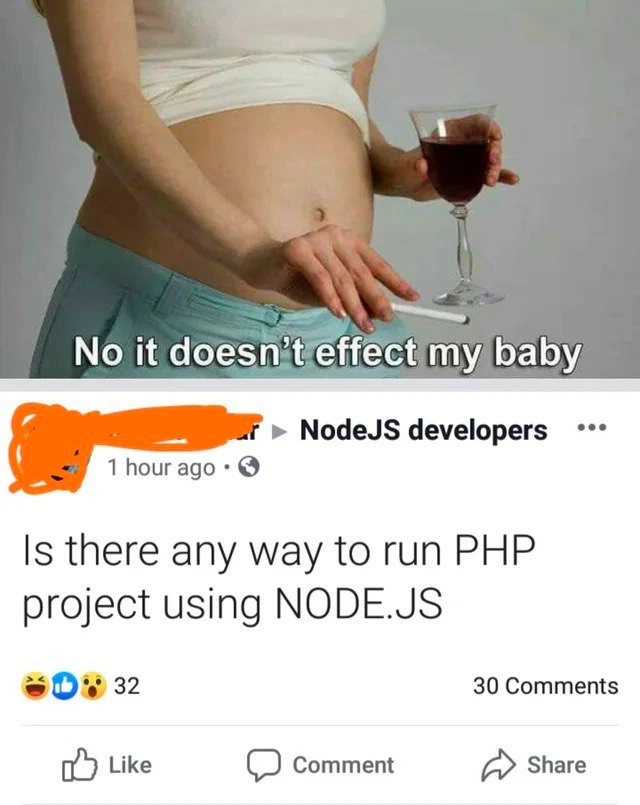
The meme’s punchline lands with a knowing groan from seasoned engineers. In the top panel, a pregnant woman blithely drinking red wine says “No it doesn’t affect my baby.” This image perfectly encapsulates a developer doing something obviously harmful to a project while insisting it’s fine. The bottom panel – a Facebook post asking “Is there any way to run PHP project using NODE.JS” – is the tech equivalent of that scenario. The poster is essentially proposing to feed a project a cocktail of mismatched technology and claiming nothing will go wrong. Experienced devs see this and immediately think, “Oh no, that’s not how any of this works!”

Why is it so cringey-funny? Because it hits on a classic language_runtime_mismatch mistake. Node.js and PHP belong to entirely separate ecosystems; each has its own engine under the hood (Node’s V8 for JavaScript, PHP’s Zend Engine for PHP). Running a PHP project inside Node is like transplanting an engine from a boat into a car – you’re defying the fundamental design of both systems. Seasoned engineers have lived through enough Languages and Frameworks fiascos to know that mixing runtimes leads to untold pain: everything from bizarre bugs and performance issues to nights spent debugging unholy integrations at 3 AM (the kind of RelatableDeveloperExperience that turns your hair grey). We chuckle because we’ve seen wide-eyed newcomers ask things like this in dev communities, not realizing the Pandora’s box they’re prying open. It’s a shared joke in DevCommunities: every so often someone proposes a wacky idea (“Can I plug this totally different thing into that other thing and get magic?”) and the veterans collectively facepalm while reaching for the popcorn. The NodeJS Facebook group is no exception – a public forum where questions range from brilliant to facepalm-inducing. This post was the latter, and the reactions (32 laugh emojis!) show the community’s mix of amusement and disbelief. It’s a bit of DeveloperHumor to see someone earnestly ask if Node.js – a runtime built specifically for JavaScript – can directly execute a PHP codebase. The seasoned folks know the answer is basically “No, and you’re missing some fundamental concepts,” but they might answer with biting sarcasm rather than a plain lecture.

Let’s unpack why running PHP on Node is a bad idea beyond “just because.” First, architecture: Node.js is designed as an event-driven, non-blocking server environment, great for handling lots of concurrent I/O using JavaScript. PHP, historically, is designed to run a script to completion per request (each PHP script starts, does its job, and finishes). They have completely different lifecycles. Trying to mash them together breaks assumptions left and right. You’d effectively be creating a Frankenstack: imagine a long-running Node server that, under the hood, spins up a PHP parser whenever it encounters a .php file. The complexity of managing two runtimes in one process (or even in one system) is through the roof. You'd deal with double the memory footprint, dueling garbage collectors, and context-switching overhead that would make any performance-minded engineer weep. Second, maintainability: you now have to worry about updates and security patches for two platforms in one application. If something goes wrong, is the bug in your Node layer or in the PHP execution layer? Good luck untangling that mystery spaghetti. And who is even comfortable debugging both V8 engine issues and PHP opcodes at the same time? That skillset is rare, my friend. It’s a textbook example of “just because you can doesn’t mean you should.”

The meme also pokes fun at the newbie_request_gone_wrong dynamic. We’ve all been beginners at some point, and inevitably we asked questions that made veterans smirk. This one is a prime example. The question likely stems from misunderstanding what NodeJS actually does. Perhaps the poster had used Node.js to run some JavaScript and thought, “Hey, Node runs stuff on a server, PHP is stuff I want to run on a server, so… can Node run PHP?” It sounds almost logical until you grasp that Node isn’t a universal server that runs all languages; it’s specifically a JavaScript runtime. The Facebook group context adds another layer of humor: unlike a formal Q&A site (Stack Overflow), social media dev groups often react with memes and snark. The top-panel image with the mom and wine is itself probably posted by someone in the comments as a witty response, equating the “it’ll be fine” attitude. The grammar error in “doesn’t effect my baby” even mirrors the technical ignorance – a small flag that the person isn’t in expert territory. It’s a bit of extra salt seasoned devs would notice: if you can’t spell affect, maybe you also don’t fully grasp how different runtime engines work. Harsh, but the DevCommunity humor can be brutal like that.

To seasoned developers, the idea of php_on_node triggers a mix of laughter and PTSD. We’ve been in those meetings where someone high up asks, “Couldn’t we just reuse this old PHP module in our new Node app? That would save time, right?” and you have to gently (or not-so-gently) explain that this is how nightmares begin. It’s like hearing “I put regular gas in my diesel engine, but it should be fine, right?” Nope. Not fine. Cue the mechanic’s exasperated look. In tech terms, Node and PHP are not plug-and-play interchangeable. Integrating them is possible only through very clunky means (e.g., spinning up a PHP server and proxying to it, or using Node to call PHP scripts via command line), all of which defeat the purpose of using Node in the first place. You don’t gain performance or convenience; you just add layers of potential failure. The experienced crowd has a saying for these scenarios: “At scale, everything that can go wrong will go wrong.” Running two different language runtimes in one app multiplies the ways things can go wrong.

So when the OP blithely asks if there’s “any way” to do this, the seasoned devs hear it in the same tone as “It’s not that bad for the baby, right?” It triggers that dark humor we use to cope. The top-voted response was basically the textual embodiment of an eye-roll. One commenter famously replied, “It’s definitely possible but f**k you.” 😈 In other words: Sure, you can do it if you’re absolutely determined to ignore all sage advice, but you’re going to wish you hadn’t. The blunt "f**k you" here isn’t literal hatred; it’s comic hyperbole born out of exasperation. It’s a spicy way of saying, “That idea offends my engineer sense so much that I can’t help but react strongly.” The laughter reactions and shocked emojis on the post show that most people in that Node.js group understood the sarcasm and found it hilarious. It’s developer humor golden rule #1: laugh so you don’t cry.

In summary, this meme resonates with senior devs because it piles up multiple layers of inside jokes: the absurdity of a LanguageComparison gone wrong, the LanguageWars truce moment (where JS and PHP gurus alike unite just to say “No” to this craziness), and the familiar scene of a naive question in a tech forum getting a snarky reality check. It’s funny because it’s a scenario we’ve all seen in one form or another – someone trying to bend the rules of the tech universe, and getting smacked (humorously) by reality. The lesson hiding behind the laughter is one every engineer learns sooner or later: every tool has its proper use, and using it for the wrong purpose will come back to bite you. Or put more bluntly, “Just because you can do something in code doesn’t mean you won’t create a monster.” 🧟‍♂️

Level 4: Turing-Complete Overkill

In theoretical computer science, both JavaScript (which powers Node.js) and PHP are Turing-complete. This means, given unlimited resources, one can simulate any program in either language. In other words, yes – in the same theoretical sense that you could build a working computer out of dominoes – you could run a PHP project using Node.js. How? By effectively strapping a PHP interpreter onto Node’s back. There are some almost-comical ways to achieve this: for instance, writing a PHP interpreter in JavaScript, or compiling the entire PHP runtime into a form that Node’s V8 engine can execute (imagine compiling the PHP interpreter to WebAssembly and loading it inside Node – runtime_inception at its finest). In fact, the industry has seen wild experiments akin to this: Quercus once ran PHP on the Java JVM, and PeachPie compiles PHP into .NET IL. These projects basically reimplement PHP’s engine on a different virtual machine. It’s a testament to Turing-completeness and developer mad science that such cross-runtime feats are even possible. But let’s be clear: this is insanely over-engineered. You’d be constructing a Rube Goldberg machine of software – Node.js running an embedded PHP engine, which in turn runs the PHP project – all just to avoid using PHP in the normal way. The performance overhead alone would be herculean: multiple layers of interpretation, context switching between engines, and likely epic memory leaks as two garbage collectors (V8’s and PHP’s) tango unpredictably. Sure, computers can do it, but at what cost? This is the very definition of Turing-complete overkill: just because a system can compute something doesn’t mean you should force it to. Any sober computer scientist (perhaps clutching their head like a stressed parent) will tell you that yes, it’s technically possible to achieve a php_on_node Frankenstein – but the fundamental question is why on earth would you? It’s like using a rocket launch to toast a marshmallow: theoretically feasible, pragmatically absurd.

Description

A two-panel meme that equates a technically misguided question with harmful real-world behavior. The top panel shows a stock photo of a pregnant woman holding a glass of wine and a cigarette, with the caption, 'No it doesn't effect my baby,' including a grammatical error ('effect' instead of 'affect'). The bottom panel is a screenshot of a post from a 'NodeJS developers' Facebook group, where a user asks, 'Is there any way to run PHP project using NODE.JS'. The original poster's caption, 'It’s definitely possible but fuck you,' adds to the cynical tone. The meme brutally mocks the question, suggesting that trying to run a PHP project within a Node.js environment is as fundamentally wrong and ill-advised as the behavior depicted in the top image. It's a classic example of 'language wars' humor, gatekeeping, and the ridicule that inexperienced developers sometimes face in online communities for asking questions that reveal a deep misunderstanding of the technologies involved
Comments

8
Anonymous ★ Top Pick Sure, you can run PHP in Node.js. Just spawn a child process. You'll get to enjoy PHP's inconsistent function names and Node's single-threaded event loop fighting over which one gets to crash the server first
  1. Anonymous ★ Top Pick

    Sure, you can run PHP in Node.js. Just spawn a child process. You'll get to enjoy PHP's inconsistent function names and Node's single-threaded event loop fighting over which one gets to crash the server first

  2. Anonymous

    Sure, just containerise the PHP site, transpile it to TypeScript, bundle with Webpack, ship it through an AWS Lambda layer running Deno, and voilà - nine months later you’ll still wonder why the baby speaks both echo and console.log

  3. Anonymous

    This is the same developer who'll spend three weeks building a custom WebAssembly bridge to run PHP in Node rather than admit they picked the wrong runtime for a legacy migration

  4. Anonymous

    Technically yes - npm has a PHP interpreter package, which is how you get an architecture diagram that doubles as an incident report

  5. Anonymous

    Asking if you can run PHP in Node.js is like asking if you can compile Java to x86 assembly by renaming the file extension - technically you could spawn a child process and shell out to the PHP interpreter, but at that point you're not 'running PHP in Node.js,' you're just admitting you've architected yourself into a corner and are too committed to the Node ecosystem to admit that sometimes the right tool for the job is... the tool the job was written for

  6. Anonymous

    Sure, exec php-fpm from Node's child_process and reverse-proxy it; congrats, you've rebuilt LAMP with extra latency and two observability bills

  7. Anonymous

    Sure, you can run a PHP project with Node - spawn php‑fpm via child_process, hide it behind Express and NGINX, call it “microservices,” and watch your SLOs, latency, and error budget do the actual parenting

  8. Anonymous

    Node devs on PHP: 'Just spawn a child_process with callbacks - baby's fine till the first unhandled rejection kicks

Use J and K for navigation