The Eternal Question: Bug or Feature?
Why is this Bugs meme funny?
Level 1: Oops or On Purpose?
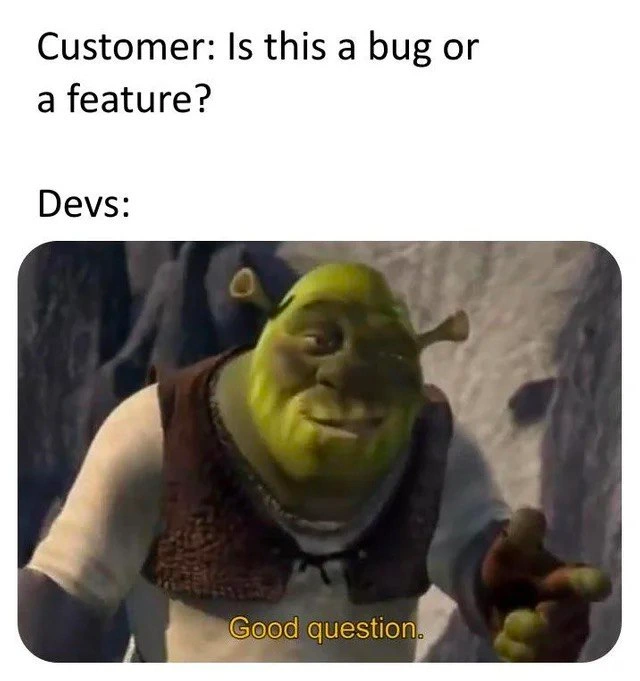
Imagine you’re playing with a toy and it does something unexpected — like a car toy that suddenly makes a funny noise that nobody told you about. Your friend asks, "Hey, did it mean to do that, or was that a mistake?" That’s basically what “Is this a bug or a feature?” means. A bug is like a mistake or an “oops” in a game or toy, and a feature is like a trick or ability that was put there on purpose. The meme shows a customer asking a developer if something in the software was on purpose or not. The developer (like the ogre Shrek in the picture) just says, "Good question," kind of chuckling. It’s funny because it’s like being asked, “Did you spill the milk on purpose or was it an accident?” and you just grin and go, “Hmm, good question!” The developer’s basically admitting in a silly way that they’re not sure if that quirky behavior was intended or just a goofy accident. It’s a joke about how sometimes even the people who made something can be unsure if a surprise result is an error or a cool hidden bonus. In simple terms: the customer is confused, the developer is a little embarrassed, and everyone laughs because sometimes mistakes and surprises can look the same until you decide what to call them.
Level 2: By Accident or Design
Let’s break down what’s happening in this meme in simpler terms. We have a brief customer vs. developer dialogue. The text at the top reads:
Customer: Is this a bug or a feature?
Devs: "Good question."
In the image below the text, we see the famous green ogre Shrek from the animated film, with a subtitle saying "Good question." This image represents the developers’ response. Basically, the customer is asking the developers whether some behavior in the software was done on purpose (feature) or is it a mistake (bug). And the developers, personified by Shrek, are replying with a hesitant “Good question”. It’s like when someone asks you something tricky and you respond, "Hmm, that’s a good question," because you need a moment (and also because you’re not sure of the answer).
In the software world, a bug is an error or flaw in the program that causes it to produce an incorrect or unintended result. A feature, on the other hand, is a part of the software’s functionality that was intentionally designed to be there — basically something that the software is supposed to do. The classic joke "Is it a bug or a feature?" comes up because sometimes it’s not clear-cut. Developers might jokingly call something a "feature" when it’s actually a bug that they didn’t anticipate, especially if that bug doesn’t crash the system and users kind of accept it (or even find it useful). This is where the tag UndocumentedBehaviour (undocumented behavior) fits in: the software might be doing something that wasn’t documented in the requirements or user manual. It’s doing something, but nobody wrote it down as a planned requirement. So is it wrong, or did we just fail to mention it? “Undocumented feature” is a tongue-in-cheek term developers use for a bug that they’re half-seriously presenting as a feature.
Now, why would developers ever be unsure or cheeky about this? Often it comes down to AmbiguityInRequirements and MisalignedExpectations. Maybe the client or stakeholder didn’t clearly specify what they wanted in that part of the system. For example, imagine the spec (specification) said, “The app should sort the list of names.” If it didn’t say how to sort (maybe alphabetically by first name? last name?), the developers might choose one. If later the customer expected a different order, the customer might think the app is doing it “wrong” (so, a bug). But the developers might say, “We thought it was a feature to sort by last name, since it wasn’t specified.” That’s a specification_gap – something the spec didn’t clearly define. When such gaps happen, developers fill in the blanks by design or by guess. If the guess doesn’t match the customer’s expectation, suddenly everyone’s confused about whether the software is incorrect or the request was just unclear. This is the ambiguity the meme is highlighting.
It’s also about Communication. The meme humorously captures a communication gap: the customer is asking a straightforward question, expecting a straightforward answer. But the developers respond in a way that isn’t a clear yes or no. Shrek’s face with that sly expression adds to the humor — it’s like the devs are caught off guard and trying to diplomatically answer without admitting fault. Developers (especially less experienced ones) might panic when a client asks, “Did you mean to do that?” If they say “It’s a bug,” they fear looking unprofessional. If they say “It’s a feature,” they worry the client might reply, “But we never asked for that feature!” It’s a ClientExpectations tightrope. This meme is very relatable because even junior devs quickly learn that managing stakeholder expectations is part of the job.
We also see tags like ScopeCreepConfusion and FeatureLabelingDilemma. Scope creep is when new features or changes keep getting added to a project beyond what was originally agreed upon. Sometimes a team might introduce a small change or an extra bit of functionality (intentionally or accidentally) that wasn’t in the original plan — this can cause confusion later. The feature labeling dilemma is exactly the scenario here: the team needs to decide whether to label this unexpected behavior as a legitimate feature (maybe the scope just “crept” a little) or to admit it’s a bug and fix it. Early in your career, you might encounter this when you deploy something and a user finds a quirk. Your project manager might literally ask you, half-jokingly, “Well, can we call it a feature?” If it’s harmless and the user doesn’t hate it, sometimes the stakeholders will decide not to call it a mistake. They might even update the requirement after the fact so it looks intentional. On the flip side, if the user is unhappy, everyone will agree it’s a bug and prioritize a fix.
The use of a Shrek meme template is just for comedic effect. Shrek is a well-known character that people find funny and likable, and the scene with him saying "Good question." emphasizes a kind of shrugging, honest admission of uncertainty. Even if you’re a junior developer, you probably recognize that feeling: a client asks you something about the system’s behavior that you also find puzzling, and you have to think fast. Maybe you smile awkwardly and say, “Huh, that’s interesting… I’ll look into it!” That’s basically what Shrek’s “Good question” stands in for. It’s the developers being caught between clients and the truth. The RelatableDeveloperExperience here is that sometimes devs genuinely aren’t sure if something was supposed to happen or not, because software can be unpredictable and requirements can be unclear. And instead of immediately answering, they might humorously acknowledge the question while they figure out the answer.
So in summary, this meme’s top text sets up a very familiar situation (customer asking if it's a bug or feature), and the bottom image punchline is the developers’ witty, evasive response ("Good question"). It highlights the common problem of ambiguous requirements and the social dance of explaining software oddities. For a junior dev, the lesson (and the joke) is: software behavior falls into a grey area more often than you'd think, and how you communicate about it can be just as important as the code itself.
Level 3: Schrödinger's Feature
At the senior engineer level, this meme hits on the eternal ambiguity in software development: when does an unexpected behavior stop being a bug and start being called a feature? The Shrek quote "Good question" is basically the dev saying, "Even I'm not sure, let me check the spec... oh wait, there was no spec." This is a classic BugVsFeature scenario. In complex systems, weird emergent behaviour pops up all the time. Maybe the code does something nobody explicitly planned because two modules interacted in a funky way. Now a customer discovers it and asks the dreaded question: "Is this a bug or a feature?"
Why is this so funny (or painful) for experienced devs? Because we've all been there, scrambling to decide how to label an unexpected outcome. If users like the behavior or management thinks it’s beneficial, you can bet it will be spun as an “undocumented feature”. If it’s causing problems, suddenly it’s a critical bug to fix by EOD. The humor comes from that shifting narrative. A cynical translation of the dev’s "Good question." is: "Well, it wasn’t intentionally built (bug), but now that you noticed it, we can pretend we intended it all along (feature), depending on what saves us more headache." In other words, until you observe the consequences, the behavior is in a quantum state – Schrödinger’s feature – both a bug and a feature. Only when the box is opened (the customer notices) do we collapse the wavefunction and decide which label to slap on.
This wink to RequirementsAmbiguity and specification_gap is very real in the industry. Often the requirements are incomplete, or the acceptance criteria didn’t cover some edge case. So when that edge case arises in production, no one is sure if the software is wrong or if the requirement was just vague. Senior devs know that poorly defined projects lead to these "good question" moments. It’s essentially a communication bug between stakeholders and devs that manifests as strange app behavior. But hey, if you phrase it right, that communication bug becomes a feature label in the release notes! (We’ve all seen release notes where a bug fix is worded so positively it sounds like a new feature.)
There's also a bit of dark humor in that Shrek image choice. Shrek, the grumpy green ogre, is known for his blunt honesty and layered personality (like an onion, as he says). Devs “going full Shrek mode” suggests we drop the polite corporate pretense and answer with candid sarcasm. The subtitle "Good question." delivered deadpan is basically the dev stalling for time or cheekily acknowledging the issue. It’s the kind of dry humor a battle-worn developer uses instead of outright admitting “I have no clue how that happened or what to call it.” The meme captures a relatable developer experience: those meetings where a client points out an odd behavior and everyone on the dev team quietly debates whether to own it as a feature (“actually, we thought you’d find this helpful”) or apologize for it as a bug.
On a serious note, seasoned programmers also recognize the stakeholderExpectations management game here. Admitting something is a bug can make the product look bad or the team seem sloppy; calling it a feature might irritate the customer if they feel it wasn’t what they asked for. It’s a lose-lose question. So what do experienced devs do? Sometimes they answer with a non-answer — like "Good question" — buying time to read the room. They’ll then evaluate: Can this quirk be justified as a useful feature? If yes, call it a feature and update the docs later. If no, label it a bug and add it to the sprint backlog (with a silent prayer it’s not a sev-1 emergency). The meme is poking fun at this feature_labeling_dilemma. It’s funny because it’s true: the line between bug and feature is often just who gets to spin the story. As the cynical saying goes, "It’s not a bug, it’s a feature!" — a phrase uttered equally in jest and in desperate seriousness by devs over the decades. In the end, the dev (like Shrek) gives a shrug and a sly half-grin, because the best answer they have is simply, "Good question."
Description
A classic two-part meme format. The top section contains text: 'Customer: Is this a bug or a feature?'. Below this, under the label 'Devs:', is a reaction image. The image is a still frame of the character Shrek from the movie of the same name. He has a thoughtful, slightly smug expression on his face and is gesturing with his hand as if conceding a point. The caption at the bottom of the image reads, 'Good question.' The humor lies in the developers' non-committal and slightly mischievous response. It perfectly captures the ambiguous nature of some software behaviors, which could be unintended errors (bugs) or could be spun as undocumented, intentional functionality (features), depending on the perspective and the effort required to fix them. The meme resonates with any developer who has had to navigate this delicate conversation with stakeholders
Comments
8Comment deleted
It's a feature if the product manager can sell it. It's a bug if it wakes someone up at 3 AM. Until then, it's just 'unexpected behavior'
If support can bill it and QA can’t reproduce it, congratulations - your P1 bug just got promoted to a strategic feature
The real answer depends on whether the Jira ticket was created before or after the code was deployed to production
It's a bug until enough enterprise customers build workflows on it - then it's a feature with an SLA and a deprecation committee
When a customer asks 'Is this a bug or a feature?', the correct answer depends entirely on whether it's documented in the spec, mentioned in the retrospective, or already shipped to production. Senior engineers know this is actually a philosophical question about the nature of intentionality in software - if nobody wrote a test for it, did the behavior ever truly exist? The real answer: 'It's a feature until the post-mortem, then it becomes a learning opportunity.'
In enterprise triage, it's a feature when PM can retrofit acceptance criteria before the postmortem; it's a bug when SRE has a flame graph and a PagerDuty ticket
Features are bugs with a spec doc; the rest get stack traces in prod
Our classifier is cost-center aware: label=bug when Support pays; label=feature when it helps Product hit an OKR; else default=“works as designed” with an updated spec