Skip to content
DevMeme
309 of 7435
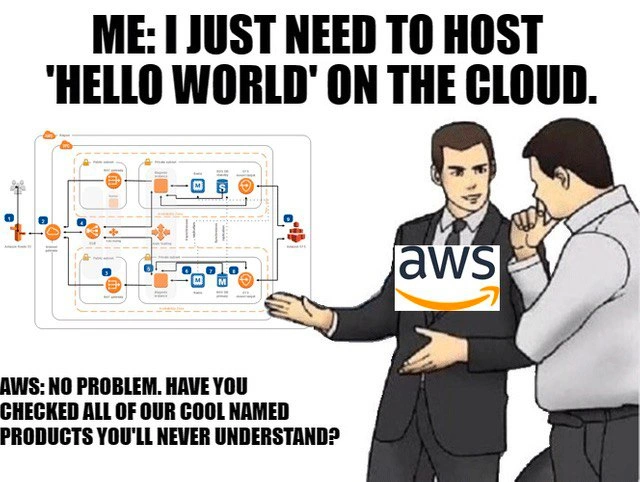
Hosting 'Hello World' on AWS: A Modest Proposal
AWS Post #367, on May 11, 2019 in TG

Hosting 'Hello World' on AWS: A Modest Proposal

Why is this AWS meme funny?

Imagine you ask for a single cookie as a snack, and instead someone builds a gigantic cookie factory just to give you that one cookie. đŸȘ It’s silly, right? You only needed a tiny thing, but they went and created a whole complicated system to deliver it. There are conveyor belts, machines, workers with hairnets, and 47 different steps, all to produce one little cookie for you. You’d probably scratch your head and think, “Wasn’t this a bit much?”

That’s exactly the joke here. In the picture, a person just wanted to put the words “Hello World” on a website (a very simple task). But the Amazon cloud (AWS) is showing off a huge, complex plan with dozens of pieces (like that over-the-top cookie factory) to do it. The feeling it gives is both funny and a little overwhelming – kind of like using a tank to swat a fly. The humor comes from how ridiculously overboard the solution is compared to the tiny problem. Even if you don’t know anything about cloud computing, you can laugh because it’s obvious they made something simple into something crazy-complicated. It’s poking fun at the idea that sometimes big companies use way too many tools and steps for a job that could be done in one simple step. In other words, the poor developer in the meme just wanted a simple website, and AWS responded by saying, “Sure, here’s an entire theme park of technology to go with that!” It’s funny because we all understand wanting something basic and getting much more than we bargained for.

Level 2: So Many Services

For a newer developer or someone just learning about the cloud, this meme might seem both amusing and a bit bewildering. Let’s break it down. AWS (Amazon Web Services) is a giant collection of online services that let you run applications on someone else’s computers (the AWS data centers). When the person says “I just need to host ‘Hello World’ on the cloud,” they mean they wrote a tiny program or webpage that displays “Hello World” and they want to put it on the internet. “Hello World” is the go-to simple app – usually the first thing you write when learning a new programming language – so it’s a super basic request.

Now, AWS is very powerful, but it’s also infamous for having a lot of moving parts. The meme jokes that AWS’s response is “No problem. Have you checked all of our cool named products you’ll never understand?” accompanied by a very overengineered diagram of many AWS services. In plainer terms: AWS is offering an extremely complicated solution with dozens of different services (each with a cool name) to accomplish something very simple. This is cloud humor poking fun at how AWS sometimes turns a small task into a complex project.

What are those tiny icons in the diagram? They each represent a specific AWS product or service. Here are some likely suspects shown and what they do in real life:

  • Amazon EC2 – This stands for Elastic Compute Cloud. It’s basically a virtual server (a computer) in AWS where you can run applications. In a simple world, one EC2 instance could host a “Hello World” website.
  • Elastic Load Balancer (ELB) – A load balancer distributes incoming traffic across multiple servers so no one server is overwhelmed. It’s useful if you expect lots of visitors or need redundancy. For “Hello World” with one user, an ELB is arguably overkill, but AWS might include it to be “enterprise-ready” just in case.
  • Amazon S3 – Simple Storage Service. This is a service for storing files (objects) in the cloud. You can even host a static website out of S3. If all you have is a static “Hello World” webpage, putting it in an S3 bucket would actually be one of the simplest AWS solutions – but the meme’s diagram likely adds S3 on top of other services, making things more complex than needed.
  • AWS Lambda – A serverless functions service. This lets you run code without managing any servers at all; you just upload a tiny function (like a Python or Node.js function) and AWS runs it on demand. Lambda is great for event-driven tasks. Using it for a continuous “Hello World” web service might be strange, but maybe the diagram tossed in a Lambda function doing some ancillary task (just to show off).
  • Amazon RDS – Relational Database Service. This provides managed databases (like a hosted MySQL or PostgreSQL). Typically, a “Hello World” app doesn’t need a database at all, unless you’re storing data. Including RDS in the diagram is part of the joke – it’s an example of AWS suggesting a heavy-duty component even when it might not be necessary for a basic app.
  • Amazon Route 53 – AWS’s DNS (Domain Name System) service. DNS translates your website name (like helloworld.com) to the IP address of the server. Route 53 is actually a sensible service even for simple projects if you want a custom domain to point to your Hello World app. The meme includes it to show that AWS isn’t leaving anything out of this big solution bundle.
  • VPC (Virtual Private Cloud) – This is your own private network inside AWS. Think of it as a virtual data center where you can have sub-networks (subnets), routing rules, and security controls. In AWS best practices, even a simple app ends up inside a VPC for security. The diagram shows multiple VPC subnets (perhaps one for public-facing stuff and one for private backend stuff). Setting up a VPC correctly can involve a lot of knowledge (internet gateways, NAT, route tables), which adds to the complexity.
  • Auto Scaling – AWS can automatically launch or shut down EC2 instances based on load. For example, if suddenly thousands of people access your Hello World, auto-scaling could start new servers to handle it. It’s a clever feature for big applications that experience variable traffic. For one little “Hello World” app, you probably won’t need this, but the official architectures often include it to be ready for anything.
  • CloudWatch & CloudTrail – These are monitoring and logging services. CloudWatch monitors your resources and can alert you if (for example) your server is using too much CPU or is down. CloudTrail keeps logs of who did what in your AWS account (for auditing). In an enterprise “landing zone,” they are standard for observing what’s happening. A newbie just hosting Hello World wouldn’t think of these at first, but AWS loves to remind you of all the operational tools.

These are just a few of the “cool named products” likely referenced. AWS has an entire catalog of names like Fargate, Kinesis, Aurora, Neptune, etc. – and for a newcomer, it can absolutely feel overwhelming. The meme exaggerates by saying “products you’ll never understand,” but it pokes fun at a real feeling: when you’re new to AWS, a lot of service names sound like sci-fi characters or mythical creatures, and it’s hard to know what each does without a lot of study. It’s cloud_onboarding_complexity in a nutshell: there’s a steep learning curve to even the basics.

The phrase “47-Service Landing Zone” in the title is a tongue-in-cheek reference to how AWS often encourages setting up a Landing Zone — a pre-configured, secure, multi-account environment with all the trimmings. A Landing Zone isn’t a single service, but rather a collection of AWS best practices and setups: separate accounts for dev vs prod, centralized logging, security guardrails, networking set up with VPCs and subnets, etc. It’s like AWS’s suggested starting blueprint for enterprises. In reality, configuring a Landing Zone can indeed involve a lot of services and steps (maybe not literally 47, but when you count every little component, it can feel that way). So saying “Hello World turns into a 47-service landing zone” humorously exaggerates that even the simplest project gets the full enterprise treatment as if it were a huge mission-critical system.

Now, why is this funny to developers? Because we’ve all been in a situation where something that should be simple turned out absurdly complicated due to corporate policies or over-engineering. Over-engineering means designing a solution that's far more complex than necessary for the task at hand. Here, using dozens of AWS services to say “Hello World” is a perfect example of over-engineering. It’s like using a 10-ton crane to lift a spoon. Developers (especially those who have worked with large companies or cloud projects) find this relatable. Many juniors learn the ideal – “just write your code and run it” – only to later discover that in a real cloud environment you have to deal with network settings, security groups, load balancers, identity and access management, and so on, even for something tiny. The meme humorously shines a light on that big gap between expectation and reality.

Another term hinted in the meme is vendor lock-in. This means becoming so dependent on a provider’s proprietary services that it becomes hard to move somewhere else. In the meme, AWS is effectively saying “use all of our things!” If you actually did architect your Hello World with 47 AWS-specific services, you’d be pretty tied to AWS; moving that setup to another cloud provider (like Google Cloud or Azure) would be extremely difficult because each AWS service has its own unique features and configuration. The joke about “you’ll never understand” also jabs at how AWS’s complexity can make you feel trapped in their way of doing things.

Finally, the format of the meme itself: “slaps roof of car” is a popular meme template. Usually, it features a car salesman slapping the car’s roof saying something like, “This bad boy can fit so much [X] in it.” It’s a way to humorously exaggerate the capacity or feature of something. In this case, the AWS rep (the salesman) is slapping the big architecture diagram, implying “This cloud setup can fit so many services in it!” The text “AWS: No problem. Have you checked all of our cool named products...?” is the punchline that replaces the usual salesman’s boast. It’s making fun of how AWS tries to offer you every service under the sun. The other character in the meme (the “ME:” person on the right, hand on chin) looks either confused or skeptical – which is exactly how a developer might feel when being presented with an overly complex solution to a simple request.

In summary, to a junior dev: the meme is funny because it shows an extreme exaggeration of a real phenomenon. AWS has a lot of services, and sometimes you get the feeling they want you to use them all, even when you don’t need to. It’s poking fun at the AWS cloud ecosystem for being so complicated that even a “Hello World” ends up looking like a space shuttle launch. The truth is, you can host a simple Hello World on AWS with just one service (for example, just using an EC2 instance or just using an S3 static website), but the meme jokes that AWS will instead introduce you to a whole world of other services – leaving you a bit dazed and asking, “Do I really need all of this?!” It’s a lighthearted way to vent about the steep learning curve and complexity of modern cloud infrastructure. After all, figuring out how all these pieces fit together is a rite of passage for cloud developers – and until then, memes like this let us laugh at the absurdity.

Level 3: Landing Zone Labyrinth

At first glance, this meme slaps you with a cloud architecture design absurdity that every jaded engineer recognizes. The developer says they “just need to host Hello World” – about as simple a request as it gets – but the AWS salesman (complete with a big AWS logo on his suit) proudly gestures toward a sprawling diagram of interconnected services. It’s the classic “slaps roof of car” format, except the car is an Amazon data center, and the salesman is basically bragging, “This bad boy can fit so many managed services in it.” The humor hits home because AWS, the king of cloud providers, often turns even trivial deployments into a Byzantine enterprise infrastructure. This single image riffs on aws_service_sprawl – that tendency to throw the entire kitchen sink of cloud services at a problem – creating an over-engineered monstrosity for something as tiny as printing “Hello, World!”.

The architecture diagram in the meme is hilariously overblown: it’s Hello World overkill in full display. You can spot a flurry of AWS icons: there’s likely an Amazon EC2 instance (virtual server) sitting behind an ELB (Elastic Load Balancer) even though there’s probably only one user. There are multiple VPC subnets drawn out, perhaps with NAT Gateways and Internet Gateways to segment networks because why not. An Amazon RDS database is in there too – maybe our “Hello World” needs a highly available relational database for that one string of text 🙃. Storage? Of course! An S3 bucket to hold the single static page, and perhaps an EFS or FSx just in case. We see a Route 53 DNS service handling the custom domain, an Auto Scaling Group ready to launch more EC2 instances at the slightest hint of traffic, and even an AWS Lambda function or two triggering off of S3 events (perhaps to log each hello for posterity). There are likely CloudWatch alarms, IAM roles for every micro-component, maybe a CloudFront CDN, and a WAF for security – all drawn with those official orange and blue AWS icons. Essentially, the meme’s whiteboard is a 47-service landing zone where a simple one-page app has been exploded into a full-blown enterprise reference architecture. It’s a cloud_onboarding_complexity nightmare that senior devs joke about when trying to follow AWS’s endless “best practices.”

Why is this funny (and painful)? Because it nails a real industry pattern: overengineering. Experienced engineers have sat through meetings where a simple idea ballooned into an entire microservices ecosystem. Here, the innocent “Hello World” is burdened with production-grade everything: multi-tier architecture, high availability, and every AWS product someone’s budget will allow. The meme exaggerates, but not by much – AWS’s own solution architects often present reference designs that feel this convoluted, even for modest apps. There’s an element of VendorLockIn satire too. AWS has a cool named product for every need (and plenty you didn’t know you had). Once you adopt all those cool named products – from Amazon S3 to AWS Lambda to DynamoDB and beyond – you’ll never escape their orbit. It’s the cloud equivalent of being sold a luxury sports car when you asked for a bicycle; sure, it’s fancy, but now you’re stuck buying the premium fuel. Seasoned devs recognize that AWS’s sprawling ecosystem, while powerful, comes with massive cognitive overhead. Every new service has its own quirks, limits, and learning curve. So the caption “Have you checked all of our cool named products you’ll never understand?” pokes fun at how overwhelming AWS’s menu can be – especially when those services are pushed on you even if you don’t need them.

This shared joke hides some scars. Any senior engineer who’s been through a large cloud project chuckles and cringes because they know there’s truth here. We’ve seen scenarios where deploying a simple web page required touching a dozen AWS consoles or writing hundreds of lines of CloudFormation/Terraform. We’ve experienced the aws_service_sprawl first-hand: start with one EC2 instance, then add a load balancer for “future scale”, then segregate into private subnets for “security”, then throw in a monitoring stack, then... suddenly your “Hello World” is a mini NASA launch. Each piece might be justified in isolation – Route 53 for reliable DNS, multiple AZs for fault tolerance, IAM roles for granular security, etc. – but collectively it feels insane for a tiny app. The meme is essentially AWS saying “Sure, we can host your little app – but let’s also set you up with a robust enterprise-grade deployment pipeline and oh, have you considered our machine learning services too?” The slap_roof_of_car_meme format perfectly captures that smug enthusiasm of a salesperson overwhelming you with features.

From a systems design perspective, there’s irony in how simple problems meet complex solutions in the cloud. AWS preaches the Well-Architected Framework (covering security, reliability, performance, cost optimization, etc.), which is great – except it means even a toy app ends up architected like a mission-critical system. The meme’s absurd “47-Service” setup highlights the gap between theoretical best practices and practical needs. It’s a commentary on cloud architecture design culture: architects often fear under-designing, so they over-design everything. There’s a bit of “if all you have is a hammer, everything looks like a nail” going on – AWS has hundreds of hammers, so they’re eager to use them all. The hello_world_overkill scenario lampoons that tendency. It resonates with senior devs because we know how we got here: years of AWS adding service after service (over 100 and counting by 2019), each solving a niche problem or adding a layer of abstraction. Over time, what used to be a simple LAMP stack on one server morphed into a distributed monstrosity of microservices, each one doing a small thing but collectively introducing massive complexity. As Tech Historians (yes, some of us have been around that long) might point out: not long ago “Hello World” ran on a single box; now it runs on an indeterminate swarm of Docker containers managed by Kubernetes, fronted by API Gateways, talking to serverless functions, all monitored by AI ops tools
 Progress, right? The meme condenses that entire saga into one image, which is equal parts hilarious and horrifying.

And of course, there’s the on-call engineer’s perspective – the dark humor of knowing that each added service is another potential point of failure at 3 AM. More services, more AWS bills, and more late-night PagerDuty alerts because some configuration in that tangled web went wrong. (Is the site down because Auto Scaling spun down the instance? Did a Route 53 DNS record not propagate? Or maybe the Lambda function’s IAM permissions are off – again.) The meme’s joke carries an undertone of exasperation: we’ve created an infrastructure so elaborate that even a simple app’s deployment diagram looks like an MC Escher painting. It’s funny because it’s true – and every experienced cloud engineer has the war stories to prove it. In short, “When AWS turns Hello World into a 47-service landing zone” is a tongue-in-cheek warning: in the cloud, YAGNI (You Ain’t Gonna Need It) is often forgotten, and the result is a labyrinthine setup that only a cynical, battle-scarred dev could love (or hate).

Description

This meme uses the 'Slaps Roof of Car' or car salesman format to satirize the perceived complexity of Amazon Web Services (AWS). At the top, bold text reads, 'ME: I JUST NEED TO HOST "HELLO WORLD" ON THE CLOUD.' The meme features a salesman, with the AWS logo superimposed on his jacket, enthusiastically presenting an incredibly complex, multi-layered cloud architecture diagram instead of a car. Below, the salesman's punchline reads, 'AWS: NO PROBLEM. HAVE YOU CHECKED ALL OF OUR COOL NAMED PRODUCTS YOU'LL NEVER UNDERSTAND?'. The humor stems from the massive disparity between the user's simple request and the over-engineered, enterprise-grade solution offered. It perfectly captures the overwhelming experience many developers face when first using a major cloud provider, where the sheer number of services and the assumed architectural complexity can feel like overkill for basic tasks
Comments

8
Anonymous ★ Top Pick This architecture is perfect for 'Hello World'. It's infinitely scalable, has seven nines of availability, and only costs $800 a month after you forget to tear down the NAT Gateway
  1. Anonymous ★ Top Pick

    This architecture is perfect for 'Hello World'. It's infinitely scalable, has seven nines of availability, and only costs $800 a month after you forget to tear down the NAT Gateway

  2. Anonymous

    Proof you can’t even say “Hello” on AWS without provisioning a multi-AZ relationship first

  3. Anonymous

    The best part about AWS is that by the time you've figured out which 47 services you need for Hello World, they've deprecated three, renamed five, and launched twelve new ones that do the same thing but with AI in the name

  4. Anonymous

    Step one of hosting Hello World on AWS: a Well-Architected Review. Step two: discovering the NAT Gateway costs more than your entire app's lifetime value

  5. Anonymous

    This perfectly captures the AWS experience: you come in wanting to deploy a static HTML file, and three hours later you're knee-deep in VPCs, security groups, IAM roles, CloudFormation templates, and a Lambda function that somehow got involved. The real kicker? That 'Hello World' now costs $47/month because you forgot to delete the NAT Gateway the solutions architect insisted you'd 'definitely need for production-grade reliability.' Meanwhile, your Vercel-using colleague deployed theirs with `git push` and is already on their third coffee break

  6. Anonymous

    Request: host a hello-world; Response: three VPCs, six subnets, ALB->ECS->RDS, SQS DLQ, and a 1,200-line CloudFormation 'for reliability.' YAGNI must be the only AWS service I can't find in the console

  7. Anonymous

    On AWS, the smallest deployable unit isn’t a container - it’s a Well-Architected diagram with 17 services, three accounts, and an IAM policy diff that needs a graph database

  8. Anonymous

    AWS 'Hello World': Orchestrating EC2-VPC-Lambda-S3 via API Gateway because one VM lacks the panache of acronymic indigestion

Use J and K for navigation