Skip to content
DevMeme
6036 of 7435
The C++ Standards Committee Deprecation Two-Step
Languages Post #6609, on Mar 31, 2025 in TG

The C++ Standards Committee Deprecation Two-Step

Why is this Languages meme funny?

Level 1: The Wobbly Table Fix

Imagine you live in a very old house. There’s a wobbly table in the dining room with one short leg. To stop it from wobbling, the previous owner shoved a bunch of old books and papers under that leg years ago. It’s ugly – a pile of tattered books on the floor – and you decide, “This stuff is ancient junk, I’m cleaning it up!” You pull out the stack of old books and toss them away. For a moment, you feel great for getting rid of that old clutter. But as soon as you do, the table starts shaking and about to tip over. The dishes slide, a vase nearly crashes to the ground – yikes! You panic, realizing those “junk” books were actually doing an important job: they were propping up the table. In a hurry, you grab the books back from the trash and shove them under the leg again to stabilize everything. Phew, disaster avoided. It’s a funny little drama: you tried to tidy up by removing something old, then had to quickly put it back when things went wrong. That’s exactly the joke this meme is making, but with computer code. The people in the cartoon thought an old piece of code wasn’t needed and tried to drop it, then realized that everyone was relying on it and they’d be in big trouble without it. So they rushed to bring it back. Even though those old books (or that old code) seemed like useless clutter, they turned out to be holding things together. The humor comes from that “uh-oh” moment and the speedy reversal – it’s a silly cycle of “throw out the old thing, panic, bring it back!” which anyone can understand, even without knowing about C++ or programming.

Level 2: Feature Flip-Flop

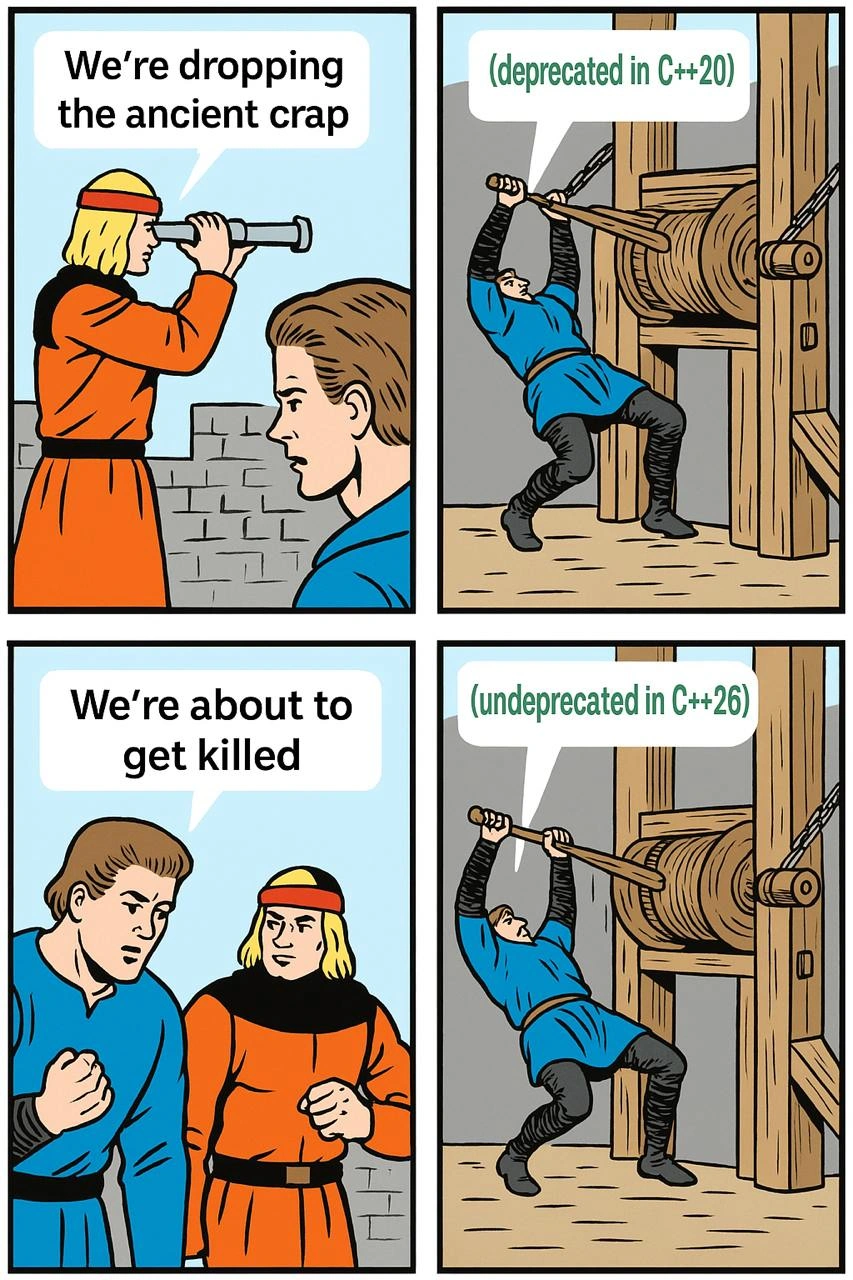
Let’s break down the technical joke in simpler terms. In programming, deprecation means a feature (like a function, class, or library component) is officially marked as old and discouraged. It still works for now, but the language maintainers are hinting “we might remove this in the future, so please migrate your code to the new way.” In the context of C++, C++20 is a version of the C++ standard (released in the year 2020) that introduced many modern features. The meme imagines that C++20 also deprecated some “ancient” feature – perhaps some old function or programming style that has been around forever. The first panel’s text “We’re dropping the ancient crap” is a playful way of saying the committee wants to get rid of that old feature in C++20. The second panel explicitly labels that act as “(deprecated in C++20)”. You can imagine a line in the standard or compiler notes saying something like: “Feature X is deprecated in C++20.” For example, in real life, std::auto_ptr was a classic C++98 smart pointer that got deprecated in C++11 and removed by C++17 because std::unique_ptr was superior. Deprecation is like a big warning sign to developers: “don’t use this anymore, it’s going away.”

Now, why is that a problem? Because legacy code (old codebases) often rely on those exact “ancient” features. Think of huge code projects that started 20 years ago – they might still use that feature X everywhere. If a new C++ version outright removes it, those projects won’t compile or will break at runtime. This is where backward compatibility becomes a concern: new versions of a language or tool need to still support stuff from older versions, or else users can’t upgrade without major work. The meme’s third panel (“We’re about to get killed”) dramatizes the panic when people realize a deprecation is about to cause a breaking change. In a real scenario, it’s like maintainers of big software suddenly saying, “Oh no, if we adopt C++20, our program might stop working, and we don’t have time to rewrite thousands of lines to remove usage of that feature!” There’s a real anxiety around this in C++ circles – sometimes humorously called ABI backcompat anxiety. ABI stands for Application Binary Interface, which, simply put, is how compiled code pieces work together. If a change in the language alters data structures or function signatures, old compiled libraries might not work with new ones. That’s a nightmare for projects that depend on pre-compiled third-party libraries. It’s one reason C++ standards are cautious; one small change can ripple out and “kill” a lot of software builds.

Finally, the meme’s punchline in panel 4, “(undeprecated in C++26)”, shows the committee reversing the decision. C++26 would be the version coming in 2026 (since the committee typically releases a new standard every three years: 2017, 2020, 2023, and the next would be 2026). Undeprecating is not a common formal term, but here it means “we decided NOT to remove that feature after all.” Essentially, the committee would be saying, “Oops, our bad – we’ll keep this thing around in C++26 because too many people still need it.” This kind of feature flip-flop is humorous because it makes the standards body look like they can’t make up their mind, but it usually happens for pragmatic reasons. They announce a deprecation to encourage migration, but if adoption of the new approach is too low or if the old feature proves too vital, they might halt the removal. For a relatable example, think of a software library you use that says “Function XYZ is deprecated, use ABC instead.” You might ignore that for a while if XYZ still works. If one day an update actually removed XYZ, and tons of apps broke or developers complained, the maintainers might release a patch to put XYZ back in. In essence, legacy systems have a lot of inertia – they don’t change quickly – and maintainers (or committees) sometimes yield to that reality. This meme uses a medieval castle scenario (dropping the castle gate and then pulling it back up) as a funny analogy for the C++ committee’s predicament: try to drop old stuff to improve the language, then quickly raise it back when you realize you’ve opened the gates to disaster (angry developers, broken builds!). It’s a relatable humor moment for anyone who’s seen big software platforms struggle with breaking changes and the burden of technical debt carried from older generations of code.

Level 3: Battering Ram of Backcompat

Experienced C++ developers recognize the dark humor here immediately. The four-panel comic dramatizes the C++ standards committee doing its loaded dance with legacy code. In Panel 1, the lookout in orange proudly announces, “We’re dropping the ancient crap.” This is that triumphant meeting moment when the committee (or any dev team) decides to finally deprecate some archaic feature that’s long outlived its welcome. Perhaps it’s an old C-style API or a dangerous class like std::auto_ptr from the bygone days. Marking something as (deprecated in C++20), as shown in Panel 2 by the blue-clad worker straining at a wooden winch, is the committee essentially turning the crank to lower the castle’s drawbridge – dropping what they perceive as dead weight. There’s almost a celebratory tone: “We’ve wanted to get rid of this for ages, and C++20 is our chance!” Seasoned engineers know to hold their applause, because they’ve seen this movie before.

By Panel 3 the mood shifts: the second sentry in blue is clenching his fist and fretting, “We’re about to get killed.” This captures that sinking feeling senior devs get right after a bold breaking-change is announced. Reality sets in. All the brown-field enterprise projects, legacy codebases, and critical systems built over decades suddenly start failing in pre-release tests. The moment you “drop” that ancient piece of tech debt, you discover it was load-bearing. In practice, maybe dozens of Fortune 500 companies find their massive codebases (with minimal unit tests 😬) won’t compile or will misbehave because of the removal. The ABI backcompat anxiety kicks in hard. For example, altering something fundamental in the standard library (say the memory layout of std::string or eliminating a legacy IO facet) can break binary compatibility between libraries. It’s like hearing the crack of a medieval battering ram hitting your castle gate. Breaking changes threaten to let chaos (or invaders) in. Old services fail to start, builds spew errors, and CTOs receive panicked phone calls. The very stability the castle (C++ ecosystem) relied on is now in question.

Panel 4 is the punchline every veteran expects: the same worker at the winch now declares “(undeprecated in C++26)”. In other words, after all the panic and outcry, the committee performs a standard_committee_u_turn. They hastily retract the decision in the next revision, attempting to save face and, frankly, save everyone’s neck. This actually happens in the tech world: a feature flagged for removal gets a last-minute pardon once it’s clear how many critical systems would be wrecked. It’s a comical feature flip-flop. We saw hints of this with things like std::istream locale facets or certain POSIX C functions – whenever removal was discussed, big stakeholders would pipe up, “Actually, we still need that.” The phrase deprecate_then_undeprecate isn’t standard terminology, but it perfectly describes this embarrassing backpedal when theory meets practice. Senior devs laugh (perhaps bitterly) because they’ve lived this. One day you’re excitedly refactoring to remove “cruft”, the next day you’re undoing that commit because production went 🔥. The ISO C++ committee, despite all its careful proposals and reviews, ultimately serves real-world C++ users. Those users run LegacySystems that might have been compiled 10+ years ago and absolutely cannot be broken by a new compiler or standard library. This is why C++ carries so much TechnicalDebt across versions – it’s the price of keeping the ecosystem functioning. As much as the committee wants to modernize (drop old garbage, simplify the language), they must also ensure LanguageEvolution doesn’t burn the millions of lines of LegacyCode out there. The meme’s medieval siege imagery is tongue-in-cheek: any attempt to quickly overhaul C++ is as perilous as letting a castle gate slam down during an attack. You risk your entire fortress. So the blue guard’s panic – “We’re about to get killed” – is every lead engineer thinking about the downstream impact, and the final panel’s retreat is the grudging acceptance that backward compatibility won the day. In short, this meme humorously encapsulates a very real C++ saga: bold change, immediate regret, and an eventual u-turn to keep the peace.

Level 4: The Halting Problem of Deprecation

At the most abstract level, this meme highlights a near-undecidable problem in language evolution: how do you safely remove a widely-used feature from a Turing-complete system? In theory, deciding whether a deprecated feature can be eliminated without breaking any existing code is as hard as analyzing all possible programs that use it. This edges into the realm of the Halting Problem – you’d need to simulate or examine every binary and codebase out there to be sure nothing critical fails. In formal terms, the decision boundary for “safe to deprecate” grows combinatorially with each new usage context. Thanks to Hyrum’s Law (which informally says any observable behavior in your system will be depended on by somebody), a C++ feature that’s been around since the 90s will invariably be entrenched in ways the standards committee cannot fully predict or verify. Deprecation proposals often come with academic justifications (cleaner semantics, removal of footguns, better optimization potential), but they slam into the intractable complexity of real-world usage. Each C++ feature interacts with others (templates, macros, the preprocessor, ABI hooks) in a complex graph of dependencies. Removing one node from that graph can have far-reaching effects on type deduction, object layouts, or symbol resolution – a bit like trying to remove a Jenga block from the bottom of a gigantic tower blindfolded. The ISO committee operates in a reality bounded by these mathematical and practical constraints: even with careful deprecation schedules, computational complexity and sheer coverage impossibility mean they can never test every castle wall for cracks. So the decision to yank out “ancient crap” isn’t just a cultural or business one; it’s bumping against fundamental computability limits and the explosion of state space in existing programs. In short, the committee’s predicament is akin to solving an NP-hard problem with stakeholders screaming that time’s up. The medieval siege metaphor fits perfectly: it’s the unsolvable conundrum of trying to modernize a complex system without collapsing the countless structures built atop it. If that sounds impossibly hard – it absolutely is. Backward compatibility might as well be a law of physics in systems this large, an inviolable conservation rule: break it at your peril.

Description

A four-panel comic strip in a medieval setting that satirizes the C++ language standards process. In the first panel, a character in orange robes looks through a spyglass from a castle wall and declares, 'We're dropping the ancient crap.' The adjacent panel shows a man in a blue tunic operating a large wooden winch, releasing a heavy mechanism, with a speech bubble above him saying, '(deprecated in C++20).' The third panel shows the original two characters looking panicked, with the one in orange saying, 'We're about to get killed.' The final panel mirrors the second, but now the man is struggling to reverse the winch, with a new speech bubble reading, '(undeprecated in C++26).' The meme humorously critiques the C++ standards committee for deprecating features that seem obsolete ('ancient crap') but are later discovered to be critical, forcing them to reverse the decision in a future standard. This scenario is relatable to senior C++ developers who have witnessed the language's sometimes turbulent evolution and the real-world consequences of removing long-standing, albeit arcane, features
Comments

18
Anonymous ★ Top Pick Deprecating a C++ feature is like removing a load-bearing brick from a medieval castle because it doesn't look modern. It's all fine until you realize that brick was the only thing holding up the entire concept of 'memory safety'
  1. Anonymous ★ Top Pick

    Deprecating a C++ feature is like removing a load-bearing brick from a medieval castle because it doesn't look modern. It's all fine until you realize that brick was the only thing holding up the entire concept of 'memory safety'

  2. Anonymous

    Nothing says “committee consensus” like shipping a removal in C++20 and rediscovering ten million lines of COBOL-tier templates still depending on it by C++26

  3. Anonymous

    After 20 years in the industry, you realize the C++ committee's deprecation warnings are like production alerts at 3am - they'll definitely wake you up, but by the time you've refactored everything, they've already rolled back the change and now your 'fix' is the problem

  4. Anonymous

    When the C++ standards committee plays 'musical chairs' with language features, but the music is a 6-year deprecation cycle and the chairs are your production codebase. Nothing says 'stable ABI' quite like features that get deprecated in C++20 only to be undeprecated in C++26 - because apparently even the committee couldn't decide if that ancient crap was actually crap or just misunderstood genius. Meanwhile, your CI/CD pipeline is having an existential crisis trying to figure out which compiler flags to use

  5. Anonymous

    Deprecating C++ relics feels victorious - until 'unexpected' UB activates the blade mid-merge to main

  6. Anonymous

    WG21’s deprecation policy is basically a two‑phase commit: mark it deprecated in C++20, discover half of prod depends on it, then roll back in C++26 for eventual consistency with reality

  7. Anonymous

    In C++, deprecation is basically a feature flag for committee panic: ship the warning, watch half of finance fail to compile, then flip it back before the ABI freeze

  8. @afdanilkin 1y

    What are these features (deprecated in C++20, to be restored in C++26)?

    1. dev_meme 1y

      Asking serious question in meme channel? What are you, a real dev who ain’t just pretending to be one? 🤔

    2. @playday3008 1y

      https://en.cppreference.com/w/cpp/memory/polymorphic_allocator/destroy

      1. @Art3m_1502 1y

        What the actual fuck

      2. @Vlasoov 1y

        according to undeprecating PR, it was not garbage rather API contract respect

    3. @Sun_Serega 1y

      I'm pretty sure admin asks the latest ClosedAI model to generate memes with only a general direction, and this is one of relatively good results

      1. dev_meme 1y

        Are you for real? 😭

      2. @chupasaurus 1y

        I'm pretty sure admin never asked Threads FE devs for that🤯

  9. @imfreetodowhatever 1y

    I think of my future granchildren...maybe their grandchilren will see full support of modules from C++20 A man can dream...

    1. @SamsonovAnton 1y

      Scientists assert that a person was already born that will one day witness it.

  10. @JackOhSheetImSorry 1y

    Feature just went on sabbatical 🌚

Use J and K for navigation