Skip to content
DevMeme
5485 of 7435
Hacker Icon Smea Taunts Nintendo by Running Homebrew Launcher at Their HQ
Security Post #6011, on May 20, 2024 in TG

Hacker Icon Smea Taunts Nintendo by Running Homebrew Launcher at Their HQ

Why is this Security meme funny?

Level 1: Breaking the Rules for Fun

Imagine you have a toy that’s locked in a box by the toy company. The company says, “You can play with the toy, but only in our special playroom and exactly how we allow it. No taking it apart or changing it!” Now picture a clever kid who manages to pick the lock on that box, take the toy out, and come up with a cool new trick the toy can do that the company never planned. That kid is so proud and bold that they go right up to the toy company’s front office, stand outside the window, and make the toy do the new trick while waving hello. That’s essentially what’s happening in this meme – and it’s why it’s both funny and triumphant in a cheeky way.

In the photo, the “toy” is a Nintendo 3DS game device, and the “new trick” is running a homebrew launcher (an unofficial program) on it, which Nintendo normally wouldn’t allow. The person basically broke the rules of the device and then said “hi” to Nintendo with proof in hand. It’s like a student figuring out a puzzle the teacher said was unsolvable, and then showing the solution right outside the teacher’s door with a big grin. The feeling it gives is a mix of rebellion (“I’m not following your rules!”) and playfulness (“No hard feelings, but look what I did!”). Even if you don’t know the technical details, you can sense the mischief and pride. The guy in the meme isn’t destroying anything; he’s just showing off that he could do something clever. It’s that classic playful scene of “I did something you said I couldn’t do, and now I’m saying hello to you with it.” In simple terms, it’s a fun reminder that curious people will always find creative ways to play – even right under the rule-maker’s nose.

Level 2: Console Hacking 101

So what exactly is going on in this meme? Let’s break it down in simpler terms. We have a Nintendo 3DS, which is a handheld gaming console (imagine a Game Boy on steroids, with 3D graphics and internet connectivity). Nintendo designs these devices to only run approved software – basically, the games you buy on cartridge or download from their eShop. Think of it like a locked phone that only allows apps from the official App Store. The 3DS has built-in checks to prevent any unapproved apps from running. In tech terms, that means it won’t run code unless it’s digitally signed by Nintendo. If you try to run something else, the console says “Nope, not gonna happen.”

Now, homebrew is the term for any software made by hobbyists or fans that isn’t authorized by the console maker. (The word comes from “homemade brew” like homemade beer – in this case, homemade games or apps!). Enthusiasts write homebrew games, emulators, or custom tools to extend the device’s capabilities. For example, someone might write a homebrew app to turn the 3DS into a media player, or to run classic games from older systems. But to run these cool homemade apps on a 3DS, you first have to unlock or hack the console, because by default it’s like a club with bouncers at the door (and those bouncers check for Nintendo’s signature on every guest, er, app).

What smealum (the person in the tweet) did was find a way to jailbreak the 3DS. Jailbreaking is a term often used with iPhones, but it applies here too – it means removing the manufacturer’s restrictions so you can run whatever code you want, effectively freeing the device from its “jail”. In the context of the 3DS, this usually involves discovering a vulnerability – basically a mistake or oversight in the 3DS’s software. This could be, for instance, a game that doesn’t handle certain data correctly. A classic example from the 3DS days is an exploit called Ninjhax: hackers found out that if you scan a special QR code in the game Cubic Ninja, it would trigger a bug that lets you run custom code (like the Homebrew Launcher). Another example is Soundhax, where a specially crafted MP3 file could crash the 3DS’s sound player app and slip into homebrew loading. These are all types of exploit development – writing data or code that exploits a bug to do something unintended. It’s like finding out that a specific sequence of button presses on a vending machine gives you free soda because of a flaw in its program.

Once an exploit is used and you manage to run a piece of custom code on the 3DS, that code can open a door for more. In the image, the 3DS screen shows “the homebrew launcher”. This Homebrew Launcher is basically a friendly menu that appears after you’ve hacked the console, allowing you to launch various homebrew apps from an SD card. Think of it as unlocking a secret “app store” of unofficial goodies on your device. It’s unsigned code (no Nintendo signature), yet it’s running – which means the hack worked! Getting that far typically means the hacker has temporarily bypassed or permanently disabled the signature check. Sometimes it’s temporary (you have to perform the exploit each time on boot), and sometimes, if the hack is advanced, it becomes permanent (like installing custom firmware that stays on the device).

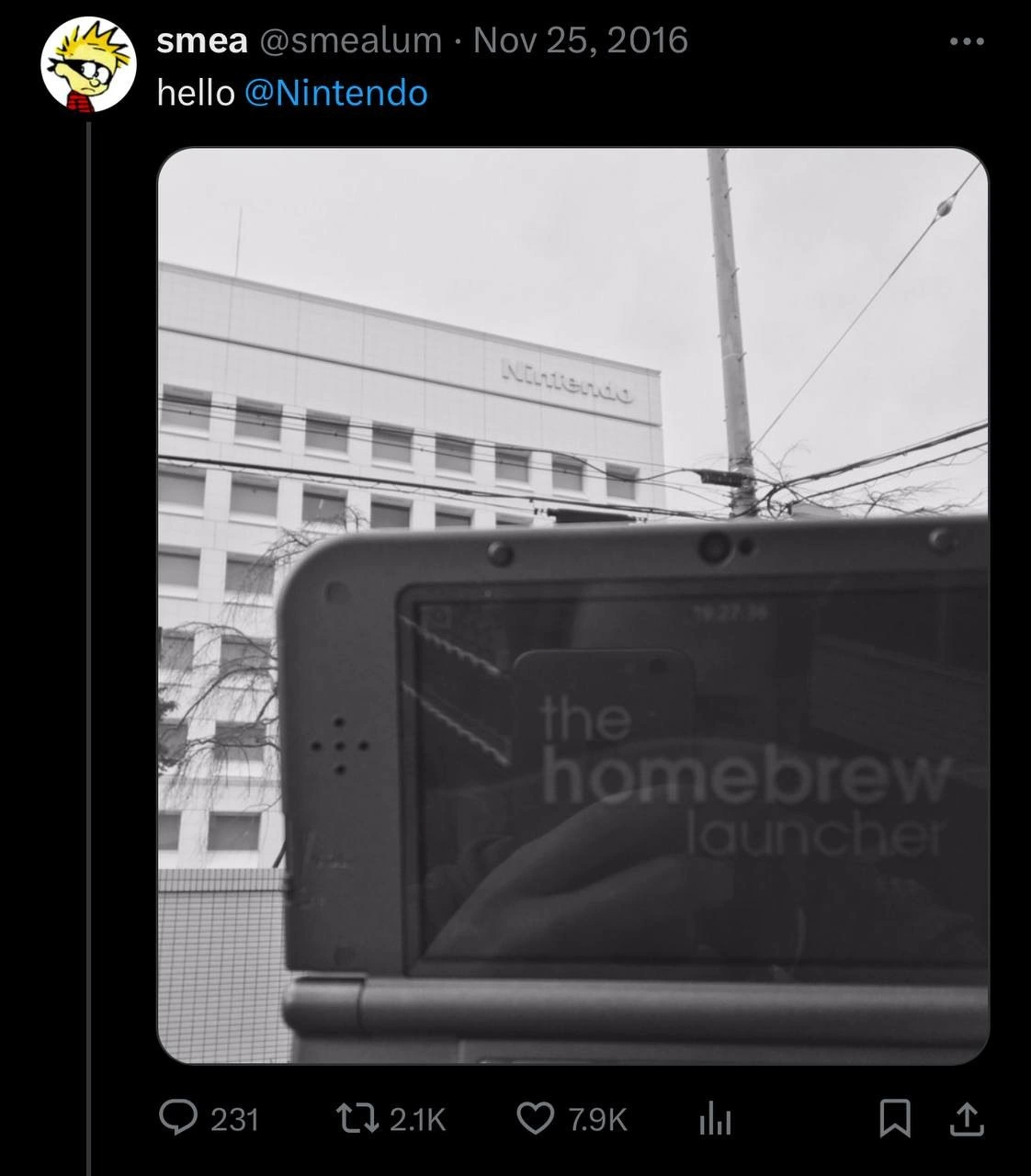
Now, the funny part: why take a picture of this in front of Nintendo’s building? Because it’s a playful way of saying “Look what I can do!” The tweet just says “hello @Nintendo” – very short, very cheeky. The photo is a tweet screenshot, meaning someone took a screenshot of that tweet interface (with the username, date, and the image). The black-themed Twitter UI in the meme shows it was a tweet from November 25, 2016. It got a lot of likes and retweets (as visible at the bottom), which means it resonated with many people. The phrase “corporate_building_flex” in the tags basically describes exactly that: doing something daring or boastful (a flex) in front of a corporate building (Nintendo’s HQ). And indeed, in the picture, you can see the big Nintendo sign on the building in the background. The person literally held up the hacked 3DS so that the Nintendo logo is visible right above it – making the composition of the photo a visual punchline.

To connect this with general tech terms:

  • Reverse engineering is mentioned in the tags. That’s like taking apart a machine to figure out how it works. Here, hackers reverse-engineered parts of the 3DS system and games to find out where the weak points were. They might use tools to dump the code from a game cartridge or observe how the system behaves, looking for any “holes” or mistakes.
  • Exploit development is the next step: once you find a potential hole (say, the game doesn’t check how long your username is), you develop an exploit – for example, you create an extra-long username that crashes the game in a controlled way and then injects the Homebrew Launcher program into memory.
  • Hardware hacks can sometimes mean physically modifying a console (like soldering a modchip onto the circuit board to bypass security). In the 3DS’s case, early on people did use flashcarts (special game cartridges loaded with custom firmware) or hardware mods, but by the time of this tweet, software exploits were enough. It’s still under the umbrella of hardware hacks, because you are fundamentally changing how the hardware operates, just through software means.
  • Security is a broad tag here: it highlights that this is a security bypass. Nintendo’s security said “you can’t do that,” and the hacker found a way to do it anyway. In security terms, this is an exploitation of a vulnerability to gain unauthorized access.

People who are new to this might ask, “Why do hackers/homebrew developers do this? Is it to pirate games?” The meme doesn’t show piracy explicitly – it’s showing a Homebrew Launcher, which is usually presented as a hub for legal homebrew (original fan-made content). Many hackers actually frown upon piracy; they often put in disclaimers like “our exploit is for homebrew only, we do not support piracy.” However, realistically, once the device is jailbroken, it often can be used for pirated games too, and that’s a big reason companies like Nintendo try to stop it. But from the hacker community’s perspective, a lot of it is about freedom and fun. It’s the fun of overcoming a challenge and the freedom to use the device you bought however you want (for example, running a custom theme, or using the 3DS as a calculator, or playing fan-translated games that were never released in your region). This falls into gaming culture and hacker culture: a blend where gamers with technical skills apply them to extend the life and capabilities of their favorite gadgets.

So, summing up in plainer terms: the meme shows a hacker who got his Nintendo 3DS to run a custom program (the Homebrew Launcher). This isn’t supposed to be possible, because Nintendo locks the system down. He’s effectively showing off (flexing) that achievement by photographing it right in front of Nintendo’s own headquarters. It’s like saying “Look, I broke your rules!” in a mischievous yet proud way. The humor and impressiveness come from the context – everyone who knows Nintendo’s stance on hacking knows they really try to prevent this. Seeing it done so openly is both funny and a nod of respect to the hacker’s skill.

If you’ve ever heard of someone “modding” their game console or “jailbreaking” a device, this is exactly that, but taken to the next level of demonstrative flair. It’s a combination of technical wizardry (finding the exploit), cultural statement (supporting homebrew scene), and a bit of a daredevil stunt (doing it at Nintendo HQ). For a newcomer: just know that the 3DS in that picture is doing something it was never intended to do, and the person holding it is effectively waving that fact in front of the very people who said “you can’t.”

Level 3: Hacking in Broad Daylight

This meme captures a moment of bold hacker humor that seasoned developers and security enthusiasts immediately recognize. In the photo (a screenshot of a tweet by @smealum from late 2016), we see a Nintendo 3DS held up in the foreground, proudly displaying “the homebrew launcher” on its screen. And what looms in the background? The actual Nintendo corporate headquarters building, with the big Nintendo logo on its facade. It’s a literal in-your-face moment: running unauthorized software on Nintendo’s own device right outside Nintendo’s house. For those in the know, this is the ultimate “I did it, you guys” flex in the world of console modding. It’s as if a graffiti artist tagged their name on the factory that produces anti-graffiti paint – a playful dare and declaration of victory rolled into one.

Why is this so humorous and satisfying for tech folks? It’s because it highlights the eternal cat-and-mouse game between hardware manufacturers and hackers. Nintendo (like other console makers) works hard to lock down their systems, primarily to prevent piracy and protect their intellectual property. They design custom hardware, require digital signatures on games, and issue frequent firmware updates to patch any weaknesses. On the flip side, you have the homebrew community – tinkerers and programmers who see a locked system not as a deterrent, but as a challenge. Every time a new gaming console or gadget is released, a sort of unspoken race begins: How long until someone manages to run their own code on it? It’s practically tradition in gaming culture. This tweet is a perfect example of that tradition: smealum found a way to run the Homebrew Launcher on the 3DS, and commemorated it by greeting Nintendo from right outside their HQ. It’s cheeky, it’s daring, and it’s dripping with geek swagger.

For experienced devs, the phrase “hello @Nintendo” on Twitter alongside that image reads like a modern “Hello, World” moment with extra sass. The classic first thing you do when you gain code execution on a device is often to display a friendly “Hello world!” to prove it’s no fluke. Here, the target of the greeting is Nintendo themselves, which is a tongue-in-cheek way of saying, “Look, I’ve got my code running on your device – thought you’d want to see this.” It’s worth noting that smealum is a well-known figure in the console hacking scene (especially for the 3DS): he developed exploits like Ninjhax, which used an exploit in the game Cubic Ninja to launch homebrew. By November 2016, when this tweet was made, the community had several exploits and even custom firmware in the works. The image of the Homebrew Launcher likely means the 3DS in his hand has been jailbroken (unlocked from Nintendo’s restrictions) using one of those exploits. This wasn’t a trivial accomplishment – it represented countless hours of reverse engineering the 3DS’s operating system (code-named “Horizon”), poking at system apps and games to find any glitch that could be turned into a doorway.

The humor also comes from the audacity of the setting. Nintendo’s headquarters (whether in Kyoto, Japan or the regional ones) are symbolic “fortresses” of proprietary gaming magic. Taking a device they built, altering it to do something they explicitly forbid, and then literally holding it up in front of their office is a power move. It’s done in broad daylight, announced on a global platform (Twitter), with a friendly wave (“hello”). It’s the equivalent of a magician performing a trick with someone else’s prop right in front of them. In hacker culture, this is celebrated as a form of creative triumph. There’s no malice here – it’s more like a group of locksmiths being impressed that one of their own picked an unpickable lock and went to show the locksmith guildmaster. Everyone kind of chuckles and nods, even if the guildmaster (Nintendo) officially disapproves.

This meme also nods to the security cat-and-mouse dynamic. Historically, every time hackers find a method to enable homebrew or exploits on a console, the manufacturer responds. Nintendo often releases a system update to patch the specific vulnerability used. In the 3DS era, it was common for hackers to advise others, “don’t upgrade your firmware past version X if you want to keep your homebrew,” because the next update would close the hole. So there’s a communal sense of “enjoy this while it lasts.” By the time such a photo is possible, it usually means the hack is public or about to be, and Nintendo’s engineers are probably scrambling to figure out “How did they do that? Can we patch it?” One can imagine the mix of reactions at Nintendo’s office when that “hello” tweet went viral among tech circles: the security team perhaps had a brief facepalm moment, while engineers who secretly admire hacking might have felt a grudging respect. It wouldn’t be surprising if some Nintendo developers were thinking, “Well, time to update our threat models again.”

The developer community finds this funny because it’s relatable beyond just consoles. It’s the same energy as finding a bug in production software that the original developers insisted was unbreakable. It recalls those common tech jokes: “It’s not a bug, it’s a feature” or “Works on my machine.” Here the subtext is, “Our console’s security is unhackable” – and the meme’s image responds, “Challenge accepted… and completed.” It’s a classic underdog victory story: a small group of hackers versus a multimillion-dollar corporation’s security measures. And at least in this snapshot, the hackers scored a point.

In the broader hacker culture, moments like this are almost celebratory. People who grew up tinkering with gadgets see it as pushing the boundaries of what’s possible. Running homebrew on a 3DS can unlock all sorts of things Nintendo never intended – from custom games and emulators (like playing classic SNES games via emulator on your 3DS) to fan translations and utilities. There’s a genuine passion driving this: love for the hardware and a desire to fully own what you purchased. Being able to modify your device freely is a core principle for many in the tech world (the whole open-source/Linux and jailbreak communities share this ethos). This tweet encapsulates that spirit in one image: defying limitations creatively.

And let’s not miss the playful bravado: calling it a “bold hardware hacking flex” is apt. “Flex” in internet slang means showing off. It’s done with a bit of humor and style here. smealum didn’t just quietly announce the hack in a forum – he literally flexed on Nintendo by doing this at their HQ. There’s an element of showmanship that seasoned devs recognize. We’ve all seen or heard of presentations at hacker conferences where someone demonstrates a wild exploit on a big screen, often dropping a funny message or executing an unexpected app (like running Doom on an ATM or getting Linux to boot on a fridge). This tweet is basically a mic-drop moment in that same vein, and that’s why it resonates and amuses those of us who follow security and hardware exploits.

In summary, at this “senior engineer” perspective, the meme humor comes from: (a) the technical achievement of running homebrew on a locked-down console, (b) the ironic and public way it’s presented (“hello Nintendo” from right outside their door), and (c) the larger narrative of the ongoing tussle between console makers and the hacker/modder community. It’s a respectful taunt—no vandalism, no theft, just a brilliant demonstration of skill with a wink. In the world of security, that’s almost endearing. As developers, we can’t help but smile at the scenario: the kid who wasn’t allowed to have dessert sneaks a cupcake and eats it right on the kitchen doorstep with a grin. “Hello, Nintendo,” indeed – message received loud and clear.

Level 4: Breaking the Chain of Trust

At the very core of this meme lies a battle of cryptography and exploits. Modern consoles like the Nintendo 3DS are designed with a secure boot chain – a series of checks where each stage of the system’s startup is cryptographically signed by Nintendo. The console’s hardware has a built-in public key that can verify Nintendo’s digital signatures, ensuring that only officially signed code (games, firmware updates, etc.) will run. In a perfect world, this chain of trust is unbreakable: if you try to run unsigned code (code not blessed by Nintendo’s secret private key), the system will simply refuse to execute it. It’s like a high-security lock where only Nintendo has the correct key.

However, hackers like smealum find clever loopholes in the implementation of this security. They dig into the system through reverse engineering – disassembling firmware or game code to understand its inner workings. Often, the weakness isn’t in the cryptography itself (Nintendo’s encryption wasn’t cracked in the traditional sense) but in the software that runs on the device. For example, many console hacks exploit a buffer overflow or similar bug in a game or system app. If a piece of code doesn’t handle input lengths correctly, an attacker can feed it specially crafted data (like an oversized save file or a malformed image) to overflow a buffer in memory. This overflow can overwrite parts of memory with hacker-controlled data, effectively injecting new instructions for the CPU. With careful crafting, those injected instructions can jump the fence of the security sandbox. This is the art of exploit development: finding a crack in the wall and widening it into a door.

On the 3DS, hackers leveraged such vulnerabilities to run a small starter program – in this case, the homebrew launcher – that opens the gate for any other unauthorized software. Under the hood, the process might involve a ROP chain (Return-Oriented Programming chain) constructed from existing pieces of Nintendo’s own code. Imagine using Nintendo’s code against itself: the exploit repurposes tiny snippets of legitimate functions (called gadgets) in a sequenced chain to perform unintended actions, like disabling signature checks or giving higher privileges. It’s like constructing a ransom note by cutting out words from the victim’s own letters – using the system’s code in unintended ways. Through ROP and other techniques, the hacker can trick the console into accepting homebrew software as if it were officially signed.

To truly appreciate the elegance here: consoles are supposed to be closed systems, fortified by layers of encryption and privileged execution levels. The 3DS, for instance, had a separation between the user mode (for games) and kernel mode (with deeper control), and even a dedicated security processor (the ARM9) handling sensitive tasks. A complete takeover of the system often required multiple stages: first a userland exploit in a game or app to get in, then a kernel exploit to gain full control of the main CPU, and possibly an ARM9 exploit to access the deepest secrets (like encryption keys or the boot ROM). Each stage is progressively harder, often requiring chaining exploits – a true high-wire act of technical skill. smealum and other console hackers essentially perform digital surgery: using precision tools and knowledge of hardware quirks (sometimes even timing attacks or voltage glitches) to bypass each security measure. Ultimately, they can break the chain of trust – not by cracking the uncrackable keys outright, but by finding a way around the locks, much like discovering a hidden side door left ajar.

What makes this truly deep-tech ironic is that the entire security design (from cryptographic signatures using algorithms like RSA/ECDSA, to hardware-backed key storage) is meant to be mathematically robust. It’s built on principles that, in theory, can be proven secure. Yet in practice, the implementation imperfections are where the cracks form. This meme’s image – showing the homebrew launcher running on a 3DS – is the triumphant result of that cryptographic cat-and-mouse game. It’s a snapshot that says: “We found a way in, right past your crypto locks.” The hacker didn’t need to brute-force any 2048-bit keys (an astronomically impossible task); instead, they sidelined the lock entirely by exploiting software flaws. In security terms, it’s a beautiful demonstration of Kerckhoffs’s principle: the idea that a system must be secure even if everything about it (except the secret key) is known. Nintendo’s security assumed the secret key and algorithms would hold – and they likely did – but it’s those unexpected implementation bugs that gave hackers the opening. The tweet’s audacious “hello @Nintendo” is essentially the hacker community’s way of saying “We’ve mathematically and creatively outmaneuvered your system – game on.”

Description

This image is a screenshot of a tweet from user 'smea' (@smealum) dated November 25, 2016. The tweet's text simply says, 'hello @Nintendo'. The attached photo is in black and white and shows a Nintendo 3DS handheld console in the foreground. The console's screen is on, displaying the words 'the homebrew launcher'. In the background, the large, unmistakable headquarters of Nintendo is visible. This image is an iconic moment in the console hacking and homebrew community. 'Homebrew' refers to user-made, unofficial software that runs on proprietary hardware by exploiting security vulnerabilities. For a prominent figure in that scene to take a picture of a hacked console running this software directly in front of the company's main office is a legendary, cheeky act of defiance. It celebrates the community's success in unlocking the hardware, poking fun at the cat-and-mouse game between console manufacturers and security researchers/hobbyists
Comments

7
Anonymous ★ Top Pick Nintendo's threat model apparently didn't account for a root exploit being executed within physical proximity of their own building
  1. Anonymous ★ Top Pick

    Nintendo's threat model apparently didn't account for a root exploit being executed within physical proximity of their own building

  2. Anonymous

    Staging environment: the sidewalk outside Nintendo HQ; deployment pipeline: write-to-bootrom && tweet-to-prod

  3. Anonymous

    The most effective security audit is the one where you demonstrate the vulnerability from their parking lot while their legal team is still drafting the cease and desist

  4. Anonymous

    Nothing says 'we need to talk about your security model' quite like running unsigned code on your hardware while literally standing at your front door. This is the embedded systems equivalent of a penetration tester leaving their business card in the CEO's locked office - technically impressive, delightfully cheeky, and a masterclass in responsible disclosure theater. The 3DS ARM11 kernel exploits were so elegant that even Nintendo had to respect the craft, even if their legal team didn't appreciate the photo op

  5. Anonymous

    Demonstrating unsigned code on a 3DS within sight of Nintendo HQ is the infosec version of a reproducible bug report: RCE, low latency, and no room for “can’t reproduce” from upstairs

  6. Anonymous

    Nintendo's closed garden, reflected through an open-source looking glass

  7. Anonymous

    Proof that code‑signing is a policy, not a perimeter: an @‑mention powered by an exploit chain, delivered from the parking lot

Use J and K for navigation