The True Value of NFTs in a Codebase
Why is this Testing meme funny?
Level 1: No Training Wheels
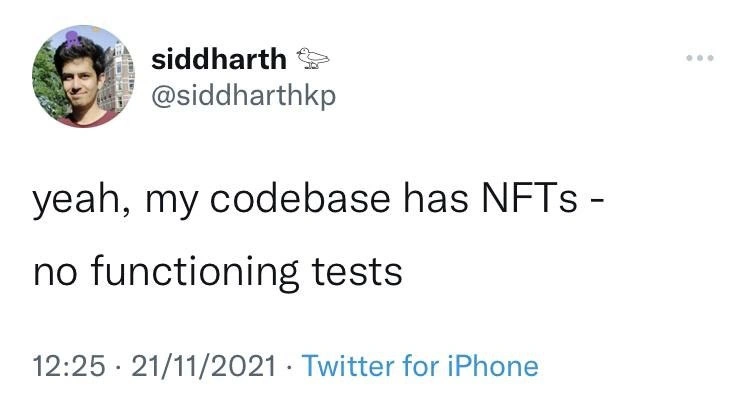
Imagine you finished a big homework assignment but never checked any of your answers. You just turned it in and hoped everything was correct. Kinda stressful, right? This meme is joking about that kind of situation, but in coding. It’s like building a big LEGO tower and not giving it even a little poke to see if it’s sturdy – then being surprised when it falls apart. Here, the programmer says their project has “NFTs,” which most people think are a super cool new tech thing (those one-of-a-kind digital collectibles). But then they reveal it actually means “no functioning tests,” basically admitting “we didn’t double-check our work.” 😂 The reason it’s funny is because they take a term that sounds impressive and twist it into a confession of something going embarrassingly wrong. It’s as if someone bragged, “I have a rocket ship!” but then whispered that “rocket ship” stands for a bike without brakes. It’s silly and a bit sarcastic. Even if you don’t know much about programming, you can laugh at the idea that a fancy acronym actually hides an oops! truth. The emotional core here is a mix of surprise and relief – surprise that NFT doesn’t mean what you expect, and relief in the form of laughter because every coder (even the one making the joke) knows they probably should have tested their stuff. It’s a humorous way of saying, “I did something risky and now I’m just joking about it so I don’t panic.”
Level 2: No Safety Net
At its core, this meme is a play on words. Normally, NFT means Non-Fungible Token, a fancy term from the crypto world. An NFT is basically a unique digital collectible – think of owning a one-of-a-kind digital artwork, certified by blockchain technology. In late 2021, NFTs were a huge trend: everyone was talking about buying and selling these unique crypto assets. But here the developer jokes that in their codebase, NFT stands for “No Functioning Tests.” In plainer words, they’re saying “my project has zero tests that work.” It’s a cheeky way to admit a lack of software tests by hijacking a buzzword.
Let’s break down what that means. In software development, tests (like unit tests) are little programs or scripts written to check that the code does what it’s supposed to do. For example, if we have a function that adds two numbers, we might write a test like:
def add(a, b):
return a + b
def test_add():
assert add(2, 2) == 4 # this test passes, because add(2,2) really returns 4
Here test_add() is a simple unit test verifying that our add function returns the expected result (4) when given 2 and 2. If the code was wrong (say add was subtracting by mistake), the test would fail and alert us. Now, when someone says their codebase has “no functioning tests,” it implies that either no tests exist or the tests are all broken (failing). Essentially, nothing is automatically checking if the code is working correctly.
Why is that a big deal? Because tests are like a safety net or a spell-checker for code. Code quality tends to be much higher when there’s a good suite of tests. If a developer makes a change, they can run the tests to quickly see if something else unintentionally broke. Without tests, you often don’t discover bugs until a user finds them (ouch!). Think of test coverage as a measure of how much of your code is exercised by tests. A project with 0% test coverage (no functioning tests) means developers are essentially flying blind. Any new feature or fix could accidentally mess up something in another part of the app, and they’d have no immediate warning.
The meme hints at technical debt: this is a term for when you take shortcuts in code (like skipping tests or writing messy code to meet a deadline) and as a result, you “owe” extra work later to fix or clean it up. A codebase lacking tests is carrying a lot of technical debt. It might work today by sheer luck or manual effort, but sooner or later those “debts” (bugs, maintenance headaches) will come due. Newer developers (and actually, everyone) who join such a project without tests usually feel nervous – any change they make could break something and they wouldn’t know until it’s in production. That’s why we say there’s no safety net. It’s like performing an acrobatic stunt with no net below to catch you if you slip. Most teams consider it a best practice to write tests for important parts of the code (some even practice Test-Driven Development (TDD), writing tests before the code). So admitting “no functioning tests” is a bit of an “oh no!” moment. It’s the kind of thing junior devs learn to avoid: the importance of a good test suite is one of those lessons you often get taught early, sometimes through painful experience.
The tweet being screenshotted as a meme is also worth noting: a lot of developer jokes circulate on Twitter and then as images. The format is a quick one-liner – perfect for inside jokes. Here, even if you’re a fairly new developer, you likely know what NFTs are (from general tech news). The joke then surprises you by switching the meaning. It reinforces a key point in a humorous way: as cool as new tech acronyms are, basics like testing shouldn’t be ignored. If you’ve just learned about writing your first unit tests, you can appreciate why having “no functioning tests” in a big project is problematic. And if you’ve struggled through a group project or an internship where tests were missing, this meme probably hits home and makes you chuckle (or cringe a little). It’s saying, “We did a fancy project, but guess what? We skipped the boring, important stuff.” And every developer, junior or senior, eventually understands that skipping the “boring stuff” like testing will come back to bite.
Level 3: Hype-Driven Development
In late 2021, NFTs (Non-Fungible Tokens) were the glamorous talk of the tech town – every startup pitch and tech article was tossing around this blockchain buzzword. Enter this tweet-meme, where a world-weary developer turns the hype on its head: “yeah, my codebase has NFTs – no functioning tests.” 🤦♂️ Instead of bragging about million-dollar JPEGs on a blockchain, they’re confessing to a far less sexy reality: a codebase with zero tests that actually pass. This juxtaposition is hilarious to experienced engineers because it mixes developer humor with a pinch of industry satire. We’ve all seen companies chase the shiny new tech (be it blockchain, AI, or whatever’s trending) while neglecting the boring fundamentals like Testing and Code Quality. This tweet is basically whispering, “Sure, we’ve got NFTs... but not the kind you think. We just skimped on writing tests.”
Every seasoned developer can recount a horror story of inheriting a project with no functioning tests. It’s the classic technical debt nightmare: the original team was moving fast and broke things – unfortunately, they also never bothered to set up a safety net. Now every change is a gamble. Deployments feel like a game of Russian roulette because you’re never quite sure which part of the codebase you’ll unwittingly break. The meme lands so well because it captures that too real scenario with a one-liner. It’s a perfect TestingHumor punchline: turning “NFT” – the epitome of cutting-edge tech hype – into an acronym for a mundane engineering woe. The contrast is rich in irony.
From a senior perspective, the phrase “no functioning tests” also hints that maybe tests do exist in this project, but they’re all red and failing (or perhaps flipping random failures). In other words, someone wrote tests at some point, but they’re so outdated or poorly designed that none of them pass anymore. That’s a special kind of pain: you have tests, but they’re useless – constant red in your CI pipeline, maybe just ignored with --force deploys. It’s practically worse than having no tests, because it breeds false confidence or outright cynicism (“Oh, those 500 failing tests? Ignore ’em, they’ve always been like that.”). CodeQuality suffers immensely in such scenarios, and only a battle-scarred dev can truly appreciate the dark comedy of bragging about it.
On top of that, the tweet meme format itself – a screenshot of a Twitter post – is a popular way devs share quick laughs. It’s informal and spreads fast, much like inside jokes around the water cooler. The author “siddharthkp” quips about NFTs to get an knowing groan from the audience: we all nod because we’ve been there. Perhaps management was excited about implementing some blockchain NFT feature in the app, but tests? Nah, no time for those. Hype-driven development at its finest: chase the fancy buzzword, skip the unit tests. The seasoned engineers reading this can practically hear the sarcastic voice: “We don’t have time for testing, we’re too busy minting our next big idea!” Meanwhile, they know that missing test coverage is going to make the codebase as volatile as the crypto market itself.
This meme also underscores an unspoken engineer coping mechanism: humor. When you’re staring at a codebase without tests, you either cry or laugh (or both). Choosing to joke that “we have NFTs” is a tongue-in-cheek way to laugh at our own peril. It shines light on the absurd reality: how many of us have worked on systems critical to the business that had zero proper tests? Way too many. It’s funny in the “haha omg, relatable” way, and a bit painful in the “we really should know better” way. The DeveloperHumor here softens the frustration of technical debt by packaging it as a clever pun. It’s a lot more fun to tell your team “we have NFTs in our repo” than to flat out admit “our test suite is non-existent and we’re living on the edge.” In true cynical veteran style, it’s humor with a hint of resignation – a joke that also kind of screams, please, can we write some tests before this whole thing crashes?
And for extra nerd points, let’s acknowledge the wordplay creativity: turning Non-Fungible Token into No Functioning Tests. It’s a perfect fit – the acronym matches, and it conveys the message succinctly. In one phrase, the author calls out the codebase’s state and pokes fun at the NFT craze. It’s like saying, “We’ve got the latest trend, but in the worst possible way.” Seasoned devs love this kind of layered joke: it bonds us over shared annoyance (UnitTesting neglected) and shared cynicism about tech fads. In the end, the meme hits a bullseye: it roasts both the project’s TechnicalDebt and the industry’s shiny-object syndrome in four words. Now that’s what I call high-quality memeing – unfortunately, higher quality than the code it describes!
Level 4: The Formal Verification Frontier
In an idealized world of software correctness, we'd prove our code is flawless using formal verification – mathematically validating that the implementation meets a specification. This is the realm of theorem provers and model checkers, where code and logic are treated like equations to be solved. However, fully verifying a non-trivial program can be as hard as solving the Halting Problem (in general, undecidable). Instead, in practice we rely on tests as a pragmatic approximation of a proof. When a codebase has “No Functioning Tests,” it essentially has zero formal or informal proofs of correctness. The software’s reliability is unquantified – a theoretical nightmare.
Consider that exhaustively testing every possible execution path in a program is NP-hard; the number of paths can explode combinatorially with each branch or loop. Automated test generation and fuzzing try to explore this space, but without any tests, we’re not even attempting a brute-force sample of the program’s behavior. It’s like leaving an extremely large equation unsolved – all potential outcomes of the code are Schrödinger’s results until runtime makes them real (often unpleasantly).
To draw an academic parallel: blockchain networks (home of real NFTs – Non-Fungible Tokens) achieve trust through rigorous cryptographic validation and distributed consensus. Each block added to a chain is tested by nodes against consensus rules. By contrast, a codebase with no tests has no internal consensus on what correct behavior is – there's no equivalent of miners validating a block. In a sense, every time the program runs, it’s performing an experiment with unknown results, because nothing beforehand established ground truth. The meme’s pun resonates on this deep level: we’ve got the trendy acronym but none of the guarantees. Just as NFTs in crypto rely on hashing and verification to prove authenticity, our software relies on tests to prove (or at least strongly suggest) correctness. With “no functioning tests,” we have neither proof nor evidence – a situation that theoretical computer science would view as inviting chaos.
Even technical debt can be framed in formal terms: it’s the gap between the current system and a hypothetically verified, well-engineered system. Here the gap is wide – no tests means the system’s properties are essentially unverified hypotheses. Every new feature or refactor is a venture into the unknown. In summary, from a formal perspective, a codebase with NFTs (No Functioning Tests) is clinging to the hope that the code’s correctness emerges by accident, since we’ve applied none of the scientific rigor (like proofs or at least systematic tests) to ensure it. It’s a tongue-in-cheek reminder that while software engineering isn’t pure math, skipping even the empirical proof of unit tests leaves us in a realm of conjecture and bugs waiting to happen.
Description
This image is a screenshot of a tweet by user Siddharth (@siddharthkp). The tweet delivers a clever one-liner: 'yeah, my codebase has NFTs - no functioning tests'. The humor comes from co-opting the hyped tech acronym NFT (Non-Fungible Token) and giving it a new, cynical meaning that resonates deeply with software developers. It's a masterful piece of tech satire, simultaneously mocking the speculative bubble of blockchain assets and lamenting the all-too-common reality of working with poorly maintained, untested code. For senior engineers, this joke is a perfect intersection of industry trend awareness and the chronic pain of technical debt, capturing a whole mood in just a few words
Comments
7Comment deleted
Management loves that our codebase has NFTs. They think it's our entry into Web3, but really it's just our exit strategy from reliable deployments
We just rebranded our failing CI suite as “NFTs - Non-Deterministic Flaky Tests,” and now the board thinks we’ve pivoted to Web3
The real non-fungible tokens are the production bugs that persist across deployments because each one is uniquely crafted by our lack of test coverage - truly one-of-a-kind artifacts that nobody wants to own
This is the kind of NFT that actually depreciates in value over time - especially when production breaks at 3 AM and you realize your 'comprehensive test suite' is just a collection of console.log statements and prayers to the deployment gods
We’ve been Web3 for years: CI passes with -DskipTests and the 95% coverage badge is just a static PNG
Our repo has NFTs: No Functioning Tests - CI relies on proof-of-workarounds
Codebase NFTs: Each deploy mints irreplaceable bugs no test suite can ever replicate