Skip to content
DevMeme
3647 of 7435
A Pragmatist's Dictionary for Cryptography Papers
Cryptography Post #3985, on Nov 29, 2021 in TG

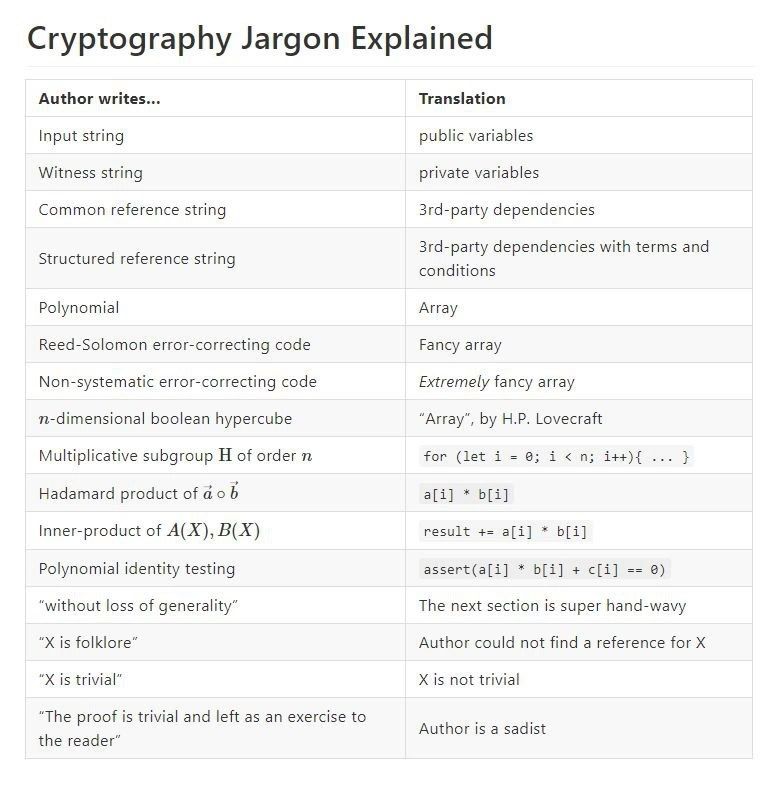
A Pragmatist's Dictionary for Cryptography Papers

Why is this Cryptography meme funny?

Level 1: Now in Plain English

Imagine you’re at school and your teacher starts speaking in a really complicated way. He says: “We shall now commence a period of nutritional intake.” All the kids look confused 😕 – nobody knows what he means. Then the teacher laughs a little and says, “In plain English: it’s time for lunch!” 🥪. Suddenly everyone gets it and giggles.

That’s exactly what this meme is doing. It’s taking big, fancy words (like the teacher’s formal announcement) and turning them into simple words (like “time for lunch”) that everyone can understand. The left side of the meme had all the big technical words, and the right side was basically saying “hey, this is what that means in normal talk.” It’s funny because the big words were describing things that turned out to be pretty simple. It’s like if someone called a ball a “spherical outdoor projectile” and then a friend whispered, “psst, he just means a ball.” You’d probably laugh and say “Why didn’t he just say ball in the first place?!”

So the heart of the joke is about translation – turning a confusing explanation into an obvious one. Just like the teacher’s fancy sentence became “time to eat,” the meme turns confusing tech jargon into everyday coding terms. It makes us smile because it reminds us of when adults or experts overcomplicate things and we just want to say, “Can you say that simply?” When they finally do, it feels like a light bulb 💡 turns on. In the end, everyone understands and we can all chuckle at how silly the complicated version sounded. The meme is basically doing that light-bulb moment over and over, and that’s why it’s so fun!

Level 2: Plaintext Version

For a newer developer or someone still learning the ropes of computer science fundamentals, this meme serves as a handy (and funny) glossary of cryptography buzzwords. Let’s break down what each term means in more familiar language, and why the “translation” is apt:

  • Input vs. Witness strings: Think of an input string as the stuff you openly feed into an algorithm (public info), and a witness string as the hidden stuff you keep secret (like a password or a secret key). In many cryptographic proofs, you have public data everyone knows (e.g., a hash of a password) and a secret piece only the prover knows (the actual password). The prover’s job is to convince the verifier that they have the secret without revealing it. So if this were code, public inputs are like normal function parameters and the witness is like a secret variable only the function uses. The meme simplifies this to “public variables” vs “private variables.” If you’ve done an exercise with functions, imagine one of the inputs is public (anyone can see it) and another is private (only the function internally uses it). Same idea here, just dressed in fancy terminology in research papers.

  • Common Reference String (CRS): In plainer terms, a common reference string is just a chunk of data that everyone in the system has to know ahead of time. It’s as if a teacher gives the whole class a special decoder ring or a page of random numbers before starting a puzzle – everyone refers to it, so it’s common. In coding, this feels like having a configuration file or a constant array that every module uses. The meme calls it a 3rd-party dependency because it’s something your system pulls in from outside (like how your project might depend on a library or an environment variable that’s provided externally). If you’ve ever used an API key or a config setting that all parts of your app need, you get the idea: that’s your “reference string” in practice. Now a structured reference string is a weirder variant – it means that reference data isn’t arbitrary; it’s generated with certain conditions. This is akin to using a vendor service that comes with terms and conditions. For example, maybe you download a machine learning model from a provider – everyone uses it (common), but you have to trust that provider’s process (terms attached). The meme captures that complexity by joking it’s a dependency with “terms and conditions.” For a newbie, just know: both are shared setup data, but the “structured” one comes with some special setup rules (and implied strings attached).

  • Polynomial = Array: A polynomial might sound like high school math class (those expressions like $3x^2 + 2x + 7$), and indeed it is. But in coding, one convenient way to represent that polynomial is by an array of its coefficients: [7, 2, 3] for $3x^2 + 2x + 7$ (notice 7 is the constant term, 2 is coefficient of x, 3 of $x^2$). So when cryptography papers talk about polynomials, they often mean you take a bunch of numbers and treat them as coefficients in such an expression. To you as a programmer, that’s literally just an array of numbers in memory. If you’ve never coded a polynomial, think of an array where each index’s value will be combined with a power of x. The meme humorously slaps a “Hello, I am basic” label on polynomial by calling it just an array. This demystifies it: even though polynomial might invoke images of elaborate formulas, manipulating one often comes down to looping through an array (for addition, multiplication, etc.) and doing arithmetic. In other words, under the hood of that fancy math term is a data structure you use every day.

  • Reed–Solomon Error-Correcting Code (ECC): This is a more advanced concept, but a very practical one. Ever wonder how a scratched DVD can still play your movie, or how a QR code can still scan even if part of it’s smudged? That’s thanks to error-correcting codes like Reed–Solomon. In essence, these codes take your original data (say, 10 numbers) and produce a larger set of data (maybe 15 or 20 numbers) by adding redundancy in a clever way. This redundancy means if some of those numbers get lost or messed up, you can still recover the originals by using the remaining ones. Reed–Solomon does this using polynomial math (treating those numbers as points on a polynomial curve). But to implement it, you’re still just moving numbers around and doing arithmetic on them – it’s like an array with some extra crunchy math toppings. The meme calls Reed–Solomon a “fancy array” which is a lighthearted way to say: it’s basically an array of data with additional calculated pieces. If you’ve used RAID drives or noticed how two parity bits can rebuild a missing bit, you’ve seen error correction in action. It seems fancy (and it is ingenious math), but at a coding level you generate a bunch of check values and append them to your data – conceptually an array where some entries are original data and others are calculated redundancies.

  • Non-systematic error-correcting code: A quick clarification: “systematic” means the original message appears unchanged in the encoded output (with extra error-correcting bits tacked on), whereas “non-systematic” means the original message is mixed and dispersed among the output – you can’t directly spot it without decoding. So a non-systematic code is even more abstruse: the encoded data looks completely different from the input message. In practice, systematic codes are easier to work with (you can still read the message part), non-systematic can be more efficient or secure since the message is fully scrambled. The meme upgrades fancy array to extremely fancy array” for this. 😄 In plain terms, it’s saying: “We took the array of data and not only added redundant info, but we even hid the original data among it so well that you’d need to decode to find it.” For a newcomer, just know this: it’s an array that’s been through a blender math-wise – definitely not as straightforward as original data plus a few parity bits. But at the end of the day, what gets stored or transmitted is still a sequence of numbers (an array), hence the humor in boiling it down to just that.

  • n-dimensional boolean hypercube: This one sounds intimidating, but let’s dismantle it. “Boolean” means true/false values (or 0/1 in binary). An n-dimensional hypercube in this context means “all combinations of true/false across n variables.” If n = 1, that’s just [True, False] (which you can picture as two points on a line). If n = 2, that’s four combinations: (False, False), (False, True), (True, False), (True, True) – which you can arrange as the corners of a square. n = 3 gives 8 combos – corners of a cube. For higher n, we say hypercube because we can’t visualize it easily, but mathematically it’s the same idea: $2^n$ combinations forming the corners of an n-dimensional shape. So, effectively, you’re dealing with a set of $2^n$ boolean configurations. For a coder, listing all of those is like nested loops or a single loop through numbers 0 to 2^n - 1 and reading their binary bits – basically it’s a huge array of possibilities. No surprise, the meme calls it an “‘Array’, by H. P. Lovecraft.” Why Lovecraft? Because for anything beyond, say, n=4, the number of possibilities grows so large it’s monstrous (exponential growth), and trying to conceptualize, say, a 10-dimensional hypercube (1024 points) or 20-dimensional (over a million points) feels mind-melting. It’s a playful way to acknowledge that while we can dryly call it “just an array of all combos,” the sheer scale or dimensional weirdness of it is Lovecraft-level crazy. But conceptually, don’t be scared: an n-dimensional hypercube is nothing more than “every possible list of n booleans” – something you could generate with a bit of code and a lot of time if n is large!

  • Multiplicative subgroup of order n: This phrase comes from the math underpinning cryptography. A subgroup is basically a subset of numbers (or elements) that is closed under multiplication. “Of order n” means there are n such elements in it. Without diving into group theory, a good example is: take multiplying numbers mod 7 (i.e., wrap around after 7). The numbers {1,2,4} form a multiplicative subgroup of order 3, because you can multiply any of them and, mod 7, the result is still in {1,2,4}, and there are 3 elements total. Okay, that might still be a bit abstract. Think of it this way: a multiplicative subgroup of order n is just some collection of n numbers where if you multiply any two (and maybe take a remainder if working mod something), you stay in that collection. It’s structured, but for using it in code, you often iterate through each element to do whatever operation you need. The meme simplifies “H is a multiplicative subgroup of order n” to a familiar loop: for (let i = 0; i < n; i++) { ... }. This is cheeky – it’s basically saying “Oh, you have n things? I bet I’ll be doing something n times then.” And indeed, if you had that subgroup and you wanted to, say, compute something for each element, you’d run a loop of length n. The formal definition and properties of that subgroup (e.g., existence of inverses, a generator that can produce all elements) are important in theory – especially for cryptographic proofs about why something works or is secure. But if you’re writing actual code to, say, multiply each element by some value, you don’t need to worry about all that algebra; you just need to loop n times. The humor here is in reducing a fancy algebraic structure to the most mundane programming task – a counted loop.

  • Hadamard product (a ∘ b): Despite the mystical-sounding name, this one’s pretty straightforward: you take two lists of equal length, and you multiply pairs of entries one by one. If a = [a0, a1, a2] and b = [b0, b1, b2], then a ∘ b (their Hadamard product) is [a0*b0, a1*b1, a2*b2]. If you’ve done element-wise operations with arrays or vectors (like multiplying two same-sized arrays in Numpy or so), you’ve done a Hadamard product. In everyday coding terms, it’s like:

    for (let i = 0; i < n; i++) {
        c[i] = a[i] * b[i];
    }
    

    The meme translation “a[i] * b[i]” is exactly that – pointing out that all this operation entails is multiplying each corresponding pair of numbers. It’s commonly used in math (like in matrix operations, error-correcting codes, etc.), but it’s one of those things that’s much simpler than its name suggests. For a junior dev, just remember “Hadamard” = “do it to each pair of elements.” Not so scary!

  • Inner product of A(X), B(X): An inner product (or dot product in vector terms) takes two sequences of numbers and produces a single number by multiplying pairs and summing them up. So if you had a = [a0, a1, a2] and b = [b0, b1, b2], the inner product is a0*b0 + a1*b1 + a2*b2 resulting in one final sum. In the meme, they write that as “result += a[i] * b[i]”, implying you’d accumulate the results of those multiplications in a loop. Many beginners have done this when calculating things like a weighted sum (say you have arrays of grades and weights and you multiply then sum to get a final score). In linear algebra notation, if A(X) and B(X) were polynomials or vectors of coefficients, their inner product is just a single number you get by this multiply-and-add procedure. It’s a fundamental operation in lots of algorithms (from machine learning to computer graphics). So again, the meme is saying: fancy term, but down-to-earth, it’s just a few multiplications and additions. Nothing to be afraid of – you could code it with a simple loop or using a library function.

  • Polynomial identity testing: This one’s a bit heady. Suppose you have two big formulas and you want to check if they’re actually the same formula just written differently (i.e., if their difference is the zero polynomial). That’s polynomial identity testing – basically verifying that for all values of X, two polynomials give the same result. Doing that by brute force (testing every possible X) is impossible when X is continuous or ranges over a huge field, but there are clever randomized ways to do it without checking every case. However, explaining those can get complex. The meme sidesteps all that nuance and tongues-in-cheek reduces it to an assert statement: assert(a[i] * b[i] + c[i] == 0). This looks like it’s checking one particular instance of a polynomial equation (maybe one coefficient index or one value of X) to see if it equals zero. It’s a joke about how, in code, one might simplistically test an identity by plugging in some numbers or iterating over coefficients to see if everything matches up. Of course, a junior dev reading that might not fully get what identity testing entails, but at minimum: if you ever had two formulas and tested a bunch of inputs to see if they always give the same output, you were doing a rudimentary form of this. The assert in the meme is like saying “for each term i, confirm that a[i]*b[i] + c[i] equals 0.” If that assert passes for all relevant i, it implies some relationship holds between those sequences (maybe that a * b = -c as polynomials). TL;DR: It’s verifying an equation works as expected – something we often do in debugging or testing, just with a fancier label when in a math paper.

Now, the latter rows of the table are all about phrasing that often confuses or irks people reading formal texts. Here’s what those mean in everyday developer speak:

  • “Without loss of generality” – You might see this phrase in a proof. It signals that the author is about to assume something specific that doesn’t actually restrict the generality of the problem. For example, “Without loss of generality, assume the first element is the largest.” They’re not saying the first element is always largest; they’re saying if it isn’t, you could renumber things or reorder, and the same argument would work. It’s basically “let’s focus on one case because all cases are essentially the same after a bit of reasoning.” To a newcomer, it feels like “wait, you’re just ignoring other cases!” But truly, it’s a logical convenience. The meme translates it humorously as “the next section is super hand-wavy.” Why? Because often after a WLOG, the author breezes through the argument as if it’s obvious that other cases are analogous – and if you don’t immediately see why, it can feel like they magically assumed the hardest part away. In more plain terms, think of it as someone saying, “To keep things simple, we’ll just talk about this one scenario – trust me, we’re not missing anything by doing so.”

  • “X is folklore” – This is basically a way authors say, “People in the field know this result, but I don’t have an official citation or proof for you.” It’s like in programming when someone might say, “It’s common knowledge that you should close database connections.” You might not know where that was first stated; it’s just something everyone picks up. In academic writing, calling something folklore can be a bit frustrating, because if you don’t know it, you’re stuck trying to hunt down where it comes from (often an exercise in googling lecture notes or asking experts). The meme’s take – “Author could not find a reference for X” – is spot on. It implies the writer probably tried to find a source and couldn’t, or didn’t bother because “everyone just knows this.” In everyday terms, it’s as if a teacher tells you a formula and when you ask why, they say “oh, it’s just a known trick people use” – helpful, yet not entirely satisfying if you’re curious. But at least you know it’s not original to that paper; it’s a known thing floating around.

  • “X is trivial” – When someone says a step or fact is trivial, they mean it’s so straightforward it doesn’t need explanation. But beware: what’s trivial to an expert can be utterly non-obvious to a student or junior dev. In plain speak, “trivial” could be rephrased as “you can figure this out in a few obvious steps (which I’m omitting).” The meme flatly flips it to “X is not trivial,” capturing the common feeling that if someone had to say it’s trivial, it probably isn’t (for you). This is a universal experience when learning: the guide or documentation says “clearly, from this it follows that Y = Z,” and you’re left thinking “umm, it’s not clear to me!” Don’t be discouraged – often it is doable, but calling it trivial is a bit of a humblebrag by the author. In friendly terms, treat “trivial” as meaning “requires only a few steps” – you might still have to work those steps out on paper. The humor here is simply the meme voicing what every learner has thought: “If you say it’s trivial one more time… 😅.”

  • “Proof is left as an exercise to the reader.” Ah, the classic. If you’ve read math or algorithm textbooks, you’ve seen this line at the end of a theorem: they show you 80% of the proof and then toss the last 20% at you to check on your own. The intention is often good – it engages you to fill in details, which is great for learning. But sometimes it’s used when that last 20% is either tedious or well-known or maybe beyond the scope, and the author decides not to spend pages on it. The meme bluntly calls the author a sadist for doing this, reflecting the half-joking sentiment of students everywhere. It’s like having a puzzle’s final piece withheld unless you solve it yourself. In dev terms, imagine a tutorial that says “Implementing the rest of this function is left as an exercise for the reader” and you’re like “Wait, what? I thought you were going to show me!” It can be a mix of flattery (“I bet you can handle this, reader!”) and annoyance (“I paid for the whole book, give me the whole proof!”). The meme exaggerates by calling the author a sadist – they probably aren’t actually cruel, but when you’re sweating over that “exercise,” it sure feels like a bit of a cruel move.

From a junior developer’s perspective, this meme is both educational and comforting. It’s educational because it deciphers a lot of jargon: you learn that big words like Hadamard product or Reed–Solomon code relate to pretty understandable concepts (array multiplication and error-handling codes). It essentially says, “Hey, you might not know these terms, but look – they map to things you do recognize.” That can demystify the intimidating world of cryptography and academic CS. It’s comforting (and funny) because it also acknowledges the struggle: if you’ve ever felt lost reading formal docs or a tough algorithm explanation, you’re not alone. The meme explicitly voices those “I don’t get it” moments and resolves them with simple translations. It turns out your intuition as a coder – the part of you that says “this sounds complicated, but is it really just an array or a loop?” – is often correct!

As a new dev, you might recall early times when you confronted documentation that felt like gibberish. Maybe you saw something like “Apply a Fourier transform and multiply in the frequency domain” and before you learned about it, that sounded like wizardry. Later you found a StackOverflow answer that said “use library X to do a fast convolution” and realized “Oh, it’s just a way to multiply numbers faster by using a trick.” This meme is capturing that exact translation vibe, but for cryptography terms. It’s essentially telling a bunch of inside jokes that newcomers can chuckle at once they’ve been brought up to speed with a one-liner explanation. Each row is a tiny lesson wrapped in humor.

So, if you’re not already familiar with these terms, reading the meme (and analyses like this) is a fun crash course. It’s CryptographyAlgorithms 101 meets stand-up comedy. You learn that academics might use spooky terms like “folklore” and “without loss of generality” – and now you also know not to be spooked by them: they have down-to-earth meanings (and yes, sometimes they signal you should ask or dig deeper). By translating the buzzwords into everyday developer lingo, this meme is practically encouraging juniors that underneath the scary nomenclature, the tech world often runs on simple concepts. And being able to laugh at the over-complication is almost a rite of passage in becoming a more experienced developer.

Level 3: From Ivory Tower to Code

For seasoned developers (especially those who’ve dabbled in cryptography or read academic papers), this meme hits home as a brilliant satire of the communication gap between research literature and practical coding. It’s funny because it’s true: cryptographers and theoretical computer scientists often write in a specialized dialect that can sound overblown or impenetrable to the average programmer. Yet, when you strip away the buzzwords, many of these complex notions translate to straightforward programming constructs. The meme lays out that translation in a deadpan two-column documentation-style table, as if to say “Don’t be intimidated – here’s what they really mean.”

Why is this combination of elements so humorous? It’s the absurdity of dressing up a simple idea in grandiose language. Seasoned engineers have seen this pattern before: academic papers or overly formal documentation describing something in the most general, mathematical terms, whereas in code it’s just an array or a loop. There’s a shared understanding (and a bit of exasperation) in the dev community that sometimes computer science fundamentals get needlessly obscured by jargon. So when the meme translates “n-dimensional boolean hypercube” to “‘Array’, by H. P. Lovecraft”, an experienced reader laughs because they’ve felt that exact bewilderment: “What on earth is an n-dimensional hypercube? Oh… you just mean a bunch of True/False combinations. Got it.” It’s a form of TechHumor that resonates with anyone who has slogged through dense academic text to implement something.

Industry patterns satirized: The meme shines a spotlight on how academic authors communicate versus how developers think. For instance, in cryptography research, it’s common to introduce new terms like “common reference string” or “witness” to fit a rigorous theoretical framework. But a practitioner might roll their eyes, thinking “just call it a config and a secret already.” This table format mimics a reference sheet or glossary, implying that devs practically need a jargon translator to get through whitepapers. It’s a gentle jab at documentation style: the left column could be phrases from a scholarly article, and the right column the candid notes a frustrated engineer scribbles in the margin after finally understanding. That contrast creates comedic tension – it’s DocumentationHumor at its finest, playing off the overly formal vs. overly literal explanation.

Shared experiences: Anyone who’s tried to implement a cutting-edge cryptography algorithm from a research paper likely chuckles at these. For example, the term “witness” is heavily used in zero-knowledge proof papers. The first time you encounter it, you might think, “Is this some magical crypto object?” Only after a deep dive (or a helpful blog post) do you realize it’s basically just the secret input or data that proves the claim – something you might simply handle as a variable holding a password or key in code. That relief – the “aha!” moment – when a scary term reduces to a familiar concept is both empowering and a bit funny in hindsight. This meme essentially strings together a bunch of those “aha” realizations in one place. Seeing them itemized, a veteran dev can nod at each row: “Yup, fell for that one… oh yes, thought that was complicated too… haha, folklore – haven’t we all seen that excuse in a paper?”

Real-world scenarios: Imagine a senior engineer integrating a new cryptographic library or protocol. They open the research paper or RFC for it and are confronted with lines like: “Using a structured reference string and an error-correcting code, we embed the witness in an $n$-dimensional hypercube.” It sounds like an incantation from a wizard’s tome! The engineer’s heart sinks: do they need a PhD in math to code this? But as they break it down (or look up simpler explanations), they find it’s just reading some inputs, doing arithmetic in a loop, maybe using an existing error-correction library, etc. The process feels like deciphering an ancient language. In fact, many DeveloperHumor anecdotes involve exactly that – turning academic instructions into working code. This meme’s table is basically the “Rosetta Stone” for one such scenario, and that recognition is golden for folks who’ve been there.

Organizational dynamics and trade-offs: There’s an underlying truth here about how knowledge is shared. Academics prioritize generality and precision – they use terms like “polynomial identity testing” because it’s a specific problem with known theoretical bounds and algorithms. They assume the reader is intimately familiar with algebra and theoretical CS. On the flip side, software engineers value clarity and practicality – they’d rather see “make sure this formula works for all cases (maybe test a bunch of values)” than an opaque term. Why doesn’t the author just say that then? Well, because in academia, saying “polynomial identity testing” packs a lot of context and exact meaning into three words, whereas a plain description might be lengthy or not general enough. It’s a bit of “best practices vs. reality”: ideally, research papers would be more accessible, and developers would have more math background – but in reality, there’s a gap. The meme pokes fun at this gap by treating those serious terms with almost childlike literalness. It’s like academic humor intersecting with developer humor – each row effectively says “here’s what the professor says, and here’s what the engineer hears.”

We also see a gentle critique of documentation and writing style. Consider the last entries about “trivial” proofs and “left as an exercise.” These are almost rites of passage in a CS education – every senior dev remembers a time they muttered “trivial, my foot!” while attempting to finish a half-proven theorem in a textbook. The meme calling an author sadist for doing that draws a knowing laugh. It’s exaggeration, sure, but it captures the mild trauma of being left alone with a problem your references promised was easy. In a collaborative development setting, you’d rarely say “it’s trivial, figure it out yourself” to a teammate – you’d provide the code or a clear pointer. Yet, in academia, that’s normal. Academic culture assumes a certain perseverance from readers, whereas developer culture prizes approachability and completeness (good docs, examples, clear acceptance criteria). This meme highlights that culture clash: one side’s “folklore” and “trivial” is the other side’s “seriously, you’re not going to explain that?!”

Systemic issues: It’s not that academics are trying to confuse developers – they write for other academics, building on a shared foundation of CS fundamentals and math. Conversely, developers (even very smart ones) spend most of their time thinking in concrete terms – data structures, algorithms they can code, edge cases in practice. So when these worlds meet, without translation, confusion happens. Over time we’ve developed bridges: specifications with rationales, wiki articles explaining papers in plain language, engineers with hybrid skills who translate theory to implementation (and vice versa). The meme’s popularity itself is evidence of this shared understanding: plenty of people living at that intersection find it hilarious because it validates their experiences. It acknowledges how decrypting jargon is almost a skill unto itself in tech.

The fact that this is presented as a satirical table suggests a documentation parody. Many companies and open-source projects maintain glossaries or ADRs (Architecture Decision Records) to clarify terms. A senior dev reading the meme might recall writing an internal wiki page like “Glossary of terms for the new zk-SNARK system” for their team, essentially doing exactly this kind of translation (albeit usually in a more serious tone). There’s also an implied camaraderie: when we share a laugh at “X is folklore”, it reduces the intimidation factor. It’s like saying, “Yeah, that paper was a tough read for all of us, you’re not alone.” This can be comforting in an industry where imposter syndrome lurks around any overly formal documentation. The meme format turns that frustration into a joke we can all appreciate – an inside joke for the developer community.

In essence, the senior perspective sees this meme as cathartic humor born from real friction between academic knowledge and everyday coding. It highlights the absurdity, lets us laugh at it, and in doing so, reminds us that complicated concepts often have a simple core. It’s a love-letter and a roast at the same time: loving the elegant math, roasting the convoluted wording. For experienced folks who’ve bridged that gap, each line of the table is a mini “IYKYK” (if you know, you know) moment – a badge of honor that you’ve been through the crypto jargon gauntlet and came out the other side, with battle scars and a sense of humor.

Level 4: Arcane Algebra Underpinnings

At the highest level, this meme riffs on cryptography research jargon – the kind found in dense academic papers about zero-knowledge proofs and error-correcting codes – by translating it into plain programming terms. The left column’s phrases (like input string, witness string, Hadamard product, etc.) are rooted in formal theoretical computer science and math. Let’s unpack a few to see why they sound so intense:

  • Input string / Witness string: In cryptographic protocols (especially NP-complete problems and zero-knowledge proofs), an input is the public part of the problem, and a witness is the secret solution or evidence that the statement is true. For example, in a zero-knowledge proof proving “I solved a Sudoku,” the given puzzle is the input and the completed grid solution is the witness. These terms come from complexity theory – formally, an NP problem has an input x and a witness w. Academically they use the term witness to generalize “secret known by the prover,” but to a coder it’s just a private variable or hidden input. The meme’s translation nails it: “input string” → “public variables” and “witness string” → “private variables.” In other words, one is known to everyone, the other is kept secret – conceptually no different from public vs. private data in a program.

  • Common reference string (CRS): This one is pure crypto jargon. Many advanced protocols (e.g. certain zk-SNARKs in cryptography) require a publicly shared random string or parameters set up ahead of time – that’s called a common reference string. It’s basically some pre-generated values that both parties trust. The meme jokes it’s a “3rd-party dependency” because, like a library or config file that your code needs, a CRS is an external piece of data the whole system relies on. A structured reference string is a subtype of CRS that isn’t just random noise – it has a special structure (often created by a trusted party with secret trapdoor information). The table calls that “3rd-party dependencies with terms and conditions”, hinting that a structured reference string comes with fine print: you must trust whoever set it up, just like using a free API that might hide some caveats. In cryptographic papers, they’ll assume “given a structured reference string” (often meaning someone did a fancy setup ceremony). Under the hood, it’s akin to having a configuration file that was generated under special conditions – a dependency with potential legal or trust implications.

  • Polynomial → Array: This highlights how theoretical math objects often reduce to simple data structures in code. In cryptography and coding theory, we love polynomials – e.g. to represent data or perform finite field arithmetic. A polynomial like $P(X) = a_0 + a_1X + \dots + a_n X^n$ can be stored in a program as an array [a0, a1, ..., an] of its coefficients. The meme cheekily says a polynomial is just an array, since if you ignore the math notation, implementing polynomial multiplication or evaluation is basically iterating over arrays of coefficients. It’s a gentle jab at how pompous “Polynomial” sounds versus how mundane an array is. Of course, polynomials in crypto are used for clever things (like secret sharing or zero-knowledge proofs where you encode information in coefficients), but end of day you’ll likely write code with arrays/lists to handle them.

  • Reed–Solomon error-correcting code: This is a specific powerful concept from coding theory. Reed–Solomon codes are used in CDs, QR codes, RAID storage, etc., to recover data if parts get corrupted. They work by treating messages as points on a polynomial and adding redundant points so errors can be corrected by polynomial interpolation. That’s heavy algebra (finite field arithmetic, evaluating polynomials), but to a programmer, encoding with Reed–Solomon means taking your data array and producing a bigger array with extra “check” values. The meme dubs it a “Fancy array” – indeed, an RS codeword is essentially your original array plus some fancy mathematically related entries. A non-systematic error-correcting code goes further: it doesn’t even keep the original data intact in the output, it scrambles data and parity together. The meme promotes that to “Extremely fancy array.” In other words, the output is just a very transformed array. These terms are academically precise – systematic means the codeword contains the original message as part of it, non-systematic means it doesn’t – but from a high-level coding view, both are just arrays of numbers with extra steps. The humor lies in collapsing all the advanced linear algebra and Galois field operations into the humble concept of an array with some bells and whistles.

  • n-dimensional boolean hypercube: Here we dive into combinatorics. An $n$-dimensional boolean hypercube is the set of all $2^n$ binary strings of length $n$. It’s called a hypercube because for $n=1,2,3$ these sets form vertices of a line, square, cube, and beyond 3D it’s an abstract hypercube. This concept shows up in theoretical CS (like analyzing algorithms on all $2^n$ inputs, or constructing certain proofs over boolean variables). It sounds exotically mathematical – conjuring images of a 7-dimensional cube is mind-bending. The meme’s punchline translation is “‘Array’, by H. P. Lovecraft.” H.P. Lovecraft wrote cosmic horror about incomprehensible monstrosities – calling an $n$-dimensional hypercube an “array by Lovecraft” suggests that this huge space of $2^n$ elements is an eldritch horror to a normal developer. 😂 Essentially, enumerating an $n$-dimensional hypercube means dealing with an array of size $2^n (which gets astronomically large fast – for instance, 50-dimensional hypercube would mean $2^{50}$ combinations!). It’s a tongue-in-cheek way to say “this is just a giant set of True/False combinations, something so huge and unfathomable that it’s horror-inducing.” The math term is accurate, but a coder would simply think of looping through all possible bit arrays of length $n (which quickly becomes impossible for large n – hence the horror).

  • Multiplicative subgroup $H$ of order $n$: This comes from abstract algebra (group theory) which underpins a lot of cryptography (like Diffie-Hellman, elliptic curves, and SNARKs). A multiplicative subgroup of order n means you have n elements (say ${h_0, h_1, ..., h_{n-1}}$) closed under multiplication (mod some prime or in some field). Practically, if you have a generator $g$ of that subgroup, the elements look like ${g^0, g^1, ..., g^{n-1}}$. To a developer, having $n$ elements that you get by repeatedly multiplying by some $g$ is basically the same as saying “we need to iterate n times”. The meme reduces “multiplicative subgroup H of order n” to pseudo-code: for (let i = 0; i < n; i++){ ... }. It’s hilariously reductive – group theory formalizes a lot of structure (closure, inverses, etc.), but if all you care about is processing each element once, you’d indeed just write a loop from 0 to n-1. The joke is that from a certain distance, that fancy subgroup of size n is just a collection of n things you might loop over. Of course the math matters (e.g. those elements might be numbers modulo a prime that have special properties), but the translation highlights how a lot of mathematical sets end up handled with plain loops and counters in code.

  • Hadamard product $a \circ b$: In linear algebra, the Hadamard product is the elementwise multiplication of two equal-length vectors or matrices. If $a = (a_1, a_2, ..., a_n)$ and $b = (b_1, b_2, ..., b_n)$, then $a \circ b = (a_1b_1, a_2b_2, ..., a_n b_n)$. This operation appears in coding theory and cryptography (and even machine learning) whenever you multiply corresponding entries. The meme simply writes it as a[i] * b[i]: which is exactly how you’d compute it in code (inside a loop, multiply each pair of elements by index). Essentially, they’re saying: “Fancy name, but it’s just a straightforward element-by-element multiply.” It’s the kind of thing a math paper cloaks in terminology, whereas a programmer sees a for-loop with a multiply instruction.

  • Inner product of A(X), B(X): Here they treat $A(X)$ and $B(X)$ as two polynomials or sequences and talk about the inner product, which typically means summing the product of corresponding terms (like a dot product of coefficient vectors). In code, a dot product is often written as accumulating in a loop: result += a[i] * b[i]. The meme’s translation “result += a[i] * b[i]” captures this exactly. It’s highlighting how an “inner product” (a term from linear algebra and signal processing) is conceptually nothing exotic – it’s what any dev writing a vector multiplication would do. Of course, in math this might be part of a larger proof or algorithm (like verifying something about polynomials $A$ and $B$), but line-for-line, it’s a familiar operation to anyone who’s done an array sum.

  • Polynomial identity testing: This is a classic concept in theoretical computer science – given two polynomial expressions, how do you check if they’re identical (produce the same polynomial)? There are randomized algorithms (e.g. plug in random values for X to see if results always equal) because comparing polynomials directly can be expensive if degree is large. The meme wildly simplifies this to assert(a[i] * b[i] + c[i] == 0). It’s like they’re imagining we had some polynomial equation $a(X) * b(X) + c(X) = 0$ and we just check each coefficient or each value of i to “test” if it holds. The code looks like asserting that for all i, a[i] * b[i] + c[i] == 0. This is effectively verifying a specific identity (maybe $A \cdot B + C = 0$ polynomially) by iterating through coefficients or sample points. It pokes fun at how a very theoretical idea (with its own elegant algorithms and complexity class implications) might be seen by a practitioner: just loop and check the condition, hoping it passes. It’s an oversimplification – real polynomial identity testing is more nuanced – but that’s the joke: even deep concepts reduce to basic checks in a tongue-in-cheek view.

Finally, the meme skewers common academic writing conventions that appear in cryptography and math papers:

  • “Without loss of generality” – Often abbreviated WLOG, this phrase means “we’re going to assume a specific case, but it’s okay because other cases work similarly.” For instance, if a theorem is symmetric in two variables, an author might say “Assume $x \le y$ without loss of generality,” meaning they’ll only prove it for $x$ not bigger than $y$ and claim the other case $x > y$ is analogous. It’s a legit logical step, but in practice, when you read “without loss of generality”, you know the author is skipping a bunch of symmetric sub-cases. The meme’s translation – “The next section is super hand-wavy” – humorously exposes how WLOG can feel to the reader: the author waves their hand and says “trust me, we don’t need to cover those other scenarios, they’re basically the same.” It’s a wink that sometimes writers use WLOG to dodge detailed case analysis, leaving the reader to accept that nothing important was lost – hopefully.

  • “X is folklore” – This is something you’ll see in academic circles when a result or method is well-known informally but hasn’t been formally published in a citable way. For example, an author might say “It is folklore that any boolean circuit can be converted to a CNF of polynomial size,” meaning this fact is floating around the community’s collective knowledge. The translation “Author could not find a reference for X” is exactly right. It implies the writer probably heard it from a colleague or in a lecture and doesn’t have a formal paper to cite. By calling it folklore, they preempt the reader’s question “where’s the citation?” with “everyone in the field just knows this.” It’s a bit of an academic in-joke – and as the meme suggests, sometimes it’s a cover for “I didn’t prove this here and I hope you’ll take it on faith or find it in some textbook appendix.” It’s both funny and slightly frustrating when you’re trying to track down the origin of a “folklore” claim.

  • “X is trivial” – If you’ve ever read math or CS papers, you’ll know that trivial can be a scary word. Authors often write “Clearly, X is trivial” or “It’s trivial to show Y,” and those are notorious red flags for students. Nine times out of ten, “trivial” means it’s NOT trivial (for you). 😅 The meme translation “X is not trivial” captures that irony. In academic-speak, trivial means “straightforward to someone who already thoroughly understands this context.” But readers may spend hours trying to fill in the “trivial” step. The humor here is universal: every developer or student reading hard documentation has hit a supposedly obvious step that was anything but obvious until you banged your head on it. The meme is basically shouting, “They said it’s trivial – beware, it’s a trap!”

  • “The proof is trivial and left as an exercise to the reader.” This one is the ultimate academic humblebrag (or cop-out). It’s commonly found in textbooks and papers when the author doesn’t want to write out a proof either because it’s too pedantic or they think the reader should be able to prove it themselves. The meme’s take – “Author is a sadist.” – is a scathing (and hilarious) interpretation of how that feels. Being told something is trivial and then being assigned to prove it on your own can indeed feel cruel when you’re struggling. In truth, the author likely assumes the reader will benefit from working through the proof themselves. But from the reader’s perspective (especially if the proof is not actually trivial), it’s like the writer gleefully handed them extra homework and skipped out. It’s a classic source of academic humor: readers swapping war stories of “the textbook left the hardest part to the reader – they must enjoy our suffering!” The meme calls the author a sadist in jest, encapsulating that exasperation we’ve all had when documentation or literature hand-waves and says “exercise for the reader 😈.”

In summary, this top level analysis shows that the meme is chock-full of references to advanced CS theory (polynomials, finite fields, boolean hypercubes, group theory) and academic conventions. Underneath the fancy verbiage, these concepts boil down to everyday operations like arrays, loops, and basic checks – the building blocks any programmer uses. The humor emerges from juxtaposing the arcane and the ordinary: it highlights how computer science fundamentals expressed in lofty academic language can map to trivial coding tasks. It’s a good reminder that even the most esoteric cryptography algorithms eventually must run on a computer as step-by-step code. This dual perspective – seeing the profound math and the simple implementation at once – is what gives experienced engineers a chuckle. They recognize both sides: the impressive formal terms from research and the down-to-earth translation needed to actually build things. By “decrypting” the jargon in a mock documentation table, the meme celebrates and pokes fun at the contrast between the Ivory Tower of academia and the pragmatism of real-world programming.

Description

This image presents a two-column table titled 'Cryptography Jargon Explained'. The left column, 'Author writes...', lists highly technical and academic terms found in cryptography and mathematics papers. The right column, 'Translation', provides a humorous and cynical interpretation from a practical software developer's perspective. For instance, 'Polynomial' is simplified to 'Array', 'Reed-Solomon error-correcting code' becomes 'Fancy array', and the intimidating 'n-dimensional boolean hypercube' is brilliantly described as '"Array", by H.P. Lovecraft'. The humor escalates to critique academic writing tropes, translating 'without loss of generality' to 'The next section is super hand-wavy' and the infamous 'The proof is trivial and left as an exercise to the reader' to 'Author is a sadist'. This meme perfectly captures the frustration and humor experienced by senior engineers when trying to implement theoretical concepts from dense academic literature, acting as a Rosetta Stone for the gap between theory and practice
Comments

9
Anonymous ★ Top Pick That 'extremely fancy array' is the one holding up the entire legacy payment system, and the 'proof left to the reader' is the Jira ticket to refactor it that has been in the backlog since the last re-org
  1. Anonymous ★ Top Pick

    That 'extremely fancy array' is the one holding up the entire legacy payment system, and the 'proof left to the reader' is the Jira ticket to refactor it that has been in the backlog since the last re-org

  2. Anonymous

    Crypto papers are basically your legacy service - once you rename every for-loop to “multiplicative subgroup” and tag every missing unit test as “left as an exercise to the reader,” nobody questions the architecture again

  3. Anonymous

    After 20 years in the industry, you realize cryptography papers are just dependency injection frameworks with extra steps - except instead of 'npm install', it's 'assume a trusted setup ceremony performed by reputable members of the community under the full moon'

  4. Anonymous

    This perfectly captures the moment when you're reading a cryptography paper at 2 AM and realize that 'polynomial identity testing' is just checking if two arrays are equal, but the author needed 47 pages of mathematical notation to say `assert(a == b)`. The real kicker? When they write 'the proof is trivial and left as an exercise' - translation: 'I couldn't figure it out either, but my tenure depends on publishing this.' And that 'n-dimensional boolean hypercube by H.P. Lovecraft' line? Chef's kiss. Because nothing says 'eldritch horror' quite like trying to visualize a 128-dimensional array at runtime

  5. Anonymous

    Crypto's 'structured reference string': the 3rd-party dep that audits your soul before trusting its CRS

  6. Anonymous

    Reading crypto papers is realizing your map(*) is called the Hadamard product, your reduce(+) is the inner product, your for-loop is a “multiplicative subgroup,” and your integration tests are “left as an exercise to the reader.”

  7. Anonymous

    Crypto papers: ornate subgroups and hypercubes; implementation: an O(n) loop, a[i]*b[i], an assert - and the hardest part is fabricating the folklore citation

  8. @Vlasoov 4y

    wait, that's illegal

  9. @callofvoid0 4y

    what the hell is this?

Use J and K for navigation