Skip to content
DevMeme
5617 of 7435
The Cursed Knowledge Hidden in Legacy Man Pages
Networking Post #6164, on Aug 18, 2024 in TG

The Cursed Knowledge Hidden in Legacy Man Pages

Why is this Networking meme funny?

Level 1: Scary Fine Print

Imagine you’re reading the fine print in the instruction manual of a car you’ve been happily driving, and you stumble on a tiny note that says: “Warning: If you drive at top speed for a long time, there’s a very small chance the brakes might quietly stop working.” 😨 It’s an incredibly rare glitch, but just knowing about it would make your stomach drop, right? You’d think, “Oh no… do I really want to drive fast now?” This meme is joking about a similar feeling, but in the world of computers. A programmer read the deep documentation about a file-sharing system (NFS) and discovered a scary hidden warning: if you use it a certain way (over UDP, a specific network method) and really push it hard, there’s a tiny chance your data could get mixed up with no error signs – basically a silent oops. It’s funny in a yikes kind of way, because normally we trust these systems, and finding out they have a spooky rare flaw is both alarming and darkly comic. The developer in the meme is saying, “I kind of regret reading that manual section,” much like you might regret reading that crazy car warning. Sometimes, not knowing felt safer!

Level 2: Use TCP Instead

Let’s break down what’s happening in simpler terms. NFS (Network File System) is essentially a way for computers to share files over a network – kind of like having a shared drive or folder that multiple machines can access. Now, NFS can run on top of different transport protocols, mainly UDP or TCP. Think of these like two different methods of sending messages:

  • UDP (User Datagram Protocol) is like sending a bunch of postcards: you write data on them and drop them in the mail. There’s no guarantee they all arrive, or arrive in order, but it’s quick and there’s no ongoing conversation – you just send and forget.
  • TCP (Transmission Control Protocol) is more like a phone call or a certified mail service: it establishes a connection and makes sure the other side got everything in the right order. If something’s missing or messed up, it notices and retries. It’s a bit more overhead, but much more reliable.

Back in the day, NFS often used UDP because it was simpler and a bit faster (no connection setup). But as networks got faster (hello, Gigabit Ethernet and beyond) and data loads grew, an ugly problem emerged when using NFS over UDP. The technical issue is with IP fragmentation. Normally, there’s a limit to how big a single network packet can be (around 1500 bytes on most networks, the MTU). If NFS needs to send a chunk of a file that’s, say, 4096 bytes (4 KB), it won’t fit in one packet. So the network layer breaks it into smaller packets called fragments. Imagine writing a long letter and using three envelopes because one envelope can’t hold all the pages – it’s exactly that idea. Each envelope (fragment) gets a label (an ID number) so the receiver knows “these 3 belong together, in this order.” When all fragments arrive, the receiver stacks them back up to rebuild the original message.

Here’s the catch: that ID number that labels fragments is only 16 bits long. In plain numbers, that means it can go from 0 up to 65,535 – and then it resets back to 0 (kind of like an old odometer rolling over). Usually, that’s plenty, but on a super fast network with tons of data flying, it’s possible to send more than 65k packets very quickly. In fact, with heavy NFS traffic over gigabit, you could reuse an ID in just a few seconds. The network stack gives itself about 30 seconds as a window to reassemble fragments (holding onto fragments waiting for their siblings). If a new set of fragments shows up with an ID that’s the same as one still in that reassembly buffer, the system might confuse fragments from two different messages that happen to have the same ID. It’s as if two of those letters we sent got the same envelope label by coincidence – the postal sorter (the receiver) might mistakenly put pages from Letter A together with pages from Letter B since the label was the same. The result is a jumbled message that neither sender intended.

Now, networking protocols usually have safety checks. UDP has a very basic one: a checksum (like a simple math sum of the data) to verify that the data isn’t corrupted. If the data changes in transit, the idea is that the checksum won’t match and the packet will be rejected as broken. But UDP’s checksum is also 16-bit, meaning it’s not super thorough. There’s a tiny chance that two different pieces of data can have the exact same checksum value (kind of like two different jigsaw puzzles that coincidentally have the same total weight, so if you only check weight you’d think it’s fine). That chance is about 1 in 65,536. Normally, the odds of random corruption sneaking past the UDP checksum are extremely low. However, in the weird case of mixed-up fragments we just described, you effectively get a random mix of two valid messages. Most of the time, that random mix will trip the checksum and get caught (because the data will look obviously wrong). But about 1 in 65k times, by pure luck, the scrambled data still satisfies the checksum check. When that happens, UDP thinks “all good 👍” and hands the data to NFS as if nothing were wrong. Silent data corruption has just occurred – the data is bad, but no error was raised. The application using NFS just got bad info, and it has no clue.

For a developer or sysadmin, silent corruption is the ultimate nightmare, because it undermines trust in the system. It’s rare, but if you transfer millions of files, even a 0.0015% chance can eventually bite you. The man page (which is the documentation you read via the man command on Unix-like systems) is warning us about exactly this: if you use NFS over UDP on fast networks, you might hit this bizarre bug where data gets mangled without any obvious error. The recommended fix? Simply use TCP instead of UDP for NFS. TCP doesn’t split packets in the same problematic way – it avoids IP fragmentation whenever possible and has its own way of keeping track of data chunks. If a single piece of a TCP transmission is lost or wrong, TCP will notice (checksums won’t match, or it won’t get an acknowledgment) and it will resend that piece. Essentially, TCP adds robust error checking and recovery, whereas UDP is a “send and pray” protocol. So by using NFS over TCP, you greatly reduce the risk of undetected corruption because you’re leveraging TCP’s reliability mechanisms.

To put it simply: NFS over UDP was an old-school setup that might give you speed in ideal conditions, but it comes with a hidden trap on modern networks. NFS over TCP is the safer default nowadays – it’s slightly more overhead, but it ensures your file data isn’t silently scrambled in transit. This meme humorously highlights that sometimes the answers (and warnings) are right there in the documentation. The developer’s shock is a lesson to all of us: if something as critical as a file system protocol has a footnote about “silent data corruption,” you probably want to know that! And if you ever find yourself debugging weird file issues, now you have one more exotic scenario to check: are we using UDP when we shouldn’t be? 😀

Level 3: Man Page Mortification

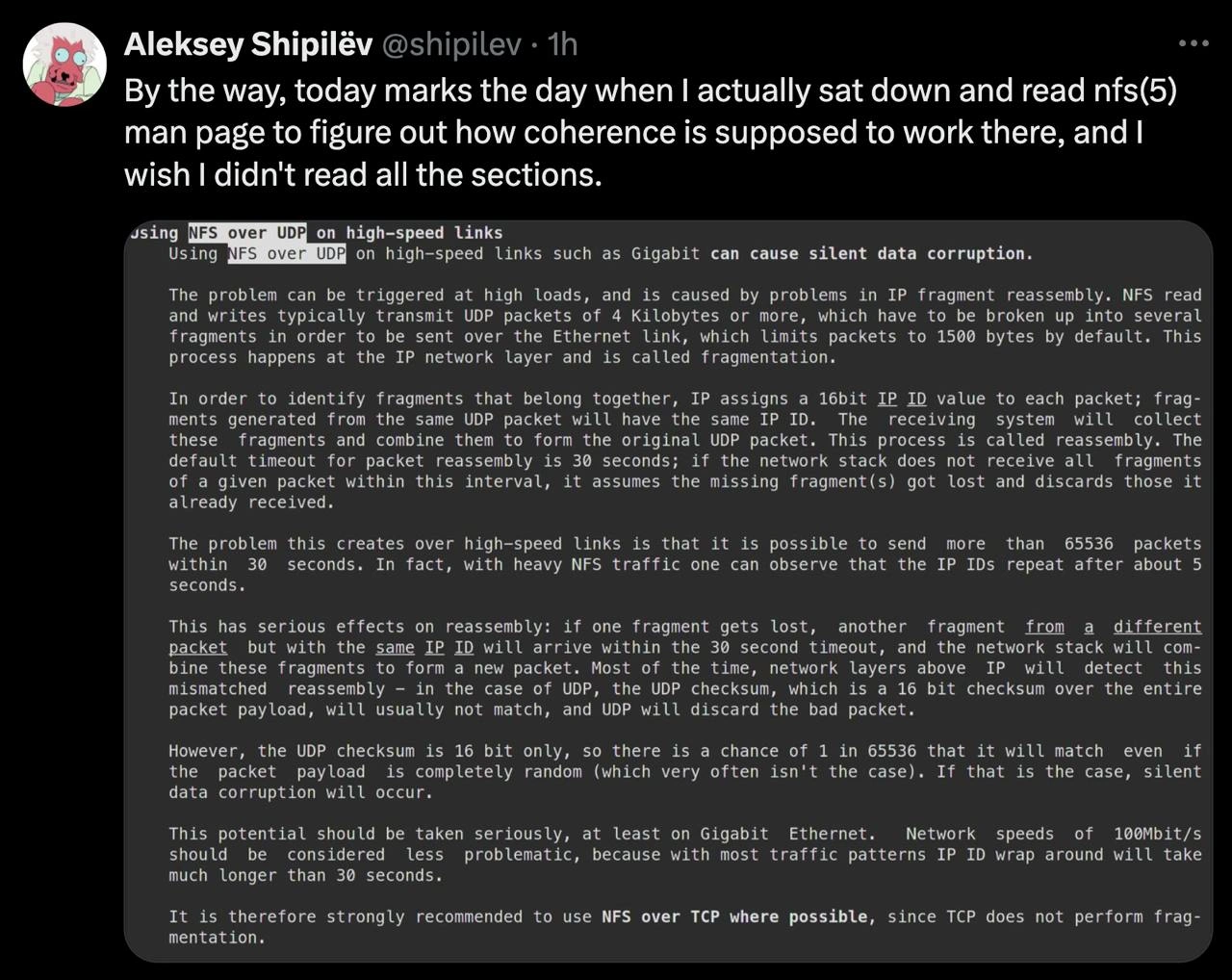
At this level, the humor shifts from pure tech minutiae to the emotional shock of a seasoned developer discovering a horrifying detail in what was supposed to be a boring manual. The tweet by Aleksey Shipilev sets the scene: “I actually sat down and read nfs(5) man page... and I wish I didn’t read all the sections.” This is a mood every experienced dev can relate to. Reading the documentation is usually a responsible act — the kind of thing we tell juniors: “Always RTFM (Read The Fine Manual)!” But every now and then, RTFM reveals a nightmare. Here, the man page casually describes a scenario where using NFS (the ubiquitous Network File System for sharing files across machines) over UDP can lead to silent data corruption. Those three words alone are enough to send a chill down any senior engineer’s spine. 😱

Why is this so darkly funny? Because it’s a classic case of the more you know, the worse you feel. The developer went looking for an explanation of how NFS cache coherence works (perhaps trying to understand how file updates propagate between clients) and instead stumbled on a hidden horror story about packet reassembly failure and data going poof. It’s like opening a technical closet and having a skeleton fall out. Senior folks know that documentation humor often comes from these frank, matter-of-fact warnings about edge-case bugs. The man page literally spells out: “Using NFS over UDP on high-speed links such as Gigabit can cause silent data corruption.” There’s no sugar-coating — it reads like a line from a tech horror novel. The humor is in the absurdity and bluntness: this critical piece of information is buried in a man page that few people read in depth until they’re desperate, and when you do read it, you suddenly question all your life choices (or at least your mounting options).

For veteran developers, there’s a layer of collective PTSD here. Many of us have been bitten by some “hidden default” or arcane bug that, in hindsight, was documented somewhere obscure. Maybe you once lost a weekend chasing a weird bug, only to find a note in an old README that explains it. In the NFS case, older sysadmins have a saying: “Never use NFS over UDP if you care about your data.” That wisdom didn’t come from nowhere — it likely came from hard-earned experience when someone noticed their files occasionally getting mysteriously corrupted. You can almost imagine the war story: two engineers in a data center at 3 AM, tearing their hair out over garbled files, until a greybeard mutters, “Could it be the UDP thing…?” and points to the dusty manual. Sure enough, boom, there it is: the quiet admission that “yeah, this might blow up under load.”

The meme’s tweet wording, “I wish I didn’t read all the sections,” carries an ironic truth: sometimes ignorance was bliss. Before reading, you might have assumed NFS over UDP is fine if it seems to be working. Now, armed with this knowledge, you realize you’ve been living on the edge of chaos without knowing it. It’s funny because it’s a mood many seniors recognize — that mix of horror and enlightenment after diving into internal docs or code. We laugh so we don’t cry, basically. It also pokes fun at how documentation can be unintentionally terrifying. The nfs(5) manual just lays it out clinically: heavy UDP usage + fragment reassembly = 1/65536 chance of random file corruption, so maybe don’t do that. It’s such a niche scenario that it reads almost like an urban legend in networking circles, except it’s real and officially documented!

Another subtle layer of humor is the contrast between what the developer intended to learn and what they actually learned. They set out to understand how “coherence” is handled – presumably meaning how NFS keeps data consistent between multiple clients (which in itself involves caches, timeouts, and is a complex topic). But along the way, they uncovered an even more hair-raising tidbit about data integrity. It’s as if you went to a library to research clean energy and stumbled on a chapter about a rare nuclear reactor failure mode. For a senior dev, this is peak relatable content: going down a rabbit hole in the docs and emerging with far more than you bargained for.

From an industry perspective, this meme highlights how legacy decisions and protocol limitations become today’s wry jokes. Why on earth was NFS ever run over UDP, given this risk? Historical context: back in the late 80s and 90s, UDP was often chosen for NFS because it’s stateless and had lower overhead on unreliable networks (plus older networks were slower, so hitting the 65k frag limit was unlikely). It seemed like a good idea at the time – simpler, faster file RPCs without the complexity of TCP. But as networks got faster and workloads heavier, that decision turned into a lurking technical debt. Modern best practice is “NFS over TCP, always,” but the fact that UDP remains an option (to preserve backward compatibility or for specialized cases) means the man page must warn about this footgun. It’s a bit of a grim joke on backward compatibility: we can’t remove it (someone might still use it), so we slap a warning label on and hope people notice. And of course, hardly anyone reads the full man page... until someone like Aleksey does, and then shares the horror on Twitter for all of us to nervously chuckle at.

In summary, at the senior level this meme resonates because it combines documentation woes (finding crucial warnings buried in text), networking gotchas (crazy UDP fragmentation bugs), and that shared feeling of “oh no, our systems are built on sand, aren’t they?” We laugh, a bit uneasily, recognizing the scenario. It’s a nod to all those in the trenches who have at some point thought, “If only I hadn’t looked under this rock, I could’ve slept easier… but now that I know, I must deal with it.” It’s both a cautionary tale (read your docs, kids!) and a dark joke about the nightmares that live in the fine print of our everyday tech.

Level 4: Reassembly Roulette

Deep in the weeds of low-level networking, the meme exposes an obscure flaw born from design limits in the Internet protocols. The Network File System (NFS) historically allowed using UDP (User Datagram Protocol) for transport, which is lightweight but has no built-in delivery guarantees. On a modern high-speed network (e.g. Gigabit Ethernet), using NFS over UDP runs into the gnarly mechanics of IP fragmentation and reassembly. Here's the crux: when a large NFS read/write (often ~4KB) is sent over a network with a typical 1500-byte MTU, it must be split into multiple IP fragments. Each fragment carries a 16-bit IP ID label so the receiver knows which fragments go together to form the original packet. But a 16-bit ID means only 65,536 unique values. At Gigabit speeds under heavy load, you can blast through all 65,536 IDs in mere seconds (~5 seconds according to that man page snippet) and start reusing them. Now, the IP layer reassembly at the receiver assumes fragments with the same (Source, Destination, Protocol, ID) belong to the same packet. If an old fragment from packet A is still hanging around (not yet timed out in the reassembly buffer) and a new packet B cycles back to that same ID, the network stack can mistakenly combine fragments from A and B into a franken-packet. This is like the network playing mix-and-match with data – a reassembly roulette game where two different UDP messages might merge. Normally, higher-level protocols catch this: e.g. UDP’s checksum is supposed to detect data corruption. But here’s the nightmare fuel – the UDP checksum is also 16-bit, meaning it’s not cryptographically strong. If the mixed-up packet’s content just happens to produce the same 16-bit checksum as expected, the network stack won’t notice the corruption. The odds are 1 in 65,536 for any given bad reassembly to slip through, but that’s far from impossible over millions of packets. In fancy terms, if an error transforms the payload in a way that’s a multiple of $2^{16}$ in the checksum space, it sails past the check unnoticed.

In formula form, given a uniform random payload error:

$$ P(\text{undetected corruption}) = \frac{1}{2^{16}} \approx 0.0015%. $$

That’s the probability the UDP checksum fails to catch a bad packet, which is exactly the chance of a 16-bit collision in the checksum. The combination of a 16-bit IP ID wraparound and a 16-bit checksum collision is the silent horror story spelled out in the nfs(5) man page. This isn’t just a theoretical gripe – it’s a consequence of fundamental protocol limits. The Ethernet/IPv4 world was built with 16-bit identifiers and checksums, which seemed plenty in older times but can buckle under today’s high throughput. It’s a classic example of how scaling up (faster links, more packets) uncovers edge cases that designers never intended to hit so frequently.

To visualize the issue, consider this breakdown of the key fields involved:

Field Size (bits) Role in Networking Limitation Impact
IP ID 16 Labels fragments for reassembly of IP packets Wraps around after 65,536 packets; on heavy traffic, old and new fragments can share an ID
UDP Checksum 16 Verifies integrity of UDP packet payload Can miss corruption if two different payloads produce the same 16-bit sum (1/65536 chance)

After about 5 seconds of saturating a gigabit link with fragmented NFS-over-UDP traffic, ID collisions become likely within the 30-second fragment reassembly window. The IP stack might then glue together pieces from different packets — a bit like assembling a jigsaw puzzle with some pieces swapped from another puzzle with the same picture ID. Most of the time this produces obviously bad data (the UDP checksum fails and the packet is discarded), but approximately one in 65k times the mutated packet still passes the checksum. The result? Silent data corruption: NFS doesn’t know anything went wrong, so it might happily write a corrupted block to disk or serve a bad file chunk to an application. No errors, no retransmits — just bad data delivered as if it were correct. For a filesystem, that’s about the worst kind of bug imaginable. It’s the sort of subtle network-induced bug that keeps storage and network engineers up at night.

This is why the man page’s final advice is so emphatic: use NFS over TCP where possible. TCP (Transmission Control Protocol) avoids this exact issue by handling packet sequencing and integrity differently. In TCP, the data stream is segmented in a way that typically doesn’t rely on IP fragmentation (it uses MSS and path MTU discovery to send chunks that fit, and sets the DF flag to avoid fragmentation). Even if IP fragmentation did occur with TCP, the TCP layer’s own sequence numbers and acknowledgments would catch missing pieces, and its checksum (also 16-bit, but TCP segments are usually smaller and if one is wrong the connection will retransmit) drastically reduces the chance of undetected mix-ups. Essentially, TCP adds a stronger framing so that pieces from different messages don’t get crossed, and any corruption or loss triggers a resend. UDP, being connectionless, lacks these safeguards — it’s up to the application or luck. In summary, the meme highlights a perfect storm of low-level mechanics: IP fragment reassembly collisions plus weak checksums yield a non-zero chance of phantom data corruption. It’s a real-world example of how deep down in the stack, hidden dragons lurk. The poor developer in the meme has just peered into one of those dragons’ lairs via the documentation, and it’s not a pretty sight.

Description

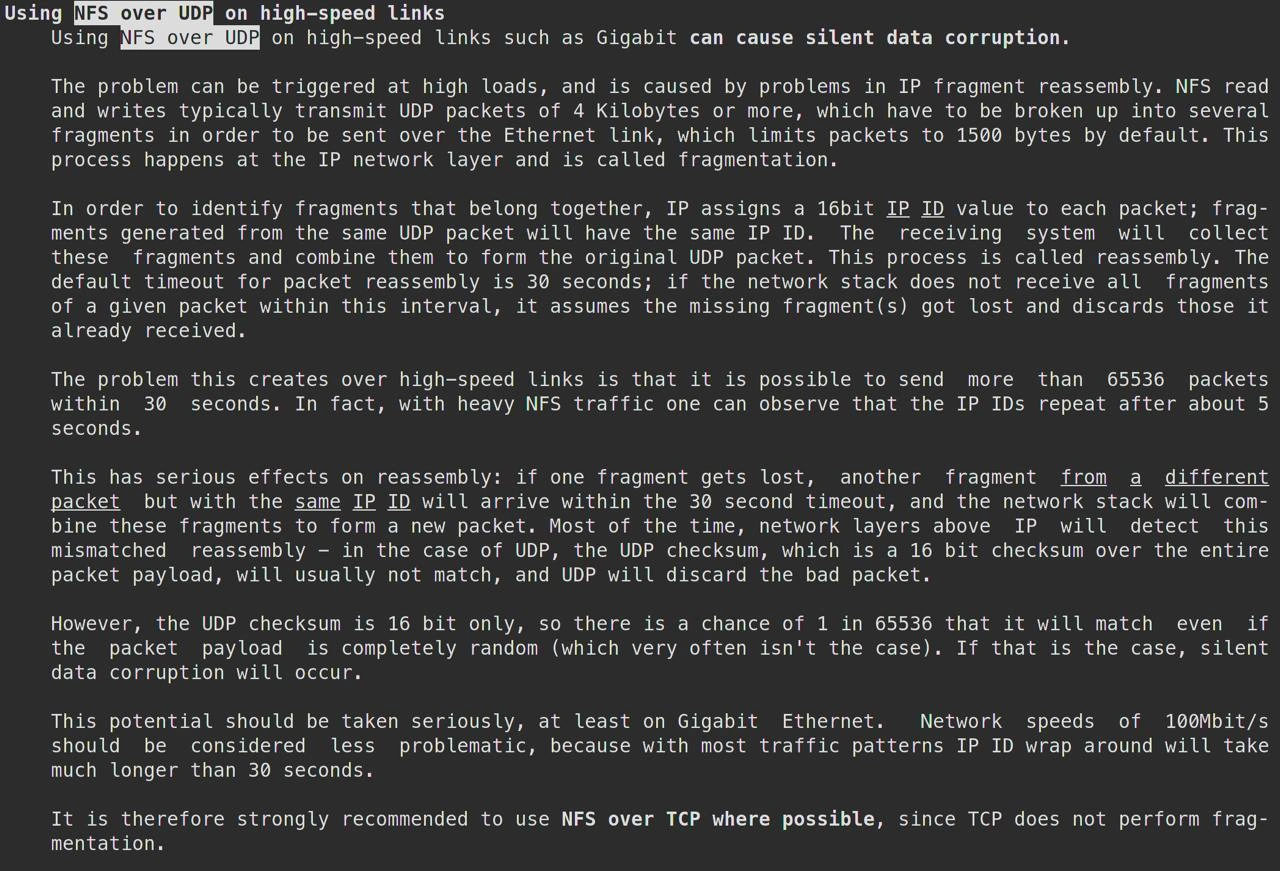
A screenshot of a tweet by Aleksey Shipilëv (@shipilev). The tweet reads: 'By the way, today marks the day when I actually sat down and read nfs(5) man page to figure out how coherence is supposed to work there, and I wish I didn't read all the sections.' Below this tweet is an embedded image containing a detailed explanation, presumably from the man page, under the heading 'Using NFS over UDP on high-speed links'. This text meticulously describes how using NFS over UDP on fast networks (like Gigabit Ethernet) can lead to silent data corruption. It explains that the 16-bit IP ID for packet fragmentation can wrap around in seconds, creating a race condition where fragments from different packets with the same ID can be incorrectly reassembled. The final, and failing, line of defense is a 16-bit UDP checksum, which has a 1 in 65,536 chance of validating the corrupted packet, leading to silent data corruption. The meme captures the horror of a senior engineer discovering a fundamental, terrifying flaw in a foundational, legacy technology that they'd previously taken for granted
Comments

7
Anonymous ★ Top Pick The nfs(5) man page is the IT equivalent of a cosmic horror story: you learn your data's integrity relies on a 16-bit checksum winning a high-speed race against IP ID wrap-around. Suddenly, 'connectionless protocol' sounds a lot like 'provably negligent'
  1. Anonymous ★ Top Pick

    The nfs(5) man page is the IT equivalent of a cosmic horror story: you learn your data's integrity relies on a 16-bit checksum winning a high-speed race against IP ID wrap-around. Suddenly, 'connectionless protocol' sounds a lot like 'provably negligent'

  2. Anonymous

    Switching NFS to UDP for “lower latency” is basically entering a 1-in-65,536 silent-corruption lottery that redraws every five seconds - perfect if your disaster-recovery plan is Schrödinger’s backup

  3. Anonymous

    Reading NFS documentation is like discovering your production database has been running on a Raspberry Pi for three years - technically impressive that it worked at all, but now you can't unsee the horror of what could have gone wrong

  4. Anonymous

    Nothing says 'battle-hardened systems engineer' quite like the moment you realize that reading the full man page wasn't paranoia - it was prophecy. Here we have the beautiful intersection of 1980s protocol design meeting gigabit networks: a 16-bit IP ID field that wraps faster than a junior dev's first production deploy, combined with a UDP checksum that gives you 1-in-65536 odds of catching silent data corruption. It's like Russian roulette, but the gun is your file server and the bullet is 'fragments from completely different packets that happen to share the same ID getting frankensteined together.' The punchline? This has been documented since forever, sitting in man pages that nobody reads until 3 AM when production NFS is doing that *thing* again. TCP doesn't fragment because TCP actually learned from its mistakes - unlike those of us who keep deploying NFS over UDP because 'it's always worked fine.'

  5. Anonymous

    NFS over UDP: coherence implemented by IP fragment roulette and a 16‑bit checksum - aka accidental chaos engineering at gigabit

  6. Anonymous

    Two decades blaming NICs for NFS corruption, then man page: 'UDP on GigE? Silent flips ahoy - use TCP.'

  7. Anonymous

    NFS over UDP: nothing says 'performance' like a gigabit link turning IP IDs into a modulo-65536 RNG and praying the UDP checksum doesn’t roll snake eyes in prod

Use J and K for navigation