Skip to content
DevMeme
5616 of 7435
Virgin Systems Engineer vs. Chad Web Developer: The Eternal Struggle
DevOps SRE Post #6163, on Aug 17, 2024 in TG

Virgin Systems Engineer vs. Chad Web Developer: The Eternal Struggle

Why is this DevOps SRE meme funny?

Level 1: Backstage vs Spotlight

Imagine a school play. There’s one kid who works backstage, handling the lights, fixing the curtains, and making sure the microphone works. They stay up late before the show, checking that everything is perfect so the performance can go on without any hiccups. During the play, nobody in the audience notices that kid (which means they did a great job!). But if one light blinks out for a second, people might whisper, “Oh no, what's wrong with the lights?” and that backstage kid might even get scolded, even though they’ve been doing excellent work all along that mostly goes unseen.

Now, there’s another kid who is the star on stage in that play. This kid comes out, says a few lines with a lot of confidence, makes everyone laugh, and the crowd claps loudly. Let’s say this star kid even forgets a line or knocks over a prop accidentally (oops!) – but then gives a big charming grin and improvises a joke. The audience still cheers because they’re entertaining and in the spotlight. After the play, everyone surrounds the star kid saying “Wonderful job! You’re amazing!” Meanwhile, the backstage kid, who quietly made sure the show could even happen, doesn’t get nearly the same applause or maybe any at all.

This meme is like that. The backstage kid is the systems engineer – working hard behind the scenes (invisibly keeping websites and servers running), and the star kid is the React web developer – doing things that everyone sees (building the part of a website you click on and can visually appreciate) and getting a lot of praise for it.

It’s funny (and a bit unfair) because usually the audience (or people in a company) notice the flashy, front-and-center work more. The meme makes us laugh by showing how the “backstage” tech person feels underappreciated and how the “onstage” tech person seems to get rewards easily. It’s exaggerating real feelings to make a point: sometimes the ones who do the most critical work get the least thanks, and those doing something more visible get all the glory – just like in a play. The humor comes from recognizing this familiar scenario and how absurd it can be.

Level 2: Sysadmin vs Web Dev Basics

Let’s break down the meme in simpler terms by explaining who these two characters are and what they do, as well as the jokes about them:

The “Systems Engineer” (Left Side) – This represents a systems administrator or DevOps/SRE engineer, basically the person who manages servers and keeps things running.

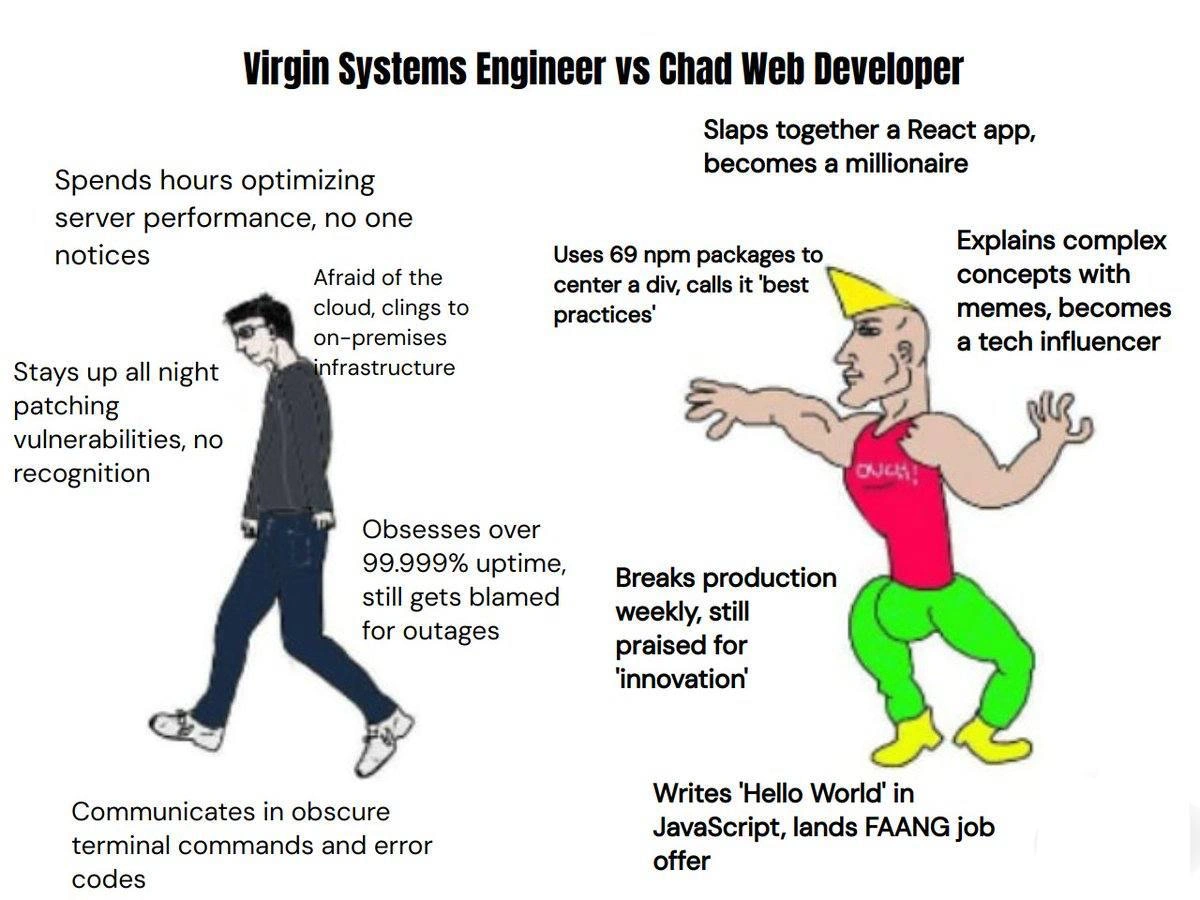
  • Role & Tasks: This person’s job is to take care of the infrastructure – the servers (either physical machines or virtual servers in a data center) that all our applications run on. They do things like configure hardware, install and update software, monitor performance, and make sure the system is secure. For example, if a website is slow, a systems engineer might optimize the server settings or upgrade a database. If there’s a security hole (a vulnerability) in the operating system or a server software (like Apache or Nginx web server), they will patch it (apply an update) to fix the issue. They might use commands in a text-only interface (the terminal) to do their work. The meme line “communicates in obscure terminal commands and error codes” pokes fun at how these experts often speak in a jargon that only other techies understand. For instance, a sysadmin might say “I grep’d the logs and found a segfault in the kernel module” – which sounds like gibberish to normal folks!
  • Uptime and Performance: Uptime means how often the service is up and available without outages. 99.999% uptime (often called “five nines”) is an almost perfect reliability goal – out of 100% time, the service is down only 0.001% of the time. In a year (525,600 minutes), 99.999% uptime allows only about 5 minutes of downtime in the whole year. That’s insanely high reliability, and aiming for that is a bit obsessive but sometimes necessary for critical systems. The meme jokes that our sysadmin “obsesses over 99.999% uptime” – meaning he works super hard to keep things running all the time, maybe by adding backup systems and double-checking everything. But despite this obsession, if there’s ever an outage or downtime, people still blame him. This is common in real life: nobody notices the hundreds of days everything works, but the one day it breaks, the IT person gets yelled at. So he’s shown as frustrated and underappreciated.
  • No Recognition: The captions “spends hours optimizing server performance, no one notices” and “stays up all night patching vulnerabilities, no recognition” illustrate that when a systems engineer does a great job (faster servers, secure systems), end-users and even managers might not realize anything was done at all. If a website loads fast, people just think “it’s normal” – they don’t see the hours of tweaking and tuning behind the scenes. If a big security problem was quietly fixed overnight, there’s no visible change, so again no one gives kudos. The poor sysadmin is doing a crucial job quietly. It’s like being the person who refuels and services a race car – if they do it perfectly, the car keeps racing and only the driver gets the spotlight.
  • On-Premises vs Cloud (Fear of the Cloud): “On-premises” (on-prem) means the company’s own servers, literally on the premises of the company or in a private data center. In contrast, “the cloud” means using servers managed by companies like Amazon (AWS), Microsoft (Azure), or Google (GCP) via the internet. The meme says the sysadmin is “afraid of the cloud, clings to on-premises infrastructure.” This stereotype exists because some old-school system admins trust their own machines more than somebody else’s. They like having physical control: they can touch the server, configure it exactly, and they feel it’s safer since they handle security themselves. Cloud is convenient but requires trusting a third party and learning new tools – which can be intimidating or seen as risky (what if the cloud provider has an outage? You can’t drive to their data center to fix it). So the meme playfully paints the sysadmin as a stubborn character who doesn’t want to migrate to the cloud era, preferring the familiar old style of hosting. (This isn’t always true, of course – many sysadmins are cloud experts, but the stereotype plays on the image of a grumpy IT guy who says “if it ain’t broke, don’t host it on the cloud!”).
  • Obscure Communication: The left figure is drawn slouched and monochrome, with quotes about error codes and commands. This emphasizes that he’s not flashy. He speaks in technical terms (like error codes, e.g., “Error 503” for service unavailable) which to non-tech people sound like a foreign language. It’s a stereotype of the socially awkward IT guy who talks about servers and code and people’s eyes glaze over. Meanwhile, the company just expects him to keep things running.

In short, the left side (the “Virgin Systems Engineer” in meme slang) is the hardworking, behind-the-scenes tech expert who gets little credit. He ensures everything works smoothly but is underappreciated and maybe a bit socially out of the limelight.

The “Web Developer” (Right Side) – This is the front-end developer, the person who makes the parts of the software that users directly interact with (like websites and mobile app interfaces). The meme calls him the “Chad Web Developer,” using “Chad” to mean the cool, confident, popular guy.

  • Role & Tools: A web developer (specifically front-end) writes code mostly in JavaScript (or TypeScript) along with HTML and CSS to create web pages/apps. The meme specifically mentions React, which is a very popular JavaScript library for building user interfaces. React developers are in high demand and often seen as “cool” in the industry right now. The Chad dev “slaps together a React app” meaning he quickly builds an application interface using React components, probably without too much worry about what’s behind it. The phrase suggests it’s done hastily or easily – maybe using a lot of premade components.
  • Using npm Packages: npm (Node Package Manager) is a repository of thousands of JavaScript packages (libraries of pre-written code). Developers use npm to import packages so they don’t have to write everything from scratch. For example, rather than writing their own function to format dates, they might use a popular date library from npm. However, this can be taken to an extreme. The meme jokes that our Chad dev uses “69 npm packages to center a div.” A <div> is a basic container element in HTML, and centering it (horizontally or vertically) with CSS is a common task front-end devs learn. It’s usually done with a couple of lines of CSS (like using margin: auto; or a flexbox). Using 69 packages to do it is a huge exaggeration to be funny – implying he over-engineers the solution by importing dozens of libraries or tools for something very simple. Why 69? It’s just a humorous number often used in internet jokes to make something sound comically exaggerated.
    • The deeper joke here: Modern web projects often have a lot of dependencies in their package.json (a file listing all npm packages your project uses). It’s not literally to center a div – but even simple projects can end up pulling many packages (one library might depend on another, and so on). People often justify this by saying it’s the “best practice” or standard way, even if it seems overkill. The meme calls that out, implying the dev might be a bit lazy or reliant on others’ code, yet confidently calls it best practice because it’s what the community does.
  • Becomes a Millionaire / Lands FAANG Job: These parts exaggerate how the web dev seemingly gets massive rewards easily. “Becomes a millionaire” suggests maybe he launched a silly app or joined a startup and struck it rich without the intense toil the sysadmin went through. “Writes ‘Hello World’ in JavaScript, lands FAANG job offer” is another facet of that. “Hello World” is typically the first very simple program you write when learning a new programming language – it just prints or displays “Hello World” to confirm the code runs. It’s like level 0 of coding, requiring minimal knowledge. By saying he does just that and lands a FAANG job, the meme humorously implies he didn’t need a lot of skill or effort to get a high-paying, prestigious job at companies like Facebook/Meta, Amazon, Apple, Netflix, Google (that’s what FAANG stands for). In reality, those companies have tough interviews – you usually need to know a lot more than Hello World – but the joke is about perception. Sometimes people see stories of young developers who know trendy tech (like React) getting snatched up by big companies or big salaries, and it can feel like “wow, they barely did anything and they got in.”
    • It’s also hinting at a bit of envy or resentment: the sysadmin may have a deep, broad skillset (servers, networks, security), but maybe he isn’t getting offers from Google because those companies often focus on software development roles. Meanwhile, a developer who’s good at a modern framework (and can maybe talk their way through an interview) might land the job. So, to a sysadmin it can appear almost unfair – hence the exaggerated scenario.
  • “Breaks production weekly, still praised for ‘innovation’”: Production means the live environment where real users use the software. If you “break production,” it means you deployed something that caused the app or site to crash or malfunction for users. That’s usually a big no-no. Claiming our Chad dev does this weekly means he’s constantly introducing bugs or downtime with his updates. Yet, he is “praised for innovation.” This highlights a cultural issue in some environments: innovation (creating new features, using new tech) is often celebrated strongly, sometimes more than stability. Maybe the company leadership prefers pushing new updates frequently, and they treat the resulting problems as just part of the process (“at least we’re delivering new stuff!”). So the dev, rather than getting in trouble for outages, is still considered a star because he’s delivering visible changes and “thinking outside the box.” It’s a sarcastic take: obviously in most companies breaking production that often would get you reprimanded or fired, but here it symbolizes how some star developers get more leeway. The sysadmin would naturally find this frustrating, because he’s trying to prevent outages while the dev is causing them, yet the dev is the one being praised.
  • Tech Influencer via Memes: The line “explains complex concepts with memes, becomes a tech influencer” refers to how the web dev engages with the community and gains fame. A tech influencer is someone in the tech world with a large following (on Twitter, YouTube, blogs, etc.) who shares knowledge, often in a fun or accessible way. It has become quite common for developers to post meme-filled threads or humorous videos to explain programming concepts. For example, someone might post a funny GIF or analogy to explain how a coding algorithm works. These often get shared widely because they make people laugh and think, boosting the author’s profile. The meme portrays the React dev as someone who leverages this trend – he can simplify and meme-ify tech ideas, which makes him popular and respected online. It’s implying that he’s better at communication and self-promotion than the sysadmin, who might be brilliant but is more introverted and not posting memes on Twitter. Because of that skill, the dev gains even more career advantage (invitations to conferences, job offers, etc., all because he can speak meme language). This is a relatively new phenomenon in developer culture: being good at sharing and simplifying knowledge can propel one’s career, not just being good at coding privately.

Summing up the basics: the meme shows a stereotypical contrast between two tech roles:

  • The Systems Engineer/Sysadmin: works in the background, focuses on stability, talks in technical code, very important but low-glamor work. When he’s successful (no downtime, secure systems), people hardly notice, and when a rare failure happens, he gets blamed. He’s depicted as the “undervalued nerd” (hunched, grayscale figure).
  • The Web Developer (React dev): works on the front-facing stuff, uses trendy tools, possibly over-reliant on external code (lots of libraries), but gets a lot of praise for making things that people can see and interact with. Even if he messes up often or his work is not as deep technically, he’s excused because he’s delivering new features or is charismatic. He’s depicted as the “cool kid” (buff, colorful Chad) striding confidently.

The meme is exaggerating to make us laugh, but it’s referencing feelings that many developers and IT professionals have experienced. Essentially, it’s saying “Isn’t it ironic how the quiet guy keeping everything running is ignored, while the showy guy building flashy stuff (and even causing issues) gets all the accolades?” Anyone who’s worked in a tech team might chuckle at that, because they’ve seen a bit of this dynamic in real life. It’s not a strict rule – plenty of front-end devs are unsung and many sysadmins are celebrated – but as a joke it hits on those stereotypical extremes.

And as a side note, the meme format itself, “Virgin vs Chad,” comes from internet culture. “Virgin” in this context doesn’t literally refer to not having had sex; it’s slang for someone who is awkward, timid, or not respected. “Chad” is slang for a confident, popular guy. This format puts two characters side by side (usually with those same poses: the left one slouching, the right one striding confidently) and lists traits of one versus the other. Here the traits listed happen to compare a sysadmin to a web developer. So the image is leveraging a well-known meme template to quickly communicate “left guy = seen as lame despite good qualities, right guy = seen as cool despite flaws.”

Level 3: Toil vs Spoils

For those of us with years in the field, this meme is a painfully relatable humor snapshot of the tech industry’s skewed reward system. It contrasts the unsung toil of systems administration (on the left) with the glorious spoils often enjoyed by flashy frontend development (on the right). The humor lands because it’s anchored in truth: the folks keeping servers running smoothly (DevOps engineers, SREs, classic sysadmins) often get minimal recognition, while those building user-facing features or hyping the latest framework can become minor rockstars. We’ve all seen it: the SysadminPainPoints of pulling an all-nighter to quietly patch a critical vulnerability or tune database performance, versus the frontend dev who deploys a shiny new interface (that maybe breaks half the time) but still gets praised for “innovating.”

Take the call-out “obsesses over 99.999% uptime, still gets blamed for outages.” Anyone who’s been on an on-call rotation knows this feel. You maintain an insanely high uptime for months (exceeding those vaunted five nines), and nobody says a word – uptime is just expected. But let there be one outage (maybe a 5-minute blip at 3 AM thanks to a freak DNS issue or a network hiccup) and suddenly it’s finger-pointing at the Ops team. 😑 It’s a classic no-win scenario: the better you do your job, the more invisible it is. This is basically the systems_engineer_stereotype: a hunched figure living in the terminal, only noticed when something breaks. The meme portrays him literally as the slouched “virgin” character, highlighting his lack of glory. The 99.999% uptime pursuit is a hallmark of DevOps/SRE culture (Google’s SREs even define an error budget to allow a tiny bit of downtime because zero outage is unrealistic). But outside the Ops team, no one cares about uptime statistics… until they dip. Then, as the meme notes, the blame rolls downhill. It’s darkly funny because it’s true – the infrastructure folks are heroes only during a crisis, and sometimes not even then.

Contrast that with the right side “Chad Web Developer,” depicted as a muscular, confident guy lapping up praise. The phrases here are jabs at react_developer_stereotype and the sometimes absurd hype around certain developer roles:

  • “Slaps together a React app, becomes a millionaire”: This satirizes startup culture and the JavaScript gold rush. It seems like every other week you hear of someone who whipped up a basic web app (often using React, the superstar JavaScript library) and either sold it as a startup for millions or got massive VC funding. It’s poking fun at how disproportionately rewarded some WebDev efforts can be. A systems engineer might toil for years optimizing systems and never see such payoff, whereas a dev who builds even a trivial app with a flashy UI might strike gold. It’s obviously exaggerated – nobody literally becomes a millionaire from centering a <div> – but it captures that frustration many backend or ops engineers feel when front-end devs get the spotlight (hence meme_contrasts that feel a bit too real).
  • “Uses 69 npm packages to center a div, calls it ‘best practices’”: Here we have a spicy poke at modern frontend development norms. The number 69 is tongue-in-cheek (a meme-y humorous number), but it underscores a real point: contemporary JS apps often have dozens (sometimes hundreds) of dependencies from npm. Centering a <div> (which could be done with a couple lines of CSS) hardly needs a library – yet it’s not unheard of for projects to pull in huge frameworks or multiple utility packages even for simple UI tasks. The barb “calls it best practices” is something an experienced developer might roll their eyes at. Best practices in software are supposed to mean proven, sensible approaches – but here it’s implying the Chad dev justifies this over-engineering by parroting whatever is trendy or recommended on blogs, regardless of actual necessity. Senior devs know the syndrome: a new dev adds a heavy dependency because “that’s what everyone on StackOverflow said to do,” even if it’s overkill. It’s a gentle roast of how Developer Experience (DX) can sometimes trump efficiency – using lots of pre-made packages certainly makes a developer’s life easier (why write your own code when there’s an npm module?), but it can be comically excessive.
  • “Breaks production weekly, still praised for ‘innovation’”: Oh, this one hits home in any DevOpsHumor circle. How many times have we seen a star developer deploy something half-baked on Friday, blow up production, and yet higher-ups hand-wave it because “we need to move fast and break things,” or “they’re innovating”? It’s basically the Facebook motto taken to absurdity. In a healthy culture, breaking production is serious. But in some hype-driven environments, flashy feature development is valued so much that even the chaos it causes is forgiven. This is a classic frontend humor gripe from the ops perspective: Ops folks end up scrambling to fix the mess (maybe rolling back the release, restoring databases, etc.), while the dev responsible might still get lauded for pushing boundaries. The meme exaggerates (“weekly” outages – yikes) to highlight how slanted the credit/blame can be. It’s simultaneously a dig at certain startups where constant outages are spun as a sign of rapid progress, and at the naivety of some devs who aren’t held accountable because they have charismatic “Chad” personas.
  • “Explains complex concepts with memes, becomes a tech influencer”: This is a nod to the modern DeveloperExperience_DX culture and social media clout. These days, it’s not just about coding; devs build personal brands. A React dev who can distill a complicated concept (say, a new framework feature or a coding principle) into a funny meme or a viral tweet can gain a huge following. They become a mini tech celebrity or tech influencer. The meme portrays that as almost absurd – imagine gaining industry fame not through groundbreaking code or research, but via dank memes and conference talks laden with jokes. Yet it happens! Many tech influencers indeed use humor and relatability to educate (nothing wrong with it, it’s effective), but from the perspective of the hard-working, camera-shy sysadmin, it can feel unfair. They’re solving real production issues at 2 AM, while the “Chad” dev is tweeting jokes about syntax and garnering applause. The subtext is a bit of jealousy and disbelief that meme-driven glory can eclipse the respect for serious engineering toil. It’s parodying the idea that social savvy and communication skills sometimes propel a dev’s career more than hardcore technical contributions do.
  • “Writes ‘Hello World’ in JavaScript, lands FAANG job offer”: Here we hit the faang_offer_myth and the sentiment that big tech hiring can sometimes seem ridiculously out of sync with actual skill. FAANG (Facebook, Amazon, Apple, Netflix, Google – now often MAANG or FANG++ including Meta etc.) jobs are seen as the holy grail due to high pay and prestige. The joke suggests the Chad developer barely has basic coding knowledge (just printing “Hello World”, the first thing any beginner writes) yet somehow waltzes into a FAANG-level job. This is poking at the notion that some individuals get hired through connections, charisma, or being part of a hype trend, rather than deep expertise – a frustrating concept for folks in the trenches. It’s obviously hyperbole (FAANG interviews are notoriously tough, requiring more than a Hello World), but it underscores how the industry can appear to reward potential or fanfare over proven grind. A systems engineer with years of experience with servers might still struggle to get noticed by these top companies, while a front-end dev who made a popular GitHub project or went viral on tech Twitter has recruiters lined up. It’s that systems_engineer_stereotype again: the quiet workhorse vs. the flashy showman.

All these contrasts form the classic virgin_vs_chad_meme format: the “Virgin Systems Engineer” is introverted, underappreciated, doing everything right but getting no love; the “Chad Web Developer” is extroverted, overconfident, maybe cutting corners but showered in praise. The meme resonates with many engineers because it exaggerates a real imbalance. In countless companies, the Ops/SRE team works tirelessly to provide a solid foundation (uptime, security, scalability), and the reward for that work is often silence (which, ironically, is kind of what you want – no incidents). Meanwhile, front-end or product developers deploy visible features (a new UI design, a fancy single-page app) and get immediate positive feedback from users and managers (“Great job, the app looks modern!”). It can breed a sort of friendly resentment encapsulated perfectly by this meme.

Historically, this divide is what gave rise to the DevOps movement: the old Developer vs. SysAdmin tug-of-war. Devs were incentivized to launch changes quickly; sysadmins were incentivized to keep things stable (often by resisting change). The meme’s joke is that even in the era of DevOps – where we try to “share the pain” and collaborate – the fundamental culture gap and recognition gap persist. The virgin vs chad caricature is an internet meme trope applied here to emphasize the extremes: one side is all duty and no recognition, the other is all swagger and all rewards. In reality, most of us fall somewhere in between, but the reason it’s funny is we’ve each known a Chad-like developer who seems to coast on confidence and trendiness, and a virgin-like engineer who does essential work in obscurity.

In summary, from a seasoned developer perspective, this meme is a satirical mirror. It reflects real DeveloperHumor and insider insight:

  • The meme_contrasts are over-the-top but point to genuine industry themes: the invisible labor of maintaining reliability versus the visible impact of shipping features.
  • It’s a comedic take on developer experience (DX) overshadowing user experience – e.g., adding tons of npm packages might make coding easier for the dev (good DX) but could bloat the app for users or drive ops folks crazy.
  • It highlights the social dynamics: the sysadmin speaks in “obscure terminal commands and error codes” (ever gotten a Slack message from Ops full of ssh commands or grep outputs? Many eyes glaze over), whereas the developer simplifies their messaging into catchy memes that everyone can understand, thus winning hearts.
  • And it definitely resonates with anyone who’s felt that the tech influencer game sometimes rewards style over substance. It’s both a laugh and a knowing sigh from the cynical veteran crowd who’ve seen brilliant engineers remain unsung while charismatic generalists rise fast.

Level 4: The Five-Nines Asymptote

At the ultra-technical level, this meme highlights a fundamental reliability engineering paradox: pursuing 99.999% uptime (the mythical "five nines") versus the cavalier complexity of modern web development. For a Systems Engineer obsessing over five-nines availability, every extra 9 in that percentage is brutally hard-earned. In concrete terms, 99.999% uptime means only about 5 minutes of downtime per year – an almost unattainable target. Achieving this demands redundant everything: load-balanced servers across multiple data centers, failover databases using consensus algorithms, backups upon backups. You’re basically wrestling with the laws of probability and physics; beyond four-nines, even cosmic rays flipping a bit in memory can be a concern. Keeping a system so highly available often entails mastering arcane infrastructure like distributed clustering, hot standby replicas, and kernel tuning for maximum performance. It’s asymptotically approaching perfection: each tiny improvement consumes exponentially more effort. The meme’s left side (“obsesses over 99.999% uptime, still gets blamed for outages”) alludes to this thankless SRE quest. No one praises the engineer for preventing the 99.999% of problems that never happened, but the 0.001% downtime (maybe a few minutes when some outage inevitably hits) will still bring blame. This is the tragedy of DevOps/SRE work: success means nothing noticeable happened, so non-technical folks assume nothing was done at all.

Meanwhile, the right side’s “slaps together a React app, becomes a millionaire” is a jab at the absurd minimalism-to-reward ratio sometimes seen in our industry. Modern WebDev culture encourages using tons of high-level abstractions and packages – the meme’s hyperbole of “uses 69 npm packages to center a div” pokes fun at that. There’s real technical complexity hidden here too: pulling in dozens of npm dependencies means relying on a huge directed graph of open-source code maintained by who-knows-what. Dependency resolution algorithms must satisfy sometimes conflicting version ranges; the Node module loader has to manage possible name conflicts or deep nested node_modules directories. The proliferation of packages can lead to dependency hell, and even senior developers know the infamous example: the removal of the tiny left-pad package once broke thousands of builds, a perfect illustration of npm_package_overkill risk. Including 69 packages for something trivial isn’t just a joke – it hints at the real complexity and attack surface this creates. Each package could introduce a bug or security vulnerability (the sysadmin on the left might end up patching vulnerabilities all night because one of those 69 packages had a critical CVE exploit). The supply chain security aspect is an advanced concern: one malicious or abandoned dependency in that sea of packages can compromise the whole app. Ironically, the Systems Engineer who’s “staying up all night patching” might literally be fixing issues caused by such excessive library use (for example, applying emergency patches when a popular npm library has a zero-day vulnerability).

There’s also an underlying commentary on on-premises infrastructure versus the cloud, which is an architectural shift with theoretical implications. The left figure “afraid of the cloud, clings to on-prem” reflects an old-school preference for direct control over servers. From a tech perspective, this hints at concerns about multi-tenant architectures and trust boundaries. In an on-premises setup, the engineer can account for every hardware component and network route, achieving reliability through known quantities. The cloud, by contrast, abstracts these details – a hyperscaler like AWS might give you easy scaling, but you surrender some control. A veteran systems engineer knows that cloud providers have their own failure modes (entire regions going down due to a faulty update, as has happened in real life). This is essentially cloud_phobia born out of experience: trusting your own carefully configured servers vs. relying on a black-box cloud service. There’s a theoretical trade-off here akin to the CAP theorem in distributed systems or the end-to-end principle in network design: how much complexity do you push to a provider versus manage yourself. The meme exaggerates it for humor, but it’s referencing this real tension.

Lastly, consider the tech_influencer_parody aspect: “explains complex concepts with memes, becomes a tech influencer.” Beneath the joke is a nod to the explosion of developer experience (DX) content and social media influence in tech. From a meta perspective, it’s hinting at how knowledge propagation has changed. Instead of dense documentation or RFCs, complex ideas (even theoretical ones like monads or the CAP theorem) are nowadays often distilled into funny tweets, TikToks, or blog posts with memes to grab attention. There’s a cognitive science angle here: using memes as mnemonic devices or social proof can make ideas more accessible and viral, which ironically can catapult a developer’s fame. The seasoned engineer might scoff, but it’s an effective form of communication in our industry’s current culture. In summary, at this deepest level the meme spotlights systemic issues built on real technical foundations: the Sisyphean task of near-perfect uptime in systems engineering, versus the cascade of abstractions in modern JavaScript development – and how each is valued (or undervalued) thanks to fundamental human and technical factors.

Description

A two-panel "Virgin vs. Chad" meme comparing a Systems Engineer to a Web Developer. On the left, the "Virgin Systems Engineer" is depicted as a lanky, sad-looking figure in dark clothes and sunglasses. Text points to his thankless tasks: "Spends hours optimizing server performance, no one notices," "Stays up all night patching vulnerabilities, no recognition," and "Obsesses over 99.999% uptime, still gets blamed for outages." He is described as "Afraid of the cloud" and communicating in "obscure terminal commands." On the right, the "Chad Web Developer" is a muscular, confident figure in a bright red top and green pants. His accomplishments are superficial and high-reward: "Slaps together a React app, becomes a millionaire," "Uses 69 npm packages to center a div," "Breaks production weekly, still praised for 'innovation'," and lands a FAANG job by writing "Hello World." The meme satirizes the cultural and value gap between backend/infrastructure roles and the more visible, often more celebrated, frontend and web development roles. It highlights the irony of systems engineers doing critical, difficult work for little recognition while web developers achieve massive success with what are portrayed as trivial or reckless efforts

Comments

12
Anonymous ★ Top Pick The Chad Web Developer's app has 99.999% uptime because it's running on the Virgin Systems Engineer's meticulously patched, on-prem server that he's too afraid to migrate to the cloud
  1. Anonymous ★ Top Pick

    The Chad Web Developer's app has 99.999% uptime because it's running on the Virgin Systems Engineer's meticulously patched, on-prem server that he's too afraid to migrate to the cloud

  2. Anonymous

    Spent two quarters hardening kernels for 99.999% uptime - React guy yarn-adds 42 deps to center a div and gets promoted for “impact”; apparently the only uptime that counts is his follower graph

  3. Anonymous

    The real Chad move is maintaining five nines uptime while deploying straight to production on Fridays - because your Kubernetes cluster has more self-healing capabilities than your mental health after 15 years of on-call rotations

  4. Anonymous

    The real tragedy isn't that the systems engineer maintains 99.999% uptime while the web developer breaks production weekly - it's that the market has decided 31.5 seconds of annual downtime is worth less than the ability to center a div with 69 dependencies and call it 'modern best practices.' Meanwhile, that React millionaire is one left-pad incident away from discovering why the systems engineer was so paranoid about supply chain security all along

  5. Anonymous

    In ops, five nines buys you silence; in frontend, one npm install buys you a valuation - right up until left-pad’s spiritual successor disappears and your error budget becomes the roadmap

  6. Anonymous

    SREs forge invisible nines in the server depths; Chads slap React glitter on it and ride to FAANG fame

  7. Anonymous

    Infra misses one SLO and writes a postmortem; the React dev installs 69 npm packages to center a div, triggers it, and writes a Medium post titled “Best Practices.”

  8. @spiderts 1y

    omg in on the left

  9. dev_meme 1y

    Yes

  10. @Le_o_R 1y

    Yup, seems accurate.

  11. @SamsonovAnton 1y

    Well, if Chad really can explain complex concepts with memes, he is not that bad.

  12. @cotoha_1 1y

    here’s some of my recognition to you, my friend admin 👌

Use J and K for navigation