Skip to content
DevMeme
5618 of 7435
The Perils of NFS over UDP on High-Speed Links
Networking Post #6165, on Aug 18, 2024 in TG

The Perils of NFS over UDP on High-Speed Links

Why is this Networking meme funny?

Level 1: Mixed-Up Puzzle Pieces

Imagine you and your friend are each working on two big jigsaw puzzles that happen to have very similar pieces. Both puzzles’ pieces are even numbered the same way on the back from 1 to 1000. Now, say you’re finishing up your puzzle but one piece is missing. By coincidence, your friend hands you a piece with the same number from their puzzle, thinking it might be yours. Amazingly, it fits into the gap in your puzzle frame! You complete the puzzle and it looks okay at a glance – but actually one piece of the picture is from your friend’s puzzle, not the one you were making. Maybe your puzzle was a landscape and the missing piece was part of the blue sky; the piece from your friend’s puzzle also has a bit of blue sky, so you didn’t notice it was the wrong piece. The result? Your picture has a sneaky mistake in it, and you wouldn’t know unless you looked very closely.

This is like what happened with sending data using UDP on a fast network. The “pieces” of a message (data packets) got mixed up with pieces from another message because they had the same label, and it all accidentally seemed to fit. Most of the time, if you put the wrong puzzle piece in, you’d see it’s wrong and take it out. But once in a while, the wrong piece might look right enough to fool you. In a computer, that means a file could get a wrong chunk of data inserted and nobody realizes it. That’s why the advice is to play it safe and use a method that doesn’t split the message into so many pieces (or at least checks really carefully). It’s a bit like using puzzle pieces that are uniquely shaped or coded so you can’t mix them up. In simple terms: don’t send important stuff in a way that can get its pieces mixed up, or you might end up with a puzzling nightmare!

Level 2: Mixed-up Fragments

Let’s break down what’s happening in simpler terms. NFS (Network File System) lets one computer use files that actually live on another computer over the network – kind of like a shared drive. You can set NFS to send data using UDP or TCP, which are two different NetworkProtocols. UDP (User Datagram Protocol) is like sending a bunch of letters with no guarantee they arrive – it’s faster and has less overhead, but if a letter (packet) gets lost, nobody automatically resends it. TCP (Transmission Control Protocol) is more like certified mail – it’s a bit slower due to extra steps, but it makes sure every packet arrives in order, resending any that get lost.

In our story, they used NFS over UDP on a very fast network (Gigabit Ethernet, which moves 1 gigabit per second – quite speedy). NFS over UDP will try to send big chunks of file data in each packet (often 4096 bytes or more). But networks have a limit on packet size (usually around 1500 bytes for Ethernet by default). So those big NFS messages have to be fragmented – split into smaller pieces – before they’re sent. Think of writing a long message on multiple postcards because one card can’t fit it all. Each fragment gets an IP ID number so the receiver knows which pieces belong together to form the original message (like numbering the postcards “1/3, 2/3, 3/3”). The receiving computer’s IP layer will wait until it has all the fragments with the same ID and then reassemble them into the full message. If a piece is missing and doesn’t show up within 30 seconds, the receiver gives up and throws away the fragments it has (assuming the missing piece got lost in transit).

Now, here’s the twist: the ID number that labels fragments is only 16 bits long, meaning it can only go up to 65535. The network will reuse IDs once it runs out (it’s like if you only had 5 digits on a ticket counter, after 99999 you go back to 00000). On a high-speed link pushing a ton of data, the system can cycle through all 65535 IDs pretty quickly – the text says in about 5 seconds under heavy load! So imagine we sent so many NFS messages that we used ID 100, 101, … up to 65535, and then again 0, 1, 2, etc., all within a half-minute window. Now suppose one big NFS packet’s last fragment got lost (say packet with ID 42 had 8 pieces, and piece 7 is missing). Normally, after 30 seconds the receiver would discard the other 7 fragments of that packet. But before that timeout hits, our NFS server has already sent another, totally different packet that by coincidence also got the ID 42 (because we wrapped around). The receiver doesn’t know it’s a different message – it just sees “Oh, more fragments for ID 42, great!” and it combines fragments from the old packet and the new packet together. The result is gibberish data, basically a mash-up of two unrelated messages. Usually, this gibberish is caught by a safety check: UDP has a checksum (a small sum calculated from the data) that usually won’t match if the data’s mixed up. So the bad packet is detected and dropped most of the time. However, that checksum is also 16-bit, which isn’t a huge security net. There’s a 1 in 65,536 chance that even a random wrong combination of data could produce the exact same checksum as the original. If that happens, the receiver says “Checksum looks good!” and passes the corrupted data up to NFS, and then to your application – with no warnings. That’s what we mean by silent data corruption: your data got scrambled, but it sneaked past the checks as if everything was fine. Scary, right?

For a junior developer or admin, the takeaway is: don’t use UDP for critical data transfers if you can help it, especially not on super-fast networks. It’s tempting because UDP is lightweight, but as we see, it can backfire spectacularly. In real life, this exact issue was so serious that everyone now recommends using NFS over TCP. TCP avoids this problem by handling data in smaller chunks that fit the network (so no IP-level fragmentation needed in normal cases) and by having acknowledgments and retransmissions – if something’s wrong, it won’t be silent. Modern NFS defaults to TCP for exactly this reason. The snippet in the meme is basically a big caution sign for system administrators: “UDP might corrupt your data on fast networks, so use TCP instead!” Here’s how that might look in practice:

# ❌ Bad idea: mounting NFS using UDP on a high-speed network (prone to fragment mix-ups)
sudo mount -t nfs -o vers=3,proto=udp server:/export /mnt/data

# ✅ Good idea: mounting NFS using TCP (reliable, avoids IP fragmentation issues)
sudo mount -t nfs -o vers=3,proto=tcp server:/export /mnt/data

By choosing TCP (proto=tcp in the mount options) we ensure the transport layer takes care of reliability. The NetworkEngineering lesson here is clear: when in doubt, favor robustness over a tiny bit of speed. Silent corruption is the kind of bug that can ruin your day, so we go with the safer protocol to preserve DataIntegrity. After all, a slightly slower transfer that’s correct is far better than a fast one that quietly garbles your files.

Level 3: Nightmare on Ethernet Street

For seasoned sysadmins and network engineers, this snippet reads like a horror story by flashlight. Imagine it’s 3 AM and you’re on call: your storage system is blazing along at gigabit speeds, backups running faster than ever… until you discover some files quietly got corrupted. No alerts, no obvious failures – just wrong data. That’s the kind of nightmare the meme title jokes about. It’s “silent” because nothing crashes, and “nightmare” because few things are scarier in IT than data corruption you can’t detect immediately. The humor here is dark and rueful: of course using NFS over UDP on a high-speed link blew up in our faces. It’s the kind of lesson you learn the hard way and then warn every new hire about: use TCP, not UDP for NFS if you value your sanity (and your data).

The combination of NFS, UDP, and gigabit networks is an infamous anti-pattern now. NFS is a distributed FileSystem protocol – basically a way to share files over a network. Back in the day, some installations ran NFS over UDP to avoid TCP’s overhead, chasing a bit more performance. It might work on slower networks, but crank the speed up and you’re playing with fire. This snippet explains exactly why: UDP doesn’t guarantee delivery or order, and it relies on IP fragmentation for large transfers. At gigabit throughput, the IP layer starts churning out fragments with repeating IDs like a cheap odometer rolling over. It’s a perfect illustration of BugsInSoftware (or rather, bugs in protocol design) that emerge under extreme conditions. Senior engineers find it both funny and painful because it’s a classic “sysadmin_warning” scenario: something that works 99.99% of the time – until it spectacularly doesn’t. The one-in-65k chance sounds tiny, but push millions of packets per minute and those odds will eventually catch up with you. It’s like playing a data integrity lottery you didn’t even know was running, and the losing ticket means random file corruption.

The meme format – a sober man-page excerpt – adds to the humor. It’s just calmly telling you how your high_speed_links can turn against you, as if this is merely a footnote in networking lore. Seasoned folks chuckle (or groan) because they’ve seen similar “gotchas” before. It’s reminiscent of the old “It’s always DNS” joke – except here it’s “It’s always UDP.” In a big enterprise, a newbie might innocently mount NFS with UDP and brag about the throughput, until a veteran chimes in with this exact warning. Cue a collective shudder from anyone who’s had to troubleshoot weird DataLoss issues that ultimately traced back to misplaced network packets. And fixing it? Thankfully, it’s straightforward: move to NFS over TCP and the nightmare vanishes. The fact that NFSv4 dropped UDP entirely is the industry’s way of saying “never again.” In summary, the humor is in the hindsight: we laugh now, but only because some poor soul lived the nightmare and wrote this cautionary tale for the rest of us.

Level 4: The 65,536 Packet Problem

At the network protocol level, this meme highlights a fundamental limitation in IPv4’s design: the 16-bit IP Identification field. When an IP packet is fragmented, each fragment carries the same ID so the receiver can reassemble them. But a 16-bit ID means only 65,536 unique values (0 to 65535). On a Gigabit Ethernet link, a busy NFS server can blast through 65k packets in mere seconds, causing the IP ID to wrap around and repeat. The IP layer’s reassembly algorithm doesn’t expect to see the same ID so soon for different data. As a result, if one fragment of a UDP packet is lost, the next unrelated packet that reuses that ID (inevitable at high rates) might arrive within the 30-second reassembly timeout. The network stack misidentifies fragments from two different messages as belonging together – a packet Frankenstein is born.

Normally, such a mismatched reassembly is caught further up the stack. For UDP, the only line of defense is the UDP checksum, a simple 16-bit sum over the data. It’s meant to detect corruption, but being 16-bit, it’s fairly weak by modern standards – essentially a checksum roulette. There’s a $1/65536$ chance that two completely different fragment combinations produce the exact same checksum. If that unlucky event occurs, UDP will accept the bogus packet as if nothing’s wrong. This is the silent data corruption nightmare: bad data slips through with no error. It’s a perfect storm of design choices from a bygone era colliding with today’s high speeds. The outcome violates every DataIntegrity principle – your storage bits get scrambled in transit, and nobody even notices.

Under the hood, this exemplifies an emergent bug from layered systems. The IPv4 designers never anticipated gigabit-level packet rates, so a 16-bit ID seemed plenty in the 1980s. UDP’s checksum was never meant as a cryptographic guarantee, just a quick check. Combine those with heavy NFS traffic (4KB UDP datagrams fragmented into 3+ frames each) and you’ve built a probabilistic ticking time bomb. It’s akin to the Y2K problem but for packets – a numeric field too small for the modern world. No wonder the snippet’s advice is to switch to TCP. Unlike UDP, TCP avoids this entire ordeal: it breaks data into segments that fit the path MTU (no IP fragmentation needed in normal cases) and uses a sequenced, acknowledged delivery. Even if IP fragmentation does occur with TCP, any missing pieces trigger a retransmission rather than a garbled reassembly. In short, TCP’s reliability and its flow control were the antidote to this 16-bit wraparound fiasco. The meme’s technical core is a cautionary tale: when pushing network protocols to their edge, watch out for hidden counter limits and statistical flukes – otherwise your NetworkEngineering trial can turn into a DataLoss horror show.

Description

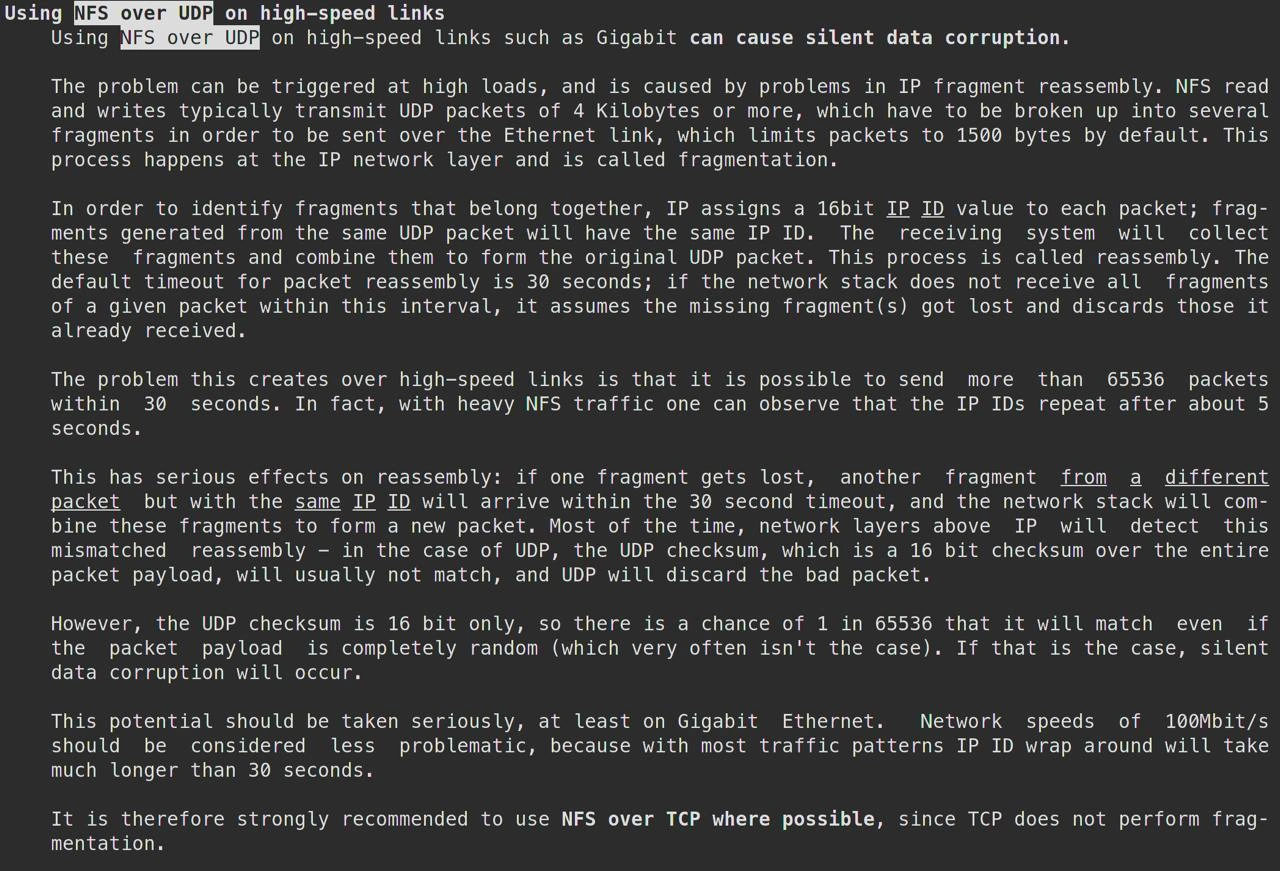
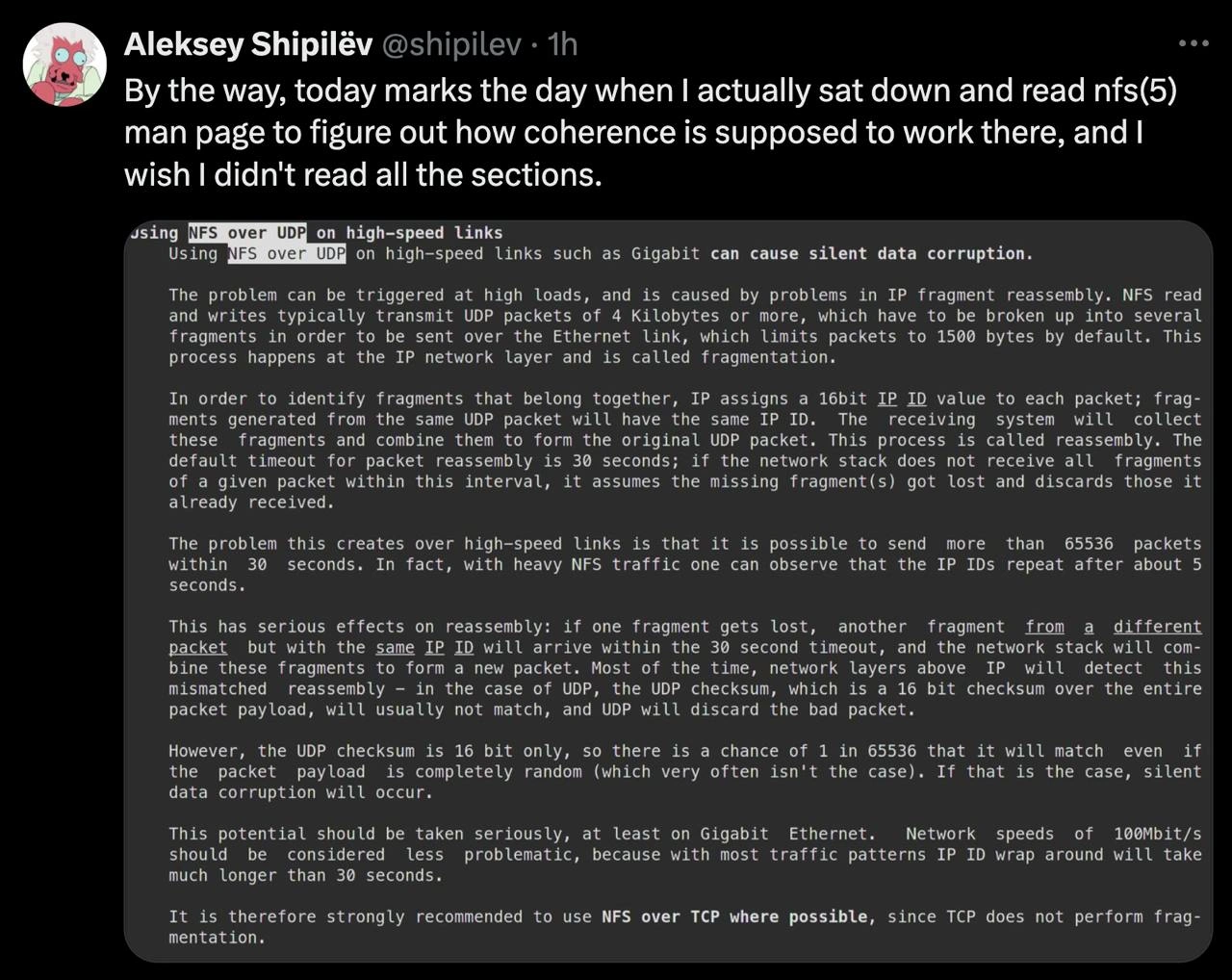
A screenshot of technical documentation detailing a critical flaw in NFS over UDP. The text, under the heading 'Using NFS over UDP on high-speed links,' explains that high-speed networks can cause silent data corruption. The issue stems from IP packet fragmentation, where the 16-bit IP ID can wrap around in as little as 5 seconds on a busy network. This creates a scenario where fragments from different original packets but with the same ID can be incorrectly reassembled. A 16-bit UDP checksum provides a final, but unreliable, check, with a 1-in-65,536 chance of incorrectly validating the corrupted data. The documentation therefore strongly recommends using NFS over TCP instead. This content highlights a deeply rooted, non-obvious failure mode in a widely used, legacy networking protocol

Comments

7
Anonymous ★ Top Pick Using NFS over UDP on a 10-gig link is like playing Russian roulette with a 65,536-chamber revolver. It feels fast until one of your packets gets reassembled with fragments from last week's backup
  1. Anonymous ★ Top Pick

    Using NFS over UDP on a 10-gig link is like playing Russian roulette with a 65,536-chamber revolver. It feels fast until one of your packets gets reassembled with fragments from last week's backup

  2. Anonymous

    Running NFS over UDP on GigE is like indexing prod with a 16-bit surrogate key - about five seconds in, the network starts JOINing random fragments and your files come back as avant-garde data art

  3. Anonymous

    Reading documentation that says "1 in 65536 chance of silent data corruption" and realizing that's basically the same odds as your startup's Series B, except the corruption is guaranteed to happen during the customer demo

  4. Anonymous

    Ah yes, NFS over UDP on Gigabit - the networking equivalent of playing Russian roulette with your data, except the chamber has 65,536 slots and you're spinning it every 5 seconds. The 16-bit UDP checksum gives you a 1-in-65536 chance of accidentally accepting corrupted packets as valid, which sounds safe until you realize that's exactly the rate at which IP IDs wrap around on high-speed links. It's the perfect storm: your IP ID counter laps itself faster than a NASCAR race, fragments from different packets arrive with matching IDs, the UDP checksum shrugs and says 'looks good to me,' and suddenly your financial database thinks π equals 3. The real kicker? It's *silent* corruption - no errors, no warnings, just quietly wrong data. This is why senior engineers have trust issues and insist on TCP for anything that matters. Remember: friends don't let friends run NFS over UDP on anything faster than 100Mbit/s

  5. Anonymous

    NFS/UDP on GigE: IP frag timeouts silently corrupting files - like mutable shared state in a distributed system, but with 30-second naps

  6. Anonymous

    NFS over UDP: IP fragmentation doing a blind join on a 16‑bit key with a 30‑second window - occasionally your files pass the checksum and fail reality

  7. Anonymous

    Running NFS over UDP at gigabit is protecting petabytes with a 16‑bit checksum - eventually the dice roll 65536 and you get a ghost write and a very long RCA

Use J and K for navigation