Skip to content
DevMeme
4311 of 7435
Boss: “No need to supervise the new dev!” - reality disagrees
Juniors Post #4713, on Aug 1, 2022 in TG

Boss: “No need to supervise the new dev!” - reality disagrees

Why is this Juniors meme funny?

Level 1: Unsupervised Surprise

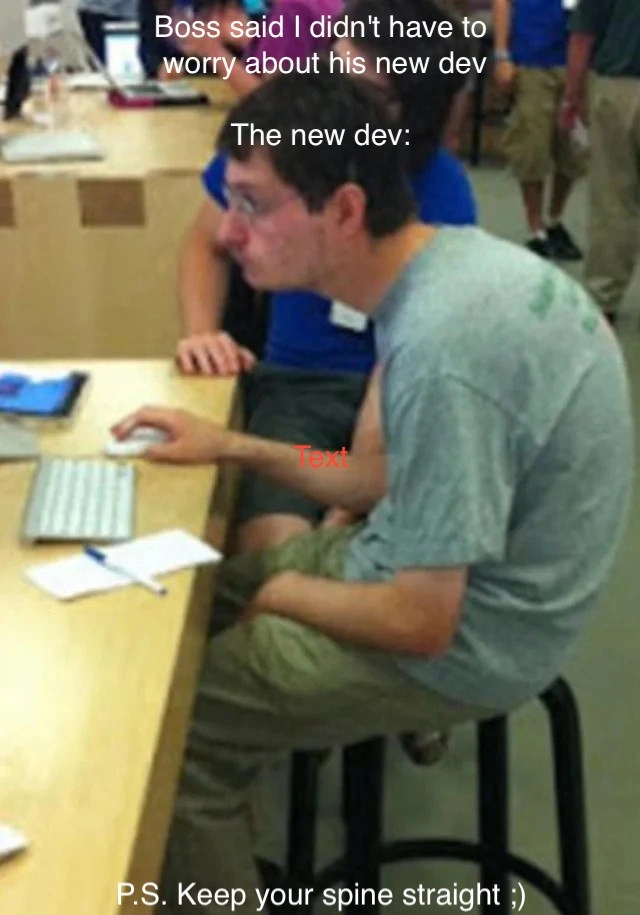
Imagine your teacher tells you, “I don’t need to watch the new kid, he’ll be just fine by himself.” That sounds confident, right? But then you peek at the new kid and see something funny: he’s sitting at his desk in a really odd way, bent over so far that his nose is almost touching his notebook. He looks uncomfortable and kind of like a curled-up shrimp! It immediately makes you think, “Uh, is he okay? Maybe someone should help him.” It’s a bit like when a parent says, “I don’t need to watch the puppy,” and then the puppy starts chewing on the furniture – oops, maybe a little supervision was needed after all! In the same way, the boss said “no need to worry” about the new developer, but the new developer ended up in a silly, hunched position that clearly isn’t good for him. It’s funny because the boss’s confidence was wrong, and you can literally see that the new person could use some help (even if it’s just “Hey, sit up straight so you don’t hurt yourself!”). So the joke is showing that sometimes when nobody’s watching, the newbie might do something goofy – not because he’s bad, but because he’s still learning. It makes us laugh, and also maybe makes us want to tap him on the shoulder and help him out.

Level 2: Onboarding Pains

Let’s zoom out and explain what’s going on in simpler terms. The meme shows a situation at work: a manager (the “boss”) told the team not to worry about a new developer who just joined. In other words, the boss is saying, “This new programmer will be fine on his own, no need to supervise or watch over him.” That’s the expectation set by the boss. Now, the meme then immediately shows “The new dev:” – and we see a photo of the actual new developer in action. The funny (and a bit alarming) part is how we see him working: he’s perched on a high stool, slouching deeply forward, with his face almost touching his keyboard and mouse. His back is rounded in a big C-shape. It looks really uncomfortable and not at all a normal way to sit and code! The text at the bottom even jokes, “Keep your spine straight ;)” because clearly, this poor guy’s spine is anything but straight.

So why is this funny to people in tech? It’s a classic case of expectation vs. reality. The boss confidently said “no need to worry,” implying the new hire is low-maintenance and everything will go smoothly. But the reality (the photo) disagrees in a humorous way: it shows a new dev who might actually need some help, if only to avoid hurting himself! It’s like if someone said “Don’t worry, my cat is super well-behaved,” and then you look over and the cat is clawing up the curtains. The boss’s statement and what we see just don’t match at all, which creates the humor. In a workplace context, it’s poking fun at how managers can sometimes be a bit too optimistic or hands-off with juniors (newer, less experienced developers), while the juniors might be quietly struggling.

Now, let’s explain a few terms and ideas here:

  • Junior Developer (Junior): This means a developer who is at a beginning stage of their career – maybe fresh out of college or a coding bootcamp, or just new to this particular team or project. Juniors usually have less experience and thus often need a bit of guidance or mentorship from more senior developers, especially when they’re onboarding (getting started at a new job).
  • Onboarding: This is the process of introducing a new person to a company or project. It includes things like setting up their computer, giving them access to tools, explaining the codebase, and yes, ideally showing them around the office including where the good chair and monitor are! Good onboarding helps a new dev learn the ropes. When onboarding is rushed or ignored, the new person might feel lost or make mistakes. Here, it humorously looks like the new dev wasn’t even shown how to set up his desk comfortably.
  • Developer Experience (DX): You might have heard of User Experience (UX) which is about making software friendly for users. Developer Experience is similar but focused on making life easy for developers. It can be about having good documentation and tools, but it’s also about the physical work environment. A positive DX would mean the company cares about things like ergonomics (comfort and efficiency in your workspace), giving developers decent gear (monitors, keyboards, chairs), and a supportive environment. In this meme, the DX seems lacking – sure, he has a fancy Apple keyboard and Magic Mouse, but nobody ensured he’s sitting right. A fancy computer doesn’t help if you’re too uncomfortable to think straight!
  • Corporate Culture: This refers to the overall style or philosophy of the company’s management and work environment. In some corporate cultures, managers assume people will figure things out on their own (a more hands-off approach). In others, there’s a culture of mentorship and checking in frequently, especially with new folks. The boss in the meme represents a culture of “sink or swim” – basically saying “he’ll be fine, just leave him be.” But the photo suggests maybe a more hands-on, caring culture was needed there. The joke hints that this company’s culture might not be paying attention to a basic issue right in front of their eyes (literally the new guy’s bad_posture).
  • Ergonomics: This is a key term here. Ergonomics is all about designing a workspace so that you can work comfortably and safely. In practice, for computer work, it means adjusting your chair, desk, and monitor so you’re not straining your body. For instance, an ergonomic setup would have your monitor at about eye level so you’re not bending your neck too much. Your chair would support your lower back and be at a height where your feet rest flat on the floor. Your keyboard and mouse should be positioned so your arms are not at a weird angle. In the photo, it’s obvious something is off ergonomically: the developer’s monitor (likely a sleek iMac or display on that wooden counter) is too low relative to his eye level, or his stool is too high. He’s slouching at the keyboard, probably because he’s trying to get closer to the screen or is intensely concentrating. A quick fix would be a monitor riser – basically a stand or anything that lifts the screen up a few inches – plus maybe a better chair. The sticky note and pen next to him suggest he’s taking notes or following instructions, but ironically no one instructed him on how not to sit like a shrimp!
  • Bad Posture: This means holding your body in a way that isn’t healthy or natural, especially for long periods. In the image, the new dev’s posture is definitely “bad” – his back is rounded, shoulders forward, neck craning out. If you sit like that for a long time, you’ll likely get a sore neck or back. It’s the kind of thing a concerned colleague might gently poke you about: “Hey, maybe adjust your chair, you’re gonna hurt your back like that.” The meme draws attention to this common issue with a bit of humor.
  • Onboarding Pain: This phrase (tagged in the context) refers to the common difficulties and “pain points” when a new developer is joining a team. It can be anything from struggling to set up the development environment, not understanding the codebase, or even small things like not knowing the team norms. Here the “pain” is quite literal – if that new dev keeps sitting like that, he’s going to be in physical pain! The meme is a lighthearted way to say: when we don’t help new team members early on, the result can be painful (for them and sometimes for the project).

The environment also adds to the humor. It looks like this might be in an apple_store_setting or a very modern open office with high tables. Those spaces look cool and minimalist, but they’re not always practical for long coding sessions. The new dev maybe didn’t get an actual desk yet, or chose a spot that’s not ideal. Often, new employees don’t immediately ask for things like a different chair or a monitor stand because they might feel they should just use what’s provided and not make a fuss. If no one is assigned to check on them, you get scenes like this: someone new doing their best, but in a somewhat absurd setup.

Why do developers find this meme so relatable and funny? Because it captures a real-life vibe in a single image. Many of us remember our first weeks on the job where we were too shy to ask a “silly question.” Maybe you had no idea how to set up the dev environment and spent half a day struggling silently, or you didn’t know you could adjust the chair height and ended up with sore wrists. It’s common to want to appear competent and not bother others, especially when you’re new. Here the new dev likely wants to prove he’s focused and capable — so he’s laser-focused on the screen, possibly debugging or writing code, to the point he’s ignoring how he’s sitting. We laugh, because we’ve seen it or done it: like pulling an all-nighter with eyes glued to the screen, then standing up and walking like a pretzel because we realized we’d been slouched for hours.

This meme also gently pokes at the boss or management. The boss figure saying “I didn’t have to worry” and then reality showing something clearly worrisome is a fun way of saying, “Managers don’t always see what’s really happening on the ground.” In tech teams, managers might sometimes be overly optimistic about a new hire’s ability to jump right in. They might assume the new dev will ask if they have issues. But in reality, new devs often don’t want to ask too many questions. So without a good mentor or buddy system, they might struggle in unexpected ways — like not even knowing the proper monitor height for comfortable coding! It’s a small detail, but it symbolizes the bigger idea that new folks need support.

In summary, at this level we understand the meme as a humorous take on onboarding gone wrong in a tiny but telling way. The categories like Juniors and Developer Experience (DX) and Corporate Culture all intersect here:

  • A junior developer is left on his own (culture of sink-or-swim),
  • The developer experience basics (like an ergonomic chair and monitor setup) were overlooked,
  • And the corporate culture might be a bit too hands-off or assuming.

The result is funny – a new guy sitting in a wild, back-breaking pose – but also a bit of a light lesson: even little things like posture can reflect whether a team is taking care of its newbies. And hey, if you’re a new dev yourself reading this, let this meme remind you: it’s totally okay to ask for a better chair or help with something! Don’t suffer in silence (your back will thank you). The team would much rather you speak up than find you later twisted like a pretzel. 😉

Level 3: Hunch-Driven Development

The boss’s casual “no need to supervise” decree is practically a horror story for seasoned engineers. To experienced devs, that line is a red flag, akin to deploying untested code to production. Here, reality responds with a meme-worthy rebuttal: the new dev is literally bending over backwards (well, forwards) to get his work done. In the blurry photo, our junior engineer is hunched into an extreme C-curve on a tall stool, face inches from the keyboard, looking more like a question mark than a confident coder. This stark contrast between management’s rosy assumption and the developer’s bad_posture signals the classic gap between corporate optimism and engineering reality. It’s a moment of DeveloperHumor where every senior on the team goes, “Yep, seen this before.”

Let’s break down why this sight is so relatable in developer culture. When a boss says “don’t worry about the new guy,” seasoned team members often exchange knowing glances. They’ve learned (sometimes the hard way) that leaving a junior completely unsupervised can lead to surprises — and not the fun kind. In this case, the surprise is half comical, half cringe: the newcomer’s posture resembles a human pretzel. It’s as if his determination to solve a problem has physically twisted him. We can almost hear his inner monologue: “Must... fix... bug... no time to sit properly!” This visual is funny, yes, but it also screams onboarding_pain. It’s the kind of relatablehumor that makes devs laugh and then immediately forward the image to the team’s group chat with a “Remember when onboarding was like this?” comment.

To seasoned devs, the photo is practically a spinal_health_warning poster. The meme even explicitly says “P.S. Keep your spine straight ;)” — mixing humor with genuine advice. Why? Because many of us have been that person or managed that person. We’ve pulled late nights slouching_at_keyboard so long our necks basically froze in place. We’ve also seen bright-eyed new hires turn into hunchbacks of the office when they’re too shy to ask for a better chair. This image encapsulates that shared experience: the new_dev_meme where the newbie’s enthusiasm, lack of guidance, and possibly suboptimal setup collide in one painfully familiar snapshot. It’s funny because it’s true. Everyone in tech remembers a scene of a colleague sitting oddly or doing something unconventional because they weren’t shown a better way.

And let’s talk DeveloperExperience_DX. In modern software teams, Developer Experience isn’t just about fancy tech stacks and fast build tools — it extends to the physical workspace. A good DX culture means the new hire gets a proper desk setup, an ergonomic chair, maybe a walkthrough of how to adjust monitor height, etc. Here, it looks like that ball was dropped. The workspace in the photo has an Apple Store vibe: sleek wooden counters, minimalistic stools. Great for a quick demo, perhaps, but not ideal for an eight-hour coding marathon. A senior walking by this scene would immediately think, “We need to fix that setup.” The need_for_monitor_riser is obvious: the monitor is so low that the developer is craning like a giraffe at a puddle. Any experienced engineer or IT person would toss this guy a stack of books or a proper stand to prop up the screen in a heartbeat. The absence of such a basic adjustment screams lack of mentorship in the little things that matter. The result? An inadvertent reenactment of the Hunchback of Notre Dame, Tech Edition.

In many companies, this scenario points to CorporateCulture issues. The boss’s overconfidence (“No need to supervise!”) might come from a company culture that expects new hires to sink or swim. It’s a sink-or-swim onboarding philosophy: throw the junior in the deep end and see if they float. Spoiler: They often flail. Here, the flailing is physical—quite literally flailing posture. In a healthy culture, a new developer’s first week would involve not just setting up accounts and version control, but also a team member saying, “Hey, you might want to adjust your chair and monitor so you don’t hurt your back. Need any help with the code or the setup?” The meme suggests this step was skipped. OnboardingPain ensues, and it’s not just metaphorical pain; it’s the very real neck-and-back pain waiting in the wings for that new dev if nobody intervenes. A senior engineer might joke darkly, “At this rate, the only thing refactoring will be his spine.”

Why is the boss’s statement so laughable to an experienced audience? Because it reflects a pattern we’ve all seen: Juniors rarely thrive in total isolation. Sure, you hired a bright developer, maybe even a “rockstar” on paper, but even rockstars need soundchecks. Without guidance, a newbie can unknowingly develop bad habits (like ignoring ergonomics or copy-pasting Stack Overflow code without understanding it). There’s an industry proverb: “A minute of guidance can save hours of debugging.” Here, a two-minute chat about posture and setup could save this dev from weeks of chiropractor visits or, say, a sloppy first project. The humor has an edge of truth: the boss’s blithe attitude is exactly how small problems snowball into big ones. Today it’s a twisted sitting pose; tomorrow it might be twisted, inefficient code wreaking havoc in production because nobody reviewed it.

Let’s put this scenario in pseudo-code for clarity (because why not?):

# Boss's onboarding philosophy
boss_confidence = True
if boss_confidence:
    new_dev.supervision = False
    print("Boss says: No need to supervise the new dev.")
# ... a little later in reality ...
if new_dev.posture == "extreme_C_curve":
    print("Reality: The new dev might need some guidance (and a monitor riser)!")

In the code above (Python pseudo-code), we see the boss turning off supervision for the new developer because of overconfidence. Then the reality check triggers when the new dev’s posture equals “extreme_C_curve” – essentially the hunched shape we see in the meme. The program logs that maybe, actually, we do need to worry about the new dev after all! It’s a lighthearted way to illustrate the expectation vs. reality clash: the boss’s program logic had a bug in it — failing to account for the human factors.

On a more serious note, the ergonomics aspect here is no joke to veteran developers. Many of us have learned (sometimes after repetitive strain injuries or lower back pain) that a proper setup is part of being a good developer. A chair at the wrong height or a monitor at the wrong angle can literally give you headaches, make you fatigued, and reduce your productivity. That’s why good teams invest in things like adjustable standing desks, external monitors, wrist supports, and yes, those mystical monitor risers (basically stands or even just a stack of old textbooks to raise the screen). Seeing the new dev twisted like a pretzel makes every senior dev’s inner DeveloperExperience advocate want to spring into action: “Quick, get this guy a better chair and maybe a mentor!” It’s practically an instinct born from years of seeing how little issues can become big problems if ignored.

The meme’s punchline also contains a friendly reminder: “Keep your spine straight ;)” – that winking emoji encapsulates the dev community’s mix of humor and earnest care. We joke about the Hunch-driven development on display, but we also genuinely don’t want our colleagues ending up with chronic back problems. In tech circles, you’ll often find jokes about slouching_at_keyboard or memes of developers evolving into hunched creatures after months of crunch time. These jokes persist because they’re based on reality. Work long enough in a poorly set-up environment, and you will feel it. Seasoned devs may chuckle at this newbie’s pose, but they’re also probably adjusting their own sitting position subconsciously while reading/watching. It’s that relatable.

In summary, at this senior perspective level, the meme lands because it layers multiple truths:

  • Management’s Naivety vs. Engineering Reality: The boss’s confidence vs the actual needs of a new hire. In software terms, it’s an obvious bug in the “onboard new developer” process.
  • Onboarding Gaps: The image visualizes an onboarding oversight. No one thought to ensure the new guy is comfortable (or perhaps no one is even around to notice). It symbolizes all sorts of guidance gaps, from coding style to using the coffee machine – but chooses posture as the hilarious evidence.
  • Developer Inside Joke: The posture itself is exaggerated, almost cartoonish, which makes it funny. But it’s an inside joke too – we’ve all seen that geeky colleague with vulture-like focus or maybe we were that person pulling an all-nighter in a weird pose. The humor has a “it’s funny cuz it’s true” energy.
  • Caring Hidden in Comedy: Under the laughs, there’s a real message: take care of your health and take care of your juniors. The best teams look out for each other. It’s a cultural thing in good dev teams to say “hey, take a break” or “fix your setup” because we know burnout and back pain are real. The meme resonates with teams that value mentoring new devs and worry about developer health – it’s practically an advocacy poster wrapped in a joke.

So, experienced devs are laughing, nodding, and maybe groaning a little. Laughing at the outrageousness of the image, nodding because “yep, seen that before,” and groaning because “oh man, my back hurts just looking at that.” The next time someone says “Don’t worry about the new dev,” you can bet these folks will remember this meme and at least double-check that the poor newbie isn’t literally tying themselves in knots. After all, even the best code ninja needs a good chair and a bit of guidance. No one wants a Hunchback of Silicon Valley on their team for real! 😄

Description

Blurry photo inside what looks like an Apple-store-style workspace. In the foreground a male developer in a grey T-shirt crouches on a tall black stool, spine bent into an extreme C-curve as he leans almost face-first toward an Apple keyboard and Magic Mouse on a wooden counter. A sticky note and pen sit nearby. Another person stands behind him, partially cropped. White caption text at top reads: “Boss said I didn't have to worry about his new dev” and directly below “The new dev:”. A closing caption at the very bottom says: “P.S. Keep your spine straight ;)”. The meme humorously contrasts management’s assurance with the visual of a junior engineer whose terrible ergonomics hint at a broader need for guidance, resonating with teams that mentor new developers and worry about developer health

Comments

10
Anonymous ★ Top Pick We’ve containerised everything, enforced liveness probes, and rolled out self-healing clusters - yet the new hire still deploys his spine as a stateful monolith with zero health checks
  1. Anonymous ★ Top Pick

    We’ve containerised everything, enforced liveness probes, and rolled out self-healing clusters - yet the new hire still deploys his spine as a stateful monolith with zero health checks

  2. Anonymous

    He's already practicing the production hotfix posture - by the time he's senior enough to fix critical outages at 3am, that spine curvature will be perfectly optimized for laptop-on-kitchen-counter debugging

  3. Anonymous

    Ah yes, the classic 'new dev posture' - a 45-degree forward lean that would make any chiropractor weep and any standing desk salesperson salivate. This is the physical manifestation of technical debt, except instead of accumulating in your codebase, it's compounding in your lumbar vertebrae. Give it six months and this developer will have the posture of a parenthesis and be debugging their own skeletal architecture. The boss said not to worry, but that's because management operates on quarterly metrics while spinal degeneration works on a multi-year roadmap. Pro tip: your IDE has keyboard shortcuts, but your spine doesn't have a rollback feature

  4. Anonymous

    Boss: “He won’t slow you down.” I’m pair programming as his IDE and lumbar microservice - P99 back pain says otherwise

  5. Anonymous

    New dev's spine: accumulated tech debt from 'just one more commit' sprints, deprecated before first PR

  6. Anonymous

    Translation of “you won’t have to worry about the new dev”: your next sprint is pair‑programming, building guardrails, and reverting their optimistic git push --force --no-verify - also book a chiropractor

  7. @IHateCupsAndDonuts 3y

    Text

  8. @Algoinde 3y

    Tried to straighten up Remembered that I bought glasses Glasses allow me to recline on the chair without bringing my head too close to the screen Always sitting straight helth

  9. @JoseAngelSanchez 3y

    🦐

  10. @azizhakberdiev 3y

    Just sit on knees. There's no another way with this low desk

Use J and K for navigation