Skip to content
DevMeme
4310 of 7435
The Over-Engineering Rabbit Hole of 'Hello World'
DesignPatterns Architecture Post #4712, on Jul 31, 2022 in TG

The Over-Engineering Rabbit Hole of 'Hello World'

Why is this DesignPatterns Architecture meme funny?

Level 1: Magic Words

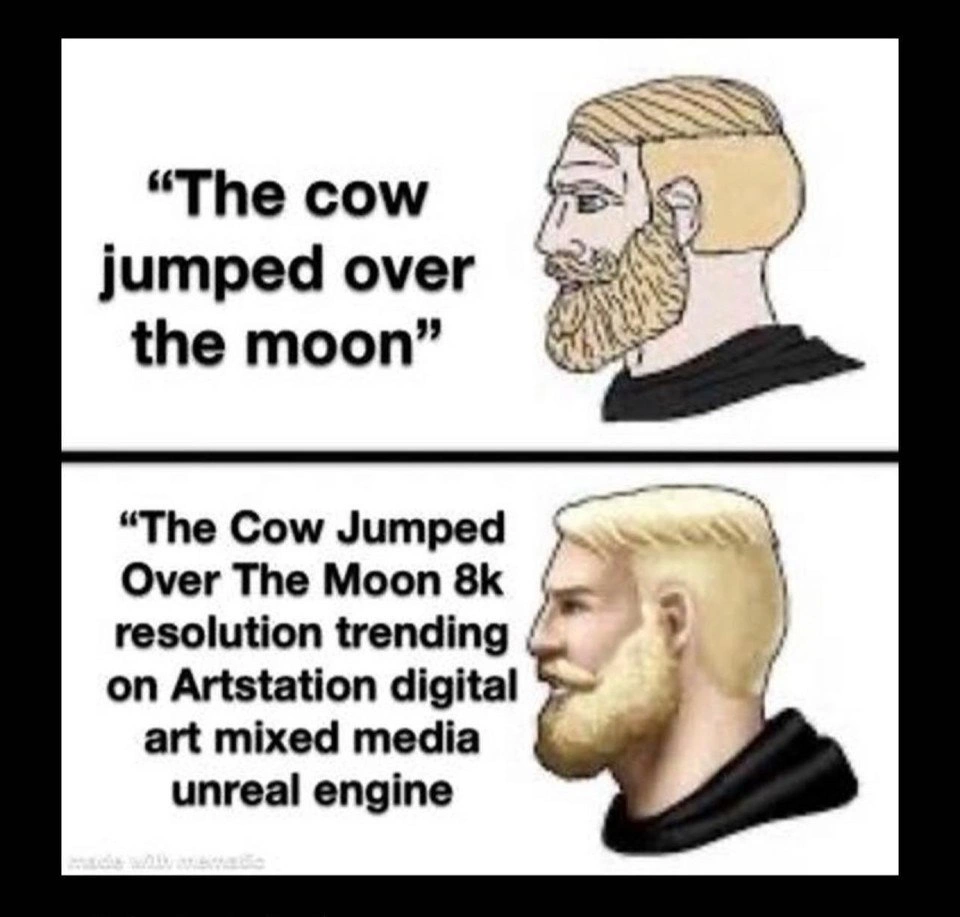
Imagine you have a special art robot that will draw anything you tell it. In the first case (top panel), someone just says to the robot, “Hey, draw me a cow jumping over the moon.” That’s a simple request – just one straightforward sentence. Now, in the second case (bottom panel), picture someone going to the same robot and instead of asking simply, they use a whole bunch of fancy magic words: “Please draw a cow jumping over the Moon, and make it super-duper detailed like a famous painting, really high quality, like those popular pictures online, using cool computer graphics!” They’re basically saying the same thing (draw a cow and a moon) but with a lot more detail and big descriptive words. It sounds kind of over-the-top, right? 🤭 It’s like if you wanted a bedtime story and instead of just asking normally, you gave your parent a whole list of exact things to include in the story. The joke here is that the second person is treating the robot like a genie that needs very specific magical instructions to get the best result. It’s funny because we usually think just saying what we want is enough – but here we see someone piling on all the extra “magic” phrases to make sure the result is really fancy. In simple terms, the meme makes us laugh at how a plain request can turn into a silly long request when we’re trying too hard. It’s showing that sometimes, talking to a computer to get what you want feels less like a normal conversation and more like using secret magic words – and that contrast is both relatable and humorous.

Level 2: From Rhyme to Render

Let’s break down what’s happening in this meme. In the top panel, we have the straightforward phrase “The cow jumped over the moon.” This is literally a line from a classic nursery rhyme (“Hey Diddle Diddle”). It’s a simple, plain-English description of a whimsical scene. If you gave this plain sentence to an AI image generator, you’d probably get the basic idea: some kind of cow, and a moon, maybe the cow mid-jump. There are no extra details or style instructions – it’s like giving a minimal sketch or a one-line story for the AI to illustrate.

Now look at the bottom panel’s text: “The Cow Jumped Over The Moon 8k resolution trending on ArtStation digital art mixed media Unreal Engine.” It’s essentially the same core idea (still a cow jumping over a moon) but now the person has tacked on a bunch of descriptive keywords. Why do this? Because in the context of AI art prompts, those extra words guide the AI on how the image should look rather than just what the subject is. Let’s decode some of those terms one by one:

  • 8k resolution: This refers to very high image resolution (7680×4320 pixels). In prompts, saying “8k” is a way to tell the AI you want a super-detailed and sharp image. It’s like saying “make it really high-def!” The AI interprets this as a cue for lots of detail and clarity (even if the output isn’t literally 8k pixels, it tries for that level of detail).
  • trending on ArtStation: ArtStation is a popular website where professional artists (especially concept artists and game artists) share their work. If something is “trending on ArtStation,” it means it’s a high-quality piece getting a lot of attention. So adding this phrase into a prompt suggests you want the image to look like the kind of top-tier, polished digital art that would be popular among artists. It’s basically saying “make it look amazing, the kind of art that gets upvoted a lot.” The AI has seen tons of ArtStation images during training, so this key phrase tends to invoke that detailed, epic style.
  • digital art: This simply tells the AI you’re looking for an image in the style of digital artwork (as opposed to, say, a photograph or a pencil sketch). It reinforces that the output should look like it’s painted or rendered on a computer. Many AI models learned from image captions that include “digital art,” and those images often are colorful, clean, and illustrative. So this helps steer the model toward a more painting or illustration look.
  • mixed media: In traditional art, “mixed media” means an artwork created with a combination of different materials or methods (like paint + ink, or drawing + collage). In prompts, people use “mixed media” to suggest a more textured or creative style, kind of a blend of styles. It gives the AI a hint that the image can be stylistically complex or layered, not just a flat simple cartoon.
  • Unreal Engine: This is the name of a famous 3D game engine known for its realistic graphics. If you’ve seen screenshots or concept art from Unreal Engine (like beautiful fantasy landscapes or very life-like game scenes), you know they have dynamic lighting, shadows, and a 3D feel. By including “Unreal Engine” in the prompt, the user is hinting they want the picture to have a 3D-rendered, realistic lighting style – as if it were made in a game engine. The AI has ingested images labeled with “Unreal Engine” or coming from game development contexts, so it associates that term with a certain dramatic, realistic style.

All these extra phrases are examples of prompt engineering – which means carefully choosing your words to engineer (or construct) the prompt that will guide the AI to produce the kind of output you want. In 2022, when people got excited about these new generative models (AIs that can create images or text from a prompt), they quickly learned that how you phrase your request makes a big difference. A simple prompt might give a blurry or boring result, whereas a prompt that’s more like a detailed instruction manual can produce something impressive.

The meme’s two panels highlight simple vs. complex input. The top is just a straightforward sentence — something even a child might say. The bottom is essentially that same request but written like a spec sheet for the AI. Notice the bottom even capitalizes each word of the main phrase “The Cow Jumped Over The Moon,” almost like a title, and then appends all the stylistic keywords. This formatting is common in community-shared prompts; some people believe capitalizing important words gives them more weight (it may or may not, but it looks deliberate and intense!). The contrast is striking and deliberately exaggerated to be funny. It’s showing the gap between an ordinary description and an over-the-top AI prompt. It’s as if the person writing the second prompt thought, “Hmm, just saying it plainly might not be enough. Let me throw in EVERY fancy term I’ve seen people use so the AI really gets it.”

For someone new to this, think of it this way: Imagine you’re working with a somewhat literal-minded artist. In the first case, you just say “Can you draw a cow jumping over the moon?” That’s it – you’re leaving the style up to the artist. In the second case, you’re saying, “Can you draw a cow jumping over the moon, and make it look like a super high-definition, very detailed piece of art that would be popular on that big art website, you know, use digital painting style with mixed techniques, and kind of like those cool Unreal Engine game graphics?” The poor artist might be like, “Okay, I get it, you want a really detailed cool picture!” In AI terms, that’s exactly what we’re doing: because the AI isn’t a genius artist but a model that patterns matches what we describe, adding all these descriptors is like giving it extra hints and constraints so it doesn’t produce a bland image.

So the meme is funny to developers and AI enthusiasts because we recognize this pattern. We’ve seen how prompt texts went from normal sentences to these chunky, almost comically long strings of keywords. It highlights the over-descriptive prompt trend. The “Nursery rhyme vs 8K prompt” title of the meme itself says it: on one end, a simple nursery rhyme line; on the other, a prompt that looks like a tech spec for an image. The categories like AI_ML and tags like prompt_engineering and ai_art_prompts indicate this is squarely aimed at AI and machine learning humor. The meme is exaggerating to make a point: using a generative AI can feel like you’re casting a spell by saying just the right words. And in 2022’s AI art craze, everyone was trying to come up with the most effective prompt spell to summon the fanciest images. So, the bottom line (pun intended) is: the bottom panel’s long prompt is not a random jumble – it’s actually a reflection of real user behavior in the AI art world, where verbosity = better visuals. And that over-the-top approach is what makes it humorous when contrasted with something as innocent as a one-line nursery rhyme.

Level 3: The Prompt Arms Race

This meme perfectly captures a recent developer/art-community phenomenon: the arms race of prompt engineering in generative AI. At first, people approached image-generating AIs naively – much like a newbie might type “the cow jumped over the moon” and expect a cute illustration straight out of a nursery rhyme. Old-school thinking says if you specify what you want, that should be enough. But experienced users quickly discovered that cranking up the descriptive dial yields dramatically better images. So what did the community do? They began stuffing prompts with every known buzzword and tag that might improve the output, a trend this meme lovingly mocks. The bottom panel’s text isn’t just random; it’s the greatest hits album of AI art prompt keywords from 2022. Phrases like “8k resolution” and “trending on ArtStation” were insider tricks—like cheat codes— to get more vivid and sharp results. Essentially, users were saying, “Hey AI, don’t just draw it; make it look like a top-tier digital painting that’s so good it’s trending online, with insane detail as if rendered in a game engine.” The meme highlights the almost absurd contrast between a simple input vs. an over-engineered prompt. It’s funny because it’s true: those of us who played with early image models remember starting with plain prompts and ending up adding a word-salad of modifiers to force the AI’s hand. The bottom request reads like someone took a humble children’s rhyme and then went full hacker mode on it, appending every trending tag they’ve seen on art forums. This reflects an almost hysterical enthusiasm in the AI art community — everyone trying to outdo each other by discovering the magic combination of words that produces the most stunning picture. It’s the culture of prompt engineering: part science, part art, and part hype.

There’s an underlying commentary on how we interact with AI tools. Instead of conversing naturally, we’ve started speaking in a kind of AI pidgin language, tossing in jargon hoping the model yields gold. It’s reminiscent of SEO keyword stuffing — remember when web developers jammed “hot terms” into pages so search engines would give a better ranking? Here the goal isn’t higher Google rank, but a prettier picture from a neural network. The meme exaggerates to show how prompt requests went from a normal sentence to what looks like hyper-specific spec docs. In real life, developers and designers swapping AI tips often share prompt examples that look just like that bottom panel: overly capitalized words, oddly specific phrases like “unreal engine, octane render, volumetric lighting, 8k”, sometimes even famous artist names (“by Greg Rutkowski” was a notorious one). The humor kicks in because we collectively recognize the pattern: we started with awe that “the AI can draw anything from a sentence!” and ended up in a scenario where using a plain sentence feels amateurish. Now you “have to” include the whole kitchen sink of artsy descriptors to get the Chad-level output. Just as the Chad meme character is the ultra-confident, optimized figure in meme culture, the bottom prompt is the ultra-optimized request, confidently (and verbosely) specifying every detail. There’s also a satirical nod to how AI tool hype drives people to extremes. When a new ML model is released, everyone scrambles to push it to the limit, often discovering unintuitive tricks. The community found that over-descriptive prompts produce better images, so of course they started doing that everywhere. Soon, prompt crafting felt like an advanced skill — job postings even popped up for “prompt engineers”! Seasoned developers chuckle at this because it’s a bit ironic: we’ve essentially re-invented a verbose configuration file or API for an AI model, except it’s hidden in a single English-ish run-on sentence. And just like coding, people copy-paste the “Hello World” of prompts (like adding “8k ultra HD” or “ArtStation”) into everything. The meme is a tongue-in-cheek commentary on this trend, exaggerating it by juxtaposing a nursery rhyme (the epitome of simplicity and childhood innocence) with an AI meme of a mega-prompt (the epitome of tech complexity and trend-chasing). Anyone who has spent late nights tweaking generative model settings or watched colleagues gleefully share their “perfect prompt” will likely smirk at this. It’s hilariously relatable: even though we know an AI should understand “cow over moon” conceptually, we don’t trust it to deliver the goods unless we also specify resolution, style, medium, trending status, and maybe the phase of the moon and the cow’s horoscope for good measure. This shared experience – the trial-and-error dance of coaxes and keywords – is exactly what the meme is lampooning. In the end, the Chad in the hoodie (bottom panel) symbolizes the modern prompt engineer: confident, armed with an absurdly long prompt, and expecting the AI to produce a masterpiece. The meme winks at us and says: look how far we’ve come (or maybe how far off-track!) from just saying a simple sentence to essentially casting a spell of keywords to get our AI art.

Level 4: Latent Space Sorcery

At the deep learning core of this meme is how generative models interpret text prompts in a high-dimensional latent space. Modern text-to-image models (like Stable Diffusion or DALL·E) encode the prompt into numeric vectors (embeddings) that guide image generation. The simple phrase "the cow jumped over the moon" produces an embedding vector capturing just the basic scene (a cow, a moon, the action). In contrast, the verbose prompt "The Cow Jumped Over The Moon 8k resolution trending on ArtStation digital art mixed media Unreal Engine" adds a stack of style and quality tokens. Each extra word nudges the neural network along specific latent directions associated with high detail and artistry. For example, “8k resolution” doesn’t literally change a setting to 7680×4320 pixels inside the model (these models can’t truly output 8K by default), but it biases the network toward highly detailed textures because during training, images tagged with “8k” were ultra-detailed. Similarly, “trending on ArtStation” steers the model toward the polished aesthetic of top-voted ArtStation posts – essentially a proxy for professional digital art quality. The prompt is being padded with latent style guides: “digital art” and “mixed media” push the rendering toward a vibrant art illustration feel, while “Unreal Engine” invokes the model’s memory of images with realistic lighting and 3D renders (since many game-art screenshots in the training data mention Unreal Engine). These extra tokens act like basis vectors in the model’s learned multimodal vocabulary – combining them with the base content (cow, moon) yields an entirely different point in the model’s latent space. The result? A more epic or detailed image composition, as the diffusion model iteratively “draws” an image that not only contains a cow and a moon, but also matches the high-fidelity, concept-art style implied by those magic words. From a theoretical perspective, what’s happening is a bit like performing vector addition in concept space:

embedding("cow over moon") 
  + embedding("8k resolution") 
  + embedding("ArtStation trending") 
  + ... ≈ A high-detail fantasy scene 

The meme humorously exposes this “latent sorcery” – the way prompt engineering hacks the internals of a neural network. It’s poking fun at how we reverse-engineered the model’s neural lexicon: simple nursery rhyme language gets amplified into a multi-line incantation of keywords. This is a direct consequence of how these models learn; they don’t truly understand a cow jumping over a moon in a vacuum, but they do pattern-match vibes and styles from the massive dataset they gorged on. So to get a flashy image, users feed the model an almost ritualistic sequence of trigger words. The meme’s 3D-rendered Chad head in the bottom panel could itself be an AI-generated or highly detailed render, symbolizing the hyper-real outputs you get when you include all those fancy latent triggers. In short, the joke operates on the fact that behind the scenes of playful AI art, there’s serious machine learning math – and prompt engineers have learned to speak the machine’s secret language of keywords to coax the most vivid results from the depths of a neural network’s imagination.

Description

This image uses the 'Expanding Brain' meme format to satirize the tendency to over-engineer simple solutions. The meme progresses through four panels, each showing a brain with increasing levels of cosmic and energetic enlightenment. The first panel, with the smallest brain, simply shows 'print("Hello World")'. The second panel escalates to a slightly more complex version, perhaps involving a simple function call. The third panel shows a massively glowing brain alongside a complex implementation involving a 'HelloWorldFactory' class, dependency injection, and abstract base classes. The final, cosmically-transcendent brain panel depicts a full-blown microservices architecture for 'Hello World', complete with a service mesh, asynchronous message queues, a Kubernetes cluster, and a CI/CD pipeline, all just to print a simple string. The humor lies in the absurdly complex architectural choices for a trivial problem, a situation many senior engineers have witnessed or been forced to participate in, reflecting on the dangers of resume-driven development and the misapplication of complex patterns
Comments

31
Anonymous ★ Top Pick The final stage of 'Hello World' enlightenment is when you realize the entire microservices stack is just a distributed monolith held together by YAML and despair
  1. Anonymous ★ Top Pick

    The final stage of 'Hello World' enlightenment is when you realize the entire microservices stack is just a distributed monolith held together by YAML and despair

  2. Anonymous

    Prompt engineering is basically Kubernetes for language models: the business need is “cow jumps over moon,” and we ship 2,000 lines of YAML detailing the cow’s fur in 8-K and which GPU it’s scheduled on

  3. Anonymous

    Remember when we optimized SQL queries for performance? Now we're optimizing nursery rhymes for neural networks, adding 'trending on Artstation' like it's a database index hint for diffusion models

  4. Anonymous

    This perfectly captures the evolution from 'make it work' to 'make it work with ray-traced global illumination, procedurally generated textures, and blockchain verification' - because apparently even nursery rhymes need a tech stack now. It's the software equivalent of turning a simple REST endpoint into a microservices architecture with Kubernetes, service mesh, and distributed tracing just to return 'Hello World'

  5. Anonymous

    From “cow jumps over moon” to “cow jumps over moon, 8k, trending on ArtStation, Unreal” - we didn’t improve the spec; we just invented a cloud bill and three new compliance meetings

  6. Anonymous

    When your Nanite-optimized cow moon jump still needs 'Lumen-illuminated subsurface scattering' in the Artstation title to outshine the competition

  7. Anonymous

    Prompt engineering is the only spec process where we regress from clear requirements to 2010-era SEO just to coax a CLIP-guided U-Net into drawing the right bovine

  8. P S 3y

    I have DALLE2 Beta acsess should I?

    1. Deleted Account 3y

      yes

      1. @morningxroutine 3y

        ebat’ avatarka

        1. @sylfn 3y

          translit rto ne angliyskiy; please use english in this chat

        2. dev_meme 3y

          Please, stick to usage of English as one and only language being allowed Thanks in advance

          1. @sylfn 3y

            > as one and only language being allowed isn't it allowed now to write multilungual messages? вне закона теперь писать многоязычные сообщения?

            1. dev_meme 3y

              Let’s see new people being used to English first 😄

    2. dev_meme 3y

      let's see let's see let's see

    3. dev_meme 3y

      Sooo? 😄 We all are waiting here! 😄

      1. P S 3y

        The Meme is correct.

        1. @ZgGPuo8dZef58K6hxxGVj3Z2 3y

          Imagine you just get a picture where the moon and the earth is visible, it would at least be correctly scaled

        2. dev_meme 3y

          (not Dalle2) The cow jumped over the moon

          1. @ascension1sm 3y

            These look a lot like something Salvador Dali would come up with

    4. @ZgGPuo8dZef58K6hxxGVj3Z2 3y

      Can you try Uranium-238? Just curious what would it generate. Don’t give it any other context just “Uranium-238” would be nice! Thanks

      1. dev_meme 3y

        Something green, probably 😄

      2. dev_meme 3y

        Yeah, green palette everywhere

        1. dev_meme 3y

          First one, but in more variations

          1. dev_meme 3y

            Third image, but detailed and upscaled (huge difference)

            1. @MVA_ONE 3y

              That looks frickin dope

        2. @RiedleroD 3y

          damn nice

        3. @ZgGPuo8dZef58K6hxxGVj3Z2 3y

          Bruh thanks

  9. P S 3y

    Here in full res.

  10. @ZgGPuo8dZef58K6hxxGVj3Z2 3y

    RTX is ON

  11. dev_meme 3y

    (not Dalee2) The Cow Jumped Over The Moon 8k resolution trending on Artstation digital art mixed media unreal engine

Use J and K for navigation