Neuralink's PR Announcement Meets Dystopian Reality
Why is this AI ML meme funny?
Level 1: Shiny Toy, Sharp Edges
Imagine your friend shows you a brand-new gadget they invented and they’re grinning, saying “Look, it works great!” But while they’re saying this, you notice their hand is bandaged and there’s a trail of red stains on the floor. 😬 In simple terms, this meme is like that. The “shiny new toy” here is a brain implant that can talk to computers – really futuristic and cool. The “sharp edges” are the fact that to use this toy, you had to do something dangerous and messy (like an operation that made someone bleed). The picture has what looks like blood on a diary page with a cheerful update written on it. It’s funny in a dark way because the words are saying “Everything is going fine!” but the blood splatter is saying “this was actually pretty scary.” It’s as if a scientist is calmly writing in their journal that their experiment is a success, while behind them the lab is a big gory mess. The humor comes from that mismatch – the polite, happy report versus the spooky, bloody scene. So it’s basically joking: “We’re doing something really new and amazing, but oops, it’s literally a bit bloody. Don’t worry, all good!”
Level 2: Bleeding-Edge Basics
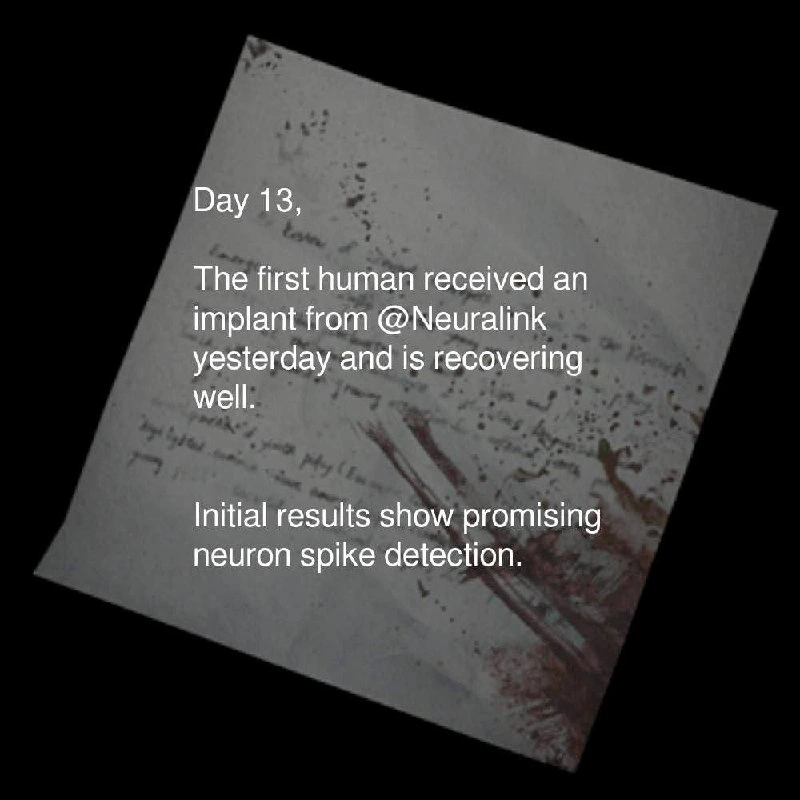
Let’s break down what’s happening here in simpler terms. The image shows a piece of white paper with what looks like dried blood stains, and on it there’s text like a log entry: “Day 13, The first human received an implant from @Neuralink yesterday and is recovering well. Initial results show promising neuron spike detection.” The phrase bleeding-edge in tech means using the newest, most experimental technology – so new that it might cut you, metaphorically. Here the meme jokes that it’s not just metaphorical: there’s literally “bleeding” on the page. It’s a visual pun. We see actual (fake) blood splatters, implying something gruesome happened during this super-new experiment. It’s combining Hardware reality (surgeries are messy) with tech optimism.
Now, Neuralink is a real company working on a brain_computer_interface (BCI) – basically a direct connection between a brain and a computer. Think of a tiny chip implanted in someone’s skull that can read signals from the brain’s neurons (nerve cells) and maybe send signals back. This technology could one day help people control a computer or prosthetic limb just by thinking, or treat neurological conditions. It’s cool, but it’s also quite invasive: surgeons have to implant fine electrodes into the brain. So “bleeding-edge” here is a play on words: it’s cutting-edge tech and it involves literal cutting into a brain, which can cause bleeding.
The text from the meme reads like an update you’d hear from a tech company or a project manager. “Day 13” suggests they are documenting progress maybe two weeks into a project. It has a chirpy tone: first human implant done, patient is fine, and we’re getting good data from the brain. This is typical of AIIndustryTrends announcements – always focusing on the positive “promising” results. Neuron spike detection refers to picking up the tiny electrical spikes that neurons emit when they fire (that’s how neurons communicate, basically little zaps). Saying they have “promising spike detection” means the implant is successfully reading the brain signals. That’s a key step for any BCI: you need to detect those neuron signals reliably to do anything useful with them, whether it’s moving a cursor on a screen or controlling a robotic arm.
For someone newer to tech or science, imagine it like hooking up a microphone in a very noisy room. The brain is the noisy room with thousands of neurons “talking.” The implant is the microphone trying to pick up one conversation. “Spike detection” is like figuring out whenever a particular person shouts a specific word in that noisy room. It’s not trivial! They probably use some form of MachineLearning or signal processing to filter out noise and identify real signals. The meme hints at AIHype because Neuralink and similar projects are often hyped as high-tech miracles. The company would say something like this in a press release to show progress.
However, the background image (blood on paper) gives a wink-wink to the fact that early trials, especially the first time a human gets a BCI implant, are scary and messy. Brain surgery even on a healthy volunteer is a big deal – there’s drilling, blood, the risk of something going wrong. The phrase “horror sprint retrospective” in the meme title suggests that if the team behind this project did an honest sprint retrospective (a meeting after a two-week sprint to discuss what happened), it would sound like a scene from a horror movie: lots of frantic moments and squeamish details. But externally, they’re keeping it sunny and optimistic. This contrast is where the humor comes from. In essence, the meme is explaining: this is super advanced tech with amazing potential, but don’t be fooled – getting here was not as clean and easy as the nice update makes it sound. It’s poking fun at how tech companies often present breakthroughs versus the gritty reality of making those breakthroughs happen.
Level 3: Hype vs Hemorrhage
This meme lands squarely in the realm of TechSatire, contrasting shiny AIIndustryTrends PR with the grisly truth of R&D. The text reads like a bland progress tweet: “Day 13, first human implant… recovering well… promising results.” If you ignore the blood spatters, it’s indistinguishable from a chirpy sprint update in a corporate all-hands. IndustrySatire gold, right? Senior engineers recognize this tone – it’s the upbeat status report that masks a trail of chaos and hacked-together solutions. The AIHype machine loves phrases like “recovering well” and “promising,” which sound reassuring but gloss over how we arrived at those sparse good notes. In a sprint retrospective, the team might candidly list what caught fire (hopefully not literally). Here, the meme imagines that retrospective as a horror diary: Day 13 of our bleeding-edge BCI project and, oh boy, we literally drew blood to hit this milestone. It’s a dark play on "bleeding-edge" being more than just metaphor.
For those of us who’ve survived death-march projects or risky deployments, the humor hits like a nerve. We’ve seen the AIHypeCycle up close: the bosses celebrate a “revolutionary update” while the team is still scrubbing the metaphorical (or literal) blood off the lab floor. The mention of Neuralink – Elon Musk’s brain-implant venture – is a deliberate lightning rod. It embodies IndustryTrends_Hype: grand promises of merging minds with machines, flashy demos of monkeys playing Pong telepathically, and ambitious timelines that make seasoned developers wince. So when the meme says “first human received an implant yesterday” by Day 13, senior devs smirk. We know real R&D is slow and cautious (with Institutional Review Boards and months of testing), but hype-driven ventures push the accelerator – move fast and break (brain) things. It’s as if a software startup’s pace was applied to invasive surgery. The result? A sprint retro that reads like Mary Shelley’s lab notes.
The blood_splatter_irony in the image is doing heavy lifting. It’s a visual punchline: the term “bleeding-edge” is usually figurative, but here the edge hasn’t just cut, it’s gashed. That clean white text on a messy background mirrors how press releases often present a HardwareHumor dichotomy – the gadget is futuristic and clean, but developing it was anything but. Early-stage brain_computer_interface trials are known to be messy, literally involving brain surgery, which can look like a horror scene. Yet marketing copy spins it as high-tech miracle with zero mention of blood, risk, or the pile of failed experiments. Senior folks remember similar PR vs. reality gaps: from polished demo videos of robotics that conveniently omit the tangle of cables and safety harnesses, to AI MachineLearning breakthroughs touted as human-level intelligence when behind the scenes there’s a grad student hand-labeling data at 2 AM. This meme zeros in on that dissonance.
It also quietly nods to the classic lab notebook from a sci-fi horror story trope. “Day 13” evokes movies where scientists log days until the experiment inevitably escapes control. The phrasing “the first human received an implant… recovering well” could be straight from a mad scientist’s journal trying to assure us that Igor is fine post-op (when Igor most certainly is not fine). It’s a HardwareEvolution horror sprint all right. Senior engineers who’ve been in high-stakes demos or rushed medical tech projects can almost smell the stress (and maybe disinfectant) behind those words. We chuckle because we’ve written “All good!” updates when things were held together with duct tape and prayers. In this case, perhaps literally with sutures and gauze. The meme’s dark wit reminds us: when someone says “bleeding-edge”, sometimes they mean it so literally you can see the blood splatter. And oh, the sprint retrospective for that project? Let’s just say it might require a strong stomach to sit through.
Level 4: The Spike Sorting Saga
At the bleeding frontier of brain_computer_interface research, we’re literally grappling with the raw neuron spike detection problem in all its gory complexity. When Neuralink says “promising neuron spike detection,” they’re hinting at the AI/ML algorithms turning noisy brain signals into meaningful data. Under the hood, an implanted chip’s electrodes pick up tiny voltage changes from firing neurons (action potentials). Each neural spike is like a quick electrical blip (~1 millisecond) amid the brain’s analog cacophony. Detecting these in real-time means running high-frequency signal sampling (often tens of kHz per channel) through filtering and thresholding logic. It’s a hardware challenge (getting clean signals from biological mush) married to a software one (separating real neuron firings from background noise).
Spike sorting is the next beastly step: figuring out which neuron each detected spike came from. Imagine dozens of neurons chatting at once on a party line – one electrode might “hear” them all. The implant’s data pipeline must decompose this jumble using advanced algorithms. Techniques range from simple amplitude thresholding to clustering in high-dimensional feature space (think principal component analysis of spike waveforms followed by k-means or Gaussian mixture models). Cutting-edge approaches even leverage NeuralNetworks (appropriately meta: using silicon neural nets to decode biological ones) to classify spikes. These methods are experimental data pipelines indeed – prototypes running on custom FPGA logic or GPU-accelerated rigs, all to achieve real-time sorting so the device isn’t just logging terabytes of noise.
The bleeding_edge_tech_literally meme backdrop of stained paper hints at how messy this gets, even in theory. Biological tissue doesn’t yield data graciously: electrodes drift, signals weaken as the brain’s immune response encases the implant, and AIHypeCycle promises of seamless symbiosis run into gritty realities of electrophysiology. We’re essentially trying to live-stream one brain’s internal electro-codec. It’s bleeding-edge science where bytes meet blood – and the fundamental spike-detection algorithms must tread a fine line between sensitivity (catch every real neuron firing) and specificity (ignore the random pops of interference). If they set the detection threshold too low, the system “hears” ghosts (false spikes); too high, and genuine neural whispers are missed. Discussions in BCI research often read like horror stories in signal processing: spectral noise demons, crosstalk nightmares, and the ever-looming specter of data loss if a channel fouls up.
Crucially, each “promising spike” in that cheery update represents a triumph over these challenges. Every blip successfully identified is a small victory of MachineLearning and engineering over entropy. But the meme winks at us: behind those clean metrics lies a chaotic lab scene – oscilloscopes, code debuggers, and yes, maybe a bit of literal blood from surgery. HardwareEvolution at this frontier isn’t just writing code; it’s slicing into flesh to install silicon. The IndustrySatire punchline is that no amount of neural network optimization or fancy algorithms can erase the fact that bleeding-edge innovation often involves actual bleeding during iteration. In other words, this “spike sorting saga” is both a cutting-edge data science pipeline and a horror show of surgical R&D, a duality that only seasoned engineers and researchers truly appreciate (usually over strong coffee and stronger stomachs).
Description
The image presents a stark visual contrast. Set against a pitch-black background is a diagonally tilted piece of paper, appearing aged, grimy, and spattered with what looks like dried blood or rust, resembling a found page from a horror movie or a post-apocalyptic journal. Overlaid on this disturbing imagery is clean, white, sans-serif text that reads like a corporate update: 'Day 13, The first human received an implant from @Neuralink yesterday and is recovering well. Initial results show promising neuron spike detection.' The juxtaposition of the sanitized, optimistic tech announcement from Neuralink with the grim, visceral background creates a powerful sense of dark humor and unease. It satirizes the often detached and overly positive way groundbreaking, and potentially dangerous, bio-tech advancements are presented to the public, hinting at a darker, more chaotic reality behind the polished corporate facade, a common trope in cyberpunk and sci-fi

Comments
18Comment deleted
Patient status: 'recovering well.' Firmware status: 'Initial commit. TODO: add error handling for BSOD (Blue Screen of Death)... literally.'
When you deploy to prod on a literal cortex, ‘hotfix’ becomes a remarkably accurate term - rollback currently involves gauze and a neurosurgeon
Nothing says 'successful medical trial' quite like formatting your announcement as a found-footage horror diary entry. At least when the neural API starts throwing 418 errors, we'll know the patient is a teapot
Ah yes, the classic 'ship's log' format for documenting humanity's first steps toward becoming debuggable wetware. Day 13 and already detecting neuron spikes - which is more than we can say for most production monitoring systems detecting actual issues. At least when this system crashes, you can't just blame it on a Kubernetes pod restart. Though I suppose 'have you tried turning it off and on again' takes on a rather darker meaning when the hardware is literally inside your skull
“Promising spike detection” is great - until the PM schedules an OTA to the motor cortex; what’s the rollback plan, git revert to prefrontal commit?
Neuron spikes on day 13: prod observability that beats shipping a custom Datadog agent
“Promising neuron spike detection” is the only A/B test where bleeding edge is both the roadmap status and the literal UI - please tell me the implant firmware supports rollback and SOC 2 for skulls
What this meme refers to? Comment deleted
To every single game with lore about no more people in the game Comment deleted
Literally tweet two posts above Comment deleted
I got it, but what "Day 13" means? Comment deleted
nothing specifically, just refers to random notes you would find in games Comment deleted
Play the orange box and get familiar with the lore to understand the memes regarding to this😂💀 halflife was recently free in steam store Comment deleted
Those are not the only games like this but thats an iconic game Comment deleted
Nah. You want Looking Glass studios games for this. Or their spiritual sequels. System Shock is where this started. Comment deleted
I don’t know those sorry I am living under the rock Comment deleted
Worth watching at least the playthroughs. LGS had really bad timing with game releases so they fell on the sidelines and and ended up going under. But their legacy is lasting as they basically pioneered the genre. https://en.m.wikipedia.org/wiki/System_Shock Comment deleted
Especially the 2017 Prey is a friggin art piece of game design. But that's beside the original point. Comment deleted