Skip to content
DevMeme
5342 of 7435
Developer Endurance: Infinite for Code, Zero for Meetings
Meetings Post #5859, on Jan 31, 2024 in TG

Developer Endurance: Infinite for Code, Zero for Meetings

Why is this Meetings meme funny?

Level 1: Play vs Homework

Imagine you have a favorite activity, like building with LEGO or playing your favorite video game, and you’re so into it that you could keep doing it all day without getting tired. It’s fun, you’re solving little challenges, and you feel like a superhero when you finally build that big castle or beat the tough level. That’s like a developer writing code and fixing bugs – it’s fun work for them, something they love and can do for hours and hours.

Now think of something that makes you feel bored or tired, like having to sit in a long classroom lecture or doing two hours of difficult homework without a break. Pretty exhausting, right? After a while, you just want to throw up your hands and say, “I quit!” In the grown-up world, a long meeting (especially a video call where you have to sit still and listen for a long time) feels just like that boring two-hour class.

So, the meme is funny because it shows a superhero who can fight bad guys (or in a programmer’s case, tackle coding problems) all day long with endless energy, but even this hero gets totally worn out by a long, dull meeting. It’s like saying: doing what you love keeps you energized, but doing something boring for too long can zap your energy really fast. A kid can play all afternoon happily, but make them sit in a chair for a two-hour talk and they’ll be drained. That’s exactly how developers feel about coding versus meetings – one is play, the other is a chore. And seeing a big strong hero go from “I can do this all day!” to “I give up” in just a couple of hours is a silly way to show just how draining those boring meetings can be!

Level 2: Hero Mode vs Zoomed Out

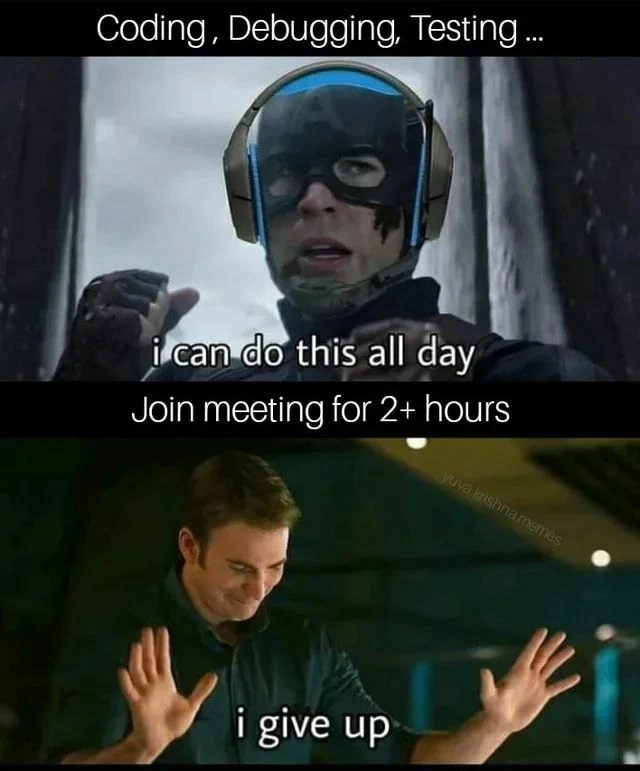
Let’s break down the meme in simpler terms. In the first panel, we see a superhero figure (it’s actually Captain America’s face, but think of it as any developer’s spirit) wearing large headphones. In tech circles, devs often wear headphones not just to enjoy music, but as a sign of being in “focus mode.” It’s like putting up a virtual “Do Not Disturb” sign. When the caption above says “Coding, Debugging, Testing…”, these are core activities in a programmer’s day. Each of these tasks – writing code, finding and fixing bugs, running tests to verify everything works – requires concentration and can actually be enjoyable and energizing for someone who loves to build things. The subtitle on that first image, “i can do this all day”, is showing the developer (or superhero) feeling confident and strong. This is a nod to a famous movie line, but here it specifically means I have plenty of stamina for the work I love. A developer in this “headphones on, hero mode” could indeed go on for hours and hours happily solving problems. It doesn’t drain them; in fact, it often energizes them because they see progress and they’re in control of their own time. It’s like when you play your favorite game or are engrossed in a hobby – you look up and realize hours have passed without you getting tired.

Now look at the second panel. It’s the same actor but in a different scene (here he looks like a regular guy, hands raised up as if surrendering). The text bridging the panels says, “Join meeting for 2+ hours”. Uh-oh. So the scenario is: this hero of coding, after just a couple hours in a long meeting, is completely worn out. The bottom subtitle “i give up” is exactly what it sounds like – our mighty coder is throwing in the towel. Instead of the pumped-up, ready-to-go stance from coding, we now see a tired, resigned pose. Why such a dramatic change? Because a 2-hour meeting (especially an online video meeting, like on Zoom) can be really draining for developers. Meetings typically involve a lot of listening, maybe repetitive status updates or prolonged discussions where a developer might not be actively participating all the time. It’s a passive activity compared to coding. You’re sitting there trying to pay attention, but your mind might wander to the code you could be writing instead. Also, many developers are a bit introverted or at least value their quiet time – being on a group video call means constantly being “on,” speaking up when prompted, and watching others’ screens. It’s mentally taxing in a different way.

In real-world terms, think about an office job (or remote job) where your day gets broken up by a lot of meetings. When you’re new to a team, you might notice senior developers saying things like they hate long meetings or they try to block off “deep work” time. Deep work just means time to focus on cognitively demanding tasks without interruption. A meeting is the opposite of that, an interruption by definition. New developers often learn the hard way that a day full of meetings means very little actual coding gets done. You might start the day excited to code a new feature, but if you have a meeting at 10 AM, another from 11–12, and then one that stretches from 2–4 PM, you’ll find it really hard to get back into coding rhythm in the small gaps between those calls. This context switching (jumping between tasks) makes you tired. It’s as if each meeting resets your brain a little, and you have to reboot your motivation to code afterward.

So, in summary, the meme’s two images show a clear contrast that every developer, even juniors as they gain experience, quickly understand:

  • Image 1: Developer is in flow (writing code, debugging, running tests). They feel like a superhero with endless energy – “I can do this all day!”.
  • Image 2: Developer sits through a two-hour Zoom meeting (common in corporate environments for project updates, planning, etc.). All that superhero energy? Gone. They’re exhausted and frustrated – “I give up.”.

It’s highlighting the common developer frustration with Meeting Overload. Coding is often the reason people become developers; it’s engaging and rewarding. Meetings, while sometimes necessary for communication, can feel unproductive and are notorious in tech culture as something to minimize. That’s why this meme is tagged as MeetingHumor and RelatableDeveloperExperience – because developers of all levels will chuckle and think, “Yep, that’s me. I can pull an all-nighter fixing code, but a couple hours of video calls and I’m done for the day.”

Level 3: Context-Switch Purgatory

For seasoned developers, the humor cuts deep because it’s painfully relatable. We thrive in “maker mode” – those stretches of uninterrupted time where you can code, debug, and test for hours, fueled by coffee and a sense of progress. You’ve probably heard the line “I can do this all day” in the meme; it’s lifted from Captain America, but here it’s every dev’s inner voice when they’re in the zone. Writing code and solving problems can feel energizing rather than exhausting. Each successful test run or bug fix gives a little dopamine hit. It’s deep-work bliss, where time flies and your mental energy (cache) stays hot. In this state, a programmer genuinely could go all day and might even forget to eat lunch because they're so engaged.

Now enter the meeting marathon – the second panel nails that nightmare. One 2-hour Zoom meeting (or a series of smaller back-to-back meetings) and even the most battle-hardened coder is ready to raise the white flag, just like our hero does with “I give up.” Why does this happen? Because meetings often fragment our focus. In industry lingo, it’s the dreaded context switching. A developer’s day is usually sliced into tiny pieces by scheduled calls: a sprint planning here, a “quick sync” there, then a status update, maybe a brainstorming session that ironically brains no storms. Each time you switch from writing code to sitting in a meeting, there’s a hidden restart cost. It’s like you have to unload the mental state of your code (all those details about how the data flows, what the functions do, where the bug might be hiding) and then load the context of the meeting (“OK, now we’re talking about ticket #123 or reviewing Q4 OKRs”). After the meeting, you’re expected to seamlessly resume coding – but by then your mind is pagging (swapping) back in all that code context from scratch. It’s exhausting! This is why senior devs treat deep-focus time like precious cache lines in a CPU – a scarce resource not to be wasted. We guard our “flow state” fiercely: you’ll see us put on big headphones (the international sign of “Do Not Disturb, I’m coding”). We decline unnecessary invites, or set aside whole days as No-Meeting days to get actual work done.

The corporate culture reality is that many companies run on a manager’s schedule, which is chock-full of meetings. Developers, however, operate on a maker’s schedule, needing long uninterrupted blocks to create working software. When a maker-type (the dev) is forced into a manager-style day (lots of meetings), it’s recipe for frustration and burnout – hence the meme’s dramatic second panel. There’s even a popular saying among devs: “That meeting could have been an email.” In this case, a two-hour video call often could have been a handful of Slack messages or a concise document. The Zoom fatigue is real – staring at a grid of faces, worrying if you’re muted or accidentally on camera while also trying to actually pay attention drains mental energy in a weirdly intense way. Studies and countless anecdotes have noted that video calls demand more continuous partial attention (you’re trying to read tone, facial reactions, you’re conscious of your own background and appearance), which leaves you wiped out.

So the meme strikes a chord: it contrasts the limitless energy a developer has for hands-on engineering work (because it’s engaging and under their control) against the instant energy crash induced by prolonged meetings (often perceived as time-consuming, sometimes unproductive, and not under the dev’s control). It’s the same person (even the same superhero actor in both frames), yet in one scenario they’re unstoppable and in the other they’re completely defeated. Every senior dev has had that day where you start full of enthusiasm to build something awesome, but then a chain of meetings hits like kryptonite and by mid-afternoon you’re mentally checked out, saying “I give up” – or in more professional terms, quietly closing the laptop and calling it a day because your brain is fried. The meme uses the superhero analogy humorously: Captain America can battle bad guys all day long, but even he apparently can’t handle a two-hour status update call without surrendering. That’s a perfect exaggeration of our reality in developer culture, where Meeting Overload is the arch-nemesis of Developer Productivity. It’s funny because it’s true: the greatest challenge to our stamina isn’t the complexity of code or the robustness of the system – it’s the endless chain of meetings that disrupt our flow and make us feel like powerless mortals by the end of the day.

Level 4: Thrashing the Cache

At the deepest technical level, this meme highlights a cognitive context switch problem, akin to how a computer’s CPU suffers when forced to juggle tasks. In computing, if you make a CPU constantly swap between processes, you get cache thrashing – the poor processor spends more time loading and unloading data from slow memory than actually doing work. Similarly, when a developer is coding, their brain’s “cache” is loaded with relevant variables, architecture details, and flow state momentum. They’re in a tight feedback loop: write code, run tests, see results, fix bugs – the mental equivalent of a CPU hitting the L1 cache repeatedly with 99% hit rate. The phrase “i can do this all day” in the first panel isn’t just bravado; it’s the reality of high-efficiency caching of ideas. The developer’s mind is pipeline-optimized for coding: prefetching context, branch-predicting the next function call, keeping the important objects in working memory (our biological “L1 cache”).

Now introduce a 2+ hour Zoom meeting – that’s like an involuntary context switch triggered by an OS interrupt. Boom, the brain’s instruction pipeline flushes. All the carefully cached deep-work state is evicted (goodbye code context, hello meeting agenda). This is comparable to a cache miss on every access: each minute in the meeting, the developer’s mind tries to recall “what was I doing in code?” only to hit a mental page fault because now it's busy processing corporate jargon and video Brady Bunch grids. In computer architecture terms, a lengthy meeting causes pipeline stalls and forces a context save/restore cycle so massive that by the time you reload the mental state (if you ever do that day), it’s branch misprediction mayhem. No wonder the second panel’s caption is “i give up”. After two hours in Zoom purgatory, the developer’s neural cache is cold. The time-slicing of attention between real work and performative “I’m listening” nods leads to thrashing: so much overhead, so little execution. In short, extended meetings evoke a hardware-level reaction in our brains – a catastrophic drop in throughput as if our focus got scheduled out by a highest-priority interrupt called “Meeting.exe”. The meme exaggerates this with a superhero reference, but under the hood it’s exposing a truth of human cognitive architecture: deep focus is a single-threaded, fragile process, and nothing kills it faster than forcing a context switch into a long, attention-draining meeting.

Description

A two-panel meme format featuring the Marvel character Captain America, which contrasts a developer's stamina for different types of work. The top panel, labeled 'Coding, Debugging, Testing...', shows a battle-worn Captain America in his full uniform, with a pair of headphones photoshopped onto his helmet. He looks determined and the caption below him reads, 'i can do this all day'. This represents the resilience and focus developers often have for complex, hands-on technical challenges. The bottom panel, labeled 'Join meeting for 2+ hours', shows the same character, now as Steve Rogers in civilian clothes, looking exhausted and dismissively waving his hands in surrender. The caption below him says, 'i give up'. A watermark for 'yuva krishna memes' is visible in the bottom right. The meme humorously captures a widely shared sentiment among software engineers: they can endure grueling hours of deep technical work but are quickly drained and defeated by long, drawn-out meetings, which are often perceived as unproductive and disruptive to their workflow

Comments

8
Anonymous ★ Top Pick A developer's stack has two layers: an infinitely deep call stack for debugging complex code, and a one-item-deep meeting stack that overflows after about 45 minutes
  1. Anonymous ★ Top Pick

    A developer's stack has two layers: an infinitely deep call stack for debugging complex code, and a one-item-deep meeting stack that overflows after about 45 minutes

  2. Anonymous

    Give an engineer eight straight hours to untangle a cyclic dependency graph and they’ll emerge victorious; put them in a two-hour status call and the only thing that scales is their ‘escape’ key latency

  3. Anonymous

    The real superpower isn't surviving Thanos's snap - it's maintaining any semblance of architectural coherence after your fourth 'quick sync' of the day where stakeholders debate whether the button should be blue or slightly bluer while your distributed system silently accumulates technical debt at compound interest rates

  4. Anonymous

    The meme perfectly captures the asymptotic relationship between developer productivity and meeting duration: while our capacity for deep technical work approaches infinity, our tolerance for synchronous communication decays exponentially after the first hour. It's the classic O(1) enthusiasm for coding versus O(n²) energy drain for meetings - where n is measured in 30-minute increments and your calendar is the adversarial input

  5. Anonymous

    Endless meetings: the only context switch costlier than refactoring a monolith mid-sprint

  6. Anonymous

    My CPU can handle a weekend prod incident, but a two-hour “alignment” call triggers a full GC and evicts the L1 cache of my flow state

  7. Anonymous

    I’ll happily chase a heisenbug for hours, but a two-hour status sync without an agenda turns my brain into a blocking call and my throughput below one story point

  8. @misesOnWheels 2y

    I can't even 30 minutes

Use J and K for navigation