Apple's $3500 Headset: The Ultimate '90s NPC Simulator
Why is this AR VR meme funny?
Level 1: Fancy Headset, Cartoon Face
Imagine your friend is wearing a super expensive high-tech helmet that lets them play in a cool virtual world. Now, you call this friend to chat. Normally, you'd see your friend's real face on the screen, right? But because they're wearing this big gadget on their head, you can't see their actual face. Instead, the fancy helmet shows you a pretend version of your friend’s face. The funny thing is, this pretend face looks like a character from a really old video game – kind of blurry and not very detailed, almost like a simple cartoon drawing of your friend. It’s as if you bought a super modern toy, but when you use it, it makes things look like they’re from when your parents were young. People think this is hilarious because the gadget is so advanced and costly, yet it makes your friend look like an old-school video game character on the call. In simple terms: a super fancy device that makes you look silly. That's why everyone's laughing!
Level 2: Why So Blocky?
Let's break down what’s happening in simpler terms. Apple’s Vision Pro is a new AR/VR headset – basically a high-tech set of goggles – that lets you experience Augmented Reality (AR) and Virtual Reality (VR). In AR mode, you still see your real room around you, but digital things (like app windows or, in this case, your friend’s video call) are layered on top of that real world view. FaceTime is Apple's video calling app, and normally when you use FaceTime on an iPhone or Mac, you see a live video of the other person’s real face. But with Vision Pro, the person on the call might be wearing the headset, which covers their face. So how do you see them? This is where Apple's Persona avatar comes in. Instead of a camera showing their actual face (since the headset blocks that), the device creates a digital version of their face – an avatar – to represent them on the call.
Now, the funny part is how these avatars look right now. Apple is calling this Persona feature a beta, meaning it's an early version that’s still being improved. Currently, the avatars that Vision Pro shows in FaceTime are kind of basic-looking – the tweet jokingly says they resemble a "'90s NPC." NPC stands for non-player character, which in video games is a background character not controlled by the player. In older 1990s games (think the original PlayStation or Nintendo 64 era), NPCs were often graphically simple: their faces might be blurry or blocky and they moved a bit stiffly. This was because computers and consoles back then weren’t powerful enough to show super detailed, realistic people. They used low-polygon models, meaning a character might be made of a few hundred flat shapes (polygons) rather than the tens of thousands used today. Fewer polygons and simpler textures meant characters looked a bit like mannequins. So, when people saw the Vision Pro’s avatars, they immediately thought of those old-school game characters. Calling someone a "low-poly '90s NPC" is a playful tease that their digital appearance isn’t very lifelike – more like an outdated video game graphic.
But why would a $3,500 ultra-modern device produce such a low-detail image of you? There are a couple of reasons rooted in technology limits. First, real-time processing: the headset has to create and animate this avatar instantly as you talk and move, so there’s no delay. That’s a tough job! It’s using machine learning (a form of AI) to guess your facial expressions and recreate them digitally. Doing all that computation quickly, without overheating or draining the headset’s battery, is challenging. To keep things running smoothly, the system might purposely simplify the avatar – kind of like how an artist might draw a quick sketch instead of a detailed portrait if they only have a second. Second, there's the issue of bandwidth on the call. High-quality video calls use a lot of data. If two people on Vision Pro are talking to each other, sending a full high-res video of a realistic 3D face might be too much data to handle (and remember, the camera can’t even see the wearer’s face, so the image has to be generated from scratch!). Instead, the devices likely send smaller packets of data – sort of like shorthand instructions for your facial movements – and each headset renders (draws) the face on its end. This efficient method uses less data but can lose fine details, making the avatar look more blurred or generic.
Think of it this way: it’s as if the headset says, "Hey, their eyebrows just went up and their mouth opened into a smile," instead of sending a full video frame of the actual smile. The receiving headset applies those instructions to a base face model of you. If the base model or the instructions aren’t super high-res, the result is an avatar that’s a little fuzzy or plasticky-looking. Apple’s mixed reality FaceTime is cutting-edge, but the way it shows people is still a work in progress. And since this is the first generation of the product, they likely played it safe by making a simple avatar rather than a super realistic one that might glitch out. It's also possible Apple didn't want to venture too far into the uncanny valley for this initial release – that's the weird zone where something looks almost human but not quite, which can feel creepy. A slightly cartoonish or blurred face might actually be less weird than a highly detailed face that moves unnaturally.
In summary, everyone is laughing at this meme because it highlights a goofy contradiction: a super advanced Apple device making your friends in a call look like they’re from an old video game. For now, that’s the reality of blending VR/AR tech with video chat – it's impressive it works at all, but it can look unintentionally funny. The expectation is that as Apple refines the software (and maybe with future hardware), these digital personas will get more realistic. But until then, we’ve essentially got Zoom calls meets Nintendo 64 vibes, and the tech community can’t help but chuckle at that.
Level 3: High Cost, Low Poly
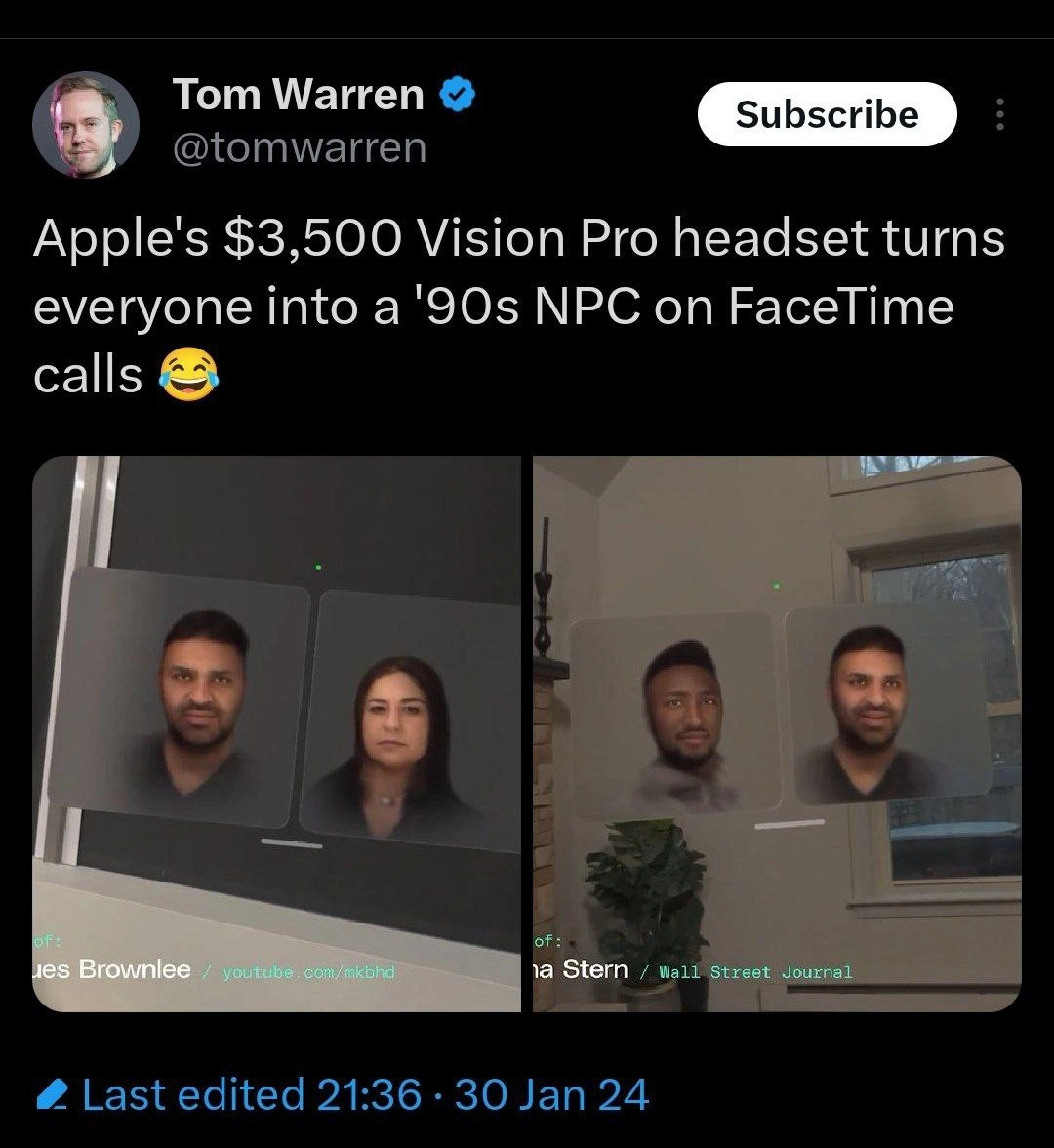
If you’ve been around tech long enough, the tweet in this meme instantly triggers a knowing smirk. Apple unveiling a $3,499 headset only to have its fancy FaceTime feature render you like a 1990s NPC is peak tech irony. We've got cutting-edge AR hardware with dual 4K displays and advanced sensors, yet on the other side of a call you end up looking like an extra from GoldenEye 007. The humor here comes from that gulf between expectation and reality: one of the world's most valuable tech companies selling a futuristic Mixed Reality gadget, but delivering an avatar that could cameo in a PlayStation 1 game. It's the classic hype vs. reality punchline. For seasoned developers and techies, it’s reminiscent of other times when revolutionary tech had comically rough edges. (Remember early voice assistants that proudly misunderstood every request? Or the first-gen smartphone cameras that took grainy VGA pics?) Here, the Vision Pro’s ultra-futuristic FaceTime in AR is tripped up by a distinctly retro limitation.
The tweet’s reference to a "'90s NPC" nails it. In gaming, NPCs (non-player characters) from the 90s were notoriously low-detail and a bit robotic. Think blocky faces with textures so blurry you could hardly distinguish a smile from a frown, and mouth movements that rarely matched the dialogue. Seeing your friends or colleagues reduced to those vibes in a modern video call is both hilarious and a little jarring. It's as if FaceTime suddenly time-traveled to the era of dial-up internet and polygon budgets. For Apple veterans, this is particularly eyebrow-raising because Apple usually prides itself on sleek user experiences. This is the company that introduced the Retina display to make everything on screen crisp and lifelike. Yet here we are, witnessing a Retina-grade headset showing fuzzy, half-formed faces. The contrast is comedy gold: you have more computing power on your head than a 90s supercomputer, but your virtual face looks straight out of The Sims circa 2000.
Why is this scenario so relatable to developers? Because we've all seen what happens when ambitious tech meets real-world constraints. There's a bit of dark humor in watching a $3k+ device grapple with problems we thought we left behind decades ago. It’s a reminder that first-generation products, no matter how premium, often have these kinds of quirks. Seasoned devs may recall the first VR meetups or video chat experiments in the past, where avatars were basically floating torsos or simple cartoon heads due to technical limits. We know that behind the scenes, Apple’s engineers probably poured countless hours into making the Persona feature work, and this blurry avatar is the best they could do given the current hardware/software limits. In a way, it’s a shared wink among tech folks: "We get it – real-time human rendering is hard." The result is funny not because we think Apple is incompetent, but because we recognize the technical trade-offs at play. It's a laugh of empathy as much as a laugh at the absurdity.
The meme also resonates because of the price tag attached. At $3,500, people joke that they'd expect nothing less than a flawless hologram of the person they're calling. Instead, they’re getting something that looks like a PS1-era game character trying to cosplay as their friend. That juxtaposition – premium price, prototype-quality avatar – fuels the humor. It’s the same kind of chuckle you get when a luxury car has a glitch that rolls down the windows randomly; it's expensive, it's advanced, and it's still a little broken. Here, the Vision Pro is literally a fancy, futuristic device that, in this one aspect, falls back to graphics we’d mock on a 20-year-old PC. The developer community finds that both endearing and comically absurd. After all, we know this will likely improve in a year or two – but for now, we have our meme and we’re going to enjoy every pixelated face of it.
Level 4: Persona Pipeline Paradox
At the cutting edge of spatial computing, Apple's Vision Pro attempts something audacious during FaceTime: rendering a realistic 3D Persona of the wearer in real-time. Under the hood, this involves capturing the wearer’s facial structure and expressions and then transmitting that likeness as a digital avatar. With outward-facing cameras busy mapping the room for AR, Vision Pro likely relies on internal sensors or algorithmic inference to guess your expressions. The device's dual-chip setup (an M2 for general compute and an R1 for sensor processing) is tasked with performing intensive machine learning algorithms to reconstruct your face on the fly. It's essentially doing on-device neural rendering – a process where a trained model generates images (in this case, your face) from sensor data. This real-time ML inference is constrained by latency: to avoid motion sickness and maintain immersion, everything must happen in milliseconds. Each frame of your simulated face has to be computed faster than the blink of an eye, leaving little room for ultra-high fidelity.
One core limitation is the bandwidth and data processing budget. Instead of streaming a raw video of your face (impossible here, since the headset covers your face and there's no direct camera view), the system sends a lightweight representation – perhaps a set of facial expression parameters or a low-detail mesh – to the other call participants. That remote device then reconstructs your face using its local copy of your Persona model. This approach is akin to how multiplayer games sync players: send minimal data (like positions or key poses) and let each client render the details. It’s efficient, but any missing nuance can make the result look low-poly or blurry. By not transmitting a full high-res video feed, Apple minimizes lag and data usage, but the trade-off is visual detail. Even though the Vision Pro boasts desktop-class compute, there's a frame rate target (likely around 90Hz for comfort) that forces a compromise: the avatar’s polygon count and texture resolution are dialed down to ensure smooth performance. In graphics terms, it’s as if the system dynamically levels down the model complexity to keep the pipeline real-time – an echo of 90s game engines which had to aggressively simplify 3D characters to run on limited hardware.
Graphical fidelity also bumps into the age-old problem of the uncanny valley. This concept, originating from robotics and CGI research, describes how a replica that is almost human but not quite exact can trigger an eerie or off-putting feeling. Apple’s Personas aim for realism – more lifelike than a cartoon Memoji – but not so photorealistic as to require Hollywood-level rendering. Yet this in-between state is tricky. The avatars have eyes, noses, and mouths in roughly the right places, but lack the micro-expressions and subtleties that make a face feel alive. Tiny mismatches in lip sync or eye focus, slight smoothing of skin textures, and the absence of true lighting and shadow detail on the face can all cumulatively give a video game vibe. In essence, by chasing realism under tight constraints, the system ends up producing an avatar that reminds us of an older generation of 3D graphics. It's a paradox: the Vision Pro uses cutting-edge AI and graphics tech, yet the outcome looks retro, evoking the era of blocky NPCs.
This isn't because Apple engineers are stuck in the 90s – it's because real-time human avatar rendering is an enormously hard problem. To convincingly simulate a person, you need nigh-perfect tracking of facial muscle movements and high-resolution rendering of skin, hair, and eyes – all synchronized in real-time. Missing even 10% of the detail can drop you squarely into uncanny valley territory. Apple’s first-generation approach appears to intentionally err on the side of too little detail rather than a not-quite-perfect photoreal face that might creep people out. By keeping the avatars slightly blurred and simplistic, they avoid harsh realism and the risk of digital zombies (those creepy almost-human figures). Historically, we’ve seen similar concessions: early telepresence and VR systems in the 90s and 2000s used ultra-simplified avatars or cartoonish characters to bypass realism entirely. The Vision Pro's "low-poly" FaceTime personas are basically a modern, ML-powered twist on that same strategy. It's a temporary step back in visual fidelity to achieve the larger step forward of being in an AR call. In the grand arc of technology, it's a fascinating case where today’s hardware and algorithms are just shy of the realism we expect, resulting in a situation so ironic that it’s meme-worthy.
Description
A screenshot of a tweet from Tom Warren (@tomwarren), a well-known tech journalist. The tweet reads, 'Apple's $3,500 Vision Pro headset turns everyone into a '90s NPC on FaceTime calls 😂'. Below the text are two side-by-side images taken from video reviews. The images show the digital 'Personas' created by the Apple Vision Pro for FaceTime calls. These avatars appear as slightly blurry, computer-generated floating heads and torsos within semi-transparent rounded rectangles. The lighting and texture give them an artificial, slightly unnerving look, characteristic of the 'uncanny valley.' The watermarks credit Marques Brownlee (MKBHD) and Joanna Stern / Wall Street Journal as the sources. The meme humorously critiques the graphical fidelity of this key feature on a very expensive, cutting-edge piece of hardware, comparing the result to the non-player characters (NPCs) found in 1990s video games, which are known for their primitive, low-polygon graphics
Comments
21Comment deleted
For $3500, the Vision Pro's 'Persona' feature successfully solves the uncanny valley problem by landing you squarely in the '90s video game cutscene valley instead
Nothing like spending $3.5k on spatial computing just to rediscover that real-time volumetric video still renders at ‘Quake II-quality’ when the network budget is the real boss fight
After 20 years of optimizing video codecs and building ML models for facial recognition, we've finally achieved the dream: making $3,500 hardware that renders humans with the same emotional range as a Goldeneye 64 guard who just noticed you're not supposed to be in the facility
When your $3,500 spatial computing headset renders you with worse fidelity than a PlayStation 2 character, you've successfully achieved what we call 'negative ROI on polygon count.' It's the hardware equivalent of spending six sprints building a microservice architecture only to discover your monolith had better latency - except here, Apple shipped the technical debt as a feature and called it 'Persona.'
Vision Pro Personas are the CAP theorem for faces: realism, low latency, and battery life - pick two; v1 partitioned realism
Two chips (M2 + R1) and a Neural Engine later, and my face still compiles to PS1-era geometry - guess that’s the cost of meeting the motion‑to‑photon SLO
Vision Pro Personas: Apple's genius optimization - zero facial meshes for sub-1ms latency, at the cost of looking like a Quake 1 reject texture
Door Kickers 2 operator avatars Comment deleted
explain this person that games back in 90s looked like this Comment deleted
it’s 80s Comment deleted
thats remake, here is original Comment deleted
don't blame the devs they had to calculate normals and vertices on cpu Comment deleted
he's not wrong but that's like mid-2000s territory. Maybe Oblivion or something Comment deleted
Honestly, it is reminiscent of that time you got prerendered box art and maybe cutscenes - but the game itself could handle like 250 triangles at a time. Comment deleted
'90s? don't modern games also give those boxes? Comment deleted
https://yt.cdaut.de/watch?v=NsL32y--h00 This is exactly what I mean. Around the Y2k the difference was really striking. And the renders looked kinda like those faces. Comment deleted
thanks for the huge flashing, really helps with my headache /s 🥺 Comment deleted
https://yt.cdaut.de/watch?v=JMe0XeWI1zo Another example Comment deleted
not quite 90s, but more like early 00s, even in late 00s (ig after 2005) games with high quality visuals started emerging. Spare me if I'm wrong Comment deleted
Spar me if you're right. Comment deleted
lmao exactly what I was thinking of when I saw that meme XD Comment deleted