AI Hype vs. Its Humble Mathematical Reality
Why is this AI ML meme funny?
Level 1: Not Actually Magic
Imagine you see someone perform an awesome magic trick, and it absolutely amazes you. You go up to the magician and say, “Thank you, that trick changed my life!” You’re thinking they must be some kind of wizard. But then the magician just shrugs and says, “I literally just used a basic card trick that anyone can learn.” 😅 It’s funny because you thought you witnessed real magic, when in fact it was a simple, ordinary technique behind the scenes. This meme is like that. The person on the left is thanking an AI as if it did something miraculous, but the AI (on the right) is basically saying, “Uh, I’m not a wizard… I just did a bunch of calculations.” In other words, what seemed like magic is actually just math. The humor comes from realizing that something we were treating like a magical genius is actually more like a speedy calculator. It’s a down-to-earth reminder: no real magic here, just a clever trick working hard in the background.
Level 2: Just Crunching Numbers
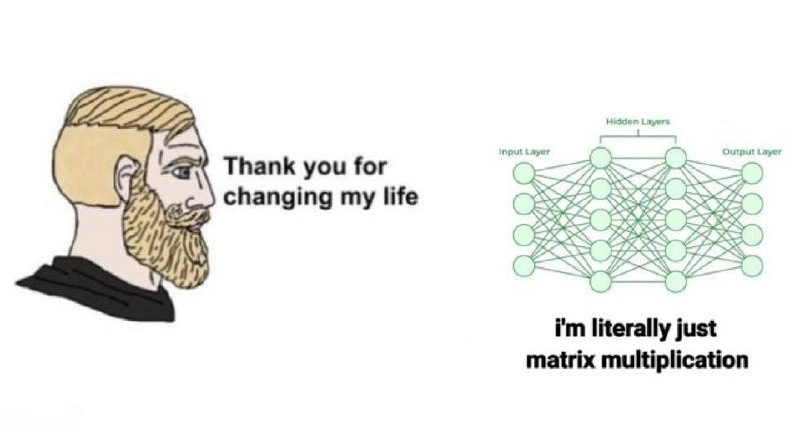
Let’s break down what’s happening in this meme in simple terms. On the left side, we have a familiar internet cartoon character (a blond Wojak with a beard) saying, “Thank you for changing my life.” He’s expressing deep gratitude, as if he’s speaking to a person or thing that had a huge positive impact on him. In context, he’s addressing an AI – basically thanking a piece of technology as though it were a life-changing mentor or wizard. This reflects how a lot of people talk about AI these days: with big praise, almost like the AI has human-like greatness. It’s that trend of ai_glorification, where folks hype up AI as something almost magical or godlike.
Now, look at the right side. It shows a green diagram of a neural network. This diagram has three labeled parts: “Input Layer,” “Hidden Layers,” and “Output Layer.” If you haven’t seen one of these before, it’s a common way to draw a feed-forward neural network – basically a type of MachineLearning model. The circles in the “Input Layer” represent input values (imagine you’re feeding in numbers that describe a thing – like pixels of an image or qualities of a customer). The circles in the “Output Layer” represent the result the network gives you (for example, the network might output a guess of what the image is, say “cat” vs “dog”, or a score predicting something). The middle circles, labeled “Hidden Layers,” are where the network does intermediate calculations – they’re “hidden” simply because you don’t directly see or set those values; the model figures them out internally. Each circle is like a little calculator (a “neuron”) that takes the numbers from the layer before it, does some math, and passes a new number to the next layer.
Those lines connecting the circles? Each line carries a number called a weight. When a circle in a Hidden Layer takes input from all the circles in the previous layer, each input number is multiplied by its respective weight (the line’s value). Then all those weighted numbers are added together, and usually another number called bias is added in. Finally, that sum might go through an activation function (which is just a predetermined math formula to squish or tweak the number – for example, to zero-out negatives or to keep numbers in a nice range). This process then repeats if there are multiple hidden layers: the output of the first hidden layer becomes the input of the next, and so on, until you get to the Output Layer’s result.
That sounds like a lot, but here’s the key: all those operations (multiply by weights, add them up) are basic math – CS Fundamentals kind of math. In fact, if you organize all the weights between one layer and the next into a grid (a matrix), you can do all those multiplications and additions in one go using matrix multiplication. Matrix multiplication is a core operation in linear algebra (a field of math dealing with vectors and matrices). It might sound fancy, but you probably learned the essence of it in school: multiplying a matrix by a vector is basically taking dot products (pairwise multiplies and sums) of rows with the vector. It’s just repetitive arithmetic. Computers are really good at this kind of thing, and there are optimized ways to do many multiplications and additions simultaneously. When the neural network in the meme says, “I’m literally just matrix multiplication,” it’s highlighting that all the impressive stuff it does can be broken down into these simple arithmetic steps repeated over and over.
To cement this, imagine a very simple example: say the Input Layer has 3 neurons (so you input 3 numbers), and the Hidden Layer has 2 neurons. The weights from the Input to Hidden could be represented as a 2x3 matrix (2 rows, 3 columns of numbers). If you multiply that matrix by a 3x1 input vector (3 numbers stacked in a column), the result is a 2x1 vector (2 numbers) – which would be exactly the two values that those 2 hidden neurons calculate. Each of those resulting numbers is w1*x1 + w2*x2 + w3*x3 (plus a bias) for one neuron, and similarly for the other neuron. That is matrix multiplication in action. So instead of doing each neuron’s math one by one in a loop, we can just do a single matrix multiply to get all the Hidden Layer outputs at once. This is how actual AI libraries do it because it’s much faster and takes advantage of the hardware. And the same idea applies from that Hidden Layer to the next layer, and so on to the Output Layer.
Now let’s relate this back to the meme’s message. The left side is treating the AI like it’s a human guru – “you changed my life!” The right side – the neural network with its layers – responds humbly (or flatly) that it’s just math. The humor is that the human-like drawing is emotional and thankful, whereas the diagram – representing the AI’s internal workings – is kind of emotionless and matter-of-fact: “I just do calculations.” It’s a bit like if someone effusively praised a robot, and the robot, being a robot, replied with something dry like “I am a series of algorithms executing.” That contrast is funny, especially to those who know how the tech works.
For a junior developer or someone new to AI, there’s also a lesson here: AIHypeVsReality. The hype might make it seem like AIs are mysterious entities or have minds of their own. But in reality, what’s happening inside is deterministic number crunching following the instructions set by programmers and the patterns learned from data. Even terms like “learning” in machine learning have a down-to-earth meaning: the model adjusts its internal numbers (weights) through a process of trial-and-error optimization (like gradient descent) to better fit the data. No actual understanding or consciousness is forming; it’s more akin to fitting a complex curve to points on a graph.
To connect with the tags: OverfittingModels is an example of what happens when that curve-fitting goes awry. If an AI model is overhyped as genius but was trained only on specific examples, it might perform well on those but fail on new ones (it “over-fit” to the training data). That’s a reminder that these systems don’t truly know things – they just match patterns. It’s an important concept a junior might encounter: the model might seem to remember the training data rather than generalize a real understanding. Again, nothing mystical – just the consequences of how the math optimization worked.
To put it simply: The meme’s neural network diagram is saying, “Don’t thank me like I’m some wise old man; I’m just a bunch of calculations strung together.” The left side represents people treating AI outputs as if they came from a wise human or a magical process. But the right side reminds us: nope, it’s linear_algebra_core operations – multiplications, additions – executed at high speed. This is a form of AI humor that engineers enjoy, because it cuts through the noise. It’s as if the neural network itself is a bit of a deep_learning_skeptic, playfully downplaying its mystique.
So, in everyday terms, the meme says: we give AI a lot of credit for being life-changing, but inside, it’s all just number crunching. Understanding that doesn’t make AI any less useful or cool, but it does demystify it. And demystifying is exactly what a good inside joke among developers does – it reminds us that even the most advanced tech is built on logical steps and CS_Fundamentals, not fairy dust.
Level 3: Glorified Linear Algebra
This meme perfectly captures the AIHypeVsReality vibe that seasoned developers know all too well. On the left, the blond Wojak character is earnestly saying, “Thank you for changing my life.” This represents all the people (or executives, or marketing teams) who view AI as almost magical — a transformative genius technology that’s practically touched by divinity. On the right, we have the neural network diagram bluntly replying, “I’m literally just matrix multiplication.” That’s the reality check, delivered with deadpan humor. It’s a comical reminder that what many hail as almost sentient or miraculous is, at its heart, AIHumor material: just a bunch of linear equations being solved extremely fast. The humor stems from this jarring contrast: ai_glorification on one side versus dot_product_reality on the other.
Anyone who’s been through a few hype cycles in tech will likely smirk at this. We’ve heard grand promises that “AI will change everything”, and indeed AI has done some amazing things, but the meme cracks a knowing joke: Don’t forget, behind the curtain it’s all code and math. It’s poking fun at the tendency to anthropomorphize and overestimate AI. The left side’s grateful “Thank you for changing my life” sounds like someone talking to a mentor or a savior. In reality, they’re talking to an algorithm that doesn’t even know it exists. It’s a bit like gushing to your calculator for doing a great job on your taxes — flattery completely lost on the mindless device. The neural net diagram essentially says, “Buddy, I’m not a wise guru, I’m just crunching numbers.” That’s the classic AI hype bubble being popped by a pin of truth.
IndustryTrends_Hype is a big target of this joke. In the tech industry (and especially in the AI/ML boom of the last decade), we’ve seen mountains of hype. Companies brand themselves as “AI-powered” to attract investments, keynote speakers dramatically compare neural networks to human brains, and glossy presentations make it sound like we’ve created living, thinking digital beings. Those of us in the trenches have sat through presentations where some executive calls a neural network “brain-like intelligence,” while we quietly know it’s closer to a glorified curve-fitting algorithm running on a very expensive cluster of GPUs. This meme is the engineer’s inside joke about that disconnect. It’s the neural network itself effectively saying, “Cool story, bro, but I’m just doing matrix math over here.”
Many senior developers and data scientists have experienced something like this in real life. Picture a meeting where a business stakeholder excitedly says, “This AI model is incredible, it understands our customers and changed everything!” Of course, they’re thanking the team as if we unleashed a thinking entity. Meanwhile, the team’s lead developer is thinking, “If only you saw the Python code – it’s just NumPy doing dot products and some if-else logic for the activation function.” It’s not that the model isn’t useful — it may very well feel life-changing due to its predictions — but there’s an ironic humor in knowing how prosaic the mechanism is. It’s like hearing someone praise a fortune-telling machine for its deep insights when you, the builder, know it’s just pulling answers from a database. The NeuralNetworks we build can appear incredibly sophisticated (they can beat humans at chess, generate human-sounding essays, etc.), which leads to awe. The meme takes that awe down a peg: all that impressive performance? Yup, it’s coming from lots of linear algebra and data grind, not from a digital soul or consciousness.
There’s also a hint of gentle deep_learning_skepticism here. Those of us who’ve debugged models or dealt with their failures know they’re far from magical. Models can be fragile: change the input in a slightly weird way and they might spew gibberish. That’s because, being just math equations, they lack true understanding. For example, an image classifier might confidently call a panda a vulture if you add some tiny noise to the image – a human would never mistake that, but our “life-changing AI” would, since it doesn’t see a panda; it just sees numbers. This vulnerability (like models overfitting or getting fooled by adversarial examples) is a reality that temper our awe. The meme doesn’t show an example of failure, but by emphasizing the mechanical nature of AI, it aligns with the cautious take: don’t treat AI like a mystical oracle; it’s a tool with very real limits. We hype these systems to the moon, yet any ML engineer can recount war stories where a supposedly smart model did something hilariously dumb because, well, it was following its math blindly. In production, maybe the “life-changing” chatbot crashes or gives absurd answers if asked something out-of-distribution. Scenes like that remind engineers that no matter how many conference talks call neural nets “brain-inspired”, they will fail in brainless ways if misused. The AIHype often glosses over these gritty details, but engineers swap stories about them, keeping each other grounded (and entertained).
Historically, this isn’t the first rodeo for AI hype. A TechHistorian (or just a cynical veteran developer) would note that in the 1960s, people were thanking perceptrons (early single-layer neural nets) as the dawn of machine intelligence, until we realized those were just doing a weighted sum and couldn’t even solve a simple XOR problem because of their linear limits. The 1980s had expert systems – basically giant if-else rule engines – and they were hyped as “AI that will run companies”, but turned out to be brittle and limited. Fast forward, we had cycles of hype around things like genetic algorithms, fuzzy logic, and then the big deep learning boom around 2012-2020s. Each time, the pattern is similar: initial awe (“It’s like the machine learns!”) followed by the sober understanding (“Actually, it’s following programmed math, and it needs lots of human-curated data and tuning”). This meme condenses that whole arc into one picture. The guy on the left is the initial awe; the text on the right is the inevitable reality check.
From an organizational point of view, the meme also resonates because it’s exactly the kind of thing an engineer jokes about after coming out of a hyperbolic product meeting. Upper management might be calling the AI solution “our secret sauce” and attributing all sorts of near-magical properties to it. Meanwhile, the devs who built it know they spent weeks debugging matrix shape mismatches, dealing with NaN errors during training (loss = NaN anyone?), and cursing floating-point precision issues. The project’s success wasn’t due to summoning a genie – it was hard work, lots of data preprocessing, parameter tweaking, and yes, matrix_multiplication grinding away on a server. So there’s a bit of pride in the subtext too: we took something so basic (multiplying matrices) and, by scaling it up cleverly, did achieve something impressive. But we haven’t transcended the laws of computation; we’ve just pushed them to new heights. It’s akin to an airplane: people might figuratively thank Boeing for the “miracle of flight,” but an aerospace engineer might chuckle and say, “It’s literally just Bernoulli’s principle and engine combustion.” True, and yet that doesn’t make a 747 any less amazing — it just demystifies it.
In summary, this meme tickles engineers because it jabs at the AI glorification we see everywhere with a healthy dose of truth. It’s a friendly reminder that even the most life-changing AI products out there are still grounded in code and math. There’s no tiny consciousness trapped in the circuit board graciously accepting your praise. There’s just linear algebra being executed really, really fast. As developers, we find that contrast funny and refreshing. It’s our way of saying, “We haven’t created Skynet or a genie in a bottle; we’ve just gotten really good at multiplying matrices.” And honestly, that reality check is both humorous and comforting. The next time someone says an AI model is “like magic,” a few of us will be fighting the urge to respond with the meme’s punchline: “I’m literally just matrix multiplication.” 😏
Level 4: Multiply and Conquer
At its core, every fancy neural network is powered by brute-force linear algebra. The meme’s right side (the green feed-forward diagram) strips away the mystique: all those neurons and connections boil down to matrix operations. In fact, the backbone of deep learning is a sequence of matrix multiplications and additions. Each layer of a neural net can be described by an equation y = f(W · x + b). Here W is a weight matrix, x is the input vector, b is a bias vector, and f(·) is a non-linear activation function. Multiply the input by the weight matrix, add the bias, apply a simple function, and repeat for the next layer. That’s it – no sorcery, just linear algebra. To put it bluntly, a neural network is doing a bunch of dot products: each neuron computes one by multiplying numbers and summing them up. For an entire layer, you can compute all those dot products simultaneously as one big matrix×vector multiply. The meme quip “I’m literally just matrix multiplication” is spot-on: the linear_algebra_core of these models is nothing more exotic than high-dimensional multiplication and addition.
Now, yes, there’s some nuance: between those matrix multiplies, you usually have non-linear activation functions (ReLUs making negatives zero, sigmoids squashing values between 0 and 1, etc.). Without those, stacking multiple linear layers would be pointless – two matrix multiplies in a row collapse into a single matrix multiply if you don’t inject some non-linearity. So the tiny sprinkle of magic (if any) is in those activation functions. But even that “magic” is just applying a simple formula to each number (no Harry Potter incantations needed). The heavy lifting at each layer — the part that eats up compute and makes GPUs sweat — is still the multiplications and additions. Modern deep learning is often tongue-in-cheek described as “glorified matrix multiplication with a non-linear twist.” This meme riffs on exactly that idea.
From a computational perspective, we’ve essentially built giant dot-product pipelines. We harness the power of GPUs (graphics processing units) and TPUs specifically because they excel at doing many multiplications in parallel. A GPU is basically a matrix-multiplication machine; it’s packed with hardware units that can multiply and accumulate numbers extremely fast. All the flashy breakthroughs in image recognition or language models ultimately come down to multiplying enormous matrices of parameters by vectors of input data (and doing that in dozens or hundreds of layers). In fact, deep learning frameworks like TensorFlow or PyTorch delegate this work to highly optimized linear algebra libraries. Under the hood, when you call model.forward(x), you’re invoking routines that call something like the BLAS function gemm (General Matrix Multiply) — code that’s been around for decades to multiply matrices efficiently. We’ve thrown billions of dollars into faster chips and larger models, but the underlying operations remain additions and multiplications on arrays of numbers. It’s as if we discovered that intelligence can be approximated by a very large spreadsheet calculation, and now we’re engineering ever bigger, faster calculators to run that spreadsheet. The meme humorously reminds us that no matter how life-changing an AI model’s output may seem, under the hood it’s powered by cold, hard math: multiply, add, multiply, add… repeat a few trillion times.
# A tiny example of a single-layer neural network forward pass (just math, no magic):
import numpy as np
# Toy weight matrix (4 neurons, 3 inputs), bias, and input vector
W = np.array([[0.2, -0.5, 0.1],
[0.8, 1.0, -0.3],
[0.4, 0.2, 0.9],
[-0.7, 0.3, 0.8]])
b = np.array([0.1, -0.2, 0.05, 0.5])
x = np.array([5.0, 2.0, 3.0])
# Linear combination: this is matrix multiplication W · x plus bias b
linear_output = W.dot(x) + b
# Apply a non-linear activation (ReLU in this case, just max(0, value) for each element)
activated_output = np.maximum(linear_output, 0)
print("Layer output:", activated_output)
In the code above, W.dot(x) is literally performing all the weighted-sum computations for the layer in one call — that’s matrix multiplication at work. The punchline “I’m literally just matrix multiplication” is like this code comment come to life. Even the almighty deep networks driving AI breakthroughs operate exactly like this, just on a much larger scale (with x being gigantic vectors and W massive matrices across many layers). If you zoom out, a deep network is essentially a chain of linear transformations (matrices multiplying vectors), interspersed with simple non-linear tweaks. This is why we often say modern MachineLearning is built on CS_Fundamentals like linear algebra. The meme distills that truth in one sassy sentence.
For added perspective, theoretical results in deep learning, like the Universal Approximation Theorem, tell us that a neural network (with enough neurons) can approximate any function. But how does it approximate complex functions? By combining lots and lots of linear pieces (those matrix multiplies) into a big, piecewise-linear or curvy mosaic. In other words, the appearance of magic emerges from an army of simple calculations. It’s akin to how a complex digital image is made of millions of individual pixels: up close they’re just colored squares, but arranged correctly they form Mona Lisa’s smile. Likewise, those weights and multiplications, arranged in the right architecture and tuned via training, can recognize your face or translate languages. It feels intelligent, but fundamentally it’s mechanical. This duality — incredible emergent behavior from elementary operations — is what makes AI both fascinating and, as the meme highlights, deep_learning_skepticism fodder. When someone gets too swept up in AI mystique, a seasoned engineer can always point and say: “Relax, it’s just matrices doing math.” And they wouldn’t be wrong.
Description
A two-panel meme on a white background. On the left, the blonde-haired, bearded 'Nordic / Chad' Wojak character looks respectfully towards the right panel and says, 'Thank you for changing my life'. On the right is a diagram of a simple feedforward neural network, showing an 'Input Layer', two 'Hidden Layers', and an 'Output Layer', with nodes connected by a mesh of lines. Below this diagram, text responds, 'i'm literally just matrix multiplication'. The humor lies in the stark contrast between the transformative, almost magical perception of Artificial Intelligence and its fundamental, core mathematical operation. While neural networks enable complex, world-altering technologies, this meme demystifies the concept for those in the know, reducing it to its basic building block of linear algebra. It's a classic joke among machine learning practitioners that pokes fun at the hype cycle by grounding the technology in its mathematical roots
Comments
18Comment deleted
The main difference between matrix multiplication and 'AI' is about a million dollars in VC funding and a keynote presentation
Remember: the only thing separating ‘world-changing AGI’ from glorified linear algebra is a colossal GPU bill and a few smug dot-products
After 20 years in tech, you realize the most revolutionary AI breakthrough is just convincing VCs that your matrix multiplication runs on 'proprietary neural architecture' instead of numpy.dot() with extra steps and a $10M cloud bill
After spending three months optimizing your transformer architecture with attention mechanisms, custom loss functions, and elaborate regularization schemes, you realize your model's performance ceiling was determined in the first 10 lines where you defined the matrix dimensions - everything else was just expensive matrix multiplication with a PhD in disguise
After years chasing SOTA, realizing your 'revolutionary' model is just cuBLAS with a PhD - suddenly, prod scaling feels trivial
Amazing how renaming SGEMM to “intelligence” adds a zero to the valuation while SREs still fight memory bandwidth
We rebranded 'call cublasSgemm a few trillion times' as intelligence; the life-changing part is procurement forwarding the A100 bill
Thank you for changing my life! Comment deleted
NEW SCAM!!!! GUYS! DON'T PAY ATTENTION TO OPENSEA, and also SCAMMERS! 😭😭😭🤬🤬🤬 Comment deleted
that's bot, not a real user, ban it completly Comment deleted
We cant. So we use democracy. Comment deleted
Maybe i retarded, but aren't the first matrix column number should be equal to the second matrix row number in order for multiplication to be valid ? If it's true, then the meme picture is incorrect 🤓 Comment deleted
https://datascience.stackexchange.com/questions/103183/working-of-dense-layer Comment deleted
A part of a graph between two layers (circle columns) refers to m*n connections, where m, n are sizes of layers. When you start with a vector of size x0, then have a layers of sizes x1, x2 and so on, you essentially have coefficient matrices of sizes x0*x1, x1*x2 and so on (they may be transposed, chosen convention is not principal). Coefficient manipulation to process your x0-sized input is thus just a sequence of matrix multiplications (with some extra steps between each two layers, like considering of intercept coefficient and activation function) Comment deleted
Soon there will be a place to prevent knowledge being lost in comments 🌚 Comment deleted
The edges of a graph between two layers represent a matrix of coefficients: each of m nodes is connected to each of the other n nodes Comment deleted
Dev meme educational Comment deleted
Just matrix multiplications and gating functions (only matrix multiplications = one linear transformation) Comment deleted