AI Overkill: Using a Neural Network for Simple Math
Why is this AI ML meme funny?
Level 1: Huge Paddle, Small Ball
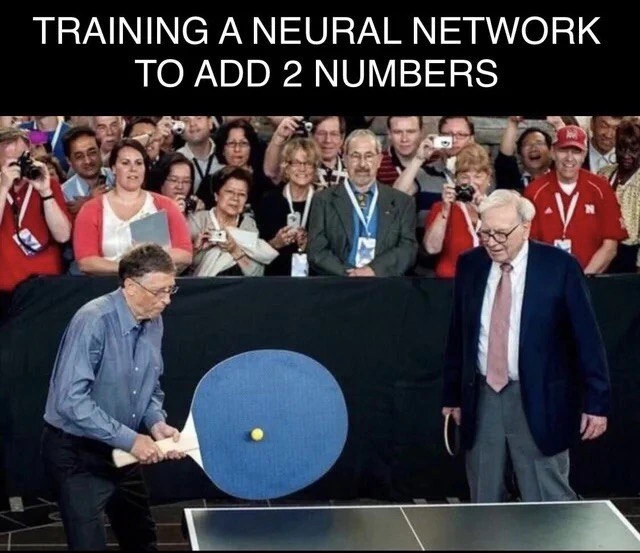
Imagine you want to do something really simple, like put two small Lego bricks together. But instead of using your hands, you build a giant robot with thousands of pieces to push the bricks together. Sounds silly, right? That’s what’s going on in this picture and joke. The photo shows a guy playing ping-pong (table tennis) with a huge paddle trying to hit a tiny ball. The paddle is comically oversized – way bigger than needed. If you actually tried to play with such a paddle, it would be super awkward!
This is funny because it’s a big, silly mismatch. It’s like using a massive tool for a tiny easy job. Adding two numbers (like 2 + 3) is really easy – you can even count it on your fingers. But the joke says someone is “training a neural network” to do it, which basically means using a super fancy computer method (the kind used for really hard problems) to figure out something simple. It’s as if to solve a little math problem, they brought in an entire space rocket! People laugh at this because the solution is way over-the-top for the size of the problem.
In everyday terms, think of using a hammer as big as a car to tap in a single small nail – it just looks ridiculous. The big paddle and small ball in the meme give us that same feeling. The man could have used a normal paddle (like we would use normal easy math), but no, he’s got this enormous paddle (that’s the crazy high-tech way). It makes everyone watching go, “Whoa, that’s overkill!” and giggle.
So even if you don’t know about neural networks or AI, the image itself tells the story: somebody is using something way too powerful and complicated for a simple task. It’s funny because we all get that you don’t need something that big to do something so small. It’s a lighthearted reminder that sometimes people use much more effort than necessary just to do a basic thing – and it looks as goofy as a giant ping-pong paddle for a tiny ball.
Level 2: Giant Tool, Tiny Task
Let’s break down the meme in simpler terms. The text at the top says “TRAINING A NEURAL NETWORK TO ADD 2 NUMBERS.” This is describing a scenario where someone uses a neural network (a complex AI program inspired by how brains work) to do a very simple job: adding two numbers together (like 2 + 3 = 5). In normal programming or everyday math, adding two numbers is extremely easy – you can do it in one step or one line of code. For example, in Python you could just:
# Simple addition with regular code:
def add_two_numbers(a, b):
return a + b
print(add_two_numbers(2, 3)) # Expected output: 5
The meme jokes that instead of doing it this straightforward way, people sometimes go for a super complicated approach because it’s “cool” or “AI-powered.” Training a neural network means you have an AI model that learns from many examples. So you would give the neural network lots of sample additions (like “1+2=3”, “2+2=4”, “2+3=5”, and so on, thousands of them) and adjust the network over time so that it starts to produce the right answers on its own. It’s a bit like instead of telling a student directly that 2+2 equals 4, you give them thousands of addition problems and hope they see the pattern and figure out the rule by themselves. Eventually, a well-designed neural network can learn that pattern – it will output 5 when you input 2 and 3, for instance – but you’ve made it way more complicated than just stating the rule upfront.
To illustrate the overkill, here’s a pseudo-code version of the complicated way:
# Overkill: using a machine learning model to learn addition
model = NeuralNetwork(input_size=2, hidden_layers=[16, 16], output_size=1)
# Prepare a large training dataset of random addition problems
training_data = []
for x in range(1000):
for y in range(1000):
training_data.append(((x, y), x + y))
# Train the neural network on the data (this could take a lot of time!)
model.train(training_data, epochs=50)
# Now use the trained model to add two numbers
result = model.predict((2, 3))
print(result) # Ideally, this outputs something close to 5 after training
In this pseudo-code, we set up a neural network with some layers (hidden_layers=[16, 16] means two layers of 16 neurons each inside, which is already overkill for adding two numbers). We then generate a bunch of pairs of numbers and their sums as training_data. The model.train() step adjusts the network’s internal parameters over 50 passes through the data. Finally, model.predict((2, 3)) gives us the network’s answer for 2+3. The expectation is it learned that 2+3≈5.
Notice how complicated that was compared to return a + b! We had to simulate a whole learning process. This is what we mean by over-engineering or an overkill solution: using an extremely complex method to do something very basic. It’s inefficient and silly, which is exactly why the meme is funny.
Now, consider the image in the meme. We see a man holding an oversized ping-pong paddle (it’s huge and blue) about to hit a normal little ping-pong ball. Normally, in ping-pong (table tennis), the paddle is just a bit bigger than your hand – small and light – because the ball is tiny and you can hit it just fine with a regular paddle. If someone shows up with a paddle the size of a door, it looks ridiculous. Sure, technically you could hit the ball with that giant paddle, but it’s clumsy and unnecessary. In fact, it might even be harder to play because the huge paddle is unwieldy! This visual is a metaphor (analogy) for the situation. The giant paddle represents the big, complex neural network and the whole training mechanism. The tiny ball represents the simple task of adding two numbers. The image exaggerates the size difference to make us immediately see how mismatched things are – big tool, tiny task.
Let’s connect it back to AI and machine learning humor. In recent years, there’s been a trend (and lots of hype) to use AI for everything. AI_ML is great for many problems – like recognizing faces in pictures, translating languages, or driving cars – where we either can’t write a simple program to do it or it’s too complicated to capture all the rules manually. But some problems, like basic arithmetic or filtering even numbers from a list, already have a perfect, straightforward solution. No need for AI there! When someone ignores the simple solution and instead says, “Hey, let’s use a neural network, that’s the hot new tech!”, it’s both silly and funny to those who understand the context. It’s akin to hype-driven decision making. This meme is essentially calling that out with humor: it’s showing the AI hype vs reality gap. Reality: you just do 2+2. Hype: “No, let’s gather big data and train a model to learn what 2+2 is!”
The tags like AIHumor, OverEngineering, and AIHype all point to this idea. Over-engineering means designing a solution more complex than necessary. People in tech often joke about over-engineering because sometimes engineers (especially when excited about a new tool or paradigm) create systems that are far more elaborate than needed for the problem at hand. It’s done with good intentions or enthusiasm, but the end result can be inefficient or hard to maintain. In our case, using a neural network to add falls squarely into that category – it’s the ultimate “because we can” approach, not “because we should.”
So, in summary, at this level: The meme uses the ping_pong_analogy (giant paddle vs small ball) to represent an ai_overkill scenario. Training a neural network (complex AI model) to solve an addition_problem (simple math like 2+2) is like using a giant comically large paddle to hit a tiny ping-pong ball. It highlights the humor in hype-driven over-engineering. Anyone who has done even a bit of programming can appreciate how adding two numbers is so basic that this scenario is ludicrous. And that’s why it’s funny – it’s pointing out in a very visual way how absurd it is to apply massive effort for a minuscule task.
Level 3: When AI is Your Hammer
For experienced developers and industry observers, this meme hits a nerve about AI hype and over-engineering. The caption “Training a neural network to add 2 numbers” immediately reads as a satire of our field’s tendency to apply a machine learning hammer to every nail, even when the “nail” is a thumbtack that could be pressed in with a finger. Everyone’s seen it: a startup boasts about an AI-powered solution for something trivial, or a team over-complicates a feature just to sprinkle in some ML pixie dust. Here, adding two numbers is the archetype of a trivial problem – it’s basically the first thing you learn in elementary math and the simplest operation a computer can do. Using a heavy-duty deep learning model for that is hilariously overly complex. It’s like bringing a supercomputer to do the job of a $1 pocket calculator.
The image of the man wielding an absurdly oversized paddle at a ping-pong table illustrates the scenario perfectly. In software terms, the giant paddle is a massive ML model with perhaps hundreds of neurons layers (or at least a very heavy framework around it), and the tiny ping-pong ball is the trivial task of computing a sum. The onlookers snapping photos and watching in amusement? They could represent the tech press and excited stakeholders wowed by the buzzwords and spectacle (“Look, he’s using AI!”) even if they don’t realize how unnecessary it is. Seasoned engineers chuckle at this because it mirrors reality: we’ve sat through conference talks or pitches where someone proudly explains how they trained a complex model (taking days of compute time and lots of data) to achieve what a two-line script could do deterministically.
Why does this happen? Partly, it’s the IndustryTrends_Hype cycle. At certain times, certain technologies (right now, it’s deep learning and neural nets) are seen as the magic wand for all problems. There’s social and economic incentive to label things as AI-powered. Managers and marketing teams love saying “we use cutting-edge AI” – it sounds innovative and can attract investment or customers. Engineers, especially those new to AI, might also be genuinely excited to apply their new skills everywhere, sometimes without doing a sanity check: is this problem actually suited for ML? In many cases, it isn’t. Here, adding two numbers is the textbook example of a problem that’s already solved by basic code. There’s no ambiguity, no complex pattern to learn – it’s pure, defined math. Over-engineering it with neural nets is funny to us because it violates the principle of using the right tool for the job. It’s as if someone insisted on using a huge SQL database and microservice architecture to store just a single key-value pair – technically possible, but completely unnecessary.
Moreover, the meme resonates due to the resource overkill involved. Training neural networks, even relatively small ones, typically requires a lot of computation. Think of loading libraries like TensorFlow or PyTorch, preparing a training dataset (for addition, you’d generate zillions of example pairs like “1+3=4”, “2+5=7”, etc.), and then running many epochs of training loops updating weights. You might even need GPU acceleration to speed it up. All that to accomplish what a single CPU instruction ADD does natively in a nanosecond! It’s a comical ROI. We can imagine the development cycle: someone spins up an expensive cloud instance, spends hours tweaking hyperparameters like learning rate or network architecture, and finally the model outputs “4” as the sum of 2 and 2. Yay, it works – but the absurdity is that we already knew the answer up front. As a senior dev might joke, we could have just coded return a + b and saved everyone the trouble, but then you couldn’t brag about having AI in your project.
This also touches on the maintainability and reliability issues. A hard-coded addition will always be correct (barring any crazy overflow or something, which is well-understood). A learned model, on the other hand, might have edge cases. What if it was mostly trained on small numbers and suddenly has to add 9999 + 1? Will it output 10000 reliably, or will it produce some slight error because it never saw that combo? Experienced folks know that machine learning models can be fragile outside their training distribution. We also know how much monitoring, retraining, and engineering effort goes into deploying an ML solution. So the idea of doing all that for simple arithmetic is laughably disproportionate. It’s satire of those real situations where teams introduced an AI dependency that became a maintenance headache, for results that a simple formula or rule could’ve achieved.
In essence, this level of analysis sees the meme as commentary on AIHype vs Reality. The reality is that not every problem needs AI or ML – many problems have straightforward solutions. But the hype (represented by that enormous paddle and the eager crowd) can blind people into using a flashy, complex approach for bragging rights or due to a misconception that “more complex = more advanced”. As engineers, we’re both amused and a little exasperated because we value elegant, appropriate solutions. The meme’s humor says: “Sure, you can use a neural network to add two numbers… but why on earth would you?” It’s a gentle poke at the tendencies in our field to sometimes lose sight of pragmatism in the excitement of new tech. And if you’ve ever had to maintain an over-engineered system, you probably smirk at this image, feeling both the irony and the relief that at least this time it’s just a joke.
Level 4: Backpropagating a Sum
At the most intricate level, this meme highlights a fundamental inefficiency in applying deep learning to a trivial deterministic problem. In computational theory terms, adding two numbers is as simple and well-defined as it gets – essentially a constant-time operation $f(x,y) = x + y$. A neural network, however, approaches this as a general function approximation problem. That means instead of directly computing $x+y$ with fixed logic, it uses dozens or even millions of adjustable parameters (weights) and learns the addition function by example. This is like using a high-dimensional curve-fitting algorithm to rediscover the definition of addition from scratch.
To a machine learning researcher, it’s almost absurd: we have a closed-form solution for addition, yet here we would be using gradient descent to nudge a network’s weights until it approximates the sum operation. Gradient descent is a heavy iterative optimization procedure (the backpropagation algorithm) that tweaks parameters by computing gradients (partials derivatives) of a loss function measuring error. For adding two numbers, the loss could be the squared difference between the network’s output and the true sum. Minimizing that error across many examples via backpropagation will eventually calibrate the network – essentially relearning what + means. The universal approximation theorem tells us a neural network can model any continuous function given sufficient complexity, so yes, it can learn to add. But the theorem doesn’t say anything about the practicality or efficiency of doing so for such a simple function. Here, the “function” (addition) is linear and exact, whereas the neural network approach is non-linear and approximate until trained to convergence.
This contrast showcases a Turing tarpits scenario in AI: neural networks are incredibly flexible (Turing-complete in theory), but that flexibility can become a quagmire when used for something straightforward. The direct addition algorithm is mathematically guaranteed correct for all inputs (e.g., standard binary addition covers all cases with carries). In contrast, a trained neural network might only interpolate correctly within the range of data it saw. If you only train it on examples like 1+2 or 50+75, will it reliably get 999+1 or 10,000+20 correct? Possibly not, unless those patterns were in the training set or the model has actually inferred the general rule of addition (which is not trivial without specialized architecture). Standard feed-forward networks aren’t naturally equipped to handle arbitrary-precision addition because that requires handling potentially unbounded digit lengths or carrying, which is more akin to an algorithmic process than a continuous mapping. Researchers have indeed explored neural networks or differentiable models that learn arithmetic or algorithms (like Neural Turing Machines or Transformer networks taught to do addition), but those typically require significant design and still underperform a simple coded solution on out-of-distribution inputs.
From a computational complexity perspective, the disparity is comical. A classical addition of two n-bit numbers is $O(n)$ in time (or $O(1)$ if you consider fixed-size machine integers). Training a deep learning model, however, is far more resource-intensive: it’s $O(N \cdot E)$ where N is the number of training examples (possibly thousands or millions) and E is the number of training epochs iterating through that data. Not to mention the constant factors: heavy linear algebra operations on each pass, memory for storing large weight matrices, etc. In the end, after expending all that effort, the model outputs a number – hopefully the correct sum. It’s a bit like performing a massive Monte Carlo simulation to confirm that $2 + 2$ indeed equals 4. The math checks out, but you’ve burned through gigaflops of computation (and possibly a few GPUs) to get there.
The metaphor of the giant ping-pong paddle encapsulates this perfectly: the enormous paddle represents the unwieldy complexity and computational heft of deep neural network math being swung at the tiny, simple “ball” of the addition problem. The laws of physics (or in computing, the underlying math) certainly allow you to hit that ball with the huge paddle – just as they allow you to approximate a sum with a neural net – but it’s ridiculously overkill. The humor emerges from this mismatch: knowing the elegant simplicity of addition, and then seeing the convoluted contraption we’ve built (massive weight matrices and endless multiplications) just to land on the same one-step result. In essence, the meme is a nerdy nod to the absurdist extreme of AI hype, where theoretical capabilities collide with comedic impracticality.
Description
The meme displays a well-known photograph of Bill Gates and Warren Buffett playing table tennis, with a large crowd watching in the background. Bill Gates is on the left, humorously wielding a comically oversized blue ping-pong paddle to hit a small yellow ball. Warren Buffett stands opposite him, looking on. Above the image, a caption in bold white text reads: 'TRAINING A NEURAL NETWORK TO ADD 2 NUMBERS'. The humor is derived from the absurdity of the analogy. Using a neural network, a complex and computationally intensive tool, for a trivial and deterministic task like adding two numbers is a massive over-application of technology, perfectly illustrated by using a giant, unwieldy paddle for a delicate game like table tennis. This resonates with experienced engineers who have witnessed the hype cycle where complex solutions like AI/ML are proposed for problems that can be solved with a simple script or basic arithmetic, highlighting a common form of over-engineering in the industry
Comments
9Comment deleted
The model's loss function is just the developer's tears as they burn through the AWS budget to achieve 99.8% accuracy on '2+2=4' but it still thinks 2+3 is 4.9999999998
Just deployed a 64-GPU transformer on Kubernetes to approximate 1 + 1; finance calls it “innovation spend,” I call it a 400 ms latency wrapper around the + operator
After 500 epochs, the model achieved 99.8% accuracy at predicting paddle trajectories but still insists that 2+2 equals 'backhand slice'
When your startup's Series A pitch deck includes 'AI-powered addition' and you've allocated 47 GPU hours to train a transformer model that achieves 99.7% accuracy on the groundbreaking task of computing 2+2. Meanwhile, the intern's `return a + b` function has been running in production with 100% accuracy since 1972, but it doesn't scale to Web3
Replacing the + opcode with a 13B-parameter transformer: a rack of GPUs, 200ms latency, and a “let’s think step by step” prompt just to carry the 1
After a week of tuning learning rates so the MLP can do 2+2, we realized the '+' operator has zero parameters, constant-time inference, and far better out-of-distribution performance
Gradient descent on 2+2 with more observers than neurons - peak AI efficiency theater
But still: You write 2+2? AI says yes Comment deleted
Q: 5+3 A: a cat Comment deleted