The Great Equalizer: Googling What You Forgot
Why is this DevCommunities meme funny?
Level 1: Even Grown-ups Forget
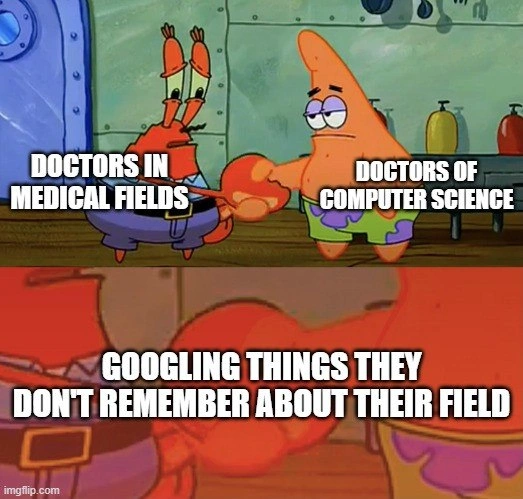
Imagine you have two friends: one wants to be a doctor who helps sick people, and the other wants to be a computer expert who makes cool apps. They both study really, really hard for a long time. You might think they know everything about their favorite subjects. But guess what? Sometimes even the smartest grown-ups forget things and have to ask for help or look things up! This meme is like seeing those two super-smart people shake hands because they both secretly do the same funny thing – they search on Google when they can't remember something.
It’s kind of like when your teacher needs to check a textbook or the internet to answer a tough question in class. Or think about your parent cooking a new recipe: even if they’re a great cook, they might still peek at the recipe to make sure they’re doing it right. In the picture, a cartoon crab (representing a medical doctor) and a cartoon starfish (representing a computer science doctor) are happily shaking hands because they realized, “Hey, you use Google to find answers you forgot? Me too!” That’s the whole joke. It feels good because it shows everyone needs a little reminder sometimes, no matter how smart they are.
So the funny lesson here is: nobody knows everything, and it’s okay to ask or search for answers. Even people with fancy degrees or big jobs use tools like Google to help them remember details. Just like you might look at the answer key for a tough homework question or ask an adult for help, grown-ups do the same thing in their jobs. And seeing two very different experts share a laugh over this makes us smile. It tells us that learning is a forever thing, and even experts keep learning (and forgetting and re-learning!). In simple terms: even the best of the best sometimes say, “Hmm, let me double-check that!” and that’s perfectly normal – and pretty funny when you think about it.
Level 2: No One Knows It All
For someone just starting out in tech (or any field), this meme is a friendly reality check: no matter how educated or experienced people are, they still have to look things up. Let’s break it down. The meme shows two characters from SpongeBob SquarePants – Mr. Krabs and Patrick Star – shaking hands. They’ve been labeled with text overlays: Mr. Krabs represents "Doctors in medical fields" (think of medical doctors like surgeons, pediatricians, etc.) and Patrick represents "Doctors of Computer Science" (people who have a Doctorate/PhD in computer science, meaning they’ve reached the highest level of academic education in that subject). In real life, both of these groups are considered experts. A medical doctor might have gone through years of medical school, and a PhD in computer science has spent years researching advanced topics in computing. You might assume these people have every little detail of their field memorized. But the big caption on the meme, written across their joining hands, says: "GOOGLING THINGS THEY DON'T REMEMBER ABOUT THEIR FIELD."
This basically translates to: even these top-level professionals use Google (or other search tools) to find answers when their own memory doesn’t have what they need. If you’re a budding developer, you might have noticed yourself doing this a lot – typing errors or questions into Google, searching Stack Overflow for code examples, checking documentation for a function’s usage. Guess what? That doesn’t really stop, no matter how experienced you get! StackOverflow dependence (relying on Stack Overflow for answers) is a common and even expected part of a developer’s life. It doesn’t mean you’re not good at coding; it means you’re smart enough to use the resources available to you. In fact, one could say a key skill in programming is knowing how to quickly find answers.
Let’s clarify a couple of terms and context here:
- Doctor of Computer Science (PhD): The term “doctor” can mean a medical doctor (an MD) or someone who has earned a doctorate degree (PhD) in a non-medical field. PhD stands for Doctor of Philosophy, which is a bit confusing because it’s not just philosophy – it’s any discipline. So a "Doctor of Computer Science" isn’t treating patients; instead, they’re someone who did advanced research in computing, like algorithms, artificial intelligence, or software engineering. They write a big dissertation (a research paper/book), and after that they get the title “Doctor” due to their degree. So the meme is making a playful comparison between medical doctors (MDs) and academic doctors (PhDs). Both have “Doctor” in their title; one knows about human bodies, the other about computers.
- Googling: This simply means using the Google search engine to find information on the internet. It has become such a common practice that “to google something” means to search for it online. Developers often google error messages, documentation pages, code snippets, or "how to do X in Python/Java/whatever". Medical professionals might google or use medical search engines for drug information, rare symptoms, or latest research (though often they use specialized sites – but the idea is the same).
- Stack Overflow: This is a popular Q&A website where developers ask programming questions and get answers from the community. It’s so widely used that if you search a programming question on Google, a Stack Overflow page is usually one of the top results. Many developers have essentially learned by reading Stack Overflow threads. It’s not explicitly shown in the meme image, but it’s strongly implied by the tags (like StackOverflowDependence) and the general developer culture: using Google often leads you to a Stack Overflow answer.
- Memory lapses in experts: This phrase just means that experts sometimes forget things. It’s normal – no one’s brain can store every fact perfectly. In technology, there’s even a humorous term RTFM (Read The Fine Manual – polite version) which basically means “it’s okay to look up the manual or documentation when you forget how something works.”
For a junior developer or someone learning, the message here is super encouraging: Don’t be ashamed of looking things up. The people who seem to know everything often just know how to quickly find what they don’t remember. When you see a senior developer swiftly resolving an issue, behind the scenes they might have quickly searched the company’s wiki or Googled an official doc. When a professor of computer science writes code, they might still flick over to a browser to double-check the parameters of a library function. This doesn't make them any less knowledgeable; it’s simply impossible to keep an entire programming language’s syntax or an entire operating system’s API in your active memory all the time. In the medical analogy, even a great doctor might think “Hmm, the dosage for this medication in a child… let me double-check to be absolutely sure,” and then consult a reference or an app on their phone.
There’s also a nod to imposter syndrome here. Imposter syndrome is that nagging feeling that you’re not as competent as others think, and you fear being “exposed” as a fraud. A lot of newcomers feel this when they have to search for answers frequently: “Am I really a developer if I keep googling basic stuff? Real devs probably know this offhand.” The meme basically laughs at that worry by showing even the “real devs” (PhDs) are doing it too. In truth, being a good developer (or doctor, or any professional) doesn’t mean never needing help – it means using tools and knowledge efficiently to get your job done correctly. In fact, one could argue the more you learn, the more you realize what you don’t know by heart. And then you develop strategies to fill those gaps – like having favorite documentation sites bookmarked, or remembering keywords to search.
Another aspect for those early in their career: Learning how to learn is as important as learning specific facts. When a new JavaScript framework comes out, even experienced devs will have to read up on it or search how it differs from what they already know. The tech industry changes rapidly, so everyone is on a continual learning curve. Google and Stack Overflow just happen to be a part of that learning process for almost everyone. It’s not “cheating” to use them; it’s effectively collaborating with the broader developer community’s knowledge. Over time, you’ll even remember some things because you looked them up so many times (like that one Stack Overflow answer you’ve opened 15 times finally sticks in your memory!). But there will always be something new or obscure to search for next.
Finally, let’s talk about the humor format: SpongeBob memes are very popular in developer humor (DeveloperMemes). The spongebob_handshake_format is specifically when two characters or groups are shown uniting over a shared trait. It’s funny because Mr. Krabs (a money-loving crab) and Patrick (a goofy starfish) are a bizarre pair to imagine together – just like it’s bizarre at first to lump medical doctors with computer scientists. The common trait written across their handshake – “Googling things they don’t remember about their field” – is the punchline. It highlights a routine that might feel embarrassing and makes it not only normal, but laugh-out-loud common. So if you’re a newbie coder constantly searching for answers, this meme is essentially giving you a high-five. It’s saying: "Look, even the folks at the top do this. You're just fine – keep Googling and keep learning!"
Level 3: Google – The Great Equalizer
For developers in the real world (even those with years of experience or fancy titles like “PhD”), this meme hits home because it’s so true and so relatable. No matter how advanced you are in your field, you'll inevitably encounter a moment where you blank on a detail and turn to Google or Stack Overflow. The meme labels Mr. Krabs as "Doctors in medical fields" and Patrick as "Doctors of computer science," then zooms in on their handshake labeled "Googling things they don't remember about their field." The humor comes from that handshake – it's an alliance between two groups we don't usually compare. Medical doctors are stereotypically seen as walking encyclopedias of health knowledge, and computer science PhDs are seen as walking encyclopedias of tech knowledge. But here they are, clasping hands in solidarity over a very human habit: searching the web for answers.
This speaks to a universal developer experience. In software development, it’s often joked that the real senior engineer isn’t the one who memorized the entire code library, but the one who can quickly find answers and solutions (often via a quick search). We sometimes call this skill “Google-Fu” – the art of crafting the right search query to get the info you need. It's a cornerstone of Developer Productivity and good Developer Experience (DX). The fact that the meme equates this to what medical doctors do as well is a comforting (and hilarious) reminder that no one is immune to forgetting. It’s not a lack of intelligence or qualification – it’s just the reality of having too much to remember. Software engineers might need to quickly look up the exact syntax for merging two dataframes in pandas, or the correct flags for a grep command, or the proper way to handle a certain HTTP status code. Similarly, a highly trained surgeon might quickly refresh on the details of a rare procedure, or a general physician might check the recommended dosage of a seldom-prescribed medication using an online reference. Both are experts, and both feel the daily pressure of keeping up with fast-moving fields where knowledge updates constantly.
From a senior developer perspective, this meme also pokes fun at imposter syndrome in a gentle way. Many developers (even very experienced ones) secretly worry “I’m a fraud because I still have to Google basic things.” Seeing that even PhDs do the same is a relief. It’s like the community collectively saying, “Hey, it’s alright – even the best of us don’t hold everything in our heads.” That’s incredibly validating. It turns a source of anxiety (forgetting things you think you should know) into a shared joke. In fact, relying on Stack Overflow or documentation is such a common practice that another joke goes: if Stack Overflow ever went down, programming productivity worldwide would plummet. This meme extends that humor to the highest echelons of expertise, implying that even lofty academics would be in the same boat searching for answers.
The SpongeBob handshake meme format itself has been used widely in internet culture to show unlikely camaraderie or commonality. By choosing Mr. Krabs and Patrick, the meme contrasts a crusty restaurant manager (Mr. Krabs) with a goofy starfish (Patrick) and labels them as two very serious groups of doctors. This exaggeration – using silly cartoon characters to represent serious professionals – adds to the humor. It visually underlines that regardless of outer differences (different fields, different “creatures”), they share this one habit. The caption “Googling things they don’t remember about their field” is emblazoned boldly, almost like the punchline delivered with a flourish. It’s essentially saying: “Look, even at the top of their game, they’re hitting up Google like the rest of us.”
Every seasoned developer can recall countless moments of quickly searching documentation or forums. Maybe you’re in the middle of coding an algorithm and suddenly you think, “What’s the exact syntax for this function again?” – cue a 10-second trip to the search bar. Or it’s 3 AM, production is on fire, and you hastily Google an obscure error message to find a solution on some Stack Overflow thread from 8 years ago. The meme is a nod to those scenarios. It humorously equalizes the playing field: your friendly neighborhood coder and a PhD researcher are laughing together, shaking hands, because both just opened a browser tab to figure something out. This extends to the medical side too – an experienced doctor might joke that they “consult Dr. Google” when encountering a puzzling set of symptoms. In reality, doctors use dedicated resources (like medical journals or specialized search engines for research), but framing it as “Googling” makes it more comedic and relatable.
In the software industry, we even design our workflows around this reliance on external info. Documentation is online for a reason – nobody expects you to have it memorized, but you should know how to find and use it. Many code editors and IDEs have built-in web search shortcuts or documentation hover-tooltips because it’s so normal to check things on the fly. And the volume of knowledge in tech is massive: frameworks, languages, APIs, best practices – all evolving continuously. The learning curve never truly ends. A PhD in CS might have deep knowledge of, say, machine learning theory, but if they need to switch context to debugging a React app or recalling the exact CLI flags for Docker, they’re likely to quickly search it. This meme captures that everyday developer routine.
In summary, from a veteran’s perspective, the joke lands because it reflects a real truth wrapped in absurdity: even the people writing academic papers or performing surgeries share the humble practice of searching things up. It’s a lighthearted reminder that expertise isn’t about never needing help – it’s about recognizing when you do and knowing where to get that help. So the next time you hastily Google “python sort list of tuples by second element” for the tenth time, remember: somewhere a PhD just searched for an algorithm detail they forgot, and a doctor just double-checked a diagnosis online. You’re in good company.
# Pseudocode of an expert's routine (developer edition)
def solve_problem(problem):
if know_solution(problem):
return solution_from_memory
else:
# Not in brain cache, fall back to external knowledge
return google_search(problem)
Level 4: Distributed Cognition
At the deepest level, this meme highlights a concept in both computer science and cognitive science: distributed cognition. Even the most advanced experts – whether a PhD in Computer Science or an MD in medicine – rely on external systems (like search engines or reference materials) as extensions of their own memory. In theoretical terms, their knowledge is not confined to the neurons in their brain; it’s distributed across tools and resources like scholarly databases, documentation, and yes, Google. This is sometimes called cognitive offloading – offloading the need to recall every detail onto an external memory source. For computer scientists, this external memory often takes the form of digital archives and the internet; for medical doctors, it might be up-to-date clinical databases or reference books.
On the computing side, think of how a cache works in a system architecture. A CPU has a limited cache memory (fast but small) for immediate data, and if something isn’t in the cache, it fetches from a larger, slower store (like main memory or even disk). Similarly, a developer’s brain might be like a fast cache for core concepts and common knowledge, but when it encounters a “cache miss” – something not immediately remembered – it reaches out to the vast “main memory” of the web. The search engine acts as a high-speed index to this huge external knowledge base. The ironic twist is that a PhD in CS might have studied or even helped develop those very indexing algorithms (like Google’s famous PageRank or advanced information retrieval techniques), yet they still rely on them daily. No human brain can hold the entire contents of an API reference or the details of every known bug fix – just as it’s infeasible for a computer to load the entire internet into RAM. Instead, we maintain pointers or mental indexes to where the information can be found. This is exactly what Googling is: using an algorithmic index to retrieve the right piece of knowledge on demand.
From a theoretical perspective, this reliance is not a weakness but a clever adaptation. It aligns with Alan Kay’s maxim that “technology is anything that wasn’t around when you were born.” For modern experts, search engines have become an integral technology of expertise. By offloading rote memorization to machines, both doctors and developers free their own mental CPU cycles for higher-level problem solving. There’s also an academic echo here: in research, if a detail is not recalled, a scientist will go back to the literature (journals, textbooks). The meme humorously narrows that down to simply “Googling it,” which is a relatable shorthand in the age of internet search. Even behind Google’s simplicity lies complex distributed systems and algorithms: web crawlers that have indexed billions of pages, sophisticated ranking algorithms that sort results by relevance, and vast data centers enabling an answer in milliseconds. The PhD in computer science surely appreciates that immense engineering – perhaps even more than a layperson – yet they utilize it just the same as anyone else when their personal memory falters.
In essence, this top-level view connects to a profound truth: knowledge in any advanced field has grown beyond what a single person can internalize. Both the medical domain and software engineering are ever-expanding knowledge domains, akin to huge codebases or libraries of information. Maintaining expertise today means knowing how to find the answer quickly just as much as knowing the answer offhand. As a wry footnote, even the legendary computer scientist Donald Knuth once said he doesn’t bother memorizing his phone number because, “why should I memorize something I can look up?” That philosophy rings through this meme: it’s championing the value of knowing how to look things up. Whether it’s through a meticulously researched medical compendium or a quick Stack Overflow query, using external knowledge systems is an advanced skill in itself. The handshake in the meme symbolizes this shared reliance: two very different kinds of “doctors” finding common ground in the one humble truth – sometimes, you just have to Google it.
Description
This meme uses the two-panel 'Epic Handshake' format from SpongeBob SquarePants. In the top panel, the characters Mr. Krabs and Patrick Star are shown shaking hands. Mr. Krabs is labeled 'DOCTORS IN MEDICAL FIELDS,' and Patrick is labeled 'DOCTORS OF COMPUTER SCIENCE.' The bottom panel is a close-up of their clasped hands, with the unifying concept written in bold white text: 'GOOGLING THINGS THEY DON'T REMEMBER ABOUT THEIR FIELD.' The humor lies in the shared, unspoken reality of two highly specialized and respected professions. It demystifies expertise by showing that even those with the highest qualifications, like medical doctors and CS PhDs, constantly rely on search engines to retrieve information. For senior developers, this is highly relatable as it normalizes the daily ritual of looking up syntax, algorithms, or API documentation, validating that the ability to find information is just as important as knowing it by heart
Comments
8Comment deleted
My CS PhD just means my Google queries for 'how to exit vim' are slightly more ashamed and a lot more specific
Twenty years of distributed systems and I still Google the exact YAML key for a Kubernetes livenessProbe - apparently a PhD only upgrades your search syntax, not your L1 cache
The real difference between junior and senior engineers isn't what they know - it's knowing exactly which Stack Overflow answer from 2011 will actually work in production, and having the battle scars to prove why the accepted answer with 2000 upvotes will destroy your database at scale
The dirty secret of every PhD defense: half the committee is frantically Googling your citations under the table. Turns out a doctorate just means you've mastered the art of knowing *which* search terms will surface that obscure algorithm you vaguely remember from a 1987 paper - and having the confidence to implement it anyway before the cache expires
After 20 years, your brain is just an LRU cache; MDs query PubMed, CS PhDs query RFCs and GitHub issues - same cache miss, different SLA
CS PhD credential: Optimizing Stack Overflow queries faster than any Big O proof
After two decades, my brain is basically an LRU with a StackOverflow-backed read-through cache - cold starts only happen during interviews
Don't remember? More like don't even know.. Comment deleted