Skip to content
DevMeme
3080 of 7435
The Frontend Developer's Job Security Strategy
Frontend Post #3395, on Jul 9, 2021 in TG

The Frontend Developer's Job Security Strategy

Why is this Frontend meme funny?

Level 1: No Spare Key

Imagine you and your friends built a giant LEGO castle together, but only one friend knows all the secret tricks to add new rooms or fix things when it breaks. He’s the only one who understands the special instructions. Now picture that friend moving away without telling anyone those secrets or leaving the instruction book. Suddenly, the rest of you want to add a cool new tower to the castle, but… you can’t. You’re stuck. You don’t even know where to begin, and you’re scared you’ll break the castle if you try.

This meme is joking about that exact situation, but in a software team. The “castle” is the app’s user interface, and the one friend is the only developer who knew how it all worked. When he leaves, everyone else is locked out of making changes – just like being locked out of your house because the only person with the key is gone. The line “That’s the neat part, you don’t.” is a funny-sad way of saying, “You simply can’t do it without me.” It’s funny because it’s true in a lot of teams: if only one person knows how to do something important and they disappear, everyone else has to just shrug and put the new ideas on hold. It’s a reminder (in a joking way) that sharing is important – whether it’s sharing the house key or sharing knowledge about code.

Level 2: Tech Debt Trap

If you’re a newer developer, this meme is basically a cautionary tale about putting all your eggs (knowledge) in one basket (one person). Let’s break down some terms and concepts:

  • Bus factor – This is a joking way to measure risk: “How many people on your team can get hit by a bus before the project completely stops?” (Don’t worry, it’s metaphorical! It really means leave or become unavailable.) In our meme scenario, the bus factor is 1. That’s really bad: if that one front-end dev isn’t around, nobody else knows how to add new features. One person was essentially the walking manual for the entire UI.

  • Knowledge silo – Think of a silo on a farm that holds grain all in one place. A knowledge silo is when one person or a small group holds all the know-how, and it’s not shared with others. Here, the departing front-end developer’s brain is the silo containing all the secrets of the UI code. No documentation, no hand-off, nothing. When he’s gone, that knowledge doesn’t automatically transfer to anyone, so the team is stuck. It’s like he spoke a language only he understood, and he didn’t teach anyone else.

  • Technical debt – This is what happens when you take shortcuts in coding or postpone clean-ups and documentation. The term compares messy code to financial debt: you “borrow” time by not refactoring or writing tests now, but you “pay it back with interest” later when the code base becomes harder and harder to work with. In our case, the UI codebase probably has lots of quick fixes, outdated hacks, and weird workarounds accumulated over months or years. That’s the TechDebt the meme hints at – the code works, but under the hood it’s a fragile mess. Adding new features on top of such shaky code is slow and risky, especially if the only person who understood those hacks isn’t around to guide you.

  • Legacy code – This means old code that has been around a long time, often written with older technology or practices. Legacy code isn’t necessarily bad, but often it lacks proper documentation or tests (especially if it evolved under tight deadlines). Here, “legacy” suggests the front-end might be using an old framework or is written in a convoluted way that newer team members find ancient and baffling. It’s like inheriting a project and discovering it was written in a mix of archaic JavaScript and cryptic spaghetti code. Without the original author, figuring out how it works is slow going.

  • Frontend monolith – The meme description mentions a frontend monolith. That’s when the UI code is one huge, inseparable unit (as opposed to being divided into smaller, independent components or services). In a monolith, everything is interconnected. If you change one thing, you might unintentionally break something else far away because it’s all tied together. For a newcomer, a monolithic codebase is intimidating: you feel like you have to understand the whole big system just to safely change one small thing. Modern best practices encourage modular design (or even micro-frontend architectures) where different parts of the UI are isolated, but clearly this project didn’t follow that.

  • Code ownership & sharing – Ideally, more than one person should be familiar with any given part of the code. Teams often do code reviews, pair programming, and write docs so that knowledge is spread out. Here, it sounds like the departing dev was the sole “owner” of the front-end code – nobody else reviewed his code in depth or learned how it all worked. So when he left, it’s as if the keys to that part of the system left with him. This lack of shared code ownership is why the feature requests hit a dead end: the remaining team literally doesn’t know how to implement them (or is too afraid to try).

Now, imagine being a junior developer joining this team right after that senior dev leaves. Day 1, your manager asks you to add a small new UI feature. You open the codebase and… yikes. Thousands of lines of unannotated, intertwined code written by someone who isn’t there to explain it. No README guide, no comments, no tests to tell if you break something. This is a DeveloperExperience_DX nightmare. You’re probably thinking, “How on earth do I even start?” The meme’s joke answer is: you don’t. In reality, you’d either have to reverse-engineer the code (which could take days or weeks) or advocate for a refactor/rewrite. But as a junior, that’s overwhelming.

The FrontendPainPoints shown here are common in older or rushed projects. If you’ve ever been handed a school assignment or bug fix on someone else’s code with zero comments, you know the feeling. It’s frustrating and a bit scary – you worry any change might break something because you don’t fully grasp how it all works. This meme exaggerates it to a comedic extreme: the team literally can’t add features without the original dev. It’s poking fun at the situation but also serving as a warning. The lesson for a junior developer is: don’t let this happen to your projects. Always try to document key parts, share knowledge with teammates, and avoid building a critical system that only you understand. Future-you (and your colleagues) will thank you.

Level 3: Bus Factor One

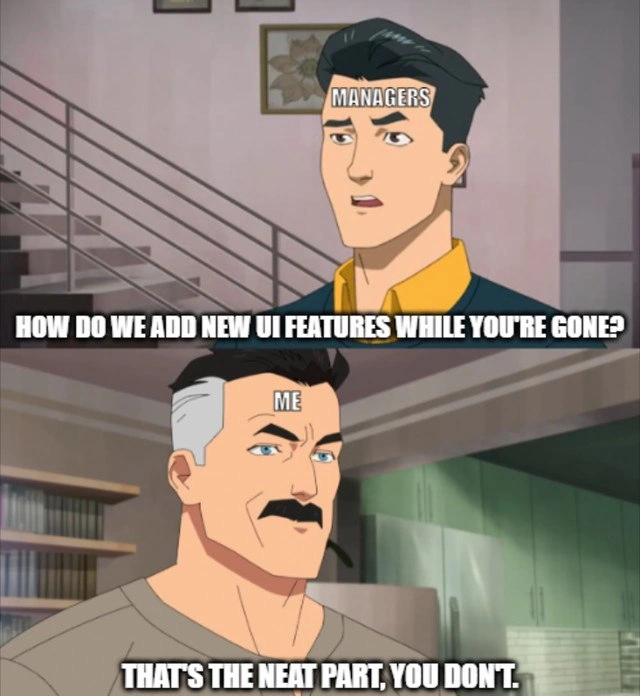
Managers: “How do we add new UI features while you’re gone?”
Me (Dev): “That’s the neat part, you don’t.”

This meme perfectly captures a bus factor of 1 in a front-end project – a single Frontend developer is the gatekeeper of all knowledge, and when they leave, the feature pipeline slams shut. The humor lands because it’s a darkly familiar DeveloperHumor scenario: an entire UI codebase so arcane and undocumented that nobody else on the team dares to touch it. The bold text in the image is a quote from the Invincible meme (“That’s the neat part – you don’t.”), which has become shorthand for “there’s literally no solution to this, sorry not sorry.” Here, it’s aimed at clueless managers who assume new UI features can still be added during the original dev’s absence. The seasoned dev’s deadpan response reveals the ugly truth: the feature requests hit a dead end because the code has effectively ossified around one person’s brain.

This is a textbook case of a knowledge silo and TechnicalDebt combining to create a nightmare of LegacyCode. The departing developer had complete code ownership of a monolithic UI – a giant ball-of-mud frontend where all the hacks, quirks, and workarounds live rent-free in one person’s head. Over time, quick fixes piled up like Jenga blocks, forming massive technical debt. Sure, it “worked” in production, but it became so brittle and convoluted that even thinking about adding a new feature without the original author feels like trying to deactivate a bomb. No wonder the dev (with a bit of cynical veteran flair) basically says, “That’s the neat part – you can’t do anything.” It’s a brutal punchline that FrontendPainPoints sufferers know too well.

Why is this so funny to developers? Because it’s painfully real. We’ve all seen that one critical system or UI that only Bob or Alice understands. Managers, wearing their optimistic hats, plan for continuous feature delivery, but the DeveloperExperience (DX) on the ground is horrific – everyone tiptoes around that spooky section of the codebase that might as well be labeled “Here Be Dragons.” The Frontend in question might be built with outdated frameworks or an over-engineered tangle of components that no one else has context for. Often, there are zero unit tests guarding it (too “hard” to write them, of course), and documentation is either nonexistent or locked in an obsolete Confluence page last updated 3 years ago. So, when the sole FrontendHumor hero goes on vacation or quits, the team essentially institutes an unwelcome feature freeze. Trying to add a new UI feature without that person risks breaking everything – or as the meme implies, you just don’t even try. It’s DeveloperPainPoints distilled into one sarcastic exchange.

Let’s compare the ideal vs our reality:

Ideal Scenario Our Reality (😬)
Knowledge shared among multiple devs Knowledge silo – one dev has it all
Code well-documented, modular, and tested Undocumented, monolithic “mystery” code
Anyone on the team can add UI features safely Only original dev can navigate this UI monolith
Continuity even if someone leaves Feature freeze if that one dev leaves

In a healthy project, no single engineer leaving should grind development to a halt. But here, a bus factor of one means that the departing dev is like a single point of failure – an architectural and organizational flaw. The meme’s dark joke highlights that flaw: the team has built a Frontend castle on one pillar. Remove that pillar, and everything wobbles. From a senior dev perspective, it’s both hilarious and tragic. “Feature requests? That’s cute,” the grizzled engineer smirks, because they know that without serious refactoring or knowledge transfer, nothing new is getting shipped. The “neat part” is dripping with sarcasm – there’s nothing neat about a TechDebt mountain that leaves your project at a standstill. It’s a cautionary tale, wrapped in humor, about why siloed knowledge and lack of code ownership sharing can quietly doom a team’s velocity.

Description

This is a two-panel meme using the 'That's the Neat Part, You Don't' format from the animated series 'Invincible'. In the top panel, a concerned-looking young man, who has a text label 'MANAGERS' on his forehead, asks, 'HOW DO WE ADD NEW UI FEATURES WHILE YOU'RE GONE?'. The bottom panel shows a stern, mustached older man, labeled 'ME', who replies with a deadpan expression, 'THAT'S THE NEAT PART, YOU DON'T.'. The meme humorously depicts a scenario where a single developer is the sole keeper of knowledge for a critical part of the system, in this case, the UI. It highlights the organizational problem of having a 'bus factor' of one, where the project grinds to a halt if that one person is unavailable. For senior engineers, this is a deeply relatable scenario, touching upon themes of knowledge silos, poor documentation, job security through obscurity, and the risks of creating an overly complex or poorly architected system that no one else can maintain

Comments

9
Anonymous ★ Top Pick They call it 'job security.' The rest of the team calls it a 'key person dependency' in the quarterly risk register
  1. Anonymous ★ Top Pick

    They call it 'job security.' The rest of the team calls it a 'key person dependency' in the quarterly risk register

  2. Anonymous

    Nothing enforces immutability quite like realizing the entire React layer is compiled exclusively in the departing dev’s head - once her OOO kicks in, prod UI becomes write-once, read-many

  3. Anonymous

    The real architectural pattern here is the Singleton Anti-Pattern: when your entire UI framework exists solely in one developer's head, and management thinks it's as simple as drag-and-drop because they saw a Squarespace ad once

  4. Anonymous

    This perfectly encapsulates the 'bus factor' problem that haunts every engineering org: when your senior frontend architect takes PTO, management discovers that 'just add the feature' isn't quite as simple as dragging components in Figma. Turns out, that person who casually refactored your entire component library, established your design system, and can debug React rendering performance in their sleep... they weren't just being dramatic about complexity. The real kicker? Management will still ask this question every single time, as if the answer might change

  5. Anonymous

    Microfrontends for autonomy, a central design system in a private npm scope only I can publish, and the CI signing key on my YubiKey - yes, you ship UI by waiting

  6. Anonymous

    Classic tribal knowledge architecture: one dev as the load-bearing pillar holding up the entire UI monolith

  7. Anonymous

    If the UI roadmap halts when one dev takes PTO, you don’t have a design system - you’ve deployed a single-node human dependency with an unpredictable SLA

  8. Deleted Account 5y

    If only you can understand the code,...😅😅

  9. @prirai 5y

    You'll break stuff more than you make

Use J and K for navigation