Over-engineering 101: Neural Networks for Basic Arithmetic
Why is this AI ML meme funny?
Level 1: Monster Truck to Next Door
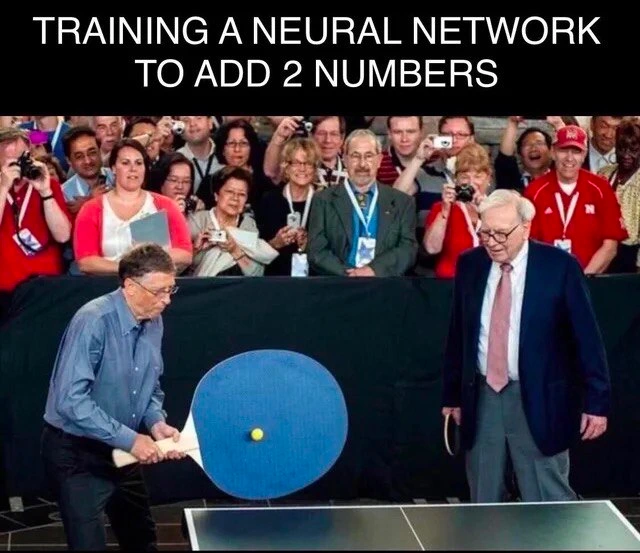
Imagine you want to do something really simple, like give your friend next door a high-five. Instead of just walking over and doing it, you rent a giant monster truck, outfitted with rocket boosters and a parade of people, to drive 20 feet to their house for that high-five. Sounds crazy, right? It’s funny because you’re using something huge and over-the-top to do something very small and easy. This meme is joking about the same idea. It’s like using an entire brain-like computer program (a huge complicated machine) just to solve a tiny math problem that you could do on your fingers. The picture of the guy with the giant paddle hitting a tiny ball makes us laugh because it’s a big, silly tool for a tiny job – just like bringing a monster truck for a one-house trip. The humor comes from that wildly unnecessary effort for a simple task, which is easy for anyone to understand. It’s a goofy reminder that bigger and fancier isn’t always better, especially for little things.
Level 2: AI vs Arithmetic
Let’s break this down in simpler terms. We have a basic arithmetic task: adding two numbers (for example, 2 + 3 = 5). Normally, in programming or using a calculator, this is extremely straightforward – essentially one step and you get the answer. In code, you’d just use the + symbol or a simple function to return the sum. It’s one of the first things you learn in any programming or math class because it’s so fundamental. Computers themselves have hardware built to do this instantly; there’s literally a part of the computer processor dedicated to addition because it’s such a common and simple operation.
Now, what about a neural network? A neural network is a type of machine learning model inspired by the human brain. It consists of layers of interconnected “neurons” (which are basically mathematical functions) that can learn to recognize patterns or relationships in data. You give a neural network a bunch of examples (called a training dataset) and it adjusts internal parameters (called weights) so that it produces the desired output for those examples. Training a neural net is a bit like teaching by trial and error: you show it a problem, it makes a guess, then you tell it how wrong it was, and it nudges itself to do better next time – and you repeat this thousands or millions of times. This process is computationally expensive, meaning it uses a lot of processing power and time, because the network might have many neurons and each training step involves lots of multiplications, additions, and other operations to tweak things. Neural networks are amazing for complex tasks like recognizing images, understanding spoken language, or predicting trends from loads of data – tasks where we don’t have a simple formula for the answer and we need the computer to find patterns for us.
But here’s the catch: adding two numbers is not a complex, unknown pattern. It’s a solved problem – we know exactly how to do it and can write the rule ourselves easily. The meme jokes about someone deciding to train a neural network to add 2 numbers. In other words, instead of using the obvious straightforward solution (just add them directly), they’re using this heavyweight machine learning approach. That’s like using an entire AI system, which might involve thousands of simulated neurons, just to figure out something as simple as “2 + 3 = 5”. It’s an example of over-engineering, which means designing a solution much more complicated than necessary.
The image uses a funny real-world analogy: a game of ping-pong (table tennis). In the photo, one player is holding an absurdly giant paddle – it’s many times larger than a normal ping-pong paddle – while the other player has a regular paddle. The ping-pong ball is tiny (as they usually are). Normally, you want a small, quick paddle to hit that small ball effectively. The huge paddle is overkill; it’s unwieldy and completely unnecessary for the task. It likely makes playing harder, not easier. This illustrates the same idea as the neural network scenario: the giant paddle stands for the huge neural network, and the tiny ball stands for the simple addition problem. Using a massive deep learning model to add numbers is like using that huge paddle to hit a tiny ball – it just doesn’t make sense. It’s funny because the solution is ridiculously out of proportion to the problem.
We can compare the two approaches side by side:
| Simple Addition (Normal Code) | Neural Network Approach (AI) |
|---|---|
How it works: Use the built-in + to directly calculate the sum. |
How it works: Let the model “learn” the sum from many examples. |
| Steps needed: 1 step (just compute a + b directly). | Steps needed: Thousands of steps (feed example sums, adjust weights over many iterations). |
| Accuracy: Exactly correct every time (determined by logic). | Accuracy: Needs to be learned; can make mistakes if not trained on those numbers. |
| Resources: Minimal – uses a tiny bit of CPU and memory. | Resources: Huge – uses lots of CPU/GPU power, memory, and time to train. |
| Complexity: Super easy to implement (one line of code). | Complexity: Hard to implement (set up neural net architecture, training loop, hyperparameters). |
As you can see, the normal way to add two numbers wins in every way for this task – it’s simpler, faster, and foolproof. The neural net way is complicated, slow, and might even fail if something in training goes wrong. So, why would anyone do that? In reality, they wouldn’t (unless it’s for a joke or an experiment), and that’s exactly the point of the meme: it’s making fun of the idea of using a super advanced tool for something trivial. It’s a commentary on AI hype – these days, terms like “AI” and “Machine Learning” are so buzzworthy that people sometimes try to apply them to every problem, even ones that have perfectly good traditional solutions. It’s like a fad where the new tool is so exciting that common sense momentarily goes out the window.
Let’s define a few of the terms and tags in context:
- AIHumor / AIHype: This refers to jokes and hype around Artificial Intelligence. The meme is both humorous and a jab at the hype – it exaggerates an AI scenario to show how silly it can be.
- OverEngineering: This is exactly what it sounds like – engineering something in an overly complicated way. If you’ve ever built a contraption or wrote code that was far more elaborate than needed, you’ve over-engineered. Here, using a neural net for addition is a textbook example of over-engineering.
- CSFundamentals: Computer Science fundamentals are basic principles like simple algorithms (e.g., how to do arithmetic, sorting, etc.). The meme contrasts a CS fundamental (addition, something every developer learns early) with a trendy approach (deep learning). It humorously highlights that sometimes people ignore fundamentals in favor of trendy tech.
- neural_net_overkill: “Overkill” means far more effort or firepower than necessary. A neural net is overkill for adding two numbers, just like the giant ping-pong paddle is overkill for that small ball.
- simple_arithmetic: This is just basic math – things like addition, subtraction, which usually don’t require any fancy processing.
- resource_inefficiency: If something uses way more resources (time, memory, CPU, money) than needed, it’s inefficient. Training a neural net to do what a basic calculation can do is highly inefficient – it wastes computational resources.
- ping_pong_meme: This describes the image – using a ping-pong scenario to convey the joke. Ping-pong here is the metaphor for the tech problem.
- hammer_for_a_nail: This comes from the saying, “When all you have is a hammer, everything looks like a nail.” It means if you’re only familiar with one tool, you try to use it for everything, even when it’s not appropriate. In the current tech climate, the “hammer” is AI for some folks, and they treat every problem (even a tiny “nail” like adding numbers) as something to hit with that hammer. The meme exemplifies that mindset in a comical way.
- heavyweight_solution / bloatware_analogy: A “heavyweight solution” is a very bulky, heavy approach. “Bloatware” is software that has a lot of unnecessary components and thus is overly large or slow. The neural network approach is the heavyweight, bloated solution here – a lot of extra baggage to do a simple thing.
So, putting it simply: The meme jokes that someone might use a cutting-edge AI approach to solve a problem as basic as 1+1. It’s funny (and a bit ridiculous) because nobody in their right mind would actually do that when the simple solution is so obvious. It’s making fun of situations where people get so caught up in using the newest technology that they lose sight of practical common sense.
The image of the ping-pong players is easy to understand once you link it: big paddle = big fancy solution (huge neural net), and small ball = small simple problem (adding two numbers). The contrast is what makes it humorous. Everyone watching in the background is laughing and taking pictures because it’s clearly a silly spectacle. In the same way, seasoned developers “watching” someone try the AI-for-addition stunt would be amused and shaking their heads.
In real life, you won’t train a neural network to add two numbers – you’d just do it directly. But the meme is a lighthearted reminder: choose the right tool for the job. Don’t use a rocket ship to drive down the block, and don’t use an advanced AI when a one-liner of code will do. It tickles our funny bone because of how exaggerated it is, and it also subtly teaches the lesson about avoiding over-engineering and not getting carried away by hype.
Level 3: Deep Learning, Shallow Problem
This meme hilariously captures a tech industry tendency to use overly complex solutions for trivial tasks – a mix of AI hype and classic over-engineering. The top text sets the scene: “TRAINING A NEURAL NETWORK TO ADD 2 NUMBERS.” Any experienced engineer reading that hears alarm bells of overkill. Why? Because adding two numbers (like 1 + 1 = 2) is arguably the simplest operation computers and programming languages can do. You’d normally solve it with a single + operator or a tiny function. But here someone is metaphorically using a massive deep learning model – the kind of heavy-duty AI you’d reserve for image recognition or natural language processing – just to compute a basic sum. It’s the software equivalent of bringing a nuclear-powered tool to do a hand calculator’s job.
The image drives the joke home with visual hyperbole. One man is about to serve in ping-pong holding an absurdly oversized blue paddle, while his opponent across the table stands ready with a normal paddle. The giant paddle represents the huge “trained neural net” solution; the normal paddle represents the simple, conventional solution. Ping-pong is a fast, precise game – normally you want a small, agile paddle to hit the tiny ball accurately. The guy wielding a paddle the size of a door is going to struggle with control, much like an over-engineered AI solution might ironically perform worse on a simple task. The spectators in the background snapping photos and laughing? They’re us – the tech community – amused (and a bit incredulous) at the spectacle of someone using such a heavyweight solution for a lightweight problem. It’s a classic “Can you believe this?!” moment that seasoned developers know all too well, either from observing industry hype or mentoring juniors who reach for the fanciest tool without considering simpler alternatives.
In real software engineering, we see this pattern whenever a buzzwordy technology is applied where it’s not needed. Not long ago, everyone was sprinkling machine learning or “AI” into projects to make them sound cutting-edge, even if the task was as basic as sorting a list or parsing a simple rule. This created some absurd situations – e.g., using a complex neural network to do something basic like detect if a number is even or to implement a FizzBuzz solution (a trivial coding challenge) with deep learning. The meme’s scenario – training a neural net to add – is exactly that flavor of absurdity. It satirizes the AI hype trend: if all you have is a hammer (or think everything needs AI), then everything, even adding two numbers, looks like a nail to be hit with a neural net. We laugh because we’ve seen proposals in meetings or hackathons that are essentially “Let’s use AI for this!” – and sometimes the “this” is so simple that the AI approach is laughably unnecessary. It’s over-engineering at its finest: using an incredibly complex approach when a straightforward one not only exists, but performs better.
Let’s break down why this is funny to those in the know. Imagine two developers tackling a requirement: compute A + B. One dev writes a five-second solution:
def add(a, b):
return a + b
print(add(3, 5)) # Outputs 8
The other dev decides this is a chance to employ the latest deep learning framework:
# Overkill approach (simplified pseudo-code)
import deep_learning_lib as dl
# Define a neural network with some layers
model = dl.NeuralNetwork(input_size=2, hidden_layers=[10, 5], output_size=1)
# Prepare training data of many (x, y, x+y) examples
training_data = [(x, y, x+y) for x,y in generate_random_pairs(10000)]
model.train(training_data, epochs=100, learning_rate=0.001)
# After training, use the model to predict the sum
result = model.predict(3, 5) # hopefully ~8 after much effort
This is a tongue-in-cheek illustration: the second approach involves setting up a whole neural network (NeuralNetwork with layers), generating thousands of example pairs of numbers ((x, y) and their sum), and running through many training epochs. Only after all that can we hope that model.predict(3, 5) gives something close to 8. We’ve replaced a one-line algorithmic solution with a convoluted learning process. In the meme, the giant ping-pong paddle is that neural net – huge and unwieldy – and the tiny ping-pong ball is the simple addition result we’re after.
From a senior engineer’s perspective, this scenario screams of diminishing returns and wasted effort. It’s funny because it’s true: such over-engineering happens in the real world, often driven by enthusiasm for new tech or misaligned incentives. For instance, during peaks of AI hype, managers or clients might insist on an “AI-powered” feature for marketing appeal, even if the underlying problem doesn’t require any learning at all. Developers, especially less experienced ones excited by new tools, might also choose an unnecessarily complex approach simply because it’s trending or because they want to put a new skill on display. We’ve seen startups that boast about using deep learning for things like UI layouts or adding two metrics together – tasks that don’t need neural nets at all. The result? Lots of compute resources and time spent to re-derive what could be a few lines of straightforward code. It’s like using a full orchestral arrangement to play “Happy Birthday” when you could just hum the tune; sure, it works, but was it worth it?
There’s an element of gentle mockery here of the current state of technology hype. AI/ML is powerful and transformative for the right problems (like image recognition, language translation, etc.), where the patterns are complex and not easily hard-coded. But in the frenzy of “AI can do everything!”, people sometimes throw neural nets at problems already solved by basic CS fundamentals. Adding two numbers is a textbook example of CS 101 fundamental capability – every programming language has built-in support for it, and every computer can do it with trivial effort. By contrast, training a neural network is resource-intensive and introduces uncertainty (will it converge to the right answer? how much data do we need?). The humor for seasoned devs comes from that mismatch: it’s an insane mismatch of tool to task, the classic definition of over-engineering. We’re essentially laughing at a caricature of a developer who ignores a simple fix and instead chooses a flashy, bloated solution because it sounds cool.
The presence of what appears to be Bill Gates (a highly respected tech icon known for software savvy) holding the ridiculous paddle adds an extra layer of irony. It’s as if even a tech billionaire genius is partaking in the folly, which satirizes how widespread and top-down the hype can be. The spectators’ amused faces mirror how veteran engineers feel watching such a scenario: a mix of bemusement and “you’ve got to be kidding me”. We’ve all had moments in meetings where someone suggests a gigantic framework or microservices or machine learning for something very simple, and we glance around to see if it’s a joke. This meme is that situation on a grand stage — literally in an arena.
In practical senior terms, this also touches on resource inefficiency. Training a huge model to do a tiny job wastes not just development time but CPU/GPU cycles, memory, maybe cloud computing credits, etc. In a production environment, it could mean an absurdly bloated service needing lots of RAM and GPU just to do what a few CPU instructions could handle. It’s the kind of thing that becomes a nightmare to maintain and scale (imagine debugging a neural net because it started giving 7.999 instead of 8, versus knowing a simple addition function will always be correct). Technical debt can skyrocket when you introduce an unnecessarily complex subsystem. Seasoned devs find it funny here because it’s depicted so starkly, but it also resonates as a cautionary tale. The meme exaggerates to make the point: don’t let AI hype or the “cool factor” of a technology blind you to common sense. Sometimes the reliable, boring solution is the right one.
In summary, at the senior-experience level, this meme is a satire of over-engineered solutions born from hype. It humorously reminds us that just because we have a fancy new hammer (deep learning) doesn’t mean every problem is a nail. The mismatch between the problem (simple arithmetic) and the proposed solution (training a massive neural network) is so extreme that it tickles the engineer’s funny bone. We laugh, perhaps a bit knowingly, because we’ve all seen projects where the solution was far more complicated than the problem warranted. This one just takes the cake: it visualizes that phenomenon in the most over-the-top way, and in doing so, pokes fun at our industry’s occasional tendency to lose sight of pragmatism in the glare of the latest tech trend.
Level 4: Backpropagating Through Addition
At the theoretical extreme, this meme spotlights a computational overkill scenario. Addition of two numbers is a trivial mathematical function – essentially the linear map $f(x,y) = x + y$. A deep neural network is a universal function approximator; given enough layers and neurons, it can learn any mapping, including this one. But using gradient descent to learn the rule “add two inputs” is like trying to derive basic arithmetic from scratch via brute-force optimization. The network starts with random weights and uses backpropagation (iteratively adjusting parameters via calculus-based error gradients) to eventually converge on the function we learned in kindergarten. From a complexity standpoint, it’s absurd: a modern CPU can add two numbers in one machine instruction (a few nanoseconds). In Big-O notation, direct addition is $O(1)$ – constant time. Training a neural net, by contrast, is on the order of $O(N \cdot P \cdot I)$ (with N training samples, P parameters, and I iterations), potentially billions of operations. It’s a massive waste of computation for a task that has an exact, constant-time solution.
To appreciate the overkill, consider how hardware and algorithms normally handle addition. Digital computers have an ALU (Arithmetic Logic Unit) built-in, essentially a tiny specialized circuit that computes sums with simple logic gates. This is a dedicated solution – it’s hard-wired to add in one step, yielding a perfectly accurate result (no training needed!). A neural network, however, is a configurable general-purpose model that “learns” addition by adjusting weights. During training, it will perform countless multiplications and additions internally (ironically doing far more math than the actual addition it’s trying to reproduce). The network might start outputting completely wrong sums at first and only after many epochs of training inch closer to the correct result. For example, it might output 3.8 for 2+2 early on and slowly improve toward 4 as it refines its weights – anathema to how deterministic binary addition works. The universal approximation theorem guarantees the network can represent f(x,y)=x+y if it has sufficient capacity, but it doesn’t guarantee an efficient learning process. In fact, unless you cleverly constrain the network (say, use a simple linear neuron that inherently adds inputs), the training is essentially forcing a complex multi-layer system to reinvent addition through data examples.
This highlights a fundamental truth from theoretical computer science and machine learning: having a general learning machine doesn’t trump knowing the actual solution. The “No Free Lunch” principle in ML tells us that if we have prior knowledge of a problem’s structure (like the exact rule for addition), we’re almost always better off using that directly than expecting a blank-slate learner to discover it experientially. Here we a priori know the perfect algorithm (just use the + operation!), so using a neural net is wildly inefficient. It’s an entropic journey of trial-and-error for a destination already on the map. From an information theory perspective, training a huge network to add is forcing a high-entropy method (learning from many bits of data) to converge to a low-entropy function (a very simple, fixed rule). You’re expending enormous energy (literally, GPU electricity) to recover a few bits of obvious information.
There’s also the matter of precision and generalization. A properly coded addition will handle any valid inputs exactly – e.g., integers of arbitrary size (within memory limits) or floating point values with well-defined precision. A neural network, on the other hand, might only learn to add numbers within the range it saw during training. If it’s only trained on, say, examples up to 100, it might flounder or give unpredictable results for 1000 + 1000 because it never extrapolated that far. In other words, a huge deep network could “overfit” to the training data, memorizing specific pairs like 2+2=4, 3+5=8, but not truly grasp the general rule. We’d have a model that works on seen examples but fails on new ones – utterly silly when the exact general rule was known all along. This is the antithesis of good engineering or math: we turned a solved problem into a probabilistic one.
Finally, consider resource efficiency: training a state-of-the-art neural net often involves GPUs or TPUs crunching numbers for hours or days. The cost in CPU/GPU cycles, memory, and even real-world power consumption can be enormous (not to mention the carbon footprint of extensive training). All that to achieve what a few transistor flips on a chip accomplish in a blink. It’s a comical demonstration of diminishing returns – throwing exponentially more compute at a linearly simple task. In summary, on a deep technical level this meme underlines a core absurdity: using a complex, general learning algorithm (with all its matrix multiplications and calculus) to do something as straightforward as addition is an academic facepalm. Just because a neural network can solve a problem doesn’t mean it’s remotely a sane way to do so when a deterministic one-liner already exists. It’s the ultimate illustration of theoretical overkill – a backpropagation-powered sledgehammer trying to tap in a tiny nail that the laws of computer science had long ago hammered in place with perfect elegance.
Description
A meme featuring a photograph of Bill Gates and Warren Buffett playing table tennis in front of an audience. A large, bold text overlay at the top reads, 'TRAINING A NEURAL NETWORK TO ADD 2 NUMBERS'. In the photo, Bill Gates is on the left, humorously wielding a giant, oversized blue ping-pong paddle, while Warren Buffett stands on the right with a standard-sized one. The image captures the absurdity of using an incredibly powerful and complex tool for a trivially simple task. The technical context is a satirical critique of the hype-driven tendency in the tech industry to apply complex solutions like machine learning or neural networks to problems that can be solved with simple, deterministic code. For experienced engineers, it’s a relatable jab at over-engineering and a reminder of the importance of selecting appropriate tools, questioning whether the complexity of a solution is justified by the problem's requirements
Comments
8Comment deleted
After three weeks and a $50,000 cloud bill, the model proudly infers that 2 + 2 is approximately 3.99999987. We've declared it a success and are now seeking funding for a subtraction model
Deployed 8,192 GPUs so our transformer can approximate x + y - because why use the ALU when you can swing a warehouse-sized paddle at a ping-pong ball?
After 500 epochs, the model achieved 99.8% accuracy at returning the ball but still insists that 2+2 equals a backhand slice to the corner
After 10,000 epochs and a $40k GPU bill, the model confidently predicts 2 + 2 = 3.99987 - ship it, that's within tolerance
This perfectly captures the modern ML engineer's dilemma: spending three weeks tuning hyperparameters, provisioning GPU clusters, and debugging gradient descent convergence issues to solve a problem that literally compiles down to a single ADD instruction. Bonus points if they wrote a 47-page architecture document justifying why they needed a transformer model with attention mechanisms for integer addition
We turned x+y into a platform problem: 8 GPUs, a feature store, and a pager so the model confidently returns 3.9997 - because O(1) isn’t cloud-native
If your addition service needs a GPU, a feature store, and an on-call rotation, the + operator probably has better p99s and a smaller carbon footprint
NNs need GPU farms and epochs for 2+2; Gates and Buffett just rally it out in one serve