Skip to content
DevMeme
215 of 7435
When the Backend is a Masterpiece and the Frontend is... Done
Deadlines Post #259, on Mar 24, 2019 in TG

When the Backend is a Masterpiece and the Frontend is... Done

Why is this Deadlines meme funny?

Level 1: Finished in a Hurry

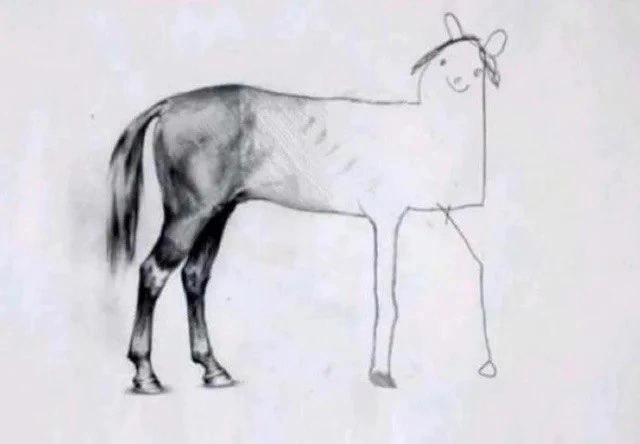
Imagine you have a school art project to draw a horse. You start on it early and spend a lot of time on the back part of the horse. You draw the tail and hind legs with great detail – shading it nicely, making it look almost realistic. That’s like when you have plenty of time to do something carefully. Now, let’s say you suddenly realize the teacher’s deadline is in five minutes and you haven’t drawn the horse’s front half yet. Uh-oh! 😱 What do you do? You grab your pencil and quickly sketch out the head and front legs as fast as you can. In your rush, the horse’s head comes out super simple – basically a square with a smiley face – and the legs are just quick lines. You do finish the drawing just in time to hand it in, but the front of the horse looks nothing like the beautifully drawn back. It’s pretty funny to look at: one half of your horse looks like a professional drawing, and the other half looks like a kid’s doodle.

This meme is showing exactly that kind of situation but in the world of programming projects. At first, when there’s lots of time, the work (like the back of the horse) is high quality and very detailed. But as time runs out, the work at the end (like the horse’s front) gets rushed and simple just so that it can be “finished” by the deadline. It’s funny because anyone who’s ever done a homework assignment or project at the last minute recognizes this feeling. You kind of laugh and cringe at the final result: it’s done on time, yay, but one part of it looks great while the other part… well, at least it’s done. In simple terms, the picture of the half-realistic, half-sticky-note horse is telling a little story: starting strong + rushing to finish = a silly outcome. And that’s why it makes people laugh – we’ve all been there, finishing something in a hurry and ending up with a result that’s half awesome and half “good enough.” At least you met the deadline, right? 🎉

Level 2: Racing the Clock

This meme shows a horse drawing that starts out amazingly detailed in the back half and then turns into a simple stick-figure drawing in the front half. It’s a visual gag that many developers share to poke fun at what can happen to projects as the deadline gets closer. The joke is basically: projects often start strong and end rushed. In software development (and really any big task), time is a critical factor. When there’s plenty of time, everyone focuses on doing things properly. When time is almost up, people switch to “just finish it” mode. The horse starts as a beautiful sketch (that’s the careful work when there’s time) and ends as a child’s doodle (that’s the rushed work at the end).

Let’s break down some of the key ideas and terms here for a newer developer:

  • Deadline Pressure: This means the stress and rush felt when a due date is approaching. In a project, a deadline is the final date by which something must be finished. For example, if an app release is scheduled for Friday, everyone feels deadline pressure as Friday gets closer, especially if a lot is unfinished. Under deadline pressure, teams might take shortcuts to save time. This is exactly what the meme’s horse illustrates: the closer the “finish line” (deadline), the more basic the work becomes. The back of the horse (done early, with less pressure) is highly detailed. The front of the horse (done last, under pressure) is extremely simple – basically just enough to say it’s done.

  • Agile Development & Sprints: Agile is a common approach to software development where work is done in small, manageable chunks called sprints (often 1-2 weeks long). The idea is to have workable software at the end of each sprint and continuously improve it. In theory, Agile methods try to prevent the big last-minute crunch by spreading work out and adjusting as you go. However, even in Agile projects, teams set goals for a release, and if those goals were too ambitious or if new tasks got added, you can end up scrambling as the release deadline nears. It’s an Agile pain point that many new developers are surprised by: just because you’re using Agile doesn’t magically remove deadline crunches. If a manager says “this all must be done by the end of the quarter” while also adding new features each sprint (classic scope creep), the last sprint can feel like a mad dash. The meme is a funny exaggeration of that dash: things that started orderly end up a bit messy because time ran out.

  • Scope Creep: This term refers to the situation where a project’s requirements keep expanding over time. Scope means the overall set of features or work to do. When scope “creeps” up, it’s like your to-do list secretly grows longer overnight. If you don’t also adjust your timeline or resources when scope increases, you’ll have the same amount of time to do more work. That usually leads to hurried, sub-par work at the end. In the horse drawing, you can imagine maybe the artist was originally just going to draw the horse’s back, but then someone said “Hey, you should draw the head too, and do it in the same time!” The result? The head gets drawn in a rush. In software, scope creep might be a client saying “can we also add this feature?” late in the game, and the team, without moving the deadline, just tries to cram it in. The quality of those last-added features often suffers (just like that wobbly stick-figure leg on the horse).

  • Code Quality: This refers to how well-written and maintainable the code is. High code quality means the code is clean, easy to read, well-tested, and works reliably. Low code quality might work for now but is brittle, messy, and likely to cause bugs or be hard to change later. At the beginning of a project, developers have time to write good quality code: they follow best practices, maybe even do some documentation and add comments, and structure everything nicely. That’s like the finely shaded, anatomically correct back half of the horse – it looks right. But as the deadline approaches, if they’re short on time, developers might write code in a hurry that “just barely works.” They might skip writing tests, or they might not handle all edge cases, or write confusing, sloppy code because they can’t afford to polish it. That’s the stick-figure front half of the horse – it works in the sense that it’s a completed drawing of a horse’s head, but it’s not going to win any awards for craftsmanship. In code terms, you’d call that output low code quality. It’s the sort of code that usually needs fixing or refactoring later.

  • Technical Debt: This is a crucial concept that new developers learn as they experience rushed projects. Technical debt is like a debt you incur when you choose a quick but poor solution instead of a better, slower solution. Imagine you’re building an app and you have two ways to implement a feature: the proper way might take a week, but a quick hack might take a day. If you choose the quick hack to meet the deadline, you “borrow time” from the future. The catch is, just like monetary debt, you’ll “pay” for it later with interest: the hack might cause bugs, it might not scale, or it might make future changes harder. Eventually, you (or someone on your team) will have to go back and clean it up properly, which often takes more effort than if it was done right initially. That extra effort is the interest on your technical debt. In the meme’s terms, technical debt is represented by that mismatched horse: the parts that were rushed (stick figure sections) are the “debt” that will need rework. The team met the deadline (hooray!), but they now owe the codebase some fixes and improvements afterwards. In a real project, you might hear developers say, “We’re taking on some technical debt to hit this deadline – we'll clean it up in the next release.” It’s a very common real-world tradeoff.

  • Real-World Tradeoffs: A tradeoff is when you give up one thing in return for something else. In projects, the big tradeoff often is quality vs. speed. If you absolutely must finish by a certain date and the amount of work is greater than you thought, you’ll trade quality for speed – meaning you’ll do things more quickly but not as well. Alternatively, you could trade scope for quality – meaning do fewer features but do them properly (not drawing the horse’s head at all if there’s no time to do it right). In reality, especially for product deadlines or client commitments, teams often feel they have to deliver all the promised features, so they trade away quality to get everything done. The meme is funny to developers because it visualizes this tradeoff in a simple way: half the horse looks great (that’s the portion done with enough time/quality) and the other half looks bad (that’s the portion done with speed at the expense of quality). Everyone in software has seen this happen at least once, so it’s very relatable humor. Even as a new developer, you might experience this on a small scale – like a hackathon or a school assignment where you spent a lot of time perfecting one part and then realized you had to rush through the rest to finish on time. You ended up with something that was half excellent, half “just okay,” which is exactly the scenario shown in the meme.

In summary, the “horse project timeline” meme is a lighthearted way to express a common developer reality: initial plans meet final deadlines, and the result isn’t always the elegant creation we set out to build. Teams do celebrate hitting a deadline – it’s an important achievement – but inside, developers might chuckle (or cringe) at what they had to do to hit that deadline. The phrase in the post, “When your team successfully hits the deadline,” is meant humorously: yes, the team delivered on time, but the outcome quality was literally a tale of two halves. New developers can learn from this that planning is important, but so is being realistic about time. If you recognize the pattern, you might try to avoid ending up with a half-stick-figure product by adjusting scope or pushing back on unrealistic timelines. But when it does happen (and it will, at some point), at least you’ll know you’re not alone – even the pros end up with a wobbly horse now and then! 😉

Level 3: Fine Art to Finger Painting

This meme is a pitch-perfect depiction of what happens when Deadline Pressure collides head-on with lofty engineering ideals. The left half of the horse – drawn in gorgeous, photorealistic detail – represents the project’s ambitious start. In early phases, the team is all-in on quality: carefully architecting systems, following SOLID principles and clean code practices, and perhaps even over-engineering a bit (because hey, there’s time). Code reviews catch every minor issue, unit tests are thorough, and the CodeQuality is as high as that beautifully shaded horse’s hindquarters. It’s the kind of beginning where the architecture diagrams look like fine art and every README is meticulously written. The project’s scope still feels manageable, the Agile sprint board is all green, and everyone talks about avoiding Technical Debt like it’s a sworn oath.

But then reality kicks in – unrealistic deadlines or scope creep (new requirements sneaking in mid-project) ensure that time ticks away faster than features get completed. The transition in the horse drawing from realism to stick-figure isn’t just comedic; it’s alarmingly accurate. As the deadline looms, priorities shift from “build it right” to “just get it done!” The proud thoroughbred we intended to deliver morphs into a wobbly-legged foal of a product. That child-like sketch of the horse’s front half is a visual metaphor for last-minute development hacks and quality cutbacks. It’s the code held together by duct tape and // TODO comments, the features implemented at 2 AM with bleary eyes and plenty of corner-cutting. A seasoned developer looks at that wonky horse head and can practically smell the Technical Debt – the kind of debt that will come galloping back during maintenance or the next release.

For experienced engineers, this image hits a darkly humorous nerve because we’ve all lived it. Trade-offs become unavoidable: to “successfully” hit the date, something’s gotta give – and it’s almost always quality. It’s the classic project management conundrum of fast, good, cheap: pick two. If the release date is immovable (fast) and all the promised features must be included (scope fixed by business expectations, essentially “cheap” in terms of cutting corners), then “good” (quality) is the one left behind. The result? A product experience as lopsided as that horse drawing. We end up shipping code that works (technically), but under the hood it’s a tangle of rushed fixes – the software equivalent of a stick-figure head stuck on a realistic horse body.

Let’s be honest, teams don’t start out intending to draw a mutant horse. In the beginning, we envision a masterpiece. Yet, as timelines shrink, even the best teams enter “crunch mode.” Imagine the sprint planning towards the end: No time for that elegant refactor or writing those missing unit tests — just commit the darn code and deploy! You skip tests, skip polish, maybe even skip critical architecture steps. That’s when AgilePainPoints really surface: the stand-ups get tense, the burn-down chart looks like a free-fall, and developers begin uttering phrases like “We’ll refactor in the next sprint, I promise” (famous last words). The pain point here is that even an Agile process can degenerate into a mini-waterfall crunch if the final deadline is rigid.

This half-and-half horse is a staple in developer humor precisely because it illustrates RealWorldTradeoffs in software projects. It’s both funny and painful. Funny, because the absurdity of a half-sketched horse is a perfect analog to the absurdity of some releases we’ve witnessed. Painful, because it’s a reminder that we often deliver such half-baked solutions under pressure. Code reviewers post-release will sigh deeply – the same way you sigh looking at that childish horse face – knowing how much rework lies ahead. The meme’s caption “When your team successfully hits the deadline” drips with irony: successfully hitting the deadline often means successfully accumulating weeks of post-release bug fixes and refactoring. In the eyes of management, the project is a success (hey, it shipped on the promised date!). In the eyes of developers, it’s a small tragedy – a beautiful back-end (the part we had time for) now awkwardly dragging a sloppy front-end (the part we rushed).

In practice, the contrast can be stark:

  • Project Kickoff: High standards and careful planning reign. Every module is designed, code is peer-reviewed, and features are built to spec. It’s like the artist spent hours shading the horse’s muscular hind legs – everything is polished. The team might even be ahead of schedule on a few tasks, proudly demonstrating a stable MVP (Minimum Viable Product) that looks promising.
  • Crunch Time: All those nice-to-have quality steps get tossed aside. Need to implement an extra feature in the last week? Sure – copy-paste some code, hardcode a value or two, and pray it doesn’t break. 😅 Did we want to refine the UI? Nope, there’s no time – ship whatever looks kind of okay. That elegant API integration planned for the front-end? It degrades into a single monolithic function with a bunch of if/else checks. By the final days, the codebase starts to accumulate //TODO: fix this later comments like candy wrappers after a binge. Unit tests coverage? Dropping faster than a rock. Documentation for those last features? Ha! It’s more like a slim README that says “will update later.” The proud thoroughbred has become a Frankenhorse assembled just enough to stand upright.

To illustrate the “just ship it” mentality, here’s a tongue-in-cheek pseudo-code of a team in final crunch:

if days_left <= 1:
    code_quality = "good_enough"    # Lower the quality bar - it's fine, just ship it
    tests_run = False              # Skip tests to save time
launch_release(product_version="1.0")  # Push the project out as-is, fingers crossed

When a veteran developer sees that stick-figure horse head, they immediately recall moments like these – the frantic last 24 hours of a project where that one feature simply wouldn’t cooperate, so you hack around it and proclaim “it’s done.” It’s a mix of pride and horror: pride that you survived the deadline crunch, horror at the TechDebt monsters now lurking in the code. This meme resonates as a cautionary tale and a commiserating joke. It says, “Yeah, we hit the deadline… but take a close look at what we delivered.” The photorealistic back and stick-figure front serve as a funny visual post-mortem of how DeadlinePressure can carve a project into two halves: the part built with idealism and the part built with adrenaline-fueled improvisation. In the war-room of software development, sometimes you do charge across the finish line on time – dragging a goofy-looking horse head behind you. And as any cynical veteran will tell you, hitting the date often becomes the only metric that matters in the moment, even if it means you’ll be debugging that wobbly creature in prod at 3 AM next week.

Description

A popular two-panel meme represented by a single image of a horse being drawn. The rear half of the horse is rendered in a highly detailed, realistic, and artistically skilled manner, showing fine shading and anatomical accuracy. In stark contrast, the front half is a simplistic, child-like stick figure drawing with a boxy body, stick legs, and a goofy smiling face. This visual metaphor illustrates a process or project that begins with high quality, ambition, and resources, but ends with a rushed, low-quality, and incomplete result due to constraints. The technical context for this meme, especially with the caption 'When your team successfully hits the deadline', resonates deeply with senior engineers. It's a classic representation of projects where the core backend logic is robust and well-engineered, but the frontend or user-facing components are hacked together to meet a deadline. It can also signify the accumulation of technical debt, where initial high standards are compromised over time, or the difference in skill levels across a full-stack team

Comments

8
Anonymous ★ Top Pick That's the project where the senior dev built the backend, and then the intern was told to 'just make a simple UI for it' the day before release
  1. Anonymous ★ Top Pick

    That's the project where the senior dev built the backend, and then the intern was told to 'just make a simple UI for it' the day before release

  2. Anonymous

    Sprint 1: DDD microservices with event sourcing. Sprint 6: a 1,200-line god-class called Horse.js - ship it, the OKR only tracks ‘date delivered.’

  3. Anonymous

    The backend is production-ready with full observability, 99.99% uptime, and CQRS event sourcing... while the frontend is still using innerHTML and a Promise.all() that everyone's afraid to touch

  4. Anonymous

    Sprint 1 got the photorealistic hindquarters; the stick-figure head shipped in the 'hardening sprint' as a known issue

  5. Anonymous

    This perfectly captures the backend engineer's approach to CSS: 'I've architected a distributed system handling millions of transactions with eventual consistency guarantees and sub-millisecond latency... but centering this div? That's a three-day spike with unknown unknowns.'

  6. Anonymous

    First microservice got DDD, tracing, and SLIs; the last one is a cronjob with a healthcheck that always returns 200

  7. Anonymous

    Modernization status: the monolith rump still does all the work; the shiny “microservices” up front are a smiling stick horse that only returns 200 on GET /health

  8. Anonymous

    Graphviz layout with zero edge labels: elegant in theory, horse-shaped in practice

Use J and K for navigation