The True Most Ambitious Crossover: git merge
Why is this VersionControl meme funny?
Level 1: All Together Now
Imagine you and your friends each have a different set of LEGO blocks and you’re each building your own little world. One friend is building a city, and another friend is building a spaceship base. Now, someone asks you all to put your pieces together into one big LEGO scene. That’s exciting – all the cool stuff in one place – but also a bit messy. The roads from the city might crash right into the spaceship, or two friends might have built something in the exact same spot and now those pieces don’t fit together. Merging code is a lot like that! Each programmer works on their own part (like their own LEGO creation on a separate table). When we do a git merge, it’s like pushing all those creations together on one table to make a single, combined project. Sometimes it fits nicely, but sometimes pieces bump into each other and we have to stop and figure out how to make them match up (that’s like fixing a merge conflict).
The meme is making a joke by comparing this coding task to a superhero team-up. Think of the biggest team of heroes you know – maybe when all the Avengers join forces in one movie. Marvel said that was the craziest team event ever. But the person in the meme says, “Ha, not really – try combining all our code changes together, that’s even wilder!” It’s funny because it’s a bit silly and exaggerated. We don’t actually think coding is more exciting than a superhero battle, but sometimes it feels that way to a programmer. It’s a playful way of saying “Combining everyone’s work can be a real adventure!” So the humor comes from treating a regular part of a coder’s day (typing git merge to join code together) like it’s some huge, dramatic crossover event. Even if you’re not a developer, you can imagine the feeling: lots of different pieces coming together all at once – whether it’s toys, stories, or code, it can be chaotic and epic, and that’s why we can’t help but smile at the comparison.
Level 2: Branches Assemble
Let’s break down the joke in simpler terms. First, Git is a popular version control system – basically a tool that tracks changes in code over time and helps programmers collaborate. Think of version control as a project’s memory: Git remembers every edit made and lets developers work on separate branches without immediately affecting the main code. A branch in Git is like a separate workspace or timeline of the code where you might add a new feature or experiment, while the main branch (often called master or main) stays stable.
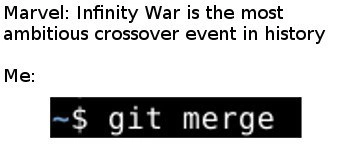
Now, when the work on a branch is done and you want to bring those new changes into the main code, you perform a merge. The command git merge (used in a command-line terminal, as shown in the image) is what you run to combine two branches together. It’s like saying: “Hey Git, take the changes from this side project and mix them into my main project.” The terminal snippet in the meme shows ~$ git merge on a black background, which is a typical command prompt. Here ~ denotes the current directory (in UNIX ~ is shorthand for the user’s home directory) and $ is the prompt sign, meaning the user is ready to enter a command. So the snippet implies the person is about to merge code via the command line. Developers often use the CLI (Command Line Interface) for Git because it’s fast and powerful. The meme uses this plain text git merge representation to immediately signal “this is about coding” to anyone familiar with Git or the terminal.
Why compare that to Marvel’s Infinity War? In pop culture, a crossover event means characters from different stories come together. Infinity War was a Marvel movie where tons of superheroes from various earlier movies (Iron Man, Thor, Black Panther, Spider-Man, you name it) all appear in one gigantic story. Marvel Studios jokingly called it “the most ambitious crossover event in history” because so many famous characters were crossing over into a single epic plot. It was a huge deal for superhero fans. The meme’s top line quotes this claim: “Marvel: Infinity War is the most ambitious crossover event in history.” Then it shows a developer’s response: “Me: git merge.” This format – “X says: ... Me: ...” – is a common meme template where “Me:” presents a punchline that humorously outshines or subverts the original statement.
In this case, the humor comes from equating a code merge to a blockbuster superhero team-up. How are they similar? Well, when you run git merge, you’re essentially combining separate code histories. Imagine two developers have been working on different features in isolation (on different branches). Each branch is like its own mini-story in the project. Merging is when those stories meet – all the code changes from both branches have to coexist in one codebase. If the branches were totally separate parts of the project, this can go smoothly. But often the branches affect the same files or functions. That’s when merge conflicts can happen. A merge conflict is Git’s way of saying “Hey, these changes don’t automatically fit together – I’m not sure which version to keep.” It usually happens when two branches have edited the same line of code or the same section of a file in different ways. For example, Developer A’s branch and Developer B’s branch both modified Player.java in a game, each in a different way – Git gets confused about which change to take, so it asks the human to decide.
When a merge conflict occurs, Git will pause the merge and mark the conflicting sections in the code with special conflict markers (literally adding lines like <<<<<<<, =======, and >>>>>>> in the file to show the two versions side by side). It’s then up to the developer to open the file, see both versions, and manually reconcile them – basically choose one version or blend them into a cohesive solution. Here’s a tiny example of what a merge conflict in a file might look like:
<<<<<<< HEAD
console.log("Hello from main team");
=======
console.log("Hello from feature branch team");
>>>>>>> feature-branch
In this snippet, everything between <<<<<<< HEAD and ======= is code from the current branch (HEAD refers to your current checked-out commit), and everything between ======= and >>>>>>> feature-branch is code from the branch you’re trying to merge in. The poor developer who triggered the merge now has to resolve this by deciding what the final console.log line should say, then delete these markers and save the file. Only then can they complete the merge. If you have many conflicts like this, it’s a tedious process. Merge conflicts are so notorious that the term itself can make a new coder nervous – but resolving them is a normal part of collaborative programming.
So, why does the meme call git merge the "real most ambitious crossover event"? It’s poking fun at how merging code from multiple contributors can be surprisingly complex and dramatic. If three different feature branches all get merged into the main branch in one day, that main branch is suddenly hosting a “crossover” of all those features. Sometimes the features intermix gracefully, but other times they collide and break things, leading to a flurry of bug fixes and more merges – a cascade of crossovers! This is very familiar in tech culture: big merges (especially right before a deadline) often turn into all-hands-on-deck events. In fact, developers joke about “merge day” or “integration day” being high drama, akin to a movie climax. It’s a form of tech humor where we exaggerate our work struggles using grand metaphors. Here the grand metaphor is Marvel’s superhero extravaganza.
To a newcomer or junior developer, the idea of a crossover might not immediately click, so think of it this way: Infinity War took heroes from separate movies (like separate projects) and put them in one film. A git merge takes code from separate branches (separate streams of work) and puts them into one combined project. Both involve combining many separate pieces into one big unified piece. The meme jokingly suggests that for developers, merging code feels like an even bigger deal than that huge Marvel movie. It’s funny because it’s an overstatement rooted in truth – merges can be very tricky, so we laugh and say, “Ha, this code merge is harder to pull off than a superhero reunion!” It’s a bit of communal programmer humor that also hints: if you’ve been through a tough merge, you’ve earned your superhero badge.
Level 3: Infinity Merge War
In this meme, a developer’s world collides with pop culture. The top text quotes Marvel's boast about “Infinity War” being the most ambitious crossover, and the punchline is the programmer’s retort: running git merge. This tongue-in-cheek comparison humorously elevates a mundane coding task to epic proportions. Why is this so funny to seasoned devs? Because merging code from multiple branches (and often multiple developers) can indeed feel like orchestrating a massive crossover event in a codebase.
Consider what a git merge really does: it takes separate lines of development (Git branches) and joins them into one unified history. In a large project, each branch might be like its own storyline developed by different “heroes” (developers) focusing on specific features. When it’s time to merge, all those storylines must converge. Just like Marvel spent a decade bringing together disparate characters and plot threads for Infinity War, engineers bring together diverged code in a single codebase. The meme wittily claims this code convergence is even more ambitious than a superhero mash-up – a playful exaggeration that makes experienced developers smirk in recognition.
The real punch comes from shared experience. Every developer with some tenure in coding humor has fought through a gnarly merge conflict or two. We’ve all felt that mix of dread and determination when typing git merge feature-branch and praying nothing blows up. The text-only terminal screenshot (~$ git merge) is subtle, but it vividly represents a common scenario: sitting at a CLI prompt about to merge, knowing chaos might ensue. Seasoned engineers read that and recall late-night coding battles merging a long-lived feature branch into main right before a deadline – a process as suspenseful as a blockbuster climax. In those moments, merge conflicts are the arch-villain. When two branches both modified the same part of the code, Git waves a white flag saying “I can’t automatically combine these, you resolve it.” Suddenly, half your files light up with conflict markers, and you feel like the Avengers facing off against an army of errors. It’s a scenario so fraught that calling it the “most ambitious crossover event” starts to sound hilariously apt.
This meme format also taps into a broader internet joke. Back when Marvel was hyping Infinity War, the marketing phrase “most ambitious crossover event in history” became a meme of its own. People on Twitter and Reddit began one-upping Marvel by naming even crazier crossovers – often comically trivial or unexpected ones – as a sarcastic retort. Here, our developer does the same with tech humor flair. By saying “sorry Marvel,” the coder implies that a git merge in progress is the true heavyweight crossover. It’s funny because it’s relatable: integrating code can indeed feel like negotiating peace among quarreling superhero factions (especially if that code was written by opinionated programmers!). The humor emerges from comparing the epic (fictional heroes uniting) with the everyday epic (engineers wrestling with version control). It’s a classic coding-humor exaggeration, and it lands because merging branches really can be an ambitious undertaking fraught with peril – as any dev who’s resolved a 5000-line merge conflict will attest.
On a serious note, the meme hints at real software engineering practices. Ideally, teams avoid “Infinity War”-level merges by integrating changes frequently (continuous integration is like having mini-crossover episodes regularly instead of one gigantic saga). But in reality, deadlines, siloed work, or overly optimistic planning can lead to massive branches that diverge for weeks or months. When they finally collide in a merge, merge hell breaks loose. Senior developers have war stories of merges that took days of effort, with everyone huddled around, manually stitching code together. It’s practically a team crossover event – back-end devs, front-end devs, QA engineers, all coming together to untangle the codebase much like Marvel’s heroes unite to save the world. The difference is, after a successful code merge, there’s no red-carpet premiere – just relieved programmers and a commit message that hopefully closes the saga. In short, this meme resonates with experienced engineers because it wraps a painful truth (merge conflicts can be ridiculously complex) in a layer of geeky fun, comparing our everyday version control battles to Hollywood’s grandest alliance.
Description
A classic two-part meme format presented on a plain white background with black text. The first line of text reads, 'Marvel: Infinity War is the most ambitious crossover event in history'. Below it, the second line simply says, 'Me:'. The punchline is delivered through an image of a command line terminal, showing the text '~ $ git merge' in a monospaced font. The joke humorously juxtaposes the epic scale of a multi-franchise superhero movie with a common, yet often dreaded, command for software developers. For an experienced engineer, a 'git merge' can represent the chaotic and complex integration of multiple divergent branches of code, each with its own history and changes. Resolving the resulting merge conflicts can feel like a monumental battle, making the 'most ambitious crossover' claim ironically relatable to the world of software development
Comments
8Comment deleted
The Avengers had to deal with one timeline-shattering snap. We have to deal with six developers all force-pushing to the main branch on a Friday afternoon. Tell me again who has it harder?
My PM calls Infinity War the ultimate crossover; I just merged the monolith, the microservice repo, a GDPR hot-fix branch, and a 2004 CVS dump - Thanos never had to resolve CRLF conflicts
The real Infinity Stones are the six different datetime formats your team decided to use across microservices, and git merge is just Thanos trying to make them all disappear with a snap
Unlike Marvel, git merge has no post-credits scene - just 47 conflict markers and a colleague who force-pushed during your lunch break
While Marvel spent $300M orchestrating their crossover event, we orchestrate ours with a single command - though both have an equal chance of catastrophic conflicts requiring a team of specialists to resolve. The key difference? Our conflicts don't have a post-credits scene explaining what went wrong
Ambitious crossover? Try git merge --octopus; ours, theirs, and six long‑lived branches in one file while rerere plays the Time Stone
Infinity War crossed heroes; git merge crosses feature branches from parallel dev universes, birthing conflicts Thanos could only dream of balancing
Most ambitious crossover? That’s just git merge --no-ff on a year‑old monorepo branch with undead submodules - Thanos never stared down <<<<<<< HEAD