Neural Network Status Update: Sounds Good, Doesn't Work
Why is this AI ML meme funny?
Level 1: All Bark, No Bite
Imagine your friend promises to build a super cool robot that will clean your room for you. It sounds amazing — you’re picturing sitting back while this high-tech helper picks up your toys and even makes your bed. Everyone gets really excited about the idea because, wow, a robot maid! Now, fast forward to when your friend finally shows you the robot. You say, “Okay, let’s see it in action!” The robot whirrs, lights blink... and then it just bumps into a wall and falls over. It doesn’t clean a thing. 😅
Basically, the big promise sounded good, but when the moment came, the robot didn’t work at all. All that hype and hope turned into a bit of a funny disappointment. You can’t help but chuckle because it’s such a total flop – like, “We thought we’d never have to clean our rooms again, and now this robot can’t even move around.” It’s the kind of laugh you have when something was talked up so much and then reality just said “nope.”
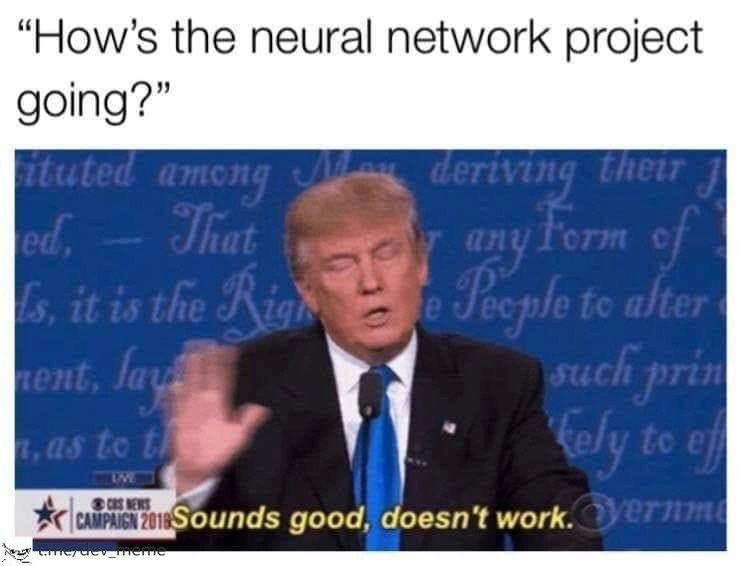
This meme is doing the same thing, but with a software project instead of a toy robot. The question “How’s the neural network project going?” is like asking “Did your amazing plan work out?” And the answer “Sounds good, doesn’t work.” is a cheeky way of saying “It was a great idea, but in practice it failed.” It’s funny because we’ve all been there: maybe someone brags about a cool trick they can do, and then they try it and it totally doesn’t happen. Or a new gadget is advertised to do incredible things, but when you try it at home, it does nothing.
“All bark, no bite” is a phrase that fits here – like a dog that makes a lot of noise (big claims) but doesn’t actually bite (no results). The meme makes us laugh about that situation. The people involved probably feel a little frustrated or embarrassed that the project isn’t working, but turning it into a joke helps. It’s a way of saying “Yeah, this didn’t succeed… isn’t it kind of ironically funny how far off it was?”
So even if you don’t know anything about neural networks, you can get the humor: it’s the classic tale of a big idea that didn’t deliver. The fancy tech project is the big idea, and “sounds good, doesn’t work” is just a humorous, blunt report of its failure. It’s like hearing someone tried to invent a flying car, and after all the buzz, the car wouldn’t even start. You’d shake your head and grin at how reality turned out. This meme captures that feeling in one quick Q&A. People find it funny because it’s a little slice of truth — lots of things in life (and tech) promise the moon but struggle to get off the ground, and sometimes the only thing you can do is have a good-natured laugh when your awesome-sounding plan goes bust.
Level 2: The Learning Curve
Let’s break down what’s going on in this meme in simple terms. The question at the top asks, “How’s the neural network project going?” If you’re new to this area, a neural network project means the team is trying to use a type of artificial intelligence to solve a problem. Neural networks are a key concept in machine learning – they’re inspired by the human brain, with layers of interconnected “neurons” (actually just mathematical functions) that can learn to recognize patterns from data. When people talk about deep learning, they mean neural networks with many layers that can learn very complex patterns. So basically, imagine a program that isn’t given explicit rules, but instead learns by example (like giving it a thousand pictures of cats and dogs so it learns to tell a cat from a dog on its own). That’s what this project likely involves. It’s the kind of cutting-edge tech that sounds really fancy and exciting, which is why someone is asking about it – presumably, folks are eager to see it succeed.
Now, the answer given in the meme is “Sounds good, doesn’t work.” In everyday language, that’s like saying: “Well, it sounded like a great idea, but it isn’t actually working.” It’s a very frank and slightly humorous way to admit a project isn’t going well. Usually in a status meeting, a developer might give more detail or soften the blow, like “we’re running into some issues” or “it’s proving tricky, we might need more time.” But here, the answer is blunt and comedic: essentially “Nope, it’s a flop so far.”
Why would a neural network project fail or struggle? There are a few common reasons, especially familiar to anyone who’s tried out machine learning for the first time:
- Not enough or poor-quality data: Neural networks learn from examples. If the team doesn’t have good data (imagine trying to teach someone to recognize cats vs. dogs but most of your example pictures are blurry or mislabeled), the network won’t learn the right things. There’s a saying in AI: “garbage in, garbage out.” If the project’s data was inadequate, the model’s results will be garbage – it just won’t work as hoped.
- The wrong approach or model: There are many kinds of neural networks and AI models. If you pick one that isn’t suited for your problem, you might get lousy results. For instance, using a model designed for recognizing images to try and predict stock prices would be misguided – it sounds high-tech, but it won’t work because it’s not built for that job. Sometimes people hear “neural network” and assume it’s a magic fix for anything, but choosing the right tool is important.
- Training difficulties: Even if you have the right model and good data, you have to train the neural network correctly. Training is like tuning the model’s internal settings so it gets better at the task. There are dozens of settings (called hyperparameters) involved – like the learning rate, which decides how big a step the model takes when adjusting itself. (If the learning rate is too high, the model jumps around and never settles down; if it’s too low, the model moves at a snail’s pace and might get stuck without improving. It’s like trying to find a light switch in a dark room: huge steps might make you miss it entirely, tiny steps might take forever.) If those settings aren’t right, the training might not succeed. The network could end up just as clueless after training as it was at the start!
- Bugs or mistakes in code: And of course, there’s the classic reason in any software project – bugs. These aren’t always obvious in ML projects because the code might run without crashing, but still have a flaw. For example, maybe the code is accidentally shuffling the data and the labels out of sync (so the network is learning from mismatched examples and answers). The program won’t throw an error, but the network will learn nonsense. Or maybe a junior dev normalizes the input data incorrectly (scaling values wrong) and the network can’t make sense of it. These kinds of mistakes can silently sabotage the project, leading to an AI that, you guessed it, “doesn’t work.”
For someone just starting out, it might be surprising how often the first attempt at an AI or neural net project fails or gives disappointing results. It’s actually very normal! Machine learning can be as much an art as a science – you try something, see how it goes, and if it doesn’t work, you analyze why and try again with adjustments. So the meme’s phrase “sounds good, doesn’t work” is a funny acknowledgment of that learning curve. You come in with a cool idea (“hey, let’s use a neural network, that’d be awesome!”), and then you hit the reality that it’s not easy to get it working correctly on the first go.
Now, about the visuals of the meme: It shows what looks like a serious scene – a man in a suit (his face is blurred out, but many recognize him as a certain famous figure) on a stage with a microphone, looking a bit dismissive with his hand up. There’s even a news caption at the bottom (“CBS News Campaign 2018”) as if this were live on television. In that original context, it was a political debate or interview, so imagine someone on live TV saying a plan “sounds good, doesn’t work.” The meme repurposes that image for a tech status update, which is part of why it’s amusing. It’s an exaggerated scenario: normally, our project meetings aren’t broadcast on CBS, and we don’t have politicians delivering our sprint updates! By using that image, the meme is jokingly treating the developer’s frustration as a matter of national importance.
The man’s gesture – a kind of wave that says “nope, forget it” – and the subtitle “Sounds good, doesn’t work” line up perfectly. It’s like he’s responding to the question with a dismissive “we gave up on that idea.” In reality, a developer might feel like doing that gesture when saying the project failed, but they’d probably be more formal or subdued. The meme just makes it overt and dramatic for comedic effect. Even if you don’t know who the figure is, you can tell from body language: he’s not pleased, and he’s shutting the conversation down with a blunt statement. That’s exactly the energy of an engineer who’s tired of debugging a neural net and has nothing but bad news to report.
For a junior developer, it’s worth noting the humor here comes with a dose of empathy. We often get excited about new technologies (AI, blockchain, you name it) because of success stories we hear. But in practice, there’s a lot of trial and error. This meme is basically the dev community laughing at itself – “Here we go again, chasing a shiny idea that isn’t panning out (at least not yet).” It doesn’t mean neural networks are bad or never work (in fact, they do amazing things in the right conditions!), just that in this particular project things aren’t coming together. The team probably has to go back to the drawing board, check their data, tweak their approach, maybe even consider that a neural net isn’t the right solution for the problem after all.
The phrase “sounds good, doesn’t work” in a broader sense is a relatable concept beyond tech, too. It’s like when you have any plan that gets everyone’s hopes up but then flops. In software, we just see this a lot because we’re often trying new, complex things. The meme taps into that shared experience: AI limitations in real life colliding with our expectations. It teaches a bit of humility — the idea that just because something is hyped and sounds like it could solve everything, you still have to do the hard work to make it actually function. And if you skip that reality check, well, you might end up giving the very update in this meme.
In summary, for someone new: this meme is saying “We tried this cool AI idea. Everyone thought it would be great. But as of now, it’s not working at all.” It’s funny because of how short and frank that update is, especially given how fancy “the neural network project” sounds. It’s the tech equivalent of saying “the big plan failed” in a deadpan way. Every developer, junior or senior, eventually experiences a project that fizzles out like this. The key is to learn from it (improve the data, fix the bug, adjust the model) and have a bit of a laugh, like this meme does, before soldiering on. That’s the learning curve in action: things often don’t work before they do.
Level 3: Hype-Driven Development
From a senior developer’s perspective, this meme nails a painfully familiar scenario: an ambitious machine learning initiative that the whole team (and likely upper management) was excited about has ground to a halt. The question at the top – “How’s the neural network project going?” – is something you’d hear in a status meeting or sprint review for a high-profile AI experiment. Everyone remembers the kickoff where using a neural net sounded like a brilliant, cutting-edge solution. Now comes the moment of truth, and the answer plastered on the meme – “Sounds good, doesn’t work.” – is a brutally honest, almost comically blunt status update. It’s the kind of dry one-liner a jaded engineer might mutter after wrestling with stubborn code at 3 AM. Seeing that frank answer superimposed on a status meeting meme format is instantly relatable to experienced devs: it’s the universal translation of “we’ve hit a brick wall.”
Why is this funny in a tech context? Because it perfectly captures AI hype vs. reality. In recent years, AI (especially deep learning) has been the industry’s golden child – every product pitch, every startup slide deck, every higher-up’s dream feature had “AI-powered” slapped on it. This creates a huge expectation bubble. A lot of projects are green-lit because “AI will make it awesome.” That’s the hype-driven development cycle: choose the solution that sounds most buzzworthy. So the phrase “sounds good” in the meme isn’t random; it points to all that optimistic talk. But then reality kicks down the door. Implementing a neural network that actually works is hard. The meme delivers the punchline “doesn’t work” like a mic drop, and experienced developers laugh (or groan) because they’ve seen this story play out time and again.
In real-world terms, this situation usually unfolds like: the team had high hopes for a neural net solving a problem – say, automatically flagging bugs in code, or predicting user behavior. Maybe a demo was whipped up that looked promising, or a competitor’s success made everyone feel “we need to do this too.” But as development went on, progress stalled. The model’s accuracy is stuck at 52%. The predictions are nonsense. Every tweak yields little improvement. Essentially, the project is in deep-learning debugging hell. When the boss or client excitedly asks “So, is our AI revolutionizing things yet?”, the truthful answer is a sheepish, “Uh, not exactly.” The meme just strips that down to an ironic one-liner. It’s funny precisely because it’s too true.
Seasoned devs have a name for this: "Hype-driven development" (the not-so-distant cousin of resume-driven development). We’ve all been there: adopting a hot new technology because it impresses people, only to discover it’s a poor fit or requires much more effort than anticipated. Neural networks are a prime candidate for this because to non-engineers they sound like magic – “the computer will learn on its own!” – but veterans know the magic often needs a lot of grunt work and luck behind the scenes. The meme highlights that contrast by pairing the buzzword optimism with the stark admission of failure. It’s basically the engineer saying, “Remember that miracle solution we touted? Welp… about that….”
The choice of image intensifies the humor. It’s a photo of a well-known public figure (recognizably former U.S. President Donald Trump, face blurred for anonymity) on a debate stage, holding up his hand as if to dismiss the very idea he’s addressing. The official-looking backdrop (blue stage, CBS News logo, “CAMPAIGN 2018” graphics) makes it look like a serious announcement. By memeing this context, it’s as if the developer’s update has become a nationally televised proclamation: “We promised you AI change, folks, but we got nothing. Next question.” 🤷♂️ The dramatic hand gesture and closed-eye expression scream “let’s not even go there.” This amplifies the comic effect – an engineer admitting defeat is treated with the same gravity as a political soundbite. For those in the know, it’s a perfect pairing: a famously brash speaker delivering a harsh truth, much like a frustrated tech lead telling the team, “I don’t care what the plan was – it just isn’t working.”
We should unpack why it isn’t working, because that’s the crux of every senior dev’s sympathetic chuckle. In complex AI/ML projects, a thousand little things can go wrong:
- Data quality – Perhaps the training data is insufficient or full of noise. (Classic: “We thought we had 100k images, but half of them are unlabeled or garbage.”) A neural net is only as good as its data; bad input guarantees bad output.
- Model choice – Maybe they picked the wrong type of model or network architecture. The hype said “use a deep neural net,” but maybe a simpler algorithm (or a different architecture like a CNN vs. an RNN) was actually more appropriate. An experienced ML engineer will tell you: use the right tool for the job, not just the trendiest tool.
- Hyperparameters & training – These are the dials and knobs (learning rate, number of layers, batch size, epochs, etc.) that you have to tune. Set them wrong, and training can flatline. For example, if the learning rate is off, the network might either overshoot and diverge or move like molasses and get nowhere. Getting these right often feels like cracking a secret code through trial and error.
- Bugs or misconfigurations – Yes, plain old bugs. Maybe the input features weren’t scaled properly, or there’s a mistake in how the loss is calculated that isn’t obvious. The code runs (no exceptions thrown), but logically it’s doing the wrong thing. I’ve seen cases where an entire neural network was effectively learning nothing because one line of code shuffled labels incorrectly. It’s a silent killer – everything executes, but the model is learning gibberish.
Any one of these issues can turn an AI project into a flop. And here’s the kicker: unlike a straightforward software bug where the app crashes and points you to the line of code, these failures are often stealthy. The training process completes without errors; you end up with a model file; it just performs terribly. So when someone asks how it’s going, you can technically say “the code is done” while also admitting “but it doesn’t actually do what we wanted.” That dichotomy is exactly what “Sounds good, doesn’t work” conveys. The idea (using a neural net) was “good” in theory and presentation, but the actual solution “doesn’t work” in reality.
For veteran engineers, the humor also lies in the candid, no-bullshit delivery. Normally, in a status meeting, you’d cushion bad news: “We’re still working on improving the accuracy, it’s a bit lower than expected but we have some promising leads.” But let’s be honest, every experienced dev has wanted to just say, “Yeah, that thing is a dumpster fire right now.” The meme’s subtitle is essentially that sentiment boiled down. It’s cathartic. We’re laughing because we’ve all had that urge to drop the corporate polish and just tell it like it is: “It sounded like a great idea, boss, but nope, not happening.” The image of a figure bluntly saying “doesn’t work” in a public forum is the fantasy of leveling with stakeholders, played for laughs.
To paint a clearer picture, consider a concrete example. Suppose this project was to use a neural net to detect bugs in code automatically (a trendy idea). Management is thrilled – “Our AI will catch issues before they hit production!” Great in theory. The team spends weeks collecting code samples, labeling bug-free vs buggy code. They throw it into a deep learning model. Training runs… and the model achieves, say, 10% accuracy (for context, random guessing could get 50% on a binary classification!). The model essentially learned nothing useful; it might even be outputting the same answer every time. After tweaking and retraining all week, the lead dev is frazzled. Enter the stand-up meeting: “So, can we start using the AI bug detector?” The dev, channeling their inner meme, can only shake their head: “Sounds good, doesn’t work.” That’s the scenario captured here. Everyone on the dev team winces because they know that pain, while outsiders might just find the bluntness amusing.
We can even imagine the dialogue in memetic form:
Manager: "So, can we wow the client with that AI feature now?"
Engineer (tired, waving hand): "Sounds good, doesn’t work."
Cue the room going silent – and maybe one person in the back suppressing a laugh because the delivery was just like the meme.
The phrase has become a bit of an inside joke among engineers exactly because of situations like this. It’s short, sharp, and universally applicable to any overhyped tech that fails to deliver. Blockchain solution crashes constantly? “Sounds good, doesn’t work.” New framework that was supposed to save time but took longer? Same energy. But it resonates especially with AI/ML because those projects often promise the moon. We joke that some presentations are 90% about how great the neural net sounds, and maybe one footnote about actual results. This meme cuts right through that fluff. It’s the ultimate BS-filtered project status.
Finally, from an organizational angle, the meme hints at how AI limitations collide with business expectations. Perhaps management treated the neural network as a plug-and-play module – “just code it up, feed it data, and we’re golden.” Experienced folks know that usually leads to frustration. Achieving production-ready AI requires careful experiment cycles, validation, and often significant domain knowledge. If those pieces weren’t considered, of course it “doesn’t work”! The honest engineer in the meme isn’t just giving a status report; they’re indirectly calling out the over-simplified planning. It’s both a joke and a bit of sardonic commentary on tech culture’s tendency to chase the next big thing without fully grasping it.
In summary, “Sounds good, doesn’t work” is the collective sigh of developers who’ve battled trendy projects gone awry. It’s funny to us because it’s a shared experience – we’ve all hyped something (to our boss, to a client, even to ourselves) that later fell flat. The meme packages that entire saga – the optimism, the struggle, the facepalm outcome – into one caption over a perfect image of dismissive exasperation. It’s a little dose of comedic truth that says: welcome to software development, where even the coolest ideas can faceplant – and we might as well laugh about it.
Level 4: Non-Convex Nightmare
At the core of this meme's humor is the gap between the theoretical promise of modern neural networks and the harsh reality of actually training them. On paper, a neural network can approximate almost any function given enough layers and data – the classic Universal Approximation Theorem assures us it sounds totally feasible. But in practice, finding the right parameters for a deep network is a wickedly hard task. Training a neural net means solving a giant optimization problem that is usually non-convex (imagine a loss landscape full of peaks, valleys, and twisty canyons). Our gradient-based algorithms (like the trusty stochastic gradient descent) can only feel the local slope of this landscape (the gradient $\nabla L$). If the algorithm happens to be sitting in a local minimum or on a flat plateau, it might stop improving even though a much better solution is out there somewhere. In plainer terms: the math might say "a solution exists," but it doesn't guarantee your training process will find it. The result? You could code everything correctly and still end up with a model that flat-out doesn't work well – a perfect scientific reality check on something that sounded great in theory.
This phenomenon isn't just hypothetical. Early deep-learning researchers frequently hit the vanishing gradient problem: as they made networks deeper (more layers), the training signal would fade or vanish by the time it reached the earlier layers. The network’s weights would barely change, learning stagnated, and you’d get a model that basically outputs random guesses. It sounded like a good idea to stack more layers for complex tasks, but initially it didn't work at all until new techniques (like ReLU activations and better initialization) came along. Even today, if you choose a poor architecture or hyperparameters, you might find your fancy model isn’t learning anything useful – the algorithm might quietly settle into a no-learning rut. It’s a “neural not-work” situation: the code runs, the math checks out, but the outcome is a flop.
Data is another unforgiving factor. Theoretical prowess means nothing if your data is insufficient or noisy. You can’t squeeze signal from a stone – if the training data doesn’t actually contain the pattern you hope the machine learning will capture, the network will diligently learn nothing. This is a known truth formalized by the No Free Lunch theorem: there's no one-model-fits-all, and if your problem/data isn't suited to neural nets, all that complexity might just learn irrelevance. A neural net that’s too powerful for a small dataset will happily overfit (memorize training examples) and then fail on new data. Conversely, one that’s too simplistic or starved of data will underfit and basically shrug its shoulders (yielding the dreaded "no improvement" flat line in your metrics). In both cases: shiny idea, dull outcome.
Historically, the field of AI has gone through hype cycles where grand ideas hit hard limits. In the late 1960s, the single-layer perceptron was hyped to solve pattern recognition, but then mathematicians (Minsky & Papert) showed it couldn’t even solve a simple XOR logic problem. Result: an AI winter – funding dried up when people realized that idea sounded good but didn’t work as once thought. Fast forward to the late 80s and early 90s: we got multi-layer networks and backpropagation, hype returned, then many huge expert-system projects failed again because they couldn’t deal with real-world complexity. Sounds familiar? Each time, the concept was promising, but the implementation fell short due to unseen complexities.
So when an engineer in 2020 says “yeah, we tried this deep learning thing – sounds good, doesn’t work,” it’s almost echoing those decades of lofty ambition meeting reality. The meme’s catchphrase is effectively a nod to the limitations of AI that only become clear when you’re knee-deep in code, math, and data. It’s the cold, theoretical truth: just because an approach is potent in principle doesn’t mean it will magically succeed on your particular problem. In science and engineering, plenty of ideas sound fantastic in meetings and papers, but Mother Mathematics has the final vote on whether they work. Here, the math (and the data) are basically telling the team, “Nice try, but no – not with this setup.” It’s a non-convex nightmare come to life: a project riding on cutting-edge theory runs smack into technical reality, perfectly capturing why this meme’s blunt punchline is as academically apt as it is darkly funny.
Description
A reaction meme about the state of a machine learning project. The top text poses the question: '“How’s the neural network project going?”'. Below this is an image of former U.S. President Donald Trump at a podium during a political event, gesturing with his hand. The background is a blue wall with stylized white text. A subtitle at the bottom of the image reads, 'Sounds good, doesn’t work.' A watermark in the bottom left says 't.me/dev_meme'. The humor is derived from applying this well-known political quote to the often-frustrating reality of AI/ML development. Many neural network projects are conceptually impressive and promising on paper but prove incredibly difficult to implement successfully, often failing to work as expected, a sentiment deeply familiar to data scientists and ML engineers
Comments
7Comment deleted
My model has a 99% accuracy on the test set. And a 100% chance of not working in production. It's a classic case of 'works on my machine, sounds good to my manager'
Neural-net status: 92% accuracy on the slide deck, 0% in prod - turns out we only managed to overfit to management
It's achieving 99% accuracy on the training set and 51% on validation - basically a very expensive random number generator with a PhD in overfitting and a minor in disappointing stakeholders
Every ML engineer knows this moment: your neural network achieves 99% accuracy on the test set, the loss curves look beautiful, and the confusion matrix is chef's kiss. Then you deploy to production and discover it's just memorized the training data, can't handle edge cases, and confidently predicts 'cat' for every input including your quarterly revenue spreadsheet. The real kicker? The model's still technically working as designed - it's just that 'designed' and 'useful' turned out to be orthogonal concepts
Neural net status: 0.99 ROC-AUC on the accidentally leaked validation set, 0.51 in prod - turns budget into CUDA heat and very confident nonsense
We hit SOTA on the slide deck; in prod it’s a distributed RNG with a GPU burn rate
Trained flawlessly on toy data, hallucinates cat pics as stop signs in prod - just like that 'scalable' monolith we swore we'd refactor