A Literal Interpretation of a 'Memories' Box
Why is this Hardware meme funny?
Level 1: Box of Memories (Literally)
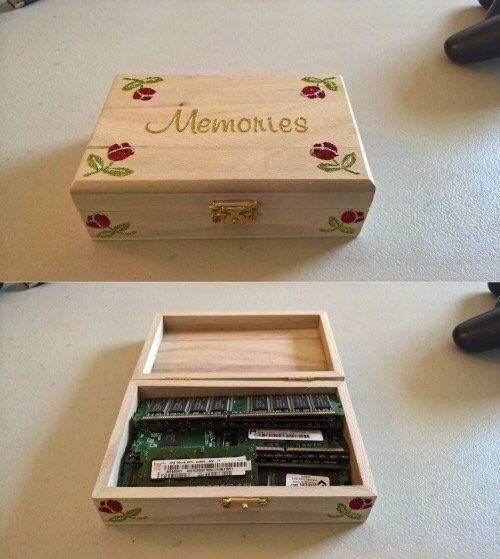
Imagine you have a little wooden box that says "Memories" on the outside. You’d probably expect it to hold special things like family photos, birthday cards, or souvenirs from a trip – things that help you remember fun times. But in this picture, when the box is opened, it’s filled with something completely unexpected: computer memory parts. Those are the green sticks that go inside a computer to help it remember and work on information (kind of like the computer’s short-term memory). The joke is that the word "memories" usually means the moments or items we treasure from our life, but here it’s being used in a totally literal way. The person put actual "memory" hardware into the "Memories" box! It’s like saying “these are my memories” and showing a bunch of computer chips.
Why is that funny? It’s because it mixes up two meanings of the same word. It’s a bit like if someone had a cookie jar labeled "Cookies," but inside you found computer chips instead of chocolate chips. You’d laugh because you expected yummy cookies, but they took “chips” to mean something else (microchips!). In this meme, you expect personal memories, but get computer memory. It’s a silly surprise. People who love computers find it extra funny because they actually call those sticks “memory” all the time. And some of them do keep old computer parts as memories of their tech adventures. So, the picture is both a joke on the word and a cute reminder that for a computer lover, old gadgets can be as precious as old photos. In simple terms: the box of "Memories" really has memories of computers inside, and that funny twist makes us smile.
Level 2: Not That Kind of Memory
In this meme, a decorative wooden memory box labeled "Memories" is used in a very literal way – it’s filled with actual computer memory sticks! Those green sticks you see are modules of RAM, which stands for Random Access Memory. In a computer, RAM is a type of hardware that stores data temporarily so the processor can access it quickly. It’s basically the computer’s short-term working memory. The meme shows a bunch of these RAM modules (desktop DIMMs and smaller SO-DIMMs, which are just different sizes of memory sticks for desktops vs. laptops) neatly stacked inside the box. Normally, a box with "Memories" written on it would hold sentimental items like photographs, old letters, or souvenirs from your life – things that help you remember past events. Here, though, it’s holding the computer kind of memory: the physical memory modules from PCs.
The joke is a classic bit of tech humor based on a play on words. The word memory has dual meaning. In everyday language “memories” are those moments or things we remember or save from our life. In the tech world, "memory" usually refers to RAM – the component of a computer that remembers data for running programs. This meme combines those meanings in a witty way. You expect a memory box to contain treasured personal mementos, but instead you find literal computer memory inside. It’s saying, “These are my memories,” and showing you RAM sticks. For a developer or any computer enthusiast, that’s instantly funny because we constantly talk about adding or upgrading “memory” (meaning RAM) in our machines. Seeing it placed in a keepsake box as if they were photograph albums is an amusing crossover between our personal lives and our tech lives. It’s wordplay: one word, two contexts colliding in a single image.
Let’s break down what those computer memory sticks actually do, so the pun becomes clearer. RAM (Random Access Memory) is where a computer stores information it’s actively using so that it can be accessed really fast. For example, when you open a bunch of browser tabs or run a game, that data sits in RAM while in use. However, RAM is volatile memory, meaning it only holds data while the computer is powered on. When you shut down, whatever was in RAM is cleared (unlike a hard drive or SSD, which keeps data long-term). So, normally you wouldn’t use RAM to store cherished information permanently — you’d use a hard drive, flash drive, or cloud storage for that. That’s why it’s extra humorous to put RAM sticks in a box labeled "Memories": personal memories are supposed to last, but the computer memory in that box can’t actually hold anything once it’s out of a computer. They’re just the hardware pieces. It’s a playful literal interpretation that almost says, “Here are my memories… well, the computer parts called memory.”
This kind of hardware humor often gets a chuckle in the tech community because many of us can relate to it. Tech folks, especially those who have been tinkering with PCs for a while, often accumulate old parts over the years. For instance, when you upgrade your computer’s RAM for more capacity, you might end up with a couple of leftover older RAM sticks. What do you do with those? A lot of us toss them in a drawer or a box, thinking “maybe they’ll be useful later” or simply not wanting to throw them out. Over time, that box becomes a little collection of outdated parts — essentially a box of old hardware that represents past projects and machines. In a sense, each piece can remind a developer of something: “Oh, this 1 GB stick came from the first PC I built in college,” or “That module was from the laptop that got me through my first coding job.” They become techie souvenirs. So the meme’s scenario isn’t entirely fictional; some people literally have a box of old RAM and other components lying around. Seeing the box actually labeled "Memories" is a fun, on-the-nose acknowledgement of that habit. It’s like the meme is saying: for a geek, these gadgets are the memories.
Because it’s tagged under Hardware and GeekHumor, it’s safe to say this joke is meant for an audience that understands what RAM sticks are. If you’re new to computing, picture those green sticks as akin to the brain of the computer, where it keeps things it’s thinking about right now. To a newcomer, it might just look like electronic junk in a jewelry box. But once you know the lingo — that those are called memory modules — the punchline clicks. It’s a simple visual pun that also carries a bit of truth about nostalgic hardware collecting. Tech enthusiasts often find charm in older technology. Just like someone might keep an old toy or ticket stub, a programmer might keep a 20-year-old memory module as a token of “the good old days of computing.” This meme encapsulates that sentiment with a straightforward literal joke: memory can mean the happy times we recall, or it can mean the RAM inside our computers, and here, it hilariously means both at once.
Level 3: RAMifications of Nostalgia
At first glance, this meme is a delightful play on memory in both human and computer terms. A quaint wooden box emblazoned with "Memories" (complete with painted roses and golden script) usually stores cherished keepsakes like old photos or letters. But here, upon opening the lid, we find it literally packed with RAM sticks – those green circuit boards are actual computer memory modules (mixes of desktop DIMMs and laptop SO-DIMMs). The top panel sets up a sentimental expectation, and the bottom panel subverts it with a nerdy twist. This literal interpretation of "memories" hits the wordplay pun sweet spot that geeks adore, because it conflates personal nostalgia with the physical hardware that a computer uses to remember data. It’s a classic case of technical geek humor: taking an everyday label and revealing a highly technical in-joke underneath.
For seasoned engineers, the image resonates on multiple levels. Many of us have a drawer or keepsake box (perhaps less decorative than this one) filled with old hardware souvenirs: outdated RAM sticks, retired graphics cards, even that ancient 56k modem or a Pentium processor keychain. Why do we hoard these obsolete components? Partly because of practicality (a spare stick of RAM can be a lifesaver when troubleshooting an old system), but largely out of tech nostalgia. Each module might carry a story from our personal computing journey — the 2GB DDR2 stick that upgraded a beloved old PC, or the rare 32MB module from the 90s that once felt like limitless memory. Stashing them away feels like preserving a little piece of history. This meme winks at that habit: it’s literally a box of memories for an engineer, filled with the memory modules themselves. The humor lands because it’s so literal: the owner’s memories are memory chips.
There’s an ironic technical subtext here that veteran developers will appreciate. We call these modules "memory" in computing, but unlike a photo album, the data in RAM is volatile – it disappears when the power goes off. A stick of Random Access Memory (RAM) doesn’t permanently hold onto the bits; it needs constant power refreshes to retain data. So putting RAM sticks in a box labeled "Memories" is a tongue-in-cheek contradiction: you’re saving devices that, by their nature, can’t save your data once removed. It’s as if the meme acknowledges that the memories on those memory sticks are gone, yet the sticks themselves have become cherished artifacts. In a way, this reflects a deeper truth about tech nostalgia: we often treasure the hardware even when its original functional value is long lost. The box preserves the physical memory modules as mementos, even though whatever 1s and 0s they once held have long evaporated. This contrast between ephemeral data and tangible nostalgia is subtly poetic — and pretty funny to anyone who’s ever tried to explain to their non-techie friends why they keep a bunch of old circuit boards “for memory’s sake.”
From a tech history perspective, this meme also nods to the rapid evolution of computer memory. The sight of multiple generations of RAM (full-sized desktop DIMMs alongside smaller laptop SO-DIMMs) all tossed together is basically an archaeological dig for hardware enthusiasts. It’s a reminder of how far we’ve come in terms of capacity and form factor. Early PCs in the 1980s and 90s used memory sticks much larger and lower capacity than what we have today. For example, a 1989-era SIMM module might have stored 1 MB of data on a board with big black chips, whereas a single modern DIMM can store 8 GB or more in roughly the same size. We went from measuring memory in kilobytes and megabytes to gigabytes and beyond, all within a few decades – a progression driven by Moore’s Law and advances in fabrication. Each set of retired modules in that box likely represents an upgrade: perhaps the owner replaced 256MB sticks with 1GB sticks, then with 4GB, and so on, each time tossing the older modules into the memory box. The result is a physical timeline of progress. Those green sticks are like fossils from different eras of computing: maybe an SDRAM from the Windows 98 era, a DDR2 from the mid-2000s, and a DDR3 SO-DIMM from an old laptop. A veteran engineer can identify them at a glance and might feel a pang of nostalgia remembering the machines they powered. It’s tech history in a literal box.
There’s even a linguistic twist worth noting. Why do we call these chips "memory" in the first place? The term was adopted in computing to draw an analogy to the way humans store information in their brains. Early computer pioneers spoke of machines "remembering" numbers using electronic memory units, long before modern RAM sticks existed. Over time, "memory" became the standard term for a computer’s fast, temporary storage. So the meme flips that origin on its head: now we have a human "memory box" storing the computer memory hardware itself. It’s a full circle of meaning. This self-referential humor is something experienced devs find clever — it’s not just a cheap visual gag, it’s reflecting on the words and how computing concepts are entwined with everyday language. The box with “Memories” written in flowing script looks like it belongs on your grandma’s shelf, yet it’s filled with green silicon boards that belong in a PC. That juxtaposition is both absurd and charming.
Finally, the shared experience encapsulated here runs deep in geek culture. In an industry that moves so fast, yesterday’s top-tier RAM is tomorrow’s trash – but not to us sentimental techies. We’ve all had that moment of holding an old stick of RAM and thinking, "Wow, I remember when this was gold and enabled me to play my games or run that IDE faster." The meme celebrates that we remember our memory. It’s simultaneously a pun and a gentle poke at how attached we can get to technology. In a sense, the box is labeled correctly: it truly holds memories – not the kind in photo albums, but the kind that only those who grew up with these exact hardware pieces can appreciate. The humor works because it’s inside baseball for IT folks: an everyday person sees random electronics, but a seasoned developer sees personal nostalgia plus a perfect pun. In summary, it’s a geeky little masterpiece combining hardware humor and heartfelt reminiscence, making us laugh and maybe even sigh, “those were the days of 512 MB RAM…”.
"640K ought to be enough for anybody."
(A famous refrain from the early PC era, humorously attributed to Bill Gates – illustrating how quickly our memory needs outgrew early expectations.)
Description
A two-panel image displaying a literal pun. The top panel shows a small, decorative wooden box with a brass clasp. The lid is inscribed with the word 'Memories' in a cursive, gold font and is adorned with simple, painted red roses. The bottom panel reveals the box opened, and instead of sentimental keepsakes, it is filled with sticks of computer RAM (Random Access Memory). The humor is derived from the wordplay on 'memory,' contrasting the expected emotional, human concept of memories with the literal, technical hardware. The RAM modules appear to be older, possibly DDR or DDR2, adding a layer of tech nostalgia for experienced engineers
Comments
7Comment deleted
I tried to store my emotional baggage in one of these, but it just threw a segmentation fault. Turns out you can't just malloc feelings
After two decades of midnight rollbacks, my sentimental keepsake is a box of ECC DIMMs - because the only memories I still trust are the ones with parity bits
Finally, a memory box that actually stores memories - though explaining to your partner why you're keeping 8GB of DDR3 from 2012 'for sentimental reasons' might require more RAM than the box contains
A perfect metaphor for the senior engineer's career: carefully preserving memories (RAM) from systems long deprecated, knowing full well you'll never use them again but unable to throw away hardware that once cost more than your monthly rent. That 512MB DDR2 stick? It powered production servers. Now it powers nostalgia - and takes up exactly as much mental space as it did physical memory addressing
Finally, a backup of all our memories - implemented in DRAM; RPO ends the moment someone pulls the plug
These memories won't leak or get garbage-collected - just periodically evicted for bigger sticks every Moore's Law cycle
Legal asked for data retention, so we archived the DIMMs in a box labeled “Memories” - compliance delighted, the kernel still can’t find RAM