When YouTube Thinks Lower Latency Means Bigger Lats
Why is this Networking meme funny?
Level 1: Mixed-Up Muscles and Internet
Imagine you ask your computer for help to make your internet faster so your games or videos don’t lag. But instead of giving you tips for faster Wi-Fi, it suddenly shows you a video about making your muscles bigger! That’s exactly the kind of silly mix-up happening in this meme. It’s funny because the computer got confused by a word that sounded similar in two different things. It’s as if you said "I want my speed better" meaning internet speed, and the computer replied, "Sure, let’s do speed exercises to run faster!" You’d probably laugh and say, “No, not that kind of speed!” Here, the computer thought a word about network speed (latency) was talking about lat muscles, so it suggested a workout video. The joke makes us giggle because even smart computers can act a little goofy and misunderstand what we really mean, just like a friend who mishears your request and does something completely unexpected.
Level 2: Latency vs Lats
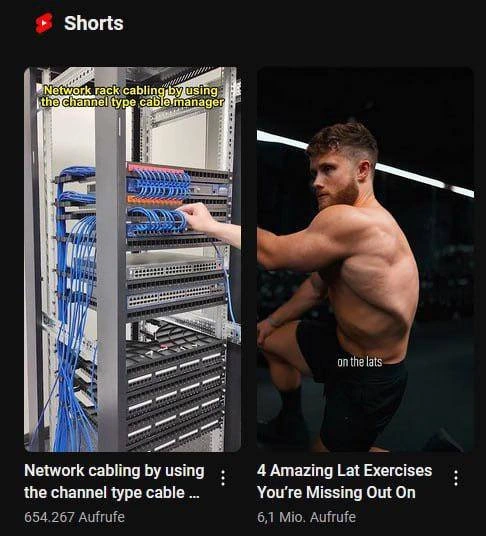
Let’s break down the joke in simple technical terms. On the left side of the meme, we have a picture from a YouTube Shorts feed showing a beautifully organized network rack. Those are Ethernet cables (the blue wires) all neatly arranged and running through a channel-type cable manager (the grey frame with slots guiding the cables vertically). This is the kind of setup you’d see in a data center or server room. The text on that thumbnail says “Network rack cabling by using the channel type cable manager.” In other words, it’s a short video about how to organise network cables neatly using a specific tool (the channel cable manager) to route them. The view count “654.267 Aufrufe” is in German – “Aufrufe” means views, so roughly 654,000 views. Clearly, a lot of people (probably IT enthusiasts) cared about tidy cables!
Now, why do network folks care about tidy cables? Two big reasons: maintenance and performance. Maintenance-wise, using proper cable management (like those channel guides) prevents tangles, makes it easier to trace a cable from one end to the other, and generally looks professional. Performance-wise, while just tidying cables doesn’t magically speed up the internet, it can prevent mistakes like plugging into the wrong port, and can reduce electrical interference if done right. In networking terms, when we talk about improving speed or responsiveness, we talk about lowering latency. Latency is the time it takes for data to travel from one point to another in a network. If you’re playing an online game or video conferencing, lower latency (often measured in milliseconds) means less lag and a more real-time feel. Network engineers are always looking to reduce latency by using faster connections, better hardware, or optimising routes.
So, the left video likely appeals to people who want to improve their network’s reliability or just enjoy the sight of a perfectly managed rack (yes, in tech circles, a picture of immaculate cabling is oddly satisfying – akin to seeing a perfectly solved puzzle). It's classic Networking content and a bit of Hardware pride too, showing off physical infrastructure done right.
Now, contrast that with the right side of the meme. The right thumbnail is from a fitness video titled “4 Amazing Lat Exercises You’re Missing Out On,” with 6.1 million views (6,1 Mio. is European format for 6.1M). The image shows a shirtless bodybuilder flexing his back muscles. The caption “on the lats” presumably relates to one of the exercises being demonstrated. In fitness lingo, “lats” refers to the latissimus dorsi muscles – those large V-shaped muscles on either side of your back that give you that “wide back” look when well-developed. If someone says “I’m working on my lats,” it means they’re doing exercises like pull-ups, lat pull-downs (which often involve a cable machine), rows, etc., to strengthen that part of the body.
So, the right video is pure gym content: how to get a stronger, more muscular back. It has absolutely nothing to do with networks or computers. It belongs to the world of workout enthusiasts, not network engineers.
Now here’s where the funny confusion comes in: The word “lat” appears in both contexts, but with totally different meanings. Latency (often shortened colloquially to “lat” in gaming or tech discussions) is about network speed, whereas lats are muscles. The meme title jokes that “YouTube thinks lower latency means bigger lats.” That suggests the person was interested in reducing network latency (maybe by organizing cables or other network tweaks) but YouTube’s recommendation system interpreted that interest as something to do with “lats” the muscles!
YouTube (and other platforms) use a recommendation algorithm – basically an AI-driven system that decides what videos to show you next or in your feed, based on what you’ve watched, liked, or searched for. Sometimes these algorithms pick up on keywords or patterns. Here, perhaps the algorithm saw the word “lat” from something the user engaged with (like a title about network latency or a tag on the video about cabling) and then thought, “People interested in ‘lat’ might like this other popular video about ‘lat exercises’.” It’s a bit of a fuzzy matching problem: the algorithm isn’t truly understanding the meaning, it’s just seeing a similar sequence of letters or an overlapping term.
For a junior developer or someone new to these concepts, think of it like this: YouTube’s program knows Video A and Video B share a common tag or keyword “lat,” so it assumes they might be related. It’s a dumb mistake a human likely wouldn’t make (we instantly know network latency and gym lats are unrelated), but computers aren’t that smart without explicitly being taught context. This kind of mix-up is basically the algorithm confusing one context for another.
Another aspect to note: YouTube Shorts UI (the interface shown) displays videos in a scrollable feed with thumbnails. If you’re scrolling through Shorts and recently watched something techy, the next suggestion might be completely different if the algorithm misfires. That’s what seems to have happened in the screenshot – the user’s feed has a tech video and right next to it a fitness video. It could be pure coincidence or a true algorithmic hiccup, but in meme-land we assume the algorithm goofed up by relating them.
So, to recap the key technical terms and what’s going on:
- Lower Latency: Means trying to make network communication quicker (reduce delay). The person likely was interested in improving network performance.
- Lats: Short for latissimus dorsi, referring to back muscles. The video is about exercise techniques to build these muscles.
- Cable Management (using a channel cable manager): A method to organize and route cables in a rack so everything is neat. It’s a hardware solution to keep the Ethernet patch panel and cables tidy, which helps in managing a network.
- YouTube Recommendation Algorithm: The AI system suggesting what you see next. It uses your viewing history and video info to guess what else you’d like. It’s part of AI/ML in action on a large scale. But it’s not perfect – it can get confused by words that appear similar or by odd patterns in user data.
- Fuzzy String Matching: A programming technique to find strings that are similar. If the algorithm used something like this, it might see “latency” and “lat exercises” both contain “lat” and count that as a similarity (a simplistic approach, but it illustrates the idea).
The meme is funny to techies because it’s a very literal example of how a lack of true understanding can lead an algorithm astray. It’s like a spell-checker or search function that’s a bit overzealous and returns results that only superficially match your query. If you’re new to networking, just remember: latency is about network speed, and it won’t be improved by doing pull-ups! And if you’re new to machine learning, this is a lighthearted intro to the idea that algorithms can connect unrelated things if those things look slightly related from a data perspective.
In essence, the two thumbnails side by side demonstrate a comical context mismatch:
- Left: “I want to make my network better (faster) by organizing these cables.”
- Right: “Here’s how to make your body better (stronger lats) by organizing your workout.”
It’s the kind of error a newbie might imagine a computer making, and indeed sometimes they do. This is both NetworkHumor and HardwareHumor because it involves a networking scenario and the physical aspect of both cables and muscles, and it’s all caused by an algorithm’s quirky suggestion. Now you can chuckle knowing why these two images together are absurd if interpreted literally!
Level 3: Crossed Wires at Layer 8
On a more concrete level, this meme captures the kind of mix-up that makes network engineers smirk and roll their eyes knowingly. We have two wildly different YouTube Shorts thumbnails side by side: one is a nirvana of CableManagement in a server rack, and the other is a bodybuilder proudly flexing his lats (the broad back muscles). The humor arises from the recommendation algorithm apparently thinking these belong together – as if watching a video about lowering network latency should naturally lead into “4 Amazing Lat Exercises.” It’s a classic case of crossed wires in the world of AI-driven suggestions.
For seasoned developers and IT pros, there’s an extra layer of irony. In networking, “low latency” is the holy grail – we spend our days trying to shave milliseconds off ping times and optimize throughput. Meanwhile, “lats” in a gym context are all about building a broad, muscular back. The phrase “When YouTube Thinks Lower Latency Means Bigger Lats” perfectly mashes up these two worlds. It’s like the algorithm heard us talking about speeding up packet transfers and responded, “Sure, let’s speed up your lat pulldowns!”
This contrast tickles the geek bone because it highlights how out-of-context an automated suggestion can be. The left thumbnail depicts a pristine ethernet patch panel with neatly routed blue cables on a channel cable manager – the epitome of orderly Networking hardware setup. Any NetworkEngineering veteran sees that and feels a sense of satisfaction: tight cable bends at right angles, labeled ports, everything in its place. We know it doesn’t directly guarantee lower latency (that depends on bandwidth, routing, propagation delay, etc.), but a tidy rack often means a well-maintained network with fewer errors. In our minds, tidy cables = professionalism and maybe a more reliable, faster network.
Now enter the right thumbnail: a ripped guy showing off his latissimus dorsi under bold text “on the lats.” It’s a completely unrelated domain – pure HardwareHumor, but “hardware” in the sense of human hardware (muscles). Yet the YouTube Shorts feed has placed these together. It’s as if the recommendation engine has a sense of humor, mixing up the TechHumor of physical network layers with literal physical training. Senior folks in tech immediately recognize what likely happened: the algorithm either matched keywords (like “lat”) or followed some weird user-behavior correlation. We’ve all seen odd recommendations and search results that make us wonder “what on earth does the algorithm think I meant?”
The industry insight here is how recommendation engines, despite their complexity, often feel like they fail at common-sense filtering. This particular mix-up exaggerates that failure to comic effect. It pokes fun at the AI_ML black box: we feed it our viewing history and keywords, and sometimes it spits out something hilariously off-base. There’s an unwritten shared experience among developers: we rely on tools and algorithms that are powerful but occasionally dumb in human terms. Seeing a highly organized network rack video immediately followed by “Get swole, bro!” content is exactly the kind of facepalm moment we joke about.
Also, consider the unintentional wordplay: latency vs lats. We know “latency” refers to network delay, and “lats” is gym shorthand for a muscle group. They sound related but live in completely separate contexts. It’s reminiscent of those times you search for one thing and get results for a homophone or abbreviation. (Many of us have experienced typing something like cat5 into a search bar to find Ethernet cable info, only to be shown cute cat videos 🐱 because the system latched onto “cat”.) Here, the word lat is the culprit. Perhaps the networking video’s title or tags included “low lat” as an abbreviation, which the recommendation system matched with “lat exercises.” The algorithm’s logic probably isn’t that trivial, but from the outside it feels like a goofy substring match.
From a senior perspective, there’s also a commentary about how broad YouTube’s content is. Networking tutorials and bodybuilding tips serve vastly different audiences, yet one platform’s AI is trying to cater to both – sometimes in quick succession. We can’t help but laugh at the absurd mental image: a dev in a data center carefully routing cables hears YouTube say, “Next up: let’s work out those back muscles!” It’s a context switch from the digital to the physical that is all too relatable in meme culture. It underscores the idea that algorithms lack true understanding; they juggle statistics and patterns. And when those patterns get tangled (like poorly managed patch cables), funny outcomes emerge.
This meme is essentially a gentle jab at the recommendation engine and a celebration of niche tech humor. It connects Networking insiders (who love their cables and low ping) with a mainstream concept (workout videos) through a silly misunderstanding. In doing so, it also highlights the human tendency to assign meaning: a senior engineer might jokingly say, “Maybe YouTube is telling me that managing cables is as important as managing my workout routine – gotta keep both the network and myself in shape!” It’s a stretch, of course, but that absurd stretch is where the humor lives.
To sum it up, at this level we appreciate why the meme is spot-on:
- Shared Pain/Experience: We’ve all seen algorithms suggest irrelevant stuff due to one overlapping word or viewing pattern. It’s a modern annoyance that unites us.
- Pun & Wordplay: Latency vs Lats is a classic nerdy pun. The slightest overlap in terminology gave birth to a perfect double entendre.
- Visual Juxtaposition: The images couldn’t be more different – tidy cables versus a muscled human. That stark side-by-side contrast amplifies the ridiculousness.
- Engineering Pride vs Popular Appeal: Notice the view counts: ~654K for the cable video (pretty niche-viral for engineering content), versus 6.1M for the lats workout (gym topics have mass appeal). It’s a nod to how our beloved tech niches are smaller communities, while general fitness can be mainstream. The algorithm might simply be favoring a broadly popular video because it’s YouTube – popularity often wins in recommendations, context be damned.
As experienced developers, we find this funny because it validates our little gripes about AI not truly “getting it.” It's a water-cooler moment: “Check out how YouTube thought my networking interest meant I wanted to pump iron!” We laugh, and maybe we double-check what we search for on our work account to avoid more interesting suggestions. This is NetworkHumor at its finest, bridging two worlds (data centers and gyms) through an algorithmic misunderstanding that we can all chuckle about.
Side Note: There’s even a sly meta-joke here about “channels.” The left video literally shows a channel-type cable manager (those vertical slots guiding the cables), and the right is from a YouTube channel about fitness. One kind of channel organizes cables, another kind of channel organizes content – perhaps the poor algorithm got its channels crossed, literally and figuratively!
And since seasoned techies love multi-meaning jargon, here’s a quick comparison of terms bridging the network and gym worlds:
| Term | In Networking 🖧 | In Fitness 🏋️♂️ |
|---|---|---|
| Lat | Short for latency (lag or delay in data transfer) | Short for latissimus dorsi, the broad back muscles (“lats”) |
| Rack | A server rack holding hardware neatly in a data center | A squat rack or equipment rack holding weights at the gym |
| Cable | Physical Ethernet cables carrying data signals | Cable machine exercises (using pulleys and weights for resistance) |
| Channel | Channel as in channel-type cable manager or a network channel (communication pathway) | YouTube channel (content source), or “channel your energy” in a workout sense |
It’s no wonder an algorithm without true contextual understanding might mix things up – so many words we use have double meanings across domains! This table just highlights how easy it is for a computer to misconnect the dots. Engineers find this amusing because we constantly deal with such “context switching” issues, albeit usually in code rather than YouTube feeds.
In the end, the meme is a lighthearted reminder: even as we build sophisticated systems, they can still screw up in very humanly understandable ways. And when they do, the results are often meme-worthy. It’s a chuckle at the expense of our AI overlords, and a nod to the importance of context – whether you’re routing packets or doing pull-ups, knowing the difference between latency and lats is key!
Level 4: Flexing in Feature Space
At the cutting edge of AI/ML, content recommendation systems operate in a high-dimensional feature space where videos are encoded as mathematical vectors. These vectors capture topics, user engagement signals, and context, ideally placing a video about tidy network cabling far away from a video about latissimus dorsi workouts. But recommendation models – even deep learning behemoths – can exhibit strange semantic overlaps. This meme plays on the idea of an algorithm misinterpreting “latency” as “lats.” In machine learning terms, it's a failure of disambiguation in the model’s latent representation.
Modern recommendation algorithms (like those at YouTube) typically use embedding layers that convert video metadata, transcripts, and user behavior into a shared vector space. They also leverage collaborative filtering, which means if many users who watch network engineering videos also watch fitness content, the algorithm may connect the dots – sometimes erroneously. In theory, the word “latency” (network delay) and “lats” (muscles) have completely different contexts, so an ideal NLP (Natural Language Processing) component or content classifier should keep them separate. However, real systems are noisy. A naive component might latch onto the substring “lat” or a correlated tag like “cable.” For instance, an overly simplistic keyword matcher could accidentally treat a “channel cable manager” video and a “cable lat pulldown” exercise video as related because both contain “cable” and “lat.” This is a textbook example of lexical ambiguity causing a recommendation glitch.
Behind the scenes, YouTube’s algorithm is performing a massive multi-objective optimization: maximize watch time, keep users engaged, and match content to inferred user interests. To do this, it processes billions of video interactions using deep neural networks. Yet even such complex systems can yield comical results like this meme depicts. Perhaps the user watched networking videos and the model over-generalized that they enjoy “lat” content – blindly mixing lower latency (faster networks) with bigger lats (stronger back muscles). In academic terms, the recommendation model might be suffering from a tiny case of feature collapse or contextual misunderstanding. The overlap of “lat” in the textual domain tricked the system’s vector math, making it “think” these videos share something meaningful.
Of course, YouTube’s real algorithm is more sophisticated than a simple keyword matcher, but outcomes like this feel so wrong that one imagines a ridiculously naive rule at play. It’s almost as if the code said:
# Naive pseudo-code for comedic effect:
if "lat" in video.title.lower():
recommend_videos(tagged_with="lat")
In reality, such errors might arise from the recommendation model picking up on latent factors that correlate networking enthusiasts with fitness videos (maybe lots of network engineers do gym workouts – who knows?). The fuzzy matching vibe of “lat” vs “lats” is a humorous illustration of how hard true language understanding is for AI. This touches on natural language processing challenges like polysemy (one term having multiple meanings) and sparse context in short titles. With billions of videos, even deep neural nets sometimes make bizarre associations – their cosine similarity in embedding space might put a networking video closer to a workout video than anyone would expect, simply due to some statistical quirk. The result: YouTube inadvertently “flexes” its recommendation engine in the wrong way, pumping up your feed with muscle videos when you were actually concerned with network muscle (i.e., performance).
This deep-dive humor reveals an underlying truth: even advanced algorithms can get confused by language and context. The joke lands so well because every seasoned engineer knows that under the hood of impressive AI recommendations, there lurk simple mistakes and unexpected couplings of unrelated concepts. When an algorithmic model misfires like this, it’s doing a twisted sort of CrossFit in vector space – combining dimensions that should never be combined. And just as mixing up exercise routines can lead to comical outcomes, mixing up semantic signals in an AI leads to these perfectly absurd recommendations.
Description
Screenshot of the YouTube Shorts feed in dark mode showing two side-by-side thumbnails. Left thumbnail: a pristine metal network rack filled with neatly dressed blue Ethernet patch cables running through grey channel-style cable managers. Overlay text reads “Network rack cabling by using the channel type cable manager”. The truncated title underneath says “Network cabling by using the channel type cable …” with “654 .267 Aufrufe” indicating view count in German. Right thumbnail: a shirtless bodybuilder flexing his back muscles; yellow caption text on the video says “on the lats”. The title below reads “4 Amazing Lat Exercises You’re Missing Out On” with “6,1 Mio. Aufrufe”. The juxtaposition humorously contrasts meticulous data-center cable management with gym lat-building tips, hinting at the recommendation algorithm’s fuzzy string matching between “latency/lat” and “lats” while senior engineers mentally map tidy physical layers to network performance
Comments
12Comment deleted
Looks like the recommender decided my Layer 1 needs a six-pack just as badly as my Layer 7
After 20 years of perfecting cable management and achieving sub-millisecond latency, you realize the algorithm rewards abs over abstractions, and your perfectly organized 10GbE infrastructure gets fewer views than someone's lat spread - proving that while we optimize for packet loss, society optimizes for body fat percentage
The real irony here is that after spending 6 hours achieving that level of cable management perfection - complete with measured runs, proper bend radius, and color-coded organization - you've actually burned more calories than any lat workout. But when the VP walks through the datacenter, they'll just ask why the internet is slow, completely oblivious to the architectural masterpiece of structured cabling you've created. At least the 654K views suggest *someone* appreciates the craft, even if it's a rounding error compared to fitness content. This is the infrastructure engineer's eternal struggle: building invisible excellence that only becomes visible when it fails
Cable managers: turning sysadmins' lats into steel while ensuring no hotspot-induced outages steal the show
The Shorts recommender clearly overfit on the token “cable” - delivering pristine rack lacing and lat pull-downs; great cosine similarity, disastrous precision, exactly like our alerting during a real outage
Great pairing, YouTube: channel‑type cable manager next to lat exercises - if only training my lats dropped P99 lat; turns out only Layer‑1 dressing does
It’s closer to yoga, actually ) Comment deleted
Same happened to me lol Comment deleted
Too much right hands)) Comment deleted
And that's not even an AI-generated picture! Comment deleted
Although the AI placed shorts... Comment deleted
zen garden of a sysadmin Comment deleted