JavaScript reinvented as browser-Java: SpongeBob crew can’t break the news
Why is this Languages meme funny?
Level 1: Reinventing the Wheel
Imagine a child proudly announcing, “I’ve invented something amazing: it’s round, it rolls, and you can use it to move things around easily!” The parents exchange amused, worried glances because, of course, the child is describing a wheel, which has been around forever. This meme is just like that. The “startup idea” here is basically reinventing something we already use every day. Everyone peeking through the window in the cartoon image feels like those parents thinking, “Oh dear, how do we tell him his big discovery is nothing new?”
In simple terms, the person on Twitter excitedly described JavaScript without realizing it. It’s as if someone said, “Hey, what if we had a drink that’s basically water with bubbles and a sweet flavor?” – not knowing they’re describing soda. The humor comes from that innocence. The SpongeBob characters outside the window represent experienced folks who already know about the existing “soda,” and SpongeBob inside is the happy guy who thinks he’s got a brand new recipe. The whole scene is funny and a little sweet because we’ve all been SpongeBob at some point, excited about an idea and unaware it’s old news. The meme makes us laugh and remember that feeling, while also nodding along, thinking, “Yep, we already have that – but I love the enthusiasm.”
Level 2: Java vs. JavaScript
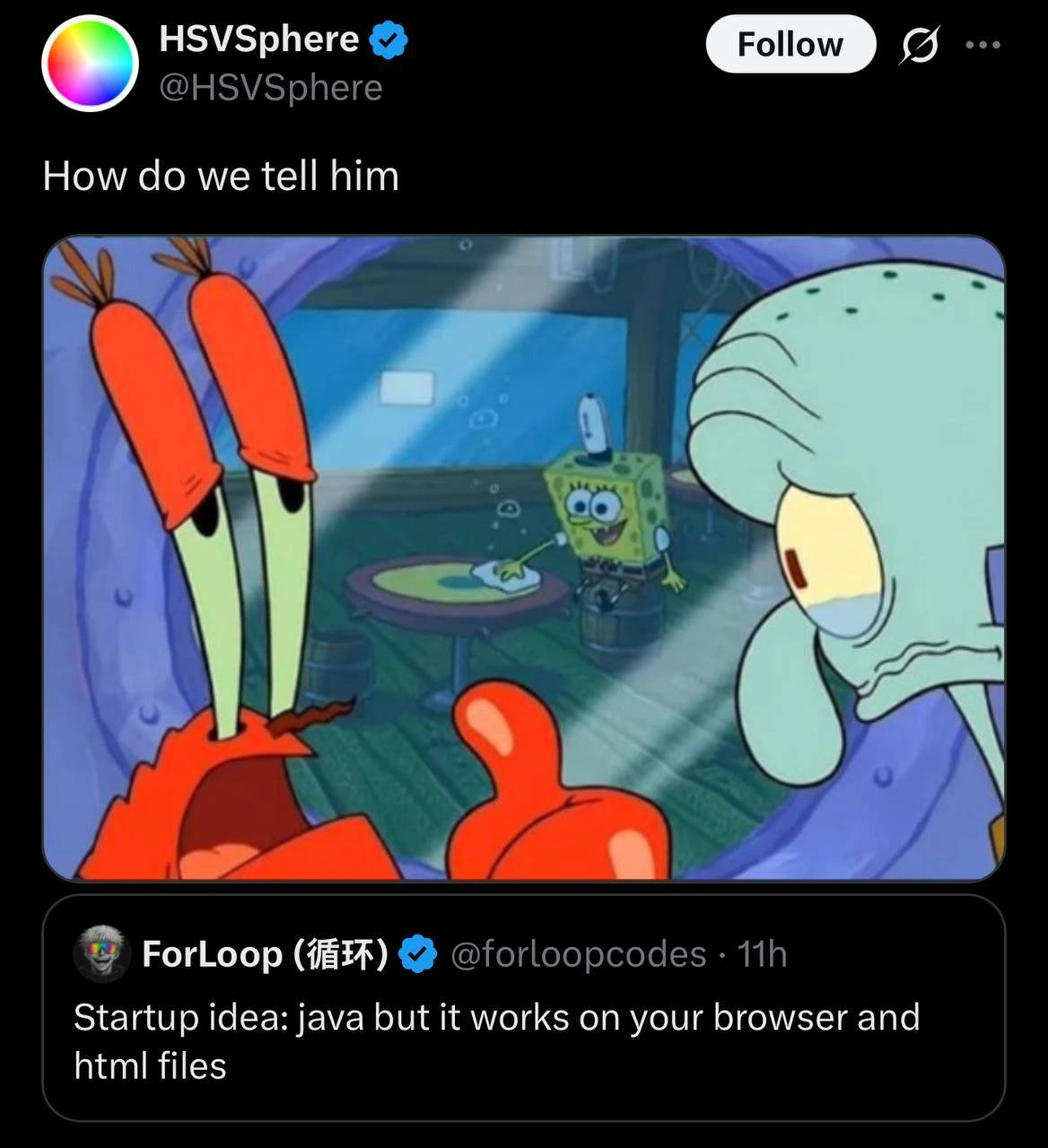
Let’s break down why this tweet is unintentionally hilarious for developers. The image is a screenshot of a Twitter post where the first user says, “How do we tell him”, and shows a SpongeBob SquarePants scene. In that scene, Mr. Krabs and Squidward peer through a window at SpongeBob, who is inside happily cleaning a table. This is a popular meme format for someone blissfully unaware of a truth while others look on worriedly. Here, SpongeBob represents the excited person with the “great startup idea,” and Mr. Krabs/Squidward represent experienced folks thinking, “Uh oh, he doesn’t know...”
Now, the “startup idea” quoted in the tweet is: “java but it works on your browser and html files.” To a non-developer, that might sound reasonable—Java is a programming language, browsers show web pages, so why not have Java work directly in the browser? But to any web developer, this statement raises a big red flag because it’s basically describing JavaScript. Here’s why:
- Java (the language) and JavaScript (the language used in web pages) are two entirely different things. Despite the confusing names, JavaScript was not built on Java. In fact, JavaScript was created independently and only named “Java-something” as a marketing gimmick when it launched in 1995 (Java was very trendy then).
- Java is typically used for building larger applications: think of Android apps, enterprise servers, or desktop programs. It’s a compiled language, meaning you write Java code, then you compile it (translate it) into bytecode that runs on the Java Virtual Machine (JVM). In the past, you could run Java in the browser using Java applets, but that required a special plugin and has since fallen out of favor and support.
- JavaScript, on the other hand, was designed specifically to run inside web browsers. You write JavaScript code and embed it directly into HTML files using
<script>tags. The browser’s JavaScript engine (like V8 in Chrome or SpiderMonkey in Firefox) then reads and executes that code on the fly. No separate compilation step that the developer has to do – the browser handles it. JavaScript is what makes web pages interactive (dropdown menus, animations, dynamic content updates, etc.).
So when the tweet says “Java, but works on your browser and HTML files,” it’s basically the textbook definition of JavaScript! It’s as if someone said, “I have an idea for a new food: a round bread with tomato sauce and cheese, cooked in an oven,” not realizing they just described pizza. The seasoned developers are those people who’ve been cooking pizza for years, now hearing it described as a novel invention. That’s why Mr. Krabs and Squidward look mortified – they’re thinking, “This poor guy has no clue that what he’s proposing already exists and is universally used.”
This ties into a concept developers jokingly call “Not Invented Here Syndrome.” That’s when a person or company prefers to create a new solution from scratch rather than using an existing one, often out of pride or ignorance of the existing solution. In newbie cases, it’s often innocent: the person just didn’t know the tool was already out there. Here the “startup idea” person probably isn’t aware that every browser since the ’90s has had the ability to run code in HTML files – using JavaScript. The Twitter user HSVsphere captioned it “How do we tell him” because it’s a delicate situation: you don’t want to crush the newbie’s enthusiasm, but you also kind of need to inform them that their great idea is nothing new.
For context, web developers have long dealt with confusion between Java and JavaScript. It’s practically an initiation joke in programming circles. Someone might say “I know Java, so JavaScript should be the same thing, right?” and we have to gently explain that aside from a few syntactic curly braces, they’re very different worlds. Java is to JavaScript as a film camera is to a webcam – the names sound related, but they serve different purposes and belong to different eras of the web. JavaScript was built for immediacy in web pages (no compiling step for the coder), and it’s the only scripting language that works natively in all browsers. Over the years, people have created tools to use other languages for web development – for example, TypeScript (which is like a stricter form of JavaScript) or transpilers that convert Java code to JavaScript – but under the hood, it all ends up as JavaScript in the browser because that’s the language browsers understand.
So, summarizing the meme in plain terms: an individual suggests making a “Java for browsers” without realizing that browser-Java already unofficially exists as JavaScript. The SpongeBob meme format perfectly captures the mix of amusement and horror from those in the know, who are figuring out how to break it to him gently. In developer humor, this is a classic case of accidental reinvention – coming up with an idea that’s already ubiquitous. It’s funny to developers because we’ve all either been that guy or seen that guy before. Early in your coding journey, it’s easy to suggest something only to have a mentor or coworker say, “Um, we’ve had that for years.” This meme just amplifies that moment in a colorful, nostalgic way.
Level 3: The ’90s Called
Seasoned developers can’t help but chuckle (or groan) at this “startup idea” because it’s basically describing JavaScript – a technology from 1995 – as if it were brand new. The tweet says “Java but it works on your browser and html files,” which is literally the original vision of JavaScript. Back in the mid-’90s, Netscape created JavaScript (originally named LiveScript) to let web pages run code in the browser. They even slyly rebranded it with “Java” in the name to ride Java’s hype, despite JavaScript and Java being entirely different beasts. Here we are, nearly 30 years later, and someone’s unknowingly pitching “Java, but in the browser!” Seasoned engineers seeing this naturally think, “1995 called – it wants its idea back.”
The humor is a perfect storm of historical irony and the classic Not Invented Here Syndrome. Mr. Krabs and Squidward in the SpongeBob image represent veteran devs looking in horror (and pity) at SpongeBob – the oblivious enthusiast happily “cleaning a table” (or in this case, happily pitching an accidental reinvention of the wheel). Their facial expressions scream: “How do we tell him... it already exists?” It’s a scenario many senior developers recognize: a newcomer excitedly proposes a brilliant new solution without realizing the industry solved (and sometimes abandoned) that exact idea decades ago. The not-invented-here flavor comes from the startup vibe – tech startups often try to “disrupt” by reinventing tools from scratch, sometimes painfully unaware that there’s already a standard tool or library for that. This tweet nails that trope: the person thinks they have an innovative pitch, but veterans know it’s basically just JavaScript with extra steps.
There’s also the long-running Java vs. JavaScript confusion being poked at. By saying “Java but for the browser,” the poster unknowingly references the common newbie mistake of assuming JavaScript is to Java what a little brother is to an older sibling. It’s the name collision fiasco that has caused endless misunderstanding: despite the naming, Java and JavaScript are about as related as a car and a carpet. The meme takes this further – the poor soul doesn’t even say “JavaScript,” they describe it as if inventing it fresh. It’s a comedic reminder that branding and history in tech can mislead folks. Veterans recall that Java applets (circa late ’90s) actually were “Java in the browser,” and they died off for good reasons (security issues, clunky plugins, user annoyance). Meanwhile, JavaScript quietly became the lingua franca of WebDev, precisely because it natively works in HTML without extra plugins. So when an eager mind proposes “Java, but it runs in your browser and HTML files,” the seasoned crowd cringes affectionately – we’ve been down that road before.
From a senior perspective, the meme is also a commentary on how tech history repeats itself. We’ve seen countless frameworks and languages created to run other languages in the browser. Remember CoffeeScript or Dart or TypeScript? Each was essentially “let’s make a better JavaScript,” and yet under the hood they all transpile to plain old JS because browsers only understand JavaScript (until WebAssembly showed up, but that’s another story). This tweet’s idea is the inverse: “let’s make Java run in the browser” – which experienced devs know either ends up as a Java-to-JavaScript compiler or a heavy plugin… in short, not a new startup, just history on repeat. The SpongeBob scene encapsulates that collective eye-roll: Squidward (the cynical coworker) and Mr. Krabs (the money-minded boss) exchange a panicked look, as if saying, “Please no, not this again.” It’s funny because it’s too real – every few years someone suggests a grand idea that’s literally a blast from the past, and the hardest part is gently explaining, “Buddy, we already have that.”
Description
Screenshot of an X (Twitter) post by @HSVsphere reading “How do we tell him,” followed by the familiar SpongeBob still where Mr. Krabs and Squidward stare through a porthole at SpongeBob happily wiping a table inside the Krusty Krab. Beneath the cartoon image is a quoted post from @forloopcodes saying, “Startup idea: java but it works on your browser and html files.” The humor comes from the oblivious ‘startup idea’ that unknowingly describes JavaScript, while the characters’ worried faces capture seasoned engineers’ horror at yet another reinvention of a 1995 technology. For developers, it’s a perfect storm of name-collision history (Java vs. JavaScript), web-dev nostalgia, and classic “not-invented-here” syndrome
Comments
33Comment deleted
Sure, call the seed round ‘Series 4.0 - because we’ve been shipping this exact polyfill since Netscape Gold.’
Somewhere in the afterlife, Brendan Eich is watching someone reinvent JavaScript while James Gosling mutters 'We tried browser Java, it had more security holes than a Swiss cheese firewall and took longer to load than a Maven build with a corrupted .m2 directory.'
This is the software equivalent of pitching 'email but for computers' to a room full of CTOs. The beautiful irony here is that Java applets were actually a thing in the 90s - complete with security nightmares and the dreaded browser plugin prompts - before being ceremoniously deprecated. Meanwhile, JavaScript literally *is* 'Java but it works in your browser' (naming confusion aside), making this startup pitch a perfect storm of reinventing two wheels simultaneously: one that already crashed and burned, and one that's currently running the entire modern web. It's like proposing to disrupt the transportation industry by inventing 'a horseless carriage' at a Tesla shareholders meeting
Their 'full-stack Java' MVP: browser JIT hangs longer than a COBOL mainframe outage
Great pitch - most of us call it JavaScript (née LiveScript); if you really want Java in the browser, ship GWT/TeaVM and tell the board it’s a WASM roadmap
The ‘startup idea’ is just JavaScript with a new label; the real work is explaining prototypes, a single‑threaded event loop, DOM APIs, and why class in JS is mostly syntactic sugar to every VC
We tell the creator of the meme that JavaScript is to Java what carpet is to car Comment deleted
Pet? Comment deleted
carpet inherits car carpet.honk() Comment deleted
Then why it is called like this? Of course cock is not related to cockroach but sometimes you have a thought Comment deleted
Because Java was popular at the time JS was created. Just like when cockroaches were named, cock was very much in fashion Comment deleted
Never thought i will read something like this Comment deleted
Greatest statement ever! Comment deleted
I think cock was popular when JavaScript was created as well... explains a lot tbh Comment deleted
We already tried Java in the browser Comment deleted
While applets were cursed ActionScript/Flash was great! Especially for security researchers 🌚 Comment deleted
Startup idea: Java, but not covered by Sun patents. Comment deleted
OpenJDK? Comment deleted
Microsoft JVM and Visual J++ No, just kidding. Microsoft.NET Comment deleted
EEE Comment deleted
wtf Comment deleted
https://cheerpj.com/cheerpj-3-1-released/ Comment deleted
Was about to post this, lol… we’ve come full-circle Comment deleted
Kill it! Kill it with fire! Comment deleted
Btw, is there a webassembly version of react native already? Comment deleted
why would it ever be useful Comment deleted
The question shouldn’t be “why?” But rather “why not?” Comment deleted
that sort of thing is why we have tons of incompatible frameworks and languages Comment deleted
JSP my beloved 😂😂😂 Comment deleted
Pizdec Comment deleted
Is that the freddy fazbear Comment deleted
har har har Comment deleted
wasn't it called applet or something? Comment deleted