Formal QA vs. The All-Seeing Production User
Why is this QA meme funny?
Level 1: Hidden Mess
Imagine you spent all day cleaning your room and you think you got everything spotless. You put away the toys, made the bed, and couldn’t see any dirt anywhere – you’re pretty sure the room has zero mess left. Proudly, you call your parent or a friend to come see. They walk in, take one look, and immediately point out a bunch of things you missed: a sock under the bed, dust on the top of the bookshelf, a comic book tucked behind the couch cushion. Oops! They found ten messy things in five seconds, even though you were so sure the room was perfectly clean.
This meme is just like that, but for a computer program instead of a room. The people who tested the program (like you cleaning your room) thought they found and fixed all the bugs (which are like little mistakes or messes in the code). They say, “All clear, no more problems here!” But then as soon as a regular user starts using the program (like your friend walking into the room), they quickly notice a whole bunch of problems that the testers didn’t see. It’s funny and a bit frustrating – kind of like laughing at how you could miss that obvious sock on the floor.
In simple terms, it’s showing that sometimes we think a job is done perfectly, but another person can instantly spot issues we overlooked. In the end, it makes us smile because we’ve all been there: whether it’s cleaning a room or making software, the real test is when someone else checks our work!
Level 2: Production Surprises
Let’s break down what’s happening in this meme in simpler terms. It’s contrasting two scenarios: testing in the lab vs. what happens when real users get the software.
QA (Quality Assurance) testers are people who try to find bugs (errors or defects in software) before the software is released to the public. They follow test protocols, which are like step-by-step checklists or scripts of things to try. For example, a test protocol for a login feature might be: “Try logging in with a correct password – expect success. Try with a wrong password – expect an error message.” Testers execute these planned tests carefully. When the meme says “Testers executing detailed protocols and reporting no more bugs,” it means the QA team went through all their planned tests and didn’t find any remaining issues. In other words, from their viewpoint, the software passed all the tests and is ready for release.
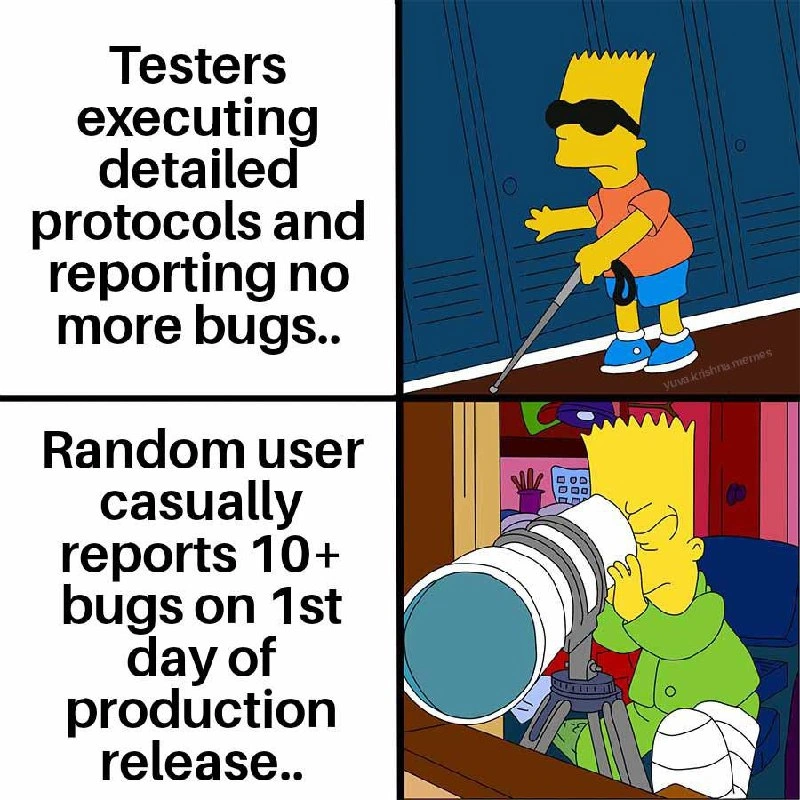
The image paired with this caption is Bart Simpson wearing dark sunglasses and tapping around with a white cane, like a blind person. This is a humorous way to suggest the testers might have missed something obvious – they were effectively “blind” to the bugs that are still in the product. (No offense to testers – it’s an exaggeration for comedic effect!). It implies maybe the testers only looked exactly where they were directed (followed the scripted tests exactly), and didn’t see problems outside those narrow paths.
Now, the bottom part: “Random user casually reports 10+ bugs on 1st day of production release.” Production refers to the live environment where real users are using the app after deployment. So day 1 of production release means the very first day actual users get their hands on this new version of the software. And lo and behold, some random user immediately finds more than 10 bugs without even trying hard! This is the nightmare (and dark comedy) of every software team: you think the product is solid, but as soon as it meets the real world, things start breaking left and right. A user report here could mean they’re emailing support, creating bug tickets, or posting on forums about issues they found.
The image with this caption shows Bart Simpson again, but this time he’s in green pajamas with his foot in a cast (like he’s been hurt) and he’s squinting through a huge telescope. This visual gag suggests that the user, despite being “casual”, somehow had a very keen eye (telescope) and managed to spot a bunch of problems. The bandaged foot could imply the user “got hurt” by those bugs (not literally, but maybe their experience was broken or they encountered errors). It’s like the user is doing a thorough inspection of the software (with the telescope) and immediately sees issues everywhere – things that the testers, even with their detailed plans, failed to notice.
So, why would a user find bugs that testers didn’t? A few key reasons in plainer terms:
- Users do unexpected things: Testers test what they planned to test. But real users might use the software in a way nobody thought of. For example, maybe the app was only tested with normal English letters, but a user enters their name with an emoji or with accents (like “José 💖”). Suddenly, a bug appears (perhaps the profile page crashes because of the emoji). The testers weren’t “looking” there, but the user just did it naturally.
- Different environment or data: The testing was done on a test server with test data. Production is the real deal – perhaps there’s a lot more data, or slightly different configurations. Imagine the app works fine when 100 test users are on it, but when 10,000 real users come in, it slows down or starts timing out. That wouldn’t show up in testing with few users. Or maybe testers always used a valid address in an e-commerce checkout test (like “123 Main St.”). But a real user left the address field blank by mistake, and that caused a bug (the app never anticipated an empty address).
Let’s illustrate a simple example with a bit of pseudocode: imagine a function that ships an order to an address:
function shipOrder(address) {
// Developer assumes address is a non-empty string
return "Shipping to " + address.toUpperCase();
}
// QA used a normal address in every test case:
console.log(shipOrder("123 Elm Street"));
// Output in testing: "Shipping to 123 ELM STREET" (looks fine)
// Real user leaves the address empty on the form:
console.log(shipOrder(""));
// Output in production: "Shipping to "
// Oops! The address is missing – a bug that was missed in QA.
In the above code, QA testers never thought to try an empty address, so the function bug (not handling an empty string) wasn’t caught. The first real user who accidentally submits without an address effectively becomes a bug finder. This is how a “casual user” can trip over things that a focused tester might overlook.
Another term you might hear for those overlooked scenarios is edge cases or corner cases – these are unusual situations or extreme cases that aren’t covered by the normal test scenarios. Testers do try to think of edge cases, but you can’t catch everything. There’s also something called exploratory testing, where testers intentionally stray from scripts to see if they can break the system in creative ways, more like a user would. Not all testing teams have time for that, though.
The meme is essentially pointing out the classic testers vs. users dynamic. Testers are professionals guided by certain expectations and plans. Users are out in the wild, unguided. To use a loose analogy: testers might walk a mapped trail (checking that the trail is clear), whereas users will wander off-trail into the forest and instantly discover the swamp and the hornet’s nest that nobody checked. 😅 In software terms, the hornet’s nest is all those bugs found on day one in production.
For someone early in their developer career, this meme is a reminder of a few lessons:
- No matter how well you or your QA team test your code, once it’s out there, real people may use it in ways you never expected. So be prepared for production issues even after a “clean” test cycle.
- It’s important to test beyond the happy path. The happy path is when everything is done correctly (users follow instructions, inputs are correct). Always consider “What if the user does something wrong or weird here?” because they certainly will at some point.
- Having good logging and monitoring in production is helpful. If a user finds “10+ bugs” on day one, you want to be able to quickly see what went wrong. This is why developers often stay alert after a big deployment – we watch the system for any error spikes or weird behaviors (because we kind of expect that something might have been missed, exactly like this meme scenario).
- Lastly, don’t be too confident just because all tests passed. Celebrate a successful QA phase, but release software with a dose of humility. As this meme humorously shows, the real world can surprise you. It’s not that the testers were bad at their job; it’s that software and user behavior are complex. Unexpected bugs in software happen to everyone, and the true measure is how quickly and gracefully you handle them when they do pop up.
And of course, the use of Bart Simpson in the images adds a fun pop-culture touch. Bart is a well-known cartoon character from The Simpsons, often associated with mischief and comedic situations. Using Bart in both frames drives the point in a lighthearted way: in one frame he’s essentially “not seeing any trouble” (literally acting blind), and in the next he’s “seeing all the trouble” through a telescope. It’s a visual punchline that pairs perfectly with the text. For a new developer or anyone, the takeaway is clear and comical: testing in the lab is important, but the real test is when the product meets the real world. Be ready for those surprises!
Level 3: Happy Path Blindness
This meme hits home for seasoned developers and testers by highlighting the gap between the QA process and messy real-world usage. In the top half, we have Bart Simpson – clad in sunglasses and tapping a cane like he’s blind – representing testers who believe they’ve caught every bug. The caption "Testers executing detailed protocols and reporting no more bugs..." drips with irony. It’s a sharp jab at how even diligent QA can develop blind spots. Often testers follow scripted test cases (the detailed protocols), focusing on expected use-cases and requirements – the classic happy path where users do everything correctly and as predicted. And on that happy path, everything might indeed look perfect (all tests green, QA sign-off achieved).
But then comes the bottom half: Bart in his green pajamas, foot in a cast (injured, perhaps by those very bugs), peering through a giant telescope. The caption reads "Random user casually reports 10+ bugs on 1st day of production release." This is painfully funny to any developer who’s been on-call during a launch. It’s the quintessential “It worked in QA, what happened in prod?!” moment. The random user – unlike testers – isn’t sticking to the script; they click the unclickable, input weird data, or just have a unique environment. In meme terms, the user is eagle-eyed (telescope) compared to the blind testers. Of course, the users weren’t trying to break things on purpose (usually), they’re just using the software naturally – and that naturally uncovers all the unexpected production bugs that QA never anticipated.
This scenario is a staple of TestingHumor in the industry because it happens so often it’s almost a rite of passage. We’ve all heard of or experienced a story where “QA found zero defects” before launch, yet within hours of going live real customers stumbled on a critical bug. Cue the urgent patch releases and late-night deployments. It’s funny in hindsight (and as a shared meme), but in the moment it’s high stress. Developers feel DeploymentAnxiety knowing that no matter how many tests passed, something could blow up once exposed to real users. Testers might feel frustrated or embarrassed – did they really miss that? And the project managers or execs are left scratching their heads, asking how our robust QA process signed off a release that instantly turned into a bug hunting safari for users.
Why do these gaps happen? Seasoned folks know a few common culprits:
- Happy-path bias: Testers often focus on verifying the application works as intended for typical scenarios (login with valid credentials, checkout with valid credit card, etc.). They might not try intentionally wacky or incorrect inputs unless it’s in the test plan. Meanwhile, a real user might, say, use an emoji in their username, or attempt a flow no one considered. Suddenly the app freaks out. QA was effectively blind to that edge case, just like Bart tapping around with a cane.
- Limited test data and environment: QA environments often have sanitized, small datasets. In production, you get extremes – giant usernames, millions of records, bizarre config settings. For example, the app might have sailed through QA with 100 test accounts, but in production a user with a 10-year-old account (with legacy data) finds a bug in profile loading. Or the test servers might not mirror the exact production configuration, so a feature that worked fine in staging hits a permission issue or a case-sensitivity problem on a production database. It’s the classic “Works on my machine” syndrome scaled up to “Works in test lab, fails in real life.”
- Time and resource constraints: Let’s face it, release cycles are often rushed. QA might have reported bugs that were deferred or deemed minor (“we’ll fix it in next version”), or they simply didn’t have time to do exhaustive regression testing on every permutation. Under deadline pressure, testers execute the core test suite and if nothing major shows up, that release gets a “zero known defects” rubber stamp. It’s not that QA intentionally misses bugs; it’s that exhaustive testing is a luxury. As a result, certain paths remain untested until users hit them.
- Psychological factor: There’s an implicit bias when you know how something is supposed to be used – you might unknowingly avoid breaking it. Testers, being insiders, have assumptions about the product. A random user has no such loyalties; they’ll happily click the wrong button, refresh at the worst time, or use the UI in a creative way. In other words, users excel at finding edge cases because they don’t know where the edges are. This meme perfectly captures that dynamic: Bart-the-tester confidently says “no bugs here” while Bart-the-user immediately finds plenty, simply by wandering outside the neat little path the testers envisioned.
For senior engineers, this meme might also evoke the idea that real Quality Assurance doesn’t end when the code ships – it begins when users start interacting with it. We often joke that our production users are the final QA team (albeit involuntarily). That’s why concepts like canary releases or beta testing exist: to expose software to a small subset of real users and catch those “10+ bugs on day one” in a safer way. It’s also why logging, monitoring, and quick rollback strategies are vital – because you assume something will slip through. As much as we want to believe in “zero defects,” the veteran’s perspective is that zero reported defects just means the bugs haven’t been found yet. The meme’s exaggerated contrast (literally blind vs. telescope) pokes fun at that eternal optimism of QA sign-off versus the harsh reality of user feedback.
In sum, this meme resonates as bugs in software folklore. It’s a wry commentary on the fallibility of our testing processes. The humor carries a hint of trauma: every experienced dev/QA has that story of a production issue that made them facepalm, saying “How did we miss that?!” It reminds us not to get complacent with a green test suite. Or as a cynical veteran might quip when seeing a “0 bugs” QA report: “Alright, who’s ready for some DebuggingFrustration in production tomorrow?” The laugh comes with a wince, because we’ve been there. This shared understanding is exactly what makes the meme so relatable in the tech community’s QA process and TestingHumor circles.
Level 4: QA’s Halting Problem
At the most theoretical level, this meme underscores a fundamental software testing dilemma: you can never conclusively prove a program has zero bugs by testing alone. The top panel’s claim of "no more bugs" is a tongue-in-cheek impossibility in computer science – akin to solving the halting problem for every code path. Why? Because the state space of non-trivial software is combinatorially explosive. Even a modest web app can be fed with countless inputs, interactions, and timing variations. Testing every possible combination is computationally infeasible – the number of scenarios grows exponentially (or worse) with each new feature or input field. This is sometimes jokingly framed as an NP-hard problem: finding all those sneaky bugs is like searching for a needle in an exponentially expanding haystack.
In formal terms, program testing can show the presence of bugs, but never their absence. You might recognize Edsger Dijkstra’s famous dictum here. QA can run a million test cases and still not touch that million-and-first scenario which hides a crash. Proving absolute correctness would require techniques like formal verification, where software is treated like a mathematical proof. While formal methods are used in safety-critical systems (e.g. avionics, cryptographic algorithms), they demand complete specifications and astronomical effort. For everyday apps, we rely on heuristics: a suite of unit tests, integration tests, and manual QA protocols that hopefully cover the most important cases. But as this meme humorously shows, those protocols are never exhaustive – something always lurks outside their scope.
There’s also the pesticide paradox: if you run the same scripted tests over and over, eventually the software “pesticide” kills the bugs those tests can catch, and no new bugs are found – not because there are none left, but because any surviving bugs are immune to those particular tests. Unless tests are constantly updated (like introducing new “pesticide” formulas), the test suite stagnates. In the meme, the testers executed detailed protocols (probably the same routines they’ve run release after release) and found nothing – a classic pesticide paradox scenario. Meanwhile, real users hit the application with fresh behaviors, instantly exposing an entire zoo of bugs that thrived outside the lab’s narrow pesticide spray.
From a systems theory view, production environments are chaotic and non-deterministic compared to controlled test labs. Minor differences in data volume, timing, or user behavior can amplify into major failures – a bit like the butterfly effect in chaotic systems. Some bugs only manifest under high concurrency or at scale (think race conditions or memory leaks), which a small-scale QA environment might never trigger. These are the infamous Heisenbugs that hide until observation conditions change (e.g., they disappear when you run a debugger, but appear in the wild). The meme’s telescope-wielding Bart – spotting issues from afar – hints that only under the broad, unblinking gaze of real-world usage do certain issues crystallize into view.
In summary, the meme humorously taps into deep truths: testing is inherently a sampling of possibilities, not a proof of perfection. To truly have “zero defects,” one would need a perfect understanding of every possible user action and system state – effectively a computational oracle. Since oracles (and magic wands) are in short supply in QA departments, we inevitably miss something. Ergo, “zero bugs” in QA is a tongue-in-cheek claim, eliciting knowing groans from experienced engineers who’ve learned that production is the only place where zero bugs might briefly exist – right before the first user logs in.
Description
A two-by-two panel meme using stills of Bart Simpson from The Simpsons. The top-left panel contains the text: "Testers executing detailed protocols and reporting no more bugs..". The top-right panel shows Bart Simpson wearing sunglasses and using a cane as if he is blind, feeling his way along school lockers. The bottom-left panel reads: "Random user casually reports 10+ bugs on 1st day of production release..". The bottom-right panel shows Bart looking intently through a large telescope. The meme humorously contrasts the perceived thoroughness of formal QA testing with the reality of software in a production environment. It jokes that even the most detailed, scripted testing can be blind to issues that real users, with their unpredictable and varied usage patterns, will uncover almost immediately

Comments
15Comment deleted
Testers are trained to see if the application works as intended. Users are gifted at discovering all the ways it works as unintended
QA’s script hit the happy path; our first production user hit Ctrl-F5 in a São Paulo timezone, pasted an emoji into the username field, and uncovered a distributed NullPointerException that spanned three microservices and my weekend
After 15 years in the industry, I've learned that the most sophisticated chaos engineering setup is still no match for Karen from accounting who somehow manages to trigger race conditions by double-clicking everything while running 47 browser tabs on her 2012 laptop with a VPN that routes through three continents
This perfectly captures the eternal truth that your test environment and production are like parallel universes - one where everything works flawlessly with your carefully curated test data and controlled scenarios, and another where users immediately discover that edge case involving a leap year, daylight savings time, and a null pointer you never imagined could coexist. It's not that QA didn't test thoroughly; it's that production users have an uncanny ability to do exactly the one thing you never documented in your 47-page test plan, usually within the first 10 minutes of release
100% coverage of the happy path; day-one users exercised the other 2^N-1 paths with a VPN, an ad blocker, flaky WiFi, and an expired SSO token
QA: “all green” with mocks and happy‑path scripts; day one a random user on 3G with 150% zoom, Turkish locale, and a stale OAuth token double‑clicks checkout - accidentally runs the chaos test suite and finds ten
QA's protocols blindside bugs; users' chaos theory exposes them on day zero
Very accurate, our bias literally blinds us to how users would use the application sometimes Comment deleted
We assume they use it in a normal way Comment deleted
QA team: delays a minor (x.Y) release 1 year after the previous one, polishing the product. User (me): reports a bunch of bugs with varying severity level just after installing the product and running it for the first time, without even digging down into the specific functions. What am I doing wrong? 🤔 Comment deleted
Shocking but devs don't have your system or your setup, and can't possibly think of every way someone will use something improper or not Comment deleted
Surprising enough, the devs I was talking about had exactly the same hardware (that is not just the same processor and motherboard, but the whole computer system). And, again, I was talking about the bugs that surface right at the installation stage and after the launch — not when doing something specific. Comment deleted
That's why formal methods are superior Comment deleted
That's the point: testers job is to think outside of "normal" way. That is developers job as well, but only if it is mentioned in requirements. 😁 Comment deleted
nope. not bias, just narrow mindness. Comment deleted