Skip to content
DevMeme
4045 of 7435
Network pros nail the RJ45 wiring joke on a CompTIA guide
Networking Post #4409, on Jun 5, 2022 in TG

Network pros nail the RJ45 wiring joke on a CompTIA guide

Why is this Networking meme funny?

Level 1: Hidden Color Code

Imagine you have a secret pattern that only your group of friends knows. For example, maybe you and your friends decided that lining up crayons in a certain color order sends a special message that means “hello” or “we’re the cool club.” Now picture seeing a photo where someone painted their fingernails with those exact crayon colors in the exact order. You and your friends would giggle because you instantly recognize the secret message, even though everyone else just sees pretty colors.

That’s what’s happening here. The person in the photo painted a very specific color code on their nails – it’s the pattern of wires inside an internet cable. Only people who learned about how internet cables are made will see it and laugh, kind of like a hidden handshake. To everyone else, it’s just a set of rainbow-striped nails. But to networking folks, those colored stripes say, “I know the cable secret!” and that’s what makes it funny and special.

Level 2: Color-Coded Cables

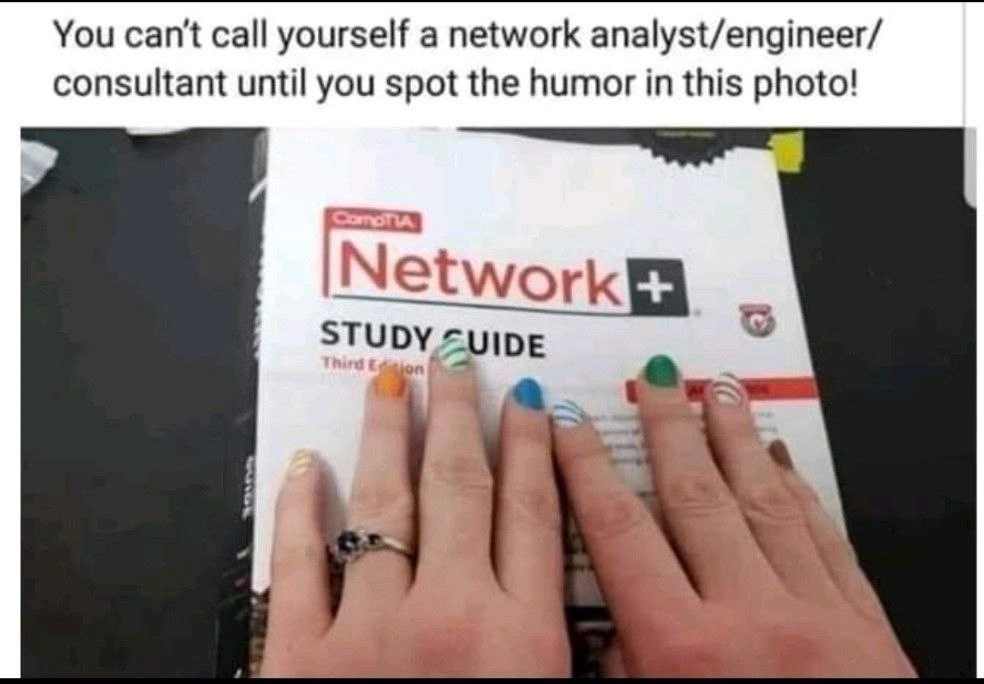
Let’s unpack the joke in simpler terms. The photo is of a CompTIA Network+ Study Guide, a book that helps people learn to become network technicians or engineers. On top of the book, someone has their hands visible, and each fingernail is painted with colored stripes in a very specific order. Those colors are not random – they’re actually the standard color order of wires inside an Ethernet cable. In networking, the typical cable that connects your computer to a router (using an RJ45 plug) has 8 tiny wires, twisted into 4 pairs, each pair having its own color scheme. For example, one pair of wires is orange/white-orange, another pair is green/white-green, then blue/white-blue, and brown/white-brown. When technicians assemble or repair these cables, they have to put the wires in a certain sequence so that both ends match up and data can travel correctly. One common standard for the sequence is called T-568B. The nails in the photo show the T-568B sequence perfectly: starting from one side it goes white-orange, orange, white-green, blue, white-blue, green, white-brown, brown across the fingers.

So why is that funny or notable? Well, if you’re new to networking or studying for a certification like Network+, one thing you learn is exactly this kind of wire color order. It’s the sort of detail you might have to memorize for an exam or recall when crimping an Ethernet cable by hand. Usually, this info lives in diagrams or flash cards – not on someone’s fingernails! By painting the nails with the Ethernet nail art of the RJ45 wiring, the person is making a nerdy inside joke. They’re saying, “I know this technical detail so well, I can put it on display.” The humor comes from the fact that only people who have that same knowledge will understand the reference. It’s a bit like a secret message. The caption even teases the reader, saying you can’t call yourself a network analyst or engineer unless you spot what’s special about the photo. In other words, if you recognize the nail colors as the Ethernet cable pattern, you’re in the know. If you don’t, then the joke sails over your head.

In plain terms, think of it this way: Networking pros deal not just with software, but also with physical cables. They often need to ensure cables are made correctly, which means knowing pin layouts and color codes. RJ45 is the rectangular connector used for Ethernet cords (it looks like a big phone plug) and it has 8 pins. Each pin is connected to a wire of a specific color. The order of those colored wires is standardized so that every cable is wired the same way (this avoids chaos like mismatched connections). Two main wiring standards exist (called T-568A and T-568B), and the book in the photo likely covers both. T-568B is commonly taught and used, and that’s the one displayed on the nails. So, a junior network technician or a student reading that study guide would immediately recognize, “Hey, those nails are in the exact pattern I just studied!” It’s a cool way of blending Certifications knowledge with everyday life – literally wearing your knowledge on your nails. This gives newcomers a chuckle and a sense of camaraderie: it’s saying, “We’ve all had to learn this obscure color code, and now it’s our little joke.”

Level 3: Nailing the Pinout

"You can’t call yourself a network analyst/engineer/consultant until you spot the humor in this photo!"

For a seasoned network engineer, that caption is a challenge – and the answer lies right at your fingertips (literally!). If you glanced at those painted nails and immediately recognized the RJ45 cable color pattern, congratulations: you’re fluent in the secret language of network cabling. The joke here is a classic bit of Networking humor. Those manicured nails aren’t just pretty – they’re painted with horizontal stripes matching the exact eight-wire color sequence of a standard Ethernet cable using the T-568B wiring scheme. That’s right: white-orange, orange, white-green, blue, white-blue, green, white-brown, brown – the precise order every network tech memorizes when crimping an RJ45 connector.

This meme brilliantly turns dry cable standards into an inside joke. The photo shows a CompTIA Network+ study guide, implying someone deep into certification prep. And instead of highlighting key facts in the book, they’ve highlighted them on their nails! It’s a playful brag: “I know my cable pin-outs so well, I can wear them.” In the world of NetworkEngineering, knowing your cable colors is like knowing your alphabet – it’s fundamental tribal knowledge. By painting the T-568B color code on their nails, the creator is effectively giving a wink to every network pro: if you instantly notice the pattern, you’ve basically passed the “Are you one of us?” test. It’s the tech humor equivalent of a secret handshake among IT folks.

Why is this funny to insiders? Because anyone who’s ever done CableManagement or built out a server room has likely spent time sorting tiny wires by color to make a proper Ethernet patch cable. If you’ve wrestled with a rat’s nest of cables, or painstakingly arranged conductors into an RJ45 jack at 3 AM, that color sequence is burned into your brain. Seeing it used as nail art is both absurd and genius. It’s absurd because, well, who paints networking standards on their body? Yet it’s genius because it instantly signals membership in the network gurus’ club. Only a true network consultant or analyst would look at this manicure and laugh out loud, because they nailed the reference. Meanwhile, everyone else just thinks it’s a rainbow manicure gone oddly specific.

There’s also a nod to certification culture here. CompTIA Network+ (the book on display) is an entry-level cert, and it drills candidates on essentials like cable types and connector pin-outs. Memorizing T-568B vs. T-568A color order is practically a rite of passage. (Fun fact: T-568A is a slightly different wiring order – swapping the green and orange pairs – but T-568B is more commonly used in the U.S., and it’s the pattern on these nails.) So the meme is basically saying: “If you’ve slogged through that study guide and earned your stripes (literally, stripe-white wires and all), you’ll get this joke.” It’s a lighthearted way of showing off hard-won knowledge. The combination of Ethernet wiring and fashion is so niche that recognizing it feels like solving a puzzle only insiders can solve. In short, the humor is layered (pun intended) across the OSI model’s Layer 1 (physical wiring) and the social layer of geeky camaraderie. If you spotted the T-568B Easter egg on those fingertips without being told, go ahead and call yourself a network engineer – you’ve earned it!

Description

The meme shows a photograph of a "CompTIA Network+ STUDY GUIDE Third Edition" textbook lying on a dark surface. Across the cover, two hands rest with manicured fingernails; each nail is painted in horizontal stripes exactly matching the eight-wire RJ-45/T-568B Ethernet color order (white-orange, orange, white-green, blue, white-blue, green, white-brown, brown). A caption above the image reads, "You can’t call yourself a network analyst/engineer/consultant until you spot the humor in this photo!" The joke is that only someone experienced with network cabling standards will realize the nails replicate an Ethernet pin-out, turning a certification study guide into a visual inside joke. The reference speaks to CompTIA certification culture and the shared tribal knowledge of network professionals

Comments

40
Anonymous ★ Top Pick That T568B manicure is the only straight-through path I’ve seen today; everything else is stuck in a Layer-8 Spanning Tree loop called “management review.”
  1. Anonymous ★ Top Pick

    That T568B manicure is the only straight-through path I’ve seen today; everything else is stuck in a Layer-8 Spanning Tree loop called “management review.”

  2. Anonymous

    When you've been debugging network issues for so long that muscle memory kicks in and you start terminating your manicure in T568B standard

  3. Anonymous

    When your manicure doubles as a subnet mask for remembering the OSI model - because real network engineers know that troubleshooting always starts at Layer 1 (Physical), even if management insists it's a Layer 8 (user) problem. At least with this approach, you'll never forget whether DNS issues occur at Layer 7 or accidentally blame the cable again

  4. Anonymous

    Spotted it: the manicure’s wired T568B - flip one hand and you’ve got a crossover; pity our patch panel labeling isn’t this consistent

  5. Anonymous

    Spotted the T568B manicure - paint the other hand 568A, call it a crossover, and tell CAB it’s patch management

  6. Anonymous

    Nails with perfect pair coloring - unlike the cable management in my last DC rack

  7. 𝙳𝚖𝚢𝚝𝚛𝚘 𝙼𝚒𝚗𝚝𝚎𝚗𝚔𝚘 4y

    zeroth

    1. dev_meme 4y

      Good for you m8

    2. @sylfn 4y

      why not zeroth

      1. @RiedleroD 4y

        because he's not an actual programmer

      2. dev_meme 4y

        Because it's not c or sql

        1. @RiedleroD 4y

          or any other programming language besides lua and scratch?

          1. @sylfn 4y

            Pascal

          2. dev_meme 4y

            Hey hey scratch is my old love

            1. @RiedleroD 4y

              …come to think of it, I don't think scratch has arrays.

              1. 𝙳𝚖𝚢𝚝𝚛𝚘 𝙼𝚒𝚗𝚝𝚎𝚗𝚔𝚘 4y

                it has but they are called lists

              2. dev_meme 4y

                Arrays? I'm really bad at english

                1. 𝙳𝚖𝚢𝚝𝚛𝚘 𝙼𝚒𝚗𝚝𝚎𝚗𝚔𝚘 4y

                  array = масив

                  1. dev_meme 4y

                    Thanks

                  2. @sylfn 4y

                    *массив (ru)

                    1. 𝙳𝚖𝚢𝚝𝚛𝚘 𝙼𝚒𝚗𝚝𝚎𝚗𝚔𝚘 4y

                      i was writing in Ukrainian

                      1. @sylfn 4y

                        uh

          3. 𝙳𝚖𝚢𝚝𝚛𝚘 𝙼𝚒𝚗𝚝𝚎𝚗𝚔𝚘 4y

            and basic i think

            1. @kitbot256 4y

              Do we count Bash as a programming language?

              1. 𝙳𝚖𝚢𝚝𝚛𝚘 𝙼𝚒𝚗𝚝𝚎𝚗𝚔𝚘 4y

                idk

          4. 𝙳𝚖𝚢𝚝𝚛𝚘 𝙼𝚒𝚗𝚝𝚎𝚗𝚔𝚘 4y

            https://iq.opengenus.org/array-indices-start-from-1/

      3. @sylfn 4y

        (0th is original post then 1st is comment)

      4. 𝙳𝚖𝚢𝚝𝚛𝚘 𝙼𝚒𝚗𝚝𝚎𝚗𝚔𝚘 4y

        yes

  8. @RiedleroD 4y

    lmao the cable colors, I get it

  9. @iashchak 4y

    Cheat sheet

  10. @declonter 4y

    T568B detected

  11. @RiedleroD 4y

    …is that the same girl as in your pfp?

    1. @sylfn 4y

      probably yes

  12. @kitbot256 4y

    And next thing you see 100mbit on your 1gig cable, and OH MY GOSH WHAT COULD GO WRONG?

    1. @RiedleroD 4y

      write in english, please. It's in the rules.

      1. @SamsonovAnton 4y

        He said that such a connection technology is optimal for 100-megabit setups. 😆

      2. @kitbot256 4y

        This was almost English. Some letters were definitely English

        1. @RiedleroD 4y

          natürlich

  13. @SamsonovAnton 4y

    Hey, what if I am a carrier-grade routing and switching expert and don't care about those miserable LAN cables? Or what if I'm an all-optical adept and never make any trade-offs towards copper technology? (Just kidding, but anyway...)

  14. @FunnyGuyU 4y

    Difficulty level: harder

Use J and K for navigation