The Primal Urge to Tidy Up Bad Cabling
Why is this Hardware meme funny?
Level 1: The Human Machine
Imagine peeking inside a toy robot and seeing a bunch of colorful wires. Now imagine looking inside a human body and seeing a bunch of colorful tubes. This meme is joking that you are kind of like a machine, because you have “wires” inside you! Your blood vessels are like the little pipes in a house, carrying important liquids (blood) to where they need to go. And your nerves are like electrical wires that let your brain send messages to your hands, feet, and all other parts. We don’t usually think of ourselves this way, so it’s a silly surprise to realize we’re built with all these cables and tubes inside. In a way, it’s like saying people are nature’s version of a high-tech gadget – and that funny comparison is what makes us smile.
Level 2: Human Hardware 101
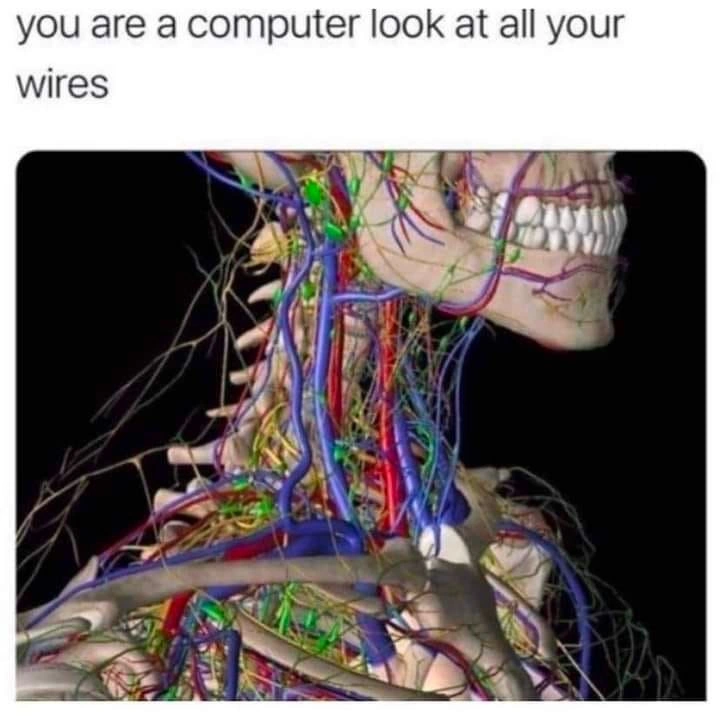
Let’s break down the analogy clearly. The meme is basically saying: a human body has wires just like a computer does. In the top text, “you are a computer look at all your wires,” it’s pointing out that our insides have lots of stringy, tube-like parts – very much like the colorful cables inside a PC tower.
In the image, the red tubes are arteries, the blue tubes are veins, and the thin green/yellow strands are nerves. Here’s what they do in real life, and their closest computer equivalents:
| Human “Wire” | Role in the Body | Computer Equivalent |
|---|---|---|
| Arteries (red) | Carry oxygen-rich blood from your heart to the body (delivering fuel and nutrients to tissues) | Power cables (carry electricity from a computer’s power supply to all the components) |
| Veins (blue) | Carry used blood back to your heart and lungs (taking away waste like CO₂) | Ground/return wires (carry used current back to the power source, completing the circuit loop) |
| Nerves (green/yellow) | Transmit electrical signals around your body (messages from brain to muscles, and sensations back to the brain) | Data/signal cables (like the wires that send information between a PC’s parts, e.g. USB or network cables) |
So in simple terms, your circulatory system (arteries & veins) is like the power supply network for a machine, and your nervous system (nerves) is like the communication network carrying data. The heart works like a power pump, pushing blood (fuel) through arteries to “power” your body, and the brain is like a processor sending commands and receiving input via the nerves.
Tech folks find this amusing because we usually think of our bodies as very different from machines. But if you’ve ever opened up a computer case, you see a bunch of color-coded wires running everywhere. Surprise – our body has a very similar look inside! It’s a fundamental analogy: both organisms and computers need ways to distribute energy and information. We have physical components in us that mirror some roles of a computer’s hardware.
The caption text drives the joke home: “YOU WANT TO PULL THEM OUT, YOU WANT TO RIP OUT THE COPPER WIRING.” Of course, no one actually wants to pull out their veins and nerves! This line exaggerates that moment of realization when a techie person sees the human body like a tangled circuit board. It imagines reacting to your own internal “wires” the way you might react to an old heap of PC cables – by yanking them out or trying to organize them. It’s an absurd thought (doing that to yourself would be deadly!), and that absurdity is exactly why it’s funny. It highlights how deeply the tech mindset can kick in: a developer sees those vein-like tubes and thinks of messy copper wiring that needs tidying up or maybe salvaging for spare parts.
In summary, the meme makes a simple but clever comparison: your body = a computer’s hardware. Once it’s pointed out, the visual similarity is hard to ignore – and that mix of surprise and silliness is what gets a laugh.
Level 3: Cable Management Instinct
For seasoned developers and hardware geeks, this meme hits that nerdy sweet spot. It bluntly declares: “you are a computer, look at all your wires” – and suddenly you can’t unsee it. Those red, blue, and green strands in the anatomical image look just like a PC’s messy wiring bundle. The humor comes from our techie habit of seeing human biology through a hardware lens. We spend our days dealing with motherboards and cables, so of course we’d compare arteries to coolant lines or power cables, and nerves to signal wires. It’s a classic human-computer analogy taken to an extreme: the body as a literal PC case full of colorful connectors.
The relatable developer humor here is that obsessive urge for cable management. If you’ve ever opened up an old server closet or a custom PC with tangled leads, you know the itch: you want to untangle and route everything neatly. Now imagine that feeling when you realize your own neck is basically a nightmare jumble of wires that nature put together without a manual. The meme’s all-caps caption (“YOU WANT TO PULL THEM OUT. YOU WANT TO RIP OUT THE COPPER WIRING.”) is an exaggerated internal monologue. It’s poking fun at that split-second thought a geek might have: What a wiring disaster – let’s re-route these! Of course, rationally we know those “wires” are vital blood vessels and nerves, not actual cables you can yank out. But the joke exaggerates the instinct: an engineer sees copper and immediately thinks about salvaging or rewiring it. It’s absurd and a bit dark… which is exactly why it’s funny.
This meme also tickles the perennial Hardware vs Software gag. As developers we joke about our “hardware” and “software” in human terms all the time: we say things like “my brain CPU overheated”, “I need to reboot with some sleep”, or “I’m running low on memory”. We’re used to anthropomorphizing our machines (“my computer is cranky today”) and, in reverse, mechanizing ourselves (“I need to recharge my batteries”). Here, the focus is purely on the hardware side of that analogy – no code or software in sight. It’s saying: forget philosophy or psychology, just look at the raw plumbing and wiring. Physically, we’re not so different from the devices we build! That’s both hilarious and a bit humbling for engineers who pride themselves on high-tech creations. Mother Nature’s biological hardware has been doing power distribution and signal busing for eons, and it still looks like spaghetti wiring!
Seasoned devs might also chuckle at the nod to “spaghetti code.” The image is literal spaghetti wiring, and yet it works flawlessly (most of the time). It’s like inheriting a legacy system with convoluted internals that somehow never crashes. There’s comfort (and comedy) in that parallel: our bodies are the ultimate legacy hardware, full of kludges and patchwork solutions (thanks, evolution), and yet here we are – running mostly bug-free. We laugh because we’ve seen those unruly systems in our work, and now we’re seeing one inside ourselves. It’s a reminder that sometimes “if it ain’t broke, don’t fix it” really does apply — even if the implementation is a ridiculous tangle of wires.
Level 4: Wetware Architecture
At the deepest level, this meme touches on the concept of wetware — treating biology as a form of computing hardware. In theoretical computer science and bioengineering, there’s the idea that a human’s nervous system and brain can be seen as an organic computer. The image humorously highlights this by showing a tangle of red, blue, green, and yellow “wires” inside a human neck and chest. These colored strands correspond to the networks of arteries (red), veins (blue), and nerves (the thin green and yellow fibers), which function like a biological wiring harness under our “chassis.”
From a CS fundamentals perspective, the analogy runs surprisingly deep. Each nerve fiber is akin to a signal wire in a circuit, carrying electrical impulses (action potentials) as information. The myelin sheath wrapping many nerves acts much like insulation around a copper wire, boosting signal transmission speed and preventing cross-talk (biological “EMI” reduction!). Your brain and spinal cord form a central processing unit, while peripheral nerves create a distributed bus network connecting sensors (eyes, skin, ears) and actuators (muscles) to the core. It’s as if evolution built a massively parallel, asynchronous system: billions of neurons networked together, rather than a single clocked CPU.
This biological “hardware” uses both analog and digital signaling. Neurons integrate analog chemical inputs and then fire off all-or-nothing pulses (digital spikes) when thresholds are reached — reminiscent of how transistors sum currents and flip states, but in a far messier, organic way. The conduction velocity in nerves (~100 m/s in myelinated fibers) is orders of magnitude slower than signals in a copper wire (nearly the speed of light), yet the brain compensates with sheer parallelism and clever architecture. For example, reflex arcs in the spinal cord act like interrupt handlers: if you touch a hot stove, a local circuit triggers your hand to withdraw before the “main processor” (brain) even registers the pain. This is similar to hardware interrupts that bypass the CPU’s main loop to handle urgent events instantly.
The meme’s caption “you are a computer, look at all your wires” playfully acknowledges these parallels. It resonates with the idea that any sufficiently complex network of processing units — whether silicon transistors or brain cells — can implement computation. In fact, computer science’s medium-independence principle suggests that you can compute with electrons in circuits or ions in neurons, as long as you have the right logical operations. Our organism-as-machine viewpoint here reduces blood vessels to power supply lines and nerves to data cables. It’s a bit of cyberpunk poetry: we are biological hardware running mind “software.”
Historically, scientists and engineers often use the latest technology as a metaphor for life. In the past we described the brain as a telegraph system or a telephone switchboard; today, we describe it as a computer. This meme carries that tradition with a wink, taking the anatomy as circuit metaphor literally. The humorous itch to “pull out the copper wiring” is an engineer’s dark joke, acknowledging that under our skin we have what looks like a chaotic wiring loom not unlike an old server rack. It’s a reminder that evolution doesn’t care about neat cable management – our internal design is full of bizarre routing (the recurrent laryngeal nerve in your neck detours nearly a foot, a very spaghetti-code solution!). Yet despite the apparent mess, the system works — an incredible, self-healing, fault-tolerant machine evolved over millions of years.
So at this deepest level, the meme tickles a fundamental thought: the boundary between wetware and hardware might be thinner than we think. We laugh, but also marvel at how the messy bundle of “wires” inside us manages to keep this organic computer (i.e. us) running, day in and day out.
Description
A low-resolution, slightly blurry image captures a chaotic scene of tangled wires and cables within a server rack or networking cabinet. The image is overlaid with white, uppercase text that reads: 'YOU WANT TO PULL THEM OUT. YOU WANT TO RIP OUT THE COPPER WIRING.' The text articulates a visceral, almost primal frustration familiar to any engineer who has encountered poorly managed physical infrastructure. This meme speaks to the deep-seated desire for order and cleanliness in technical environments, a feeling that goes beyond mere professionalism and borders on a compulsive need to fix something so blatantly wrong. For experienced engineers, it’s a relatable depiction of the silent scream they feel when faced with a legacy of technical debt made manifest in a rat's nest of cables

Comments
13Comment deleted
The difference between a junior and a senior sysadmin is that the junior wants to rip out the cables. The senior knows which one to unplug to make the screaming stop
Stop worrying about the rat’s nest in rack three - the original monolith ships with 100 K km of undocumented, color-coded wiring, self-warming coolant, zero unit tests, and it’s still delivering five-nines
After 20 years of debugging production issues, I finally understand why my doctor keeps asking about my 'system logs' and why my therapist insists my mental health issues are just unhandled exceptions in my neural network's error boundary
When your biological architecture has better cable management than your server rack, but the documentation is still terrible and there's no rollback strategy for hardware failures. At least the uptime is impressive - though the MTBF is concerningly finite and the warranty expires after about 80 years
Biology nailed HA with dual power rails and a self-healing mesh; it just shipped with vendor-locked wetware cables - no labels, pain-only logging, and the reboot command is sleep
We’re basically legacy monoliths: interrupt-driven I/O, global mutable state via hormones, undocumented spaghetti cabling, and a single choke point called the neck - evolution shipped it to prod without observability
My brain after 20 years of data center cable management: finally a topology that scales horizontally
THERE ARE WORMS UNDER YOUR SKIN YOU MUST TAKE THEM OUT RIP OFF YOUR SKIN THEY GOT INTO YOUR VEINS DIG THEM OUT DIG THEM OUT DIG THEM OUT THEY ARE IN YOUR NERVOUS SYSTEM RIP IT OFF YOU CAN SEE THEM CONTINUE RIPPING YOUR NERVES OFF THEY'RE NOT COMING OUT RIP RIP RIP RIP RIP RIP RIP RIP RIP RIP RIP RIP RIP RIP RIP RIP RIP RIP RIP RIP RIP RIP RIP RIP RIP RIP RIP Comment deleted
سبحان الله Comment deleted
please add English translation Comment deleted
I Said How great is our God Comment deleted
how great is our god Comment deleted
Cable management Comment deleted