When three lines of code earn you a four-hour victory break
Why is this DeveloperProductivity meme funny?
Level 1: Tiny Work, Big Reward
Imagine you had to clean your room, and all you did was pick up one toy and put it away. Then you tell yourself, “Great job, you’ve earned a 4-hour break to play video games!” That’s what this joke is like. The person in the meme did a very small bit of work (writing just three lines of computer code) and then treated themselves to a very big reward (a four-hour rest). To make it even sillier, out of those three lines of code, two lines were not even their own idea – they copied them from a website where programmers share answers (kind of like copying two answers from the back of the textbook).
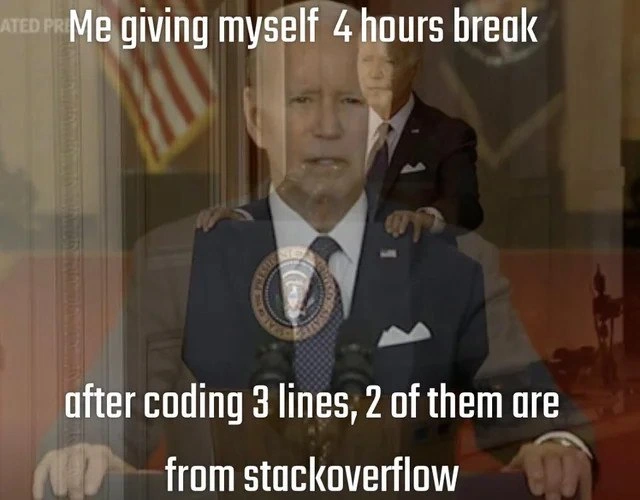
The picture in the meme shows someone putting a medal on himself, as if he’s won a race or accomplished something great – but he’s giving the award to himself. This is a funny way to show “I’m pretending I did something amazing.” The humor is super simple: the work done was tiny, but the person is acting like it was huge. We laugh because it’s an obvious overreaction. It’s like doing a tiny bit of homework and then saying you deserve a long vacation. Anyone can see that’s exaggerated and kind of silly.
So basically, the meme is joking about being lazy and proud for the wrong reasons. It’s poking fun at that feeling when you know you didn’t do much, but you still want to reward yourself. Even if you’re not a coder, you can relate – it’s the same as finishing a small chore and then slacking off as if you’ve finished all your chores. The reason it’s funny is because the person knows it’s a ridiculously small accomplishment but is still bragging to themselves. It’s a playful self-jab that says, “Haha, look at me, giving myself a prize for doing almost nothing!”
Level 2: Copy, Paste, Celebrate
Let’s break this down in simpler terms. The meme shows a person giving a medal to himself – an image commonly used online to mock someone for celebrating themselves. The text on the meme basically says: I’m giving myself a 4-hour break after writing 3 lines of code, and 2 of those lines I copied from Stack Overflow. Every part of that sentence has meaning in developer life:
“3 lines of code” – That’s an extremely small amount of code. Software programs are often made of thousands or millions of lines of code. Writing just three lines is like writing only one sentence in an essay – it’s a tiny contribution. By mentioning how short it is, the meme emphasizes that the person didn’t do a lot of work. It’s poking fun at the idea of judging work by the number of lines written. In reality, counting lines of code isn’t a good way to measure effort, but here it’s used as an obvious indicator of very little output.
“4 hours break” – This is a long break, especially compared to the small task. In many jobs (including programming), taking a four-hour break in the middle of a workday is almost like taking half the day off. The humor comes from how disproportionate this is: a tiny task followed by a huge rest. Imagine doing 5 minutes of homework and then watching TV for 4 hours – that’s the vibe. The meme exaggerates to make it funny: it’s clearly an overreaction, which is why we find it silly. This highlights a common struggle with productivity and procrastination. Developers sometimes reward themselves too quickly or avoid work by extending breaks. The meme calls that out in a playful way.
“2 of them are from Stack Overflow” – Here’s the kicker for tech folks. Stack Overflow is a famous website where developers ask and answer programming questions. If you’re stuck on a coding problem, you can often find a solution on Stack Overflow that someone else has shared. Copying code from Stack Overflow is extremely common in real life. When the meme says 2 of the 3 lines are from Stack Overflow, it means the person did not even write those lines themselves – they were copied (essentially plagiarized, but this is normal and allowed in programming as long as you’re careful). So out of the three lines, only one line is original. That makes the person’s own contribution even smaller! This is highlighting a funny aspect of dev communities helping each other: sometimes we rely heavily on community-provided answers instead of figuring everything out ourselves. It’s like doing an assignment by borrowing most of the answers from your friend. You still get credit for finishing, but you didn’t come up with it alone. In the programming world, using Stack Overflow isn’t cheating – it’s usually seen as working smart, not hard. But bragging about it or acting like a hero after copy-pasting? That’s what’s being ridiculed.
Now, why is it funny to developers? Because it’s relatable. Many programmers have done exactly this at some point: found a solution online, pasted it into their code, and felt a wave of relief that something works now. It might have taken hours of searching and reading to find those “two lines from Stack Overflow”, so when it finally fixes the bug, you feel super accomplished – even if you personally only wrote a tiny bit of code. The meme exaggerates the reaction (giving yourself a medal and a long break) to point out the silliness. It’s basically saying, “Look, I barely did anything, but I’m treating myself like I won a marathon.” The categories DeveloperProductivity and DevCommunities come into play here: it’s commenting on how we measure productivity (not by lines truly, but we sometimes act like any progress is huge) and how much we lean on community help like Stack Overflow in our daily coding.
For a newer developer or someone learning to code, this also carries a gentle lesson: don’t gauge your skill by how many lines you write. Sometimes writing just a few lines can be a big win, especially if those lines solve a tough problem. But also, be aware of when you’re actually learning versus when you’re just copying without understanding. The meme finds humor in the latter – the person copying code likely doesn’t fully grasp it, yet they’re rewarding themselves lavishly. It’s a nudge saying, “We know you got that from the internet, maybe don’t overdo the celebration.”
The image of a person awarding a medal to himself reinforces this point visually. Usually, medals are given for great achievements. If you see someone literally putting a medal on their own neck, it looks ridiculous – it means they are self-awarding without an outside judge agreeing they deserve it. It’s a popular meme image for calling out when someone is too proud of their own minor accomplishments. In this case, the accomplishment is writing three little lines of code. By pairing that image with the text, the meme maker shows that they are self-aware: they know taking a 4-hour break after such a small task is funny and over-the-top.
All together, this meme is a form of developer humor where programmers laugh at themselves. It’s very relatable: who hasn’t felt burned out and then indulged in a break after doing the bare minimum? It also touches on the reality that a lot of programming is actually searching for answers on Google or Stack Overflow. The phrase “copy-paste coding” is often jokingly used to describe how developers sometimes just copy solutions instead of writing code from scratch. This meme is basically one big friendly tease about that habit. It says: “I wrote almost nothing (most of it was copied), but I’m still going to act like I did something amazing and slack off.” Seeing it written out so plainly makes us chuckle, because it’s poking fun at a little hypocrisy or laziness in all of us. It’s a reminder not to take ourselves too seriously and that taking pride in very little work is comedic.
Level 3: Minimum Viable Effort
In this meme, a developer is awarding themselves a medal (literally, in the image) after writing a whopping three lines of code – and humorously, two of those lines were copy-pasted from Stack Overflow. The top text declares “Me giving myself 4 hours break” and the bottom text continues “after coding 3 lines, 2 of them are from stackoverflow.” This scenario playfully skewers our sense of developer productivity. It’s a tongue-in-cheek look at how easily we sometimes claim victory for minimal effort in coding.
From a seasoned developer’s perspective, the joke lands because it highlights a well-known productivity paradox. We’ve all had days where writing even a couple of lines of code felt like pulling teeth. When you finally get something working (even if it’s mostly borrowed code), it’s tempting to take a victory lap. Here that victory lap is exaggerated into a four-hour break – an obvious overcelebration for such a tiny accomplishment. The meme’s use of the “giving a medal to yourself” image nails this ironic self-congratulation: a person (a public figure at a podium) literally puts a medal around his own neck, symbolizing unearned praise. It’s a perfect visual metaphor for premature celebration in development.
Let’s unpack why those “3 lines of code” feel so iconic. In many engineering cultures, lines of code (LOC) are a terrible measure of real progress – and that’s part of the gag. Old-school managers sometimes thought more LOC = more work done, but experienced devs know that’s flawed. In fact, writing fewer lines (especially if they’re high-quality or efficient code) can be more impressive. Here, however, the dev wrote almost nothing and is acting like they won gold. It’s flipping the old LOC metric on its head for comedic effect. The codeline-to-break ratio here is absurdly high, and that absurdity makes us laugh. Essentially, the meme gently mocks those days when our effort-to-reward ratio is way out of whack (and we know it).
The Stack Overflow angle adds another layer that senior devs smirk at. Stack Overflow is the Q&A site every programmer knows – practically our collective brain. Copying two lines from Stack Overflow means the solution was largely found online, not invented from scratch. It’s a nod to how dependent modern coding can be on community-shared knowledge. There’s even a running joke in engineering: Stack Overflow-driven development – meaning a lot of code in real projects is lifted straight from online examples. Seeing “2 of them are from stackoverflow” in the meme text is an immediate tip-off that the coder didn’t exactly toil over those lines. It reminds us how often we solve issues by googling error messages or grabbing snippets from others’ answers. And honestly, using Stack Overflow is a normal part of development; even senior engineers do it daily (we just usually won’t brag about it as a monumental achievement!). The humor is in pretending that borrowing code is an act of brilliance worthy of a long break.
Seasoned devs also recognize the subtext of procrastination here. Taking a “4 hours break” after such a minor task is classic avoidance behavior. Maybe the developer is rewarding themselves to dodge a bigger daunting task up next (we’ve all been there – “I fixed one small bug, surely I deserve a lengthy coffee break before tackling the next!”). This meme captures that guilty pleasure moment: you’ve only written a few lines (and trivial ones at that), yet you’re unbelievably proud and eager to relax. It’s funny because it’s true – everyone in software has at some point felt relief from getting even a tiny thing to work after struggling. It’s a form of coping. Sometimes that one new line of code was fixing a production bug that had you stumped for hours, so it feels huge relative to effort. Other times, we’re just being lazy and any excuse for a break will do. The meme exaggerates the latter, portraying the developer as literally giving themselves a medal for slacking.
To a battle-scarred engineer, there’s also an implied dark punchline: celebrate now, but those three lines might come back to bite you later. Copy-pasted code can be a double-edged sword. Sure, it’s quick, but if you didn’t fully understand those Stack Overflow lines, you might introduce a bug or a security issue. A cynic might jokingly think, “Great, you took 4 hours off – hope those 3 lines don’t crash production while you’re sipping your latte!” The meme doesn’t show that part, but our veteran intuition fills it in. Still, the primary tone here isn’t scolding; it’s self-deprecating humor. It’s the Relatable Developer Experience of feeling like a hero for doing almost nothing. In the grand circus of developer humor, we’re basically laughing at ourselves for occasionally being lazy overgenerous with breaks. After all, using community snippets to save time is smart – but acting like you cured cancer when you merely Googled the answer is the funny part.
To illustrate, imagine a commit diff that looks like this:
# Two critical lines copied straight from a Stack Overflow answer:
config.cache_enabled = False # Line from Stack Overflow solution
app.reset() # Another line from Stack Overflow
# (Maybe the only original line is a log message celebrating the fix)
print("Bug fixed! Taking a well-earned coffee break now.")
In a real code review, senior devs would chuckle seeing those trivial changes accompanied by a lofty commit message like “Major fix implemented – time for a break.” The snippet above shows how minimal the actual “work” was – disabling a cache and resetting an app, something likely handed to the developer by an internet search. The comment in the print line is essentially the person patting themselves on the back. This is exactly what the meme is lampooning: the disconnect between small effort and big reward.
Ultimately, at the senior level, we recognize the satire. The meme pokes fun at developers (ourselves included) who sometimes act like they deserve a medal for doing the bare minimum – especially when that minimum was achieved thanks to somebody else’s answer on Stack Overflow. It’s a light-hearted critique of our own work habits: how we justify long breaks because “hey, I wrote code today!” even if it was just one original line. The reason it’s so funny (and a bit painful) is because it’s true enough to sting: modern programming often means stitching together solutions found online, and yes, sometimes celebrating that feels like winning when you’re drained. This is classic coding humor that balances pride and pokes fun at our dependency on dev communities for solutions. We laugh because we’ve all done it – triumphantly leaned back in our chair after a tiny commit, feeling like the day’s hero, ready to procrastinate relax.
Description
The meme shows the famous 'giving a medal to yourself' image: a suited politician stands at a lectern with the presidential seal, while an identical smaller version of himself behind his shoulders places a medal around his own neck. Both faces are blurred. White text is overlaid in two parts: at the top, “Me giving myself 4 hours break”, and at the bottom, “after coding 3 lines, 2 of them are from stackoverflow”. The joke highlights developer procrastination and the tendency to celebrate minimal progress, especially when most of the code was copied verbatim from Stack Overflow. It pokes fun at inflated perceptions of productivity and the reliance on community-sourced solutions in day-to-day software engineering
Comments
22Comment deleted
Three lines: one to placate the 2003-era ORM, one to satisfy the microservice’s gRPC contract, and one to keep Legal’s regex happy - tell Jira that’s eight story points, I’ll be back after my well-earned “architecture review.”
The real achievement isn't the 3 lines of code - it's successfully finding the exact Stack Overflow answer that works without triggering a cascade of dependency updates, breaking changes, or discovering the accepted answer is from 2012 and uses deprecated jQuery
The real engineering challenge isn't writing those three lines - it's convincing yourself that the four-hour 'architectural planning session' (aka scrolling through Stack Overflow, Reddit, and HN) was absolutely critical to finding that one accepted answer from 2014 that you'll copy verbatim, then spending another hour deciding whether to leave the original variable names or refactor them just enough to feel like you contributed something
StackOverflow‑driven development: 66% copy/paste, 33% glue, 100% justified a four‑hour cooldown - because if you reward LOC, that’s the optimal strategy
66% external dependency ratio - that's not risky, it's battle-tested distributed resilience
Three lines committed - two from StackOverflow - then a four-hour break to let CI, SAST, and legal decide whether I just shipped a CVE or a GPL obligation
zeroth Comment deleted
First Comment deleted
and those lines were declaring a variable and int main(){ return 0;} Comment deleted
Нет Войне Comment deleted
translate to english please Comment deleted
"No to war" Comment deleted
Make bugs, not war? Comment deleted
make pull-requests and and white hat pentests, not war Comment deleted
Such an infantile phrase. To say "No to war" is to depersonalize the war (as if it's started and keeps on going by itself) and to run away from responsibility. If you stand against the war, then at least please have balls to actually tell exactly who is to blame for it and should be stopped. And why say this phrase here, of all places, anyway? Comment deleted
↑ how to kill the mood Comment deleted
Being in Austria, you may be out of context (and I can't blame you for it), but we Ukrainians are sick of seeing Russians yapping this "nyet voine" bullshit here and there without even specifying who is actually responsible for it, and not even doing anything aside of it (as if their authorities would actually listen to the plain words lol). Comment deleted
ah? well then sorry. Comment deleted
Что блять тут инфантильного ты увидел?? Если от конченого уебана путина в моем городе каждый день гибнут дети, я в ахуе каждый день живу Так тебе достаточно? Comment deleted
second time telling you to write in english. warn 1/1 for @read_between_the_lines Comment deleted
Now that's much better. Comment deleted
write secure better open-source alternatives to proprietary software Comment deleted