Skip to content
DevMeme
4440 of 7435
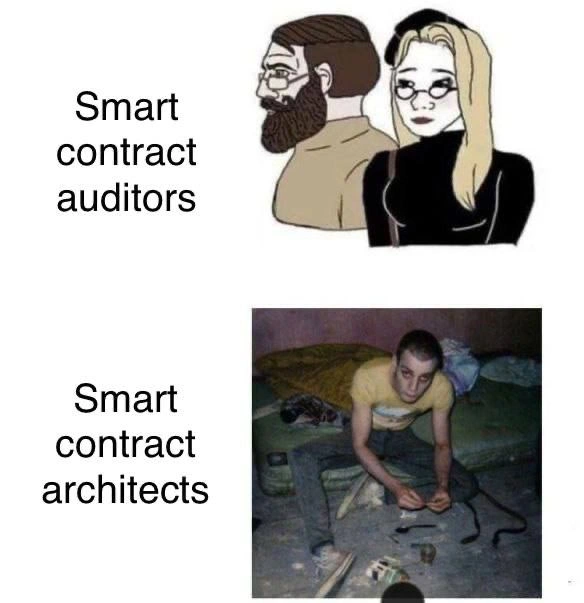
Auditors vs architects: the stark reality of smart contract development
Blockchain Post #4866, on Sep 18, 2022 in TG

Auditors vs architects: the stark reality of smart contract development

Why is this Blockchain meme funny?

Level 1: Builders vs Inspectors

Imagine you and a friend are making a huge LEGO castle. You’re the one building it. You’ve been in your room for days, with Lego bricks all over the floor, wearing your comfy old clothes, maybe with some snack wrappers and soda cans tossed around because you’ve been so busy building. Finally, the castle is done – it’s tall, it’s complex, but you’re a little worried you might have missed something in your rush. Now, your friend comes in, and this friend is like an inspector. They’re all neat and tidy, wearing a clean outfit. They walk in with a checklist and a magnifying glass to look at every corner of your LEGO castle. They didn’t help build it, but now their job is to find any weak pieces or wobbly bits that might cause the castle to fall. It’s a funny sight: you, the builder, are sitting there on the messy floor with LEGO pieces in your hair, and your friend the inspector is standing there looking like a professional art judge in a gallery. The reason this scene makes us chuckle is because the two of you look so different even though you’re working on the same castle. You’re the creative, messy builder; your friend is the careful, fussy checker. In the end, though, you do need that careful inspection — because if a small shaky brick is found and fixed, your giant LEGO castle won’t unexpectedly collapse. The meme is just like this: it’s showing a builder versus an inspector in the world of coding. One is messy from building things, and the other is spotless and checking that everything is safe and sound. It’s funny and relatable because it’s true in a lot of projects: the ones who build and the ones who review often seem like they come from totally different worlds, just like a scruffy kid and a tidy inspector examining a LEGO creation.

Level 2: Dev Life vs Audit Life

Let’s break down what’s going on for those newer to Blockchain development. A smart contract is basically a little program that lives on a blockchain like Ethereum. It can hold money (cryptocurrency) and execute logic (like “if Alice sends 1 ETH, give her 100 tokens”). Smart contracts are written in programming languages like Solidity (which is the most popular language for Ethereum, kind of similar to JavaScript in syntax). Now, the people who write these contracts – the developers – are sometimes grandiosely called smart contract architects. “Architect” here just means they design and build the contract’s code and features from the ground up. They decide how the contract manages data, how functions interact, and they implement all that logic. These are the coders, the builders of the decentralized app world. Often, especially in small projects or startups, a handful of developers (or even a lone developer) is responsible for cranking out the entire codebase of a new crypto project. It’s a tough job: not only do they have to make the thing work, but it also has to be secure against hackers from day one. Imagine writing a banking app where any bug could cost thousands of dollars – that’s the pressure on a smart contract dev. They’re developers first and foremost, but with high stakes.

On the other side, we have smart contract auditors. An auditor in this context is like a specialized software security expert. SecurityAudit teams are brought in to review the code that the architects wrote. Why? Because in crypto, a tiny mistake can be disastrous. There have been real incidents (like the DAO hack in 2016 or many DeFi hacks since) where a small oversight in the code allowed attackers to steal millions of dollars. Auditors try to prevent that. They systematically go through the smart contract’s codebase looking for vulnerabilities. Common things they check include: did the developer follow best practices for security? Are there any functions that an attacker could abuse? Is the math in the contract (like token supply calculations) done correctly? For example, a classic bug auditors look for is the reentrancy vulnerability – where an attacker can repeatedly call a contract and trick it into giving out more money than it should (this was how the infamous DAO hack happened). Auditors use both manual code reading and automated tools. Tools might include static analyzers (programs that scan the code for known risky patterns), linters (to enforce coding standards), and even programs that simulate lots of random interactions with the contract (fuzzing) to see if anything weird happens. Many auditors also write custom test cases or scripts to poke at the contract from every angle. Essentially, where the developer’s job was to build the contract, the auditor’s job is to break it (in a safe way) to see if any pieces fall off.

The meme labels these two groups and shows them very differently. It’s highlighting an often-seen culture difference in the blockchain_developer_lifestyle versus the auditing firms. Developers (architects) might be working in a very informal setting – perhaps remote at home, maybe a bit disorganized, focused intensely on coding and getting features to work. The bottom picture of the guy in a messy room with computer parts everywhere is an exaggerated caricature of that. It screams “hacker at work” or messy_coder_room, which is a common stereotype: someone so deep in coding, they don’t even notice the pile of soda cans and cables around them. Auditors, by contrast, might work at a consulting company. Even if they work remotely, they tend to operate with a clear process: they have checklists, they write a formal report for the client, and they often need to present findings to a project’s team or management. So they are depicted as composed and put-together (the top panel with the stylish characters). The vibe is that auditors are a bit more external-facing and polished, whereas devs are internal-facing and rough-edged. It’s a funny exaggeration – not all developers are disheveled, of course, and not all auditors wear turtlenecks and blazers – but it hits a nerve. In tech, we do see a contrast between the builder mentality and the consultant mentality. That’s what audit_vs_architecture is getting at: building something versus scrutinizing something can attract different personalities and work styles.

Let’s clarify a few key terms and concepts from the meme in a straightforward way:

  • Smart Contract: A program on a blockchain that automatically runs when certain conditions are met. It can't be changed once deployed (in most systems), so it has to be right the first time. Example: A smart contract could automatically pay artists a royalty every time their digital art is resold.
  • Solidity: The main programming language used to write smart contracts on Ethereum. It looks a bit like JavaScript/C++ and has quirks specific to blockchain (like handling cryptocurrency and gas, which is the fee for running code on Ethereum).
  • Smart Contract Architect (Developer): The person (or team) who writes the smart contract code. "Architect" just emphasizes that they design the structure of the contract system. They worry about functionality: "Does this code do what we want?" and also a bit about security: "Could someone abuse this function?" But often they are trying to add features quickly.
  • Smart Contract Auditor: An expert (often external to the project) who reviews and tests the code to ensure it’s secure and has high CodeQuality. They come in with a checklist of known pitfalls (for instance, "Are arithmetic operations using SafeMath to prevent overflow?" or "Are funds handled only after state changes to prevent reentrancy?"). They often write an audit report that lists all the issues found. Projects then fix those issues and sometimes the auditors check the fixes too.
  • Security (in this context): Means guarding against malicious exploits. In smart contracts, this often boils down to preventing hackers from stealing crypto or locking the contract in a unusable state. Security has to be rock solid because once the contract is live on the blockchain, anyone in the world can interact with it. There’s no safety net like there might be on a traditional server (no firewalls to block certain IPs — it’s all out in the open).
  • Code Quality: This refers to how well-written and maintainable the code is. High quality code is usually clean, well-documented, and handles errors gracefully. Low quality code might be sloppy, with lots of duplicate logic, poor naming, or lack of tests. The meme insinuates that the original code might be of “questionable” quality given the messy conditions it was produced under, hence the need for auditors to swoop in and shine a light on all the dark corners of that code.

To drive home the differences, here’s a little comparison that captures the meme’s point in a factual way:

Smart Contract Developer (Architect) Smart Contract Auditor
Writes the code in Solidity from scratch to implement features (tokens, protocols, etc.). Reviews the code line-by-line to find bugs and security issues.
Focused on functionality and shipping the project (often under tight deadlines or hype-driven timelines). Focused on security and correctness, ensuring nothing catastrophic is lurking in the logic.
Working environment can be informal: perhaps a home office or small startup (picture someone coding in pajamas or a hoodie). Working environment is more formal: maybe part of a security firm or consultancy (picture someone following a structured process, possibly in business casual attire).
May inadvertently introduce vulnerabilities due to rushing or lack of experience (e.g., forgetting to use a reentrancy guard or misusing block.timestamp for randomness). Trained to spot those vulnerabilities using both tools and expertise (e.g., they’ll catch that missing reentrancy guard and flag it as a critical issue in the report).
Might not have a rigorous process for testing (perhaps a few basic tests or just manual experiments on a testnet). Usually follows a thorough testing approach: manual code analysis, automated tools, and writing specific tests or scripts to validate behaviors.
Goal: Build something that works and attracts users/investors. They create the value. Goal: Ensure what was built won’t blow up. They protect the value.

The meme lives at the intersection of DeveloperHumor and reality. It uses caricatures to make it immediately obvious who’s who: smart_contract_auditors are the cool, calm “adults in the room,” and smart_contract_architects are the brilliant but overworked creators behind the scenes. If you’re a junior developer, imagine the auditors as the “quality assurance and security” team that comes in to double-check everything you did – except in crypto, they often aren’t even part of the same company; they’re external experts you hire. And imagine the developers as those passionate coders who may prioritize innovation and speed over tidiness. The joke is essentially: the people writing the code and the people checking the code look and live very differently. It’s a commentary on a real divide in the industry, presented in a lighthearted meme format.

Level 3: Suits vs Sweatpants

This meme takes a jab at the real-world dichotomy between smart_contract_auditors and smart_contract_architects in the blockchain industry. The top panel uses the popular wojak meme format to show a well-groomed bearded man and a stylish woman back-to-back, labeled “Smart contract auditors.” They look confident, composed – practically oozing professionalism. In the bottom panel, we see “Smart contract architects”: a lone, disheveled developer in a dingy room, crouched on a floor littered with computer parts and cables. The contrast is hilariously on point. It suggests that while the auditors (external security experts) present a polished, corporate image (the suits), the actual developers who wrote the Solidity code (the ones in sweatpants) might be living in startup-style chaos. This is developer humor painting a picture we half-jokingly recognize: the folks writing critical blockchain code often work under scrappy, under-resourced conditions, while the folks reviewing that code stroll in with an air of meticulous authority.

Why does this contrast exist? In the Blockchain startup world, it's common to have small developer teams – sometimes just a couple of engineers – furiously coding a decentralized application or DeFi project from a home office, garage, or anywhere with Wi-Fi. Deadlines are tight (there’s a token launch coming, investors watching, a community expecting the next big thing), so these smart contract architects might be pulling all-nighters, surviving on caffeine and adrenaline. Code quality can suffer; when you’re exhausted and rushing, you might leave functions unoptimized or forget to handle an edge case. Unit tests? Maybe later, if ever. Documentation? Who has time? This is the messy coder room reality: laptops, cables, maybe a soldering iron or two, and a jumble of ideas being hammered into code at 3 AM. It’s not literally true that every blockchain developer lives like a gremlin in a cave, but the meme exaggerates a grain of truth — many developers have indeed worked in less-than-ideal environments, both physically and in terms of software process. There’s a kind of tech culture legend of the brilliant coder in a hoodie who writes world-changing code from a basement. In blockchain, some of those legends are real people (or at least they feel real when you see the state of some GitHub repositories!).

Enter the smart contract auditors: often external firms or specialists hired to do a SecurityAudit on that chaotic code before it goes live (or sometimes, unfortunately, after it has already wreaked havoc on the blockchain). These auditors are like the cavalry – they’ve seen the wildest hacks and vulnerabilities, and they come armed with linters, static analysis tools, and war stories of past exploits. Culturally, auditing firms know that image matters: they need clients (projects with money) to trust them. So auditors tend to operate with a high degree of professionalism. Picture a team from a top auditing company: they might wear company-branded shirts, speak in terms of threat models and best practices, and produce glossy PDF reports detailing every issue from critical to informational. It’s a far cry from the informality of the dev’s world. The meme’s top panel characters — clean lines, cool demeanor — perfectly capture that polished consultancy vibe. These auditors might even attend industry conferences, give talks on secure SoliditySmartContracts design, and have a certain prestige. Meanwhile, the original dev might be anonymously known only by a GitHub handle, toiling in obscurity until something goes wrong.

There's an unspoken tension here that seasoned developers know too well. When an auditor picks through code, they often uncover a laundry list of issues: from minor inefficiencies to security nightmares like reentrancy bugs, integer overflows, or logic flaws that could let an attacker drain funds. If you’ve ever been on a dev team that got an external code review, you know the mix of emotions: embarrassment (“How did we miss that?”), relief (“Thank god they caught this before deploy!”), maybe a touch of impostor syndrome as your work is scrutinized by experts. The meme resonates because it feels like the auditors get to be the heroes in the story — swooping in with authority — while the architects, who built the darn thing under high stress, are depicted almost like goblins in a cave. DeveloperHumor often finds its edge in these role reversals and resentments. It’s poking fun at the idea that the glory (and sometimes big consulting fees) can go to the auditing crew, while the devs who did the heavy lifting are left with dark circles under their eyes and a pile of technical debt.

From an industry perspective, this scenario is too real. There have been countless cases where a flashy audit was used as a stamp of approval for a project that, behind the scenes, was hastily thrown together. Auditors might wear the façade of perfection, but they often know they’re diving into pretty gnarly codebases. A cynical veteran developer might quip that some projects treat an audit as a band-aid: “Don’t worry if the code’s a mess, the auditors will save us!” But of course, if the architecture is fundamentally shaky, even the best auditors can only do so much. In worst-case scenarios, both parties have it rough: the architect’s messy code leads to a nasty exploit that auditors didn’t catch in time, and then everyone is doing post-mortems in panic mode. (As the saying goes in security: “audit is not a silver bullet.”)

However, the meme’s stark visual contrast is what sells the joke. It implies a kind of role reversal of expectations: you might assume the architects (the designers/builders of innovative blockchain systems) would be the rockstars of the story, but here they’re portrayed as a bit feral. Meanwhile, auditors, who you might think of as pencil-pushers combing through code, are shown as the cool, put-together figures. It’s funny because it flips a power dynamic on its head in an exaggerated way. The CodeQuality angle here is important, too. Auditors exist because code quality in one-off blockchain projects is notoriously varied. When millions of dollars can evaporate due to one unhandled require or a mishandled fallback function, having meticulous external eyes is not just theater – it’s often necessary. Yet, this meme hints at a truth: by the time auditors are called, the development conditions may have already cemented a bunch of issues. The “stark reality” is that many Solidity devs work more like frantic hackers than careful architects, and auditors have to play the dual role of detective and firefighter to ensure the final product doesn’t implode. In summary, Suits vs Sweatpants encapsulates that divide: the externally visible polish of security experts versus the hidden chaos of the development process. It’s a tongue-in-cheek reminder to everyone in the TechHumor community that appearances can be deceiving in tech – especially in the fast-paced world of crypto development.

Level 4: Formality vs Reality

At the cutting edge of blockchain development, there's a stark contrast between how things should work in theory and how they actually play out. A smart contract is essentially an immutable program on the blockchain, a kind of decentralized state machine that often holds real money. Ideally, you'd design these contracts with mathematical rigor – proving correctness the way we prove theorems. In an academic paradise, the smart contract architects would apply formal verification to check every invariant and edge case. Tools from programming language theory like model checking, static analysis, and even theorem provers (think Coq or Z3) can, in theory, ensure a contract is bug-free before it ever gets deployed. This is the Formality side of the coin: the idea that code can be verified like a mathematical proof, guaranteeing no vulnerability exists. In fact, certain high-stakes contracts have attempted this level of scrutiny, employing formal methods to prove properties like “nobody can steal funds from this contract” under specific assumptions.

However, reality isn’t so generous. Writing a contract in languages like Solidity means embracing a Turing-complete environment with all its unpredictability. The infamous halting problem tells us there's no general automated way to catch all possible bad behaviors in an arbitrary program. Smart contracts might be simple in size (maybe just a few hundred lines of code), but their interactions – with users, with other contracts, with the Ethereum Virtual Machine (EVM) – form a complex state space. Exhaustively exploring that space is computationally infeasible; it blows up exponentially with each new variable and branch. Symbolic execution engines and fuzzers (like MythX or Echidna for Ethereum) try to simulate many possible inputs and states, searching for failures. They’re powerful, but not magic. For anything beyond straightforward patterns, human expertise is needed to piece together whether a combination of actions could break the contract’s logic. In short, the Reality is that the original smart contract architect, hunched over a keyboard in that chaotic room, is often racing the clock and the network’s gas limits, lacking the time (and sometimes the theoretical knowledge) to prove their code correct. Instead, we rely on a subsequent security audit by professionals to bridge the gap – a very human process of finding bugs that our idealized formal methods should catch, but often don’t in practice. The meme humorously magnifies this gap: on paper you’d expect pristine, rigorously vetted code; in practice you get messy scripts that later need to be picked apart by well-paid experts. The tension between formality and reality in smart contract development is exactly why those polished auditors exist – and why their job is notoriously hard despite the theoretical solutions available.

Description

Two-panel meme contrasting appearances in the blockchain world. Top panel shows a tidy Wojak-style illustration: a well-groomed bearded man and a stylish blonde woman standing back-to-back, captioned “Smart contract auditors.” Bottom panel is a grainy photo of a dingy room; a disheveled man in a yellow T-shirt crouches on a dirty floor that’s scattered with computer parts and cables, captioned “Smart contract architects.” The juxtaposition humorously implies that external auditors look polished and professional while the engineers who originally wrote the Solidity code work in chaotic conditions. It pokes fun at the divide between security auditing firms and the often under-resourced developers who design decentralized application contracts, highlighting real-world tensions around blockchain code quality and security reviews
Comments

6
Anonymous ★ Top Pick Architect: 3 AM, diff-ing re-entrancy guard patterns and debating if 32 bytes of storage savings are worth the existential risk; Auditor: 9 AM, coffee in hand, “Have you considered using OpenZeppelin?”
  1. Anonymous ★ Top Pick

    Architect: 3 AM, diff-ing re-entrancy guard patterns and debating if 32 bytes of storage savings are worth the existential risk; Auditor: 9 AM, coffee in hand, “Have you considered using OpenZeppelin?”

  2. Anonymous

    The auditor's "critical finding" is that you used 2 extra bytes of storage, while you're still having nightmares about the reentrancy attack you caught at 3am that would've drained the entire protocol

  3. Anonymous

    The fundamental asymmetry of blockchain development: auditors get to critique your immutable code after deployment when gas costs are someone else's problem, while architects are down in the trenches trying to optimize away that extra SLOAD knowing one mistake means a $50M exploit and your face on Rekt News. It's the difference between reviewing a bridge's blueprints in a climate-controlled office versus welding it together over a canyon while it's already carrying traffic

  4. Anonymous

    Auditors run Slither/Echidna and ship a 60‑page PDF; architects YOLO a UUPS proxy with an uninitialized initializer and unchecked delegatecall - then ask for a “post‑deployment” audit after TVL hits nine figures

  5. Anonymous

    Auditors ship 80-page PDFs; architects ship a 3am UUPS upgrade praying the EIP-1967 slots still line up

  6. Anonymous

    Architects ship the gas-optimized reentrancy; auditors ship the seven-figure findings report

Use J and K for navigation