Skip to content
DevMeme
1057 of 7435
Nested Loop Beats Interview Brain
CS Fundamentals Post #1187, on Mar 27, 2020 in TG

Nested Loop Beats Interview Brain

Why is this CS Fundamentals meme funny?

Level 1: The Fancy Shortcut

This is like using a huge map, compass, and measuring tools to walk across a tiny room. Those tools are useful for a mountain trip, but for the room you can just walk. The funny part is that the beginner sees the simple loop and panics, while the experienced person knows this particular job is small enough that the simple way is fine.

Level 2: Big-O Is a Map

Big-O notation describes how an algorithm grows as the input gets larger. O(n) means work grows roughly in proportion to the number of items. O(n^2) means work can grow much faster because every item may be compared with every other item. O(log n) often means the work grows slowly because the algorithm repeatedly narrows the search space.

A brute force solution tries the straightforward approach, often by checking many possibilities directly. A nested loop is a common brute-force shape:

for user in users:
    for permission in permissions:
        apply_if_needed(user, permission)

This can be too slow if both lists are huge. But if the lists are small, the code may be perfectly fine and much easier to understand than a complicated optimization.

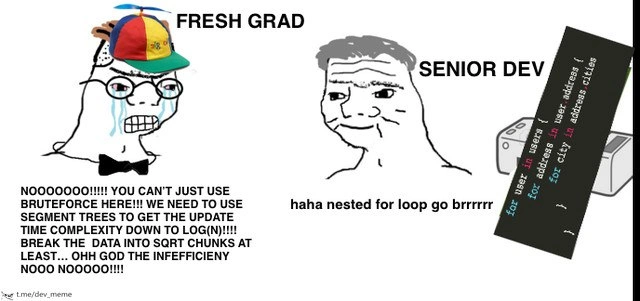
The fresh grad in the image wants advanced tools because they learned that bad complexity can be dangerous. The senior developer accepts the nested loop because real engineering also weighs readability, input size, deadlines, tests, and future changes. The lesson is not to ignore algorithms. The lesson is to use them when they solve the actual problem.

Level 3: Brute Force Budget

The joke works because both characters represent real developer failure modes. The fresh grad has recently learned powerful data structures and sees inefficiency everywhere. The senior developer has seen enough production code to know that the elegant solution can be the dangerous one when the problem does not need it.

This is the scar tissue behind premature optimization. Many systems are not slow because someone used one nested loop in a bounded workflow. They are slow because of accidental network calls inside loops, missing indexes, chatty APIs, huge payloads, lock contention, synchronous retries, unnecessary serialization, or cache invalidation strategies designed by someone having a very confident afternoon. Fixing those requires measurement, not reflexively reaching for the most advanced structure remembered from interview prep.

The phrase haha nested for loop go brrrrrr is funny because it sounds irresponsible, but it can be the responsible choice. A plain loop is easy to read, easy to test, and easy to delete. If the code is processing a small list of UI widgets, applying permissions across a few roles, or comparing a limited set of config entries, brute force may be entirely acceptable.

The senior perspective is also about organizational maintenance. Code lives longer than the mood that produced it. Segment trees and sqrt decomposition are excellent when the domain truly needs range queries, frequent updates, and large input sizes. But if the business later asks for slightly different semantics, the clever structure may become a trap. Now the team owns a miniature algorithms textbook embedded in the codebase, and the only person who understood it left after the quarterly planning meeting.

Level 4: Asymptotics Meet Reality

The left character is labeled:

FRESH GRAD

and shouts:

NOOOOOOO!!!! YOU CANT JUST USE BRUTEFORCE HERE!!! WE NEED TO USE SEGMENT TREES TO GET THE UPDATE TIME COMPLEXITY DOWN TO LOG(N)!!!! BREAK THE DATA INTO SQRT CHUNKS AT LEAST... OHH GOD THE INEFFICIENCY NOOO NOOOO!!!!

The right character is labeled:

SENIOR DEV

and calmly says:

haha nested for loop go brrrrrr

This is a clean collision between asymptotic complexity and engineering judgment. The fresh grad is not wrong in the abstract. A segment tree can support range queries and updates in O(log n) time. Sqrt decomposition can split data into blocks and often get update or query costs around O(sqrt n) depending on the operation. Those techniques exist because brute force can become catastrophic when n grows.

But Big-O notation intentionally discards constants, memory layout, implementation complexity, and the actual size of n. A nested loop may be O(n^2), but if n = 30, the data is already in memory, and the loop runs once per admin action, the practical cost may be invisible. Meanwhile, a segment tree adds indexing logic, edge cases, testing burden, and maintenance risk. It may also be slower for small inputs because the constant factors and cache behavior are worse.

The senior-dev move is not “performance does not matter.” It is “performance has a budget and a measurement context.” The correct question is not “can we reduce the theoretical complexity?” The correct questions are:

  • How large can the input realistically get?
  • How often does this path run?
  • Is it user-facing, batch, startup-time, or background work?
  • Have we profiled it?
  • Will the clever data structure survive the next requirement change?
  • Can the next maintainer prove it is still correct?

The meme’s tilted code snippet visually reinforces the forbidden simplicity: a basic nested for loop doing ordinary work while the algorithmic part of the brain screams. Sometimes that scream saves a system. Sometimes it turns a five-line loop into a bespoke data-structure shrine that nobody dares touch. The art is knowing which situation you are in before sacrificing readability to the complexity gods.

Description

A wojak-style meme labels a crying propeller-hat character "FRESH GRAD" and a calmer smirking character "SENIOR DEV." The fresh grad shouts, "NOOOOOOO!!!!! YOU CANT JUST USE BRUTEFORCE HERE!!! WE NEED TO USE SEGMENT TREES TO GET THE UPDATE TIME COMPLEXITY DOWN TO LOG(N)!!!! BREAK THE DATA INTO SQRT CHUNKS AT LEAST... OHH GOD THE INEFFICIENCY NOOO NOOOO!!!!" while the senior dev says, "haha nested for loop go brrrrrr" next to a tilted snippet of nested for-loop code. The technical joke is about choosing boring, readable brute force when real input sizes, operational constraints, and maintenance costs do not justify algorithmic machinery.

Comments

1
Anonymous ★ Top Pick The fastest algorithm is often the one whose invariants the next maintainer can still remember after lunch.
  1. Anonymous ★ Top Pick

    The fastest algorithm is often the one whose invariants the next maintainer can still remember after lunch.

Use J and K for navigation