Skip to content
DevMeme
1058 of 7435
Pandemic Career Goals: From Programmer to Toilet Paper Producer
DevCommunities Post #1191, on Mar 27, 2020 in TG

Pandemic Career Goals: From Programmer to Toilet Paper Producer

Why is this DevCommunities meme funny?

Level 1: When Work Feels Useless

Imagine you spent a lot of time building a fancy LEGO castle, but then you realize it’s super fragile and crooked. If someone asked, “Oh, are you a master LEGO builder?”, you might jokingly respond, “Nah, I just stack blocks that fall apart – basically I make LEGO trash now.” That’s what’s happening in this meme, but with computer code and toilet paper. The programmer in the picture is making fun of himself by saying the code he writes is as cheap and throwaway as toilet paper.

Why is that funny? It’s because he’s using a silly comparison to show how unhappy he is with the quality of his work. We all know toilet paper is something you use once and toss in the trash – it’s not meant to be special or lasting. By saying his programming has turned into toilet paper manufacturing, he means “My work isn’t meaningful or sturdy; it’s just a bunch of junk that people will use and throw away.” It’s an exaggeration, and exaggerations can be funny. He could have just said “ugh, my code is bad,” but comparing bad code to toilet paper is a more colorful way to express that feeling. It’s like a chef saying, “I don’t cook gourmet meals anymore, I just flip burgers at a fast food joint.” It might not be literally true, but it shows how low-value the work feels to them.

The last part of the meme shows the woman suddenly hugging and kissing the guy after he makes that joke. That adds to the humor because it’s unexpected – usually calling yourself a toilet paper maker wouldn’t be romantic! In the meme world, this kind of over-the-top reaction is just for laughs. It’s saying: sometimes, being honest about how crummy things are can be oddly endearing. Or maybe it’s implying that admitting the messy truth (that coding can be a bit crappy) is something fellow programmers appreciate.

In simple terms, this meme is funny because it takes a frustrating work situation – writing low-quality code – and describes it in a ridiculous way. It shows a programmer making fun of himself by saying he produces something as unglamorous as toilet paper. Anyone who’s ever felt frustrated with their job or the quality of something they made can relate a little. It’s a goofy form of venting. You laugh because you know that feeling of “ugh, what I made isn’t great,” and sometimes joking about it makes it feel better. Plus, the idea of a programmer switching careers to work in a toilet paper factory (especially around 2020 when toilet paper was a big deal in the news) is just plain silly. It mixes the high-tech world with the low-tech world in a way that catches you off guard.

So, even if you’re not a programmer, you can understand the core emotion: Feeling like your hard work ended up being kind of lame or disposable. The meme just uses an extreme metaphor to make that feeling light-hearted. It’s okay – even grown-up coders need to joke that their work stinks sometimes, just to get through the day with a smile!

Level 2: Spaghetti and Quick Fixes

Let’s break down the technical references and metaphors for those newer to the field. The meme’s joke centers on code quality (how good, clean, and maintainable your code is) and compares bad code to toilet paper. Why toilet paper? Because toilet paper is something cheap and meant to be used once and thrown away. The guy in the meme is basically saying his code is so low-quality and disposable that it’s like he’s manufacturing toilet paper rolls, not writing lasting software. This is a form of programmer self-deprecating humor – making fun of one’s own work to cope with frustration.

A few key terms and ideas appear implicitly in this meme:

  • Technical debt: This is a metaphor where writing quick-and-dirty code is like taking on debt. For example, if you rush a feature without writing tests or cleaning up the code, you “borrow” time now (you saved time by not doing it properly), but you’ll pay for it later when that code causes problems. It’s like skipping homework – you save time tonight, but you end up pulling an all-nighter before the exam to catch up. In coding, interest on technical debt comes due as bugs, crashes, or hours spent trying to understand the messy code later. If a codebase accumulates a lot of technical debt, developers feel like they’re constantly dealing with old messes instead of making progress. That’s when coding stops feeling like a creative job and more like a toilet paper production line, just cleaning up and patching issues non-stop.

  • Spaghetti code: This is a nickname for code that is tangled and messy, like a bowl of spaghetti. Imagine a program where the flow jumps all over the place, functions call each other in confusing ways, variables are all global and intermixed… basically, nothing is organized. Spaghetti code often happens when many quick fixes are piled on over time without a proper design. It becomes really hard to follow or change such code, just like it’s hard to trace a single noodle in a plate of spaghetti. The meme indirectly alludes to this — code so disorganized that it’s only fit to be discarded. If you’ve just started coding, you might have seen something like this if you wrote a long script with a lot of if/else and copied sections, and later found it hard to debug. That’s the start of spaghetti code. Don’t worry, it happens to everyone as they learn. The goal is to refactor (reorganize and clean) that code before it gets too knotted up.

  • Code quality: When we talk about code quality, we mean how well-written the code is. High-quality code is usually clean, meaning it’s organized, easy to read, and easy to maintain or extend. There are known principles like DRY (Don’t Repeat Yourself) which encourage not writing duplicate code, and good practices like clear naming and small functions. Low-quality code, on the other hand, might work, but it’s ugly under the hood: it’s hard to read, full of hacks, maybe lacks error handling or has a lot of code smells. A “code smell” doesn’t mean your code literally stinks, but it’s a term for something in the code that indicates a deeper problem. For example, a huge function that does 10 different things is a smell – it suggests the design could be improved (maybe it should be broken into smaller functions). In a funny way, saying code is like toilet paper is saying “Yep, my code stinks!” It’s humorously literal about code smell.

Now, why would a programmer say they “produce toilet paper” instead of programming? This reflects an identity crisis that can happen when a developer isn’t proud of their work. It’s like if someone trained as a chef ends up microwaving frozen dinners at a fast-food joint – they’d jokingly say “I’m not a chef, I’m a microwave operator now.” Here the programmer is implying they’re not doing real, high-quality programming; they’re just outputting lots of cheap code to satisfy immediate needs. The mention of toilet paper manufacturing also hints at working in volume: factories produce toilet paper in huge quantities. Similarly, sometimes companies push developers to crank out features or lines of code quickly, valuing quantity over quality. A junior developer might experience this when a boss says “Just get it working, we’ll clean it up later.” It usually means you throw together a solution that works for now (quantity) even if it’s not the best approach (quality). Later, when there’s time (often there isn’t), you’d go back and refactor it – that is, improve the code structure without changing its behavior, to pay off the technical debt.

Let’s illustrate a common quick fix that creates technical debt. Imagine we have a piece of code that might throw an error, and we write this in a hurry:

try {
    importantOperation();  // do something critical
} catch(Exception e) {
    // TODO: handle this properly later
}

In this Java-esque pseudocode, we’re catching all exceptions but not actually handling them (we just put a comment to “fix it later”). This is a classic technical debt move. It prevents the program from crashing now (so it “works”), but we’ve basically swept an unknown problem under the rug. If importantOperation() fails, our code just silently continues, potentially in a bad state. We’ve made debugging future issues harder (because we ignored the error). This is akin to using a flimsy piece of toilet paper to cover a leak: it might stop the drip for a moment, but you’ll have a nasty surprise later when it bursts. A high-code quality approach would be to catch specific exceptions and handle them or at least log them properly, maybe even add tests to cover that scenario. But under pressure, a junior dev might do the quick fix and promise themselves to fix it in the next sprint. If that fix never comes… the codebase now has one more hidden time-bomb.

Now consider developer experience (often shortened as DX). This refers to what it’s like for developers to interact with the systems, tools, and code at their job. In a high-quality codebase, the developer experience is good – it’s pleasant to add new features because the code is well-structured. In a low-quality, “toilet paper” codebase, every task is frustrating. You’re afraid to change things because the code is fragile. Small changes cause big breakages. It’s like walking on eggshells in a hoarder’s house – one wrong move and the pile of junk collapses. This poor DX contributes to that feeling of “I’m just a code janitor.” Especially for junior devs, encountering a messy legacy system can be really eye-opening. The first time you see a 500-line function with no comments and weird variable names, you might think, “Who wrote this crap?” Often, the answer is “lots of people, over years, each making small messes that added up.” And now it’s your job to work with it.

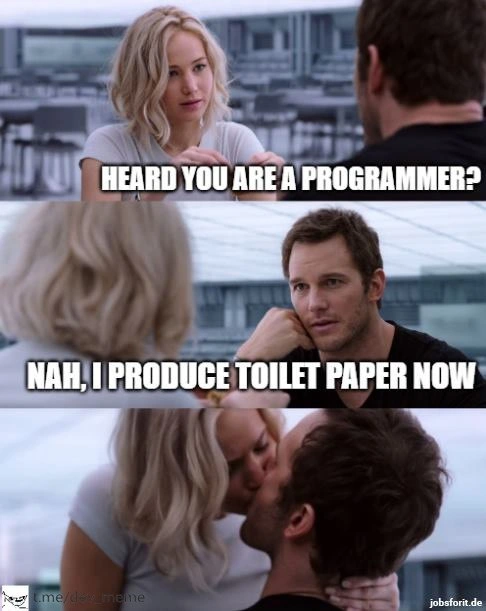
Finally, let’s decode the visual format: This meme uses a scene from the movie Passengers (2016). It shows two characters (portrayed by Jennifer Lawrence and Chris Pratt) having an intimate conversation. Meme creators love this scene for jokes because the woman asks a question and the man’s answer leads to a romantic kiss. In this case, the question and answer are about programming vs. toilet paper production. It’s absurd – you wouldn’t expect “I make toilet paper” to be a swoon-worthy confession! The contrast itself is part of the humor. The text is in big bold white uppercase letters with a black outline, which is the standard meme caption style to ensure the text is easy to read over the image. So even the presentation screams “this is a joke.” The muted blue-grey futuristic background from the movie set provides a neutral backdrop so the captions pop. Nothing in the image directly relates to coding or toilet paper – it’s the captions that create the connection. This is common in developer memes: they repurpose familiar images with new text to fit a tech joke.

In summary, for a junior developer or someone outside software: this meme is joking that writing bad code feels like a boring, un-glamorous factory job. Programming is supposed to be this high-tech, intellectual endeavor, but when the codebase is awful, the job can feel about as unspecial as making toilet paper rolls. It’s a cheeky way developers commiserate about low code quality and high technical debt – problems that turn a dream programming job into a bit of a nightmare. The humor comes from exaggeration and metaphor: nobody literally thinks code is toilet paper, but emotionally it feels that way when you’re neck-deep in a crummy project.

Level 3: Assembly Line Code

For seasoned developers, this meme hits right in the gut (or lower). It lampoons the soul-crushing feeling of churning out low-quality code under relentless deadlines. The woman’s question, “Heard you are a programmer?”, sets up the expectation of a proud tech professional. The man’s deadpan reply, “Nah, I produce toilet paper now,” is a self-deprecating punchline. He’s basically saying: “I’m not crafting elegant software anymore; I’m just pumping out crap (code) that’s only good for throwing away.” This dramatic comparison resonates with anyone who has seen a codebase degrade into a sorry state due to technical debt and pressure to deliver.

Why is this so funny (and painful) to developers? Because it’s relatable. In the real world, many programmers start their careers eager to write clean, efficient, well-architected code – the kind of stuff you learn in Computer Science classes or read about in Clean Code. But then corporate reality hits. Suddenly you’re working on a legacy system with spaghetti code dating back to 2008, or you’re asked to hastily hack together a new feature by Friday 5 PM sharp. Best practices fly out the window. Instead of feeling like an innovative problem-solver, you feel like a factory worker on an assembly line, spitting out lines of code as fast as possible. Quality? Maintainability? Those ideals get sacrificed for speed. After a few marathon coding sessions and kludgey quick fixes, you look at the result and think, “This isn’t software engineering… this is just pumping out disposable code.” In other words, “I might as well be manufacturing toilet paper.”

This meme also pokes fun at developer self-deprecation. Programmers often joke about their own work when it doesn’t meet their standards. It’s a coping mechanism. Calling your code “toilet paper” is a harsh joke about how disposable and “dirty” you perceive it. We’ve all written throwaway scripts or ugly hotfixes that we’re not proud of. Maybe you introduced a global variable as a quick hack to share state (cringing as you do it), or copy-pasted a chunk of code from Stack Overflow without fully understanding it, just to get the feature working. Sure, it might solve the immediate problem, but deep down you know you’ve just added one more code smell to the pile. When you multiply that by an entire team over months or years, you end up with a codebase that feels like a big heap of garbage used tissue. No wonder developers joke that they feel like garbage men or toilet paper producers rather than the rockstar engineers we imagined we’d be.

Let’s talk about technical debt in practice. The term “technical debt” was famously coined by Ward Cunningham, and it’s spot-on for describing this situation. It’s like borrowing time by cutting corners in your code: you get a feature out faster today, but you incur a “debt” that must be paid back with interest later (in the form of bugs, crashes, and hair-pulling maintenance work). Imagine a startup that needs to ship features rapidly to satisfy investors or users. They might skimp on documentation, skip writing tests, or slap together code in a hurry. Six months down the line, that same code is a nightmare to modify. Every change causes something else to break, because the underlying code structure is as flimsy as single-ply tissue. The developer experience (DX) deteriorates – making any progress feels like slogging through muck. When a new developer joins and asks, “Why is our checkout logic so convoluted?”, the jaded senior dev can only sigh, “Because we’ve been piling quick fixes on top of each other… Welcome to the toilet paper factory, kid.”

The assembly-line vibe is reinforced by how some companies measure developer productivity. In dysfunctional environments, managers might look at quantity over quality – counting lines of code written, commits per day, or features per release, with little regard for how maintainable or robust that code is. It’s like measuring a factory by output volume alone. Under those conditions, writing beautiful code is actually discouraged, because taking time to refactor or improve architecture would slow down the feature conveyor belt. So developers feel pressured to just “ship it” – cut the corner, push the commit, and move on. Over time, this “just ship it” culture produces a towering stack of messy code. It’s the software equivalent of stockpiling rolls and rolls of cheap toilet paper. You deliver a lot of something, sure, but nobody is proud of it, and it probably won’t hold together under stress. (Ever had cheap toilet paper disintegrate at the worst moment? Yeah, brittle code does that in production outages.)

Now, notice the third panel of the meme: the woman affectionately embraces the guy right after he delivers the toilet paper line. This adds an extra layer of dark humor. In the original movie scene (from Passengers, starring Jennifer Lawrence and Chris Pratt), it’s a romantic moment. The meme repurposes it to imply that admitting the ugly truth – “my code is crap” – is oddly cathartic or even attractive in its honesty. It’s like the developer has fully accepted his fate. In a meta way, the community (represented by the woman) is saying, “Aw, you’ve given up on code quality too? We feel you bro,” and gives him a “it’s okay, we still love you” hug. In early 2020 when this meme circulated, there was even an extra timely twist: toilet paper was literally a hot commodity (remember the great toilet paper shortage of March 2020?). So claiming to manufacture toilet paper could sound hilariously practical in that moment. A programmer humorously suggesting they’d switched to toilet paper manufacturing was basically saying “my skills are being used for crap, but hey, at least crap is in high demand!”

Ultimately, this level of analysis recognizes the shared experiences that make the joke work. Any developer with a few years under their belt has likely:

  • Inherited a legacy code base so messy that touching one part breaks five other parts.
  • Rushed a feature with duct-tape solutions to meet a deadline, cringing internally and thinking “I’ll clean it later” (but “later” never comes).
  • Felt the identity crisis of “am I even a real programmer, or just a code janitor cleaning up others’ messes and producing more waste?”
  • Sat in a meeting where business folks say “just get it done, I don’t care how,” effectively asking devs to crank out toilet-paper code they know will clog the pipes eventually.

The humor is a mix of camaraderie and cynicism. It’s funny because it’s true – many of us have felt like we’re not building glorious software castles, but rather churning out low-quality code to satisfy someone else’s immediate demands. The meme gives a face (and a laugh) to that ugly reality. As a senior dev, you chuckle, then maybe sigh, knowing exactly what it’s like to be in that guy’s shoes, half-joking that you’ve left the noble art of programming behind and joined the Toilet Paper Coders Union.

Level 4: Second Law of Programming

At the most theoretical level, this meme hints at an inevitable truth in software engineering: code tends toward chaos over time. Think of it as the Second Law of Thermodynamics but for code — left unchecked, software entropy always increases. In academic terms, maintaining perfect code quality is a near-impossible goal. As systems grow, patches and quick fixes accumulate, increasing complexity unless developers spend significant energy refactoring. This was formally observed in the 1970s by software researcher Manny Lehman, whose laws of software evolution included the idea that software complexity always increases unless work is done to reduce it. In other words, without continuous cleanup, your pristine architecture will decay into a tangled mess.

Why can’t we just keep code clean and elegant forever? Well, theoretical computer science gives us some grim news. Automatically catching every bug or design flaw in a program is undecidable in the general case — Rice’s Theorem and the Halting Problem prove there’s no magical static analyzer that can guarantee code is free of all issues. We can use linters, type checkers, and formal verification for specific properties, but ensuring 100% correctness (and thus high quality) for any arbitrary program is as impossible as, say, predicting every future toilet paper shortage. Even advanced techniques like model checking or formal verification hit practical limits: they don’t scale well to large, rapidly changing codebases full of real-world complexity.

So from a high-level perspective, a programmer joking that they “produce toilet paper now” is channeling this fundamental frustration. It’s a darkly humorous acknowledgment of software entropy. No matter how theoretically sound our design principles or how many best practices we adopt, real-world codebases often devolve into disorganized heaps of hacks. It’s as if there’s a physical law pulling our code toward disorder. Every new feature, quick fix, or rushed deadline introduces a bit more chaos. Over time those bits of chaos pile up, and maintaining the code starts to feel like shoring up a crumbling dam with paper towels. Technical debt – a concept coined by Ward Cunningham to compare suboptimal code to a financial debt – is an unavoidable byproduct of this entropy. We “borrow” time by writing less-than-ideal code now, but we pay interest later in the form of harder maintenance and nasty bugs. The interest rate is steep, and eventually the code can smell so bad (yes, “code smell” is an actual term in software engineering) that the whole system feels held together by, well, toilet paper and duct tape.

In summary, on a deep theoretical level this meme reflects the inevitability that complex software systems will accumulate mess. We can slow the decay through rigorous practices (like code reviews, refactoring, testing, using formal methods where possible), but we can’t stop it entirely. It’s a bit of a cosmic joke on programmers: even with all our fancy algorithms and type systems, most large codebases eventually slide toward “spaghetti code” madness. Seeing one’s proud programming craft reduced to a toilet paper manufacturing analogy is an extreme, tongue-in-cheek way to underscore how quality vs. quantity is a losing battle in the long run. Even the universe’s laws seem stacked against clean code. No wonder an experienced dev might sarcastically claim to be in the toilet paper business – at a certain point, cranking out code can feel like mass-producing a cheap commodity meant to be used once and thrown away.

Description

A three-panel meme using a scene from the movie 'Passengers' with Jennifer Lawrence and Chris Pratt. In the first panel, the woman asks, 'HEARD YOU ARE A PROGRAMMER?'. In the second panel, the man replies, 'NAH, I PRODUCE TOILET PAPER NOW'. The third panel shows the two characters kissing passionately. The meme captures the zeitgeist of the early COVID-19 pandemic in March 2020, when panic buying led to severe toilet paper shortages. The humor is derived from the sudden, absurd shift in societal values, where the ability to produce a low-tech, essential good became more desirable and impressive than a highly skilled technical profession like programming. It's a satirical commentary on economic disruption and the re-evaluation of what society deems 'valuable' during a crisis

Comments

7
Anonymous ★ Top Pick In 2020, the most valuable IPO wasn't a SaaS unicorn, it was a roll of 2-ply. The ultimate proof-of-work wasn't on a blockchain, it was having a stocked bathroom
  1. Anonymous ★ Top Pick

    In 2020, the most valuable IPO wasn't a SaaS unicorn, it was a roll of 2-ply. The ultimate proof-of-work wasn't on a blockchain, it was having a stocked bathroom

  2. Anonymous

    I pivoted to toilet-paper manufacturing - identical sprint cadence, nonstop rollouts, and when my output clogs the pipeline, ops finally admits it’s a capacity issue

  3. Anonymous

    After 20 years of building distributed systems that nobody understands, he finally pivoted to a product with a clear rollback strategy

  4. Anonymous

    When you realize 'production' means something entirely different outside of DevOps, and suddenly your on-call rotation involves actual physical products instead of Kubernetes pods failing at 3 AM. At least toilet paper has better uptime guarantees than most microservices

  5. Anonymous

    Escaped microservices sprawl for the ultimate monolith: infinite layers, zero network partitions, flawless unrolling

  6. Anonymous

    Programmer? Nah - I run a toilet paper factory now: CI builds that print 80MB logs and compliance that ships 300-page PDFs. Four nines of availability, zero nines of insight

  7. Anonymous

    After the staff promotion my CI/CD became CYA/CYA: JIRA → Confluence → PDF → SOC2 evidence - basically a JSON-to-toilet-paper transpiler

Use J and K for navigation