The Existential Crisis of NaN: We Are Not the Same
Why is this CS Fundamentals meme funny?
Level 1: Two Wrongs Don’t Make a Right
Think of it this way: imagine you have two identical twins who are exactly the same in every way. Now imagine each twin insisting, “I’m me, you’re you, and we are NOTHING alike!” – even though they clearly are alike. It’s silly, right? In real life, if two things are the same, they usually know they’re the same. But with NaN in computers, it’s like each NaN is a stubborn twin that refuses to admit it’s the same as another stubborn twin. Both twins (NaNs) are basically not valid numbers (like two kids who both did something wrong), yet when you ask them if they’re equal or the “same mistake,” each one says “Nope, not me, we’re different!” It’s an absurd little situation. We find it funny (and a bit frustrating) because computers, which are supposed to be logical, act kind of illogically here. It’s just like the saying “two wrongs don’t make a right.” Two error-values don’t make a valid comparison! So the meme is joking that even if “I am NaN and you are NaN,” in the computer’s eyes, we are not the same. It’s a quirky joke about how computers sometimes see the world very differently from how we humans do.
Level 2: Not a Number, Not Equal
Let’s break this down in simpler terms. NaN stands for “Not a Number.” It’s a special value that can appear in programming when calculations don’t make sense or go wrong. For example, if you try to divide 0 by 0 on a computer, you don’t get a real number – you get NaN. Think of NaN as an official “error number” that JavaScript and many other languages use to say, “Uh oh, this result isn’t a real valid number.” NaN is actually considered a number type by the language (in JavaScript, typeof NaN is 'number'), but it’s a sort of invalid number. Now, the equality operators in code (== or === in JavaScript) are used to check if two values are the same. Normally, if you compare something to itself, you’d expect it to be equal, right? For instance, 5 === 5 is true, "hello" == "hello" is true. Even a variable compared to itself, like value == value, is always true… except when that value is NaN! In JavaScript, and many other languages that follow standard number rules, any comparison involving NaN returns false. So NaN === NaN is false. Even the looser equality NaN == NaN is false (JavaScript usually has some weird differences between == and ===, but here it doesn’t matter – NaN just refuses to be equal to anything, including another NaN). It’s a built-in rule: NaN means “no valid number,” so the language treats it as never equal to any number or even another “no valid number.”
This can be really confusing if you’re new to coding. You might write code expecting to catch a NaN like this:
let score = parseInt("notANumber"); // This will result in NaN in JavaScript
if (score === NaN) {
console.log("Score is not a number!"); // This line will NEVER run
}
At first glance, it seems logical – “if score is not a number, print an error.” But score === NaN will always be false, even when score is indeed NaN. The correct way to check for a NaN value is to use a special function or method. In JavaScript, we use Number.isNaN(score) which will return true if score is NaN. Older code might use the global isNaN(score) function, which also checks if something is NaN (though it tries to convert the value to a number first, which has its own quirks). Here’s how you properly handle it:
let score = parseInt("notANumber"); // NaN, because "notANumber" is not a parseable number
if (Number.isNaN(score)) {
console.log("Score is not a number!"); // This will run correctly for NaN
}
In the snippet above, Number.isNaN(score) will be true only if score is actually the NaN value. This is the recommended way because, as we’ve learned, you cannot rely on the regular == or === to catch NaN. Another interesting tidbit: since NaN never equals itself, a quick trick to test for NaN in any language is to check if value != value (or value !== value in strict form). That condition will be true only for NaN, because it’s the only thing in programming that isn’t equal to itself. It’s a neat trick, but it looks strange in code, so using an isNaN function is clearer for most people.
So why did they design it this way? It stems from CS fundamentals of how numbers work in computers. JavaScript, like many languages, uses the IEEE-754 standard for floating-point numbers (these are numbers that can have decimal points, very large, or very small values). IEEE-754 decided that NaN is a kind of “error token.” Once you get a NaN, it means something went wrong in math, and they propagate this NaN through any further math to avoid pretending everything’s okay. Part of that decision was that NaN should never appear equal to anything else – because it’s not a real value to compare. It’s like saying “this result doesn’t exist as a normal number,” so you can’t really say it’s equal to another nonexistent result. This is consistent across languages: e.g., in Python, if you do float('nan') == float('nan') you’ll also get false. In Java, Double.NaN == Double.NaN is false as well. It’s not just JavaScript being quirky; it’s a general rule in how computers handle floating-point math.
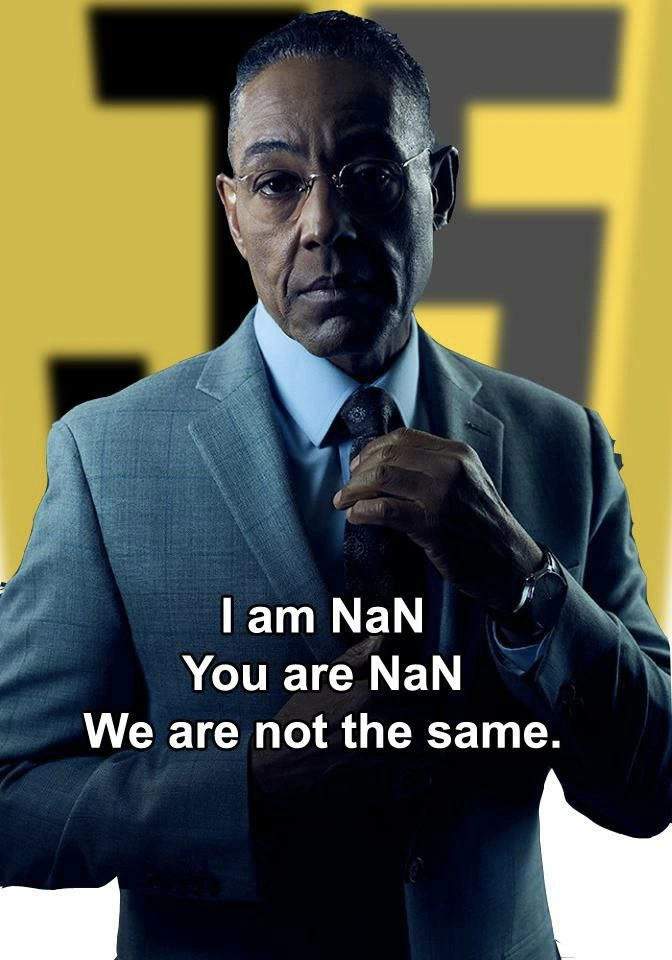
The meme we’re analyzing jokes about this fact. By writing, “I am NaN, You are NaN, We are not the same,” it highlights the exact scenario: two values that are both NaN still refusing to be equal. This is a classic language quirk that every programmer eventually learns. It’s considered a gotcha because it’s not what a normal person would expect when first learning to code. Normally, you might think “if two things look the same, they should compare as equal,” but NaN breaks that expectation. Once you know it, it’s easy to handle (you use isNaN and move on), but it’s definitely something that surprises new developers. And that element of surprise (and a little absurdity) is what makes it humorous among coders when they put it in a meme format like this. It’s a way of saying, “Don’t feel bad if this confused you — it confuses everyone at first, and here’s a funny way to remember it!”
Level 3: When x !== x
At the developer level, this meme hits on a classic LanguageGotcha that has tripped up many a programmer. The text in the image boldly declares:
I am NaN
You are NaN
We are not the same.
This is a humorous dramatization of how equality comparisons work (or rather, fail) with NaN values in code. Imagine two variables, both reading as “Not a Number.” If they could talk, one would say “I’m NaN,” the other says “I’m NaN too,” yet when you ask if they’re equal, both shout back, “We are not the same!” It’s a perfect comedic exaggeration of the fact that in JavaScript (and many other languages), NaN == NaN evaluates to false. To developers, this feels like betrayal by the very equality operator (== or ===) they rely on. Normally, you expect some basic sanity: if a and b are seemingly the same thing, then a == b should be true. I mean, if you have two identical looking objects in a program, how could they not be equal, right? But NaN is the one value that breaks this expectation, leading to baffling moments during debugging.
Seasoned devs recognize this scenario instantly. The meme’s refined, know-it-all gentleman tightening his tie (a popular meme image for asserting superiority) adds an extra layer of irony. It’s like NaN itself is portrayed as this suave, obstinate character saying, “Yes, we both might be error values, but don’t you dare consider us equal.” The humor comes from shared frustration: everyone who’s dealt with floating-point arithmetic or JavaScript type quirks remembers the first time they wrote something like:
let result = 0/0; // produces NaN
if (result === NaN) {
console.log("This will NEVER run!");
}
and then scratched their head wondering why their error handler never executes. 😅 The condition result === NaN never passes, even though result prints as NaN. It’s a classic LanguageQuirk: two identical-looking NaNs failing an equality check. The meme captures that “Aha!” (or “WTF?”) moment with a witty caption. It’s poking fun at how JavaScript (famous for its weird type coersions and LanguageGotchas) extends the IEEE-754 rule to the extreme: even using the strict identity operator === can’t make NaN acknowledge another NaN. In other words, NaN is so non-committal that it won’t even agree that it’s equal to itself.
This quirk has real-world implications in development. For example, imagine you’re writing a function to check if some sensor reading is valid. You might be tempted to do if (reading === NaN) { /* handle error */ }. That will never work correctly, because that if check is always false – even if reading is actually NaN. The correct approach (as battle-worn devs know) is to call a specific function to test for NaN. In JavaScript, we use Number.isNaN(reading) (or the older global isNaN function) to reliably catch that case. Similarly, in Python you’d use math.isnan(x), and in Java you’d call Double.isNaN(x). These special checks exist because the normal == operator just won’t cooperate with NaNs. In fact, experienced developers have a sneaky trick: leveraging the weirdness itself as a test. Since NaN is the only value where value !== value is true, some codebases literally do if (x !== x) { /* x is NaN */ } as a quick NaN detection. It’s like turning the joke on its head – using the paradox (“x is not equal to x”) as a tool. Still, it’s usually clearer to newcomers if you explicitly call an isNaN function, rather than drop a Zen riddle in your if statement.
Beyond bug catching, this NaN behavior even affects how we write tests and algorithms. Suppose you’re sorting numbers and one of them is NaN – according to IEEE rules, that NaN is unordered, so your sort routine might need a custom clause to say “put NaNs at the end” or something, because any comparison with it just returns false (it’s neither greater nor less than the other value!). Or consider unit tests: if you expect a function to return NaN for some bad input, you can’t write expect(result).toEqual(NaN) in your test, because that will fail even if result is NaN. Test frameworks have learned to provide shorthands like toBeNaN() to handle this gracefully. Seasoned devs chuckle at this, having learned the hard way that NaN is a special kind of beast. It’s a shared war story: “Remember the time I couldn’t figure out why my formula never flagged an error? Turned out I was checking equality with NaN!” Everyone nods knowingly, maybe with a “haha, yep been there” smile.
So when we see the meme proclaim, “I am NaN. You are NaN. We are not the same,” it resonates. It’s exaggerating a CS fundamental issue to highlight how absurd it feels in everyday coding. We laugh because we’ve felt that absurdity firsthand. It’s the kind of bug that makes you second-guess reality for a moment (“Did I hit my head? How can two things not be equal to each other if they’re… the same thing!?”). The meme is basically the floating_point_gotcha anthem. It reminds us that underneath our high-level code, there are deep design decisions (like IEEE-754 rules from the 1980s) still affecting us today. And it does so with style – literally, with a stylish guy in a suit, as if to say, “NaN is confidently quirky, and you just have to deal with it.” This blend of technical truth and humorous delivery is what makes developers smirk and tag it as prime DeveloperHumor. We’ve all been schooled at least once by NaN’s refusal to play by the normal rules, so we might as well joke that NaN considers itself above those rules. After all, we are NaN, and we are not the same!
Level 4: NaN’s Identity Crisis
In the realm of numerical computing, NaN (short for Not a Number) breaks one of the fundamental assumptions of mathematics: reflexivity. Reflexivity means that any value is always equal to itself (for all x, x = x). However, a NaN value defies this law – it’s the lone outlaw in the land of numbers that is not equal to itself. This isn’t a bug or random quirk; it’s by design. The IEEE-754 floating-point standard (the bedrock of modern floating-point arithmetic) deliberately defines NaN != NaN. In formal terms, equality is not an equivalence relation when a NaN is involved – we’ve introduced a non-reflexive element into an otherwise well-behaved set of values. In fact, IEEE-754 treats any comparison involving a NaN as “unordered.” This means that for a NaN x and any number (even another NaN y), the relations x < y, x > y, and x == y all return false. The usual trichotomy rule (every number is either less than, equal to, or greater than another) simply collapses in NaN’s presence.
Why would engineers craft such a strange rule? It turns out to be a fundamental safeguard in numerical computing. NaNs were introduced as a kind of “virus” for invalid results – e.g. the outcome of 0/0 or sqrt(-1) in real-number math – to propagate errors through calculations without crashing programs. If you perform any arithmetic with a NaN (say, 5 + NaN), the result is defined to be NaN, ensuring that one glitch taints the whole calculation (so you don’t accidentally treat a bad result as a valid number later). To stay consistent, the equality operation itself is also treated as an arithmetic comparison by the hardware. When a floating-point unit compares two NaN bits, it doesn’t see two identical twins; it sees two undefined values and says, “I can’t declare them equal.” Under the hood, the CPU sets a special “unordered” flag for NaN comparisons, which high-level languages interpret as a Boolean false for any equality check. Interestingly, there are actually many possible NaN bit patterns (“quiet NaNs” with various payloads, and “signaling NaNs” intended to raise exceptions). But IEEE-754 insists that no matter the bit pattern, no NaN ever equals any other – even a bit-for-bit identical one. This design prevents false assumptions: if two calculations both resulted in “not-a-number,” treating them as equal could be misleading because the underlying reasons or payloads might differ. In essence, NaN is like an “undefined” symbol in mathematics – and you can’t meaningfully claim one undefined value equals another.
All of this theory is baked invisibly into our programming languages (CS_Fundamentals hiding in plain sight). Languages from C to Python to JavaScript adopt these IEEE-754 rules for their number types. That’s why in JavaScript, for example, the expression NaN === NaN is false – the language is obeying the laws of the silicon, however counter-intuitive they seem. NaN’s refusal to acknowledge even itself is a deep quirk rooted in decades of floating-point research and design. It’s the rare case where mathematics and hardware conventions intentionally violate common sense to keep computations predictable. NaN, in a sense, has an identity crisis: by definition, it can never be identical to anything, including an identical copy of itself. This paradox sits at the intersection of hardware design and abstract math, illustrating how sometimes the equality operator has to yield to a greater logical principle – in this case, the principle that “an invalid result is unique unto itself.” It’s a fascinating corner of computing where logical purity was sacrificed for practical error-handling, giving us a scenario so absurd that it becomes a punchline in CodingHumor.
Description
This meme features the character Gustavo 'Gus' Fring from the TV series Breaking Bad, portrayed by actor Giancarlo Esposito. He is shown in a sharp grey suit, adjusting his tie with a stern, confident expression, set against a yellow and black background. This image is the basis for the popular 'We Are Not the Same' meme format. Overlaid on the image in white text is the phrase: 'I am NaN, You are NaN, We are not the same.' The humor is deeply technical, referencing a fundamental property of the 'Not a Number' (NaN) value in IEEE 754 floating-point arithmetic, which is used in virtually all modern programming languages. A defining and often counter-intuitive characteristic of NaN is that it is not equal to any value, including itself. Therefore, a comparison like `NaN == NaN` or `NaN === NaN` will always evaluate to false. The meme creates a clever, multi-layered joke by applying this strict programming rule to the meme's punchline about social superiority, making a statement that is both absurd and technically correct
Comments
13Comment deleted
NaN is the principal engineer of data types: it follows no rules but its own and considers itself unequal to all peers, especially itself
NaN !== NaN is just IEEE-754’s way of reminding us that even in maths, distributed consensus is hard
After 20 years in this industry, I've learned that NaN !== NaN is just JavaScript's way of teaching us that even in mathematics, identity is a social construct - which explains why half our microservices can't agree on what a user ID should look like
This meme perfectly captures JavaScript's philosophical crisis: NaN is the only value in the language that practices radical individualism - it refuses to be equal to itself. While mathematicians defined NaN this way in IEEE 754 to handle undefined operations, JavaScript developers have been debugging `if (x === NaN)` checks for decades. The real kicker? You need `Number.isNaN()` or the old `isNaN()` to actually detect it, because apparently JavaScript believes in 'show, don't tell' - except when it comes to NaN, where it just lies to your face about equality
IEEE‑754 said NaN != NaN; JavaScript shipped === to honor it, then added Object.is and SameValueZero so product could pretend it never happened
NaN's eternal flex: unique even to itself, forcing isNaN() just to confirm the denial
IEEE‑754 logic: I’m NaN, you’re NaN - === says we’re not the same; Object.is says we are. Choose your equality semantics before the postmortem
Didn't get! js bugs? Comment deleted
no, NaN and NaN are never equal - well, at least in js and python, but I do think that this design desicion actually makes sense. Comment deleted
lmao in python: nan==nan → False (equality check) nan is nan → True (identity check) Comment deleted
so NaNs in python aren't equal, but they are the same. Comment deleted
Sounds like plsql Comment deleted
IEEE-754 Floating point standard requires them not to be equal. But generally in languages with exceptions you'd use signalling NaN instead of silent NaN, meaning you wouldn't get it as value but rather as a computation error. Comment deleted